Active Logging and Road Access
An open-looking forest road can become unsafe in minutes when logging trucks are hauling, crews are working, or a gate has been closed. For BC ATV and UTV riders, the hard part is knowing whether a route is accessible—not just whether it appears on a map. This guide explains how to check road access, recognize restrictions, and share active industrial roads more safely.
Understand what kind of road you are approaching
A mapped road is not automatically an open road
A line on a map can represent a Forest Service Road, an industrial road, a deactivated road, or a route with access conditions that have changed since the map was made. Even when a road crosses Crown land, that does not mean every part of it is open to recreational riding at every moment. Closures, work activity, road conditions, and posted restrictions can all affect access.
This is why checking a map is only a starting point. Tools such as onX Offroad can help you see mapped routes and plan where you intend to go, but a mapped route is not confirmation that the road is open today. Check local signs and notices before riding, and be prepared to turn around if access is restricted or conditions are unsafe.
Start by identifying the road type and the organization or operator responsible for it, where that information is available. A Forest Service Road may have different access arrangements from a road serving a private worksite or an active industrial operation. For background on how public land and road access relate, see BC Resource Roads Count as Crown Land and BC Forest Service Road Rules for ORVs.
Access can change along one route
A road may be open at one point and restricted farther along. Logging activity can be limited to a section, a spur, or a work area, while the main route remains passable. A gate or sign may apply only beyond that point, so do not assume that access at the trailhead means you have permission to continue everywhere.
Pay attention to signs at junctions and road entrances, including temporary notices. A restriction might prohibit all traffic, limit access to certain users, or warn that industrial vehicles are operating. If a sign is unclear, take the cautious option: stop, avoid entering the affected section, and seek current information from the responsible road manager or local authority. Posted Restrictions on a Road offers more context on why signs matter.
Check conditions before you leave
Look for current closure and work information
Before loading your ATV or UTV, check for road notices, closures, and active hauling information relevant to your intended route. Conditions can shift after rain, snow, washouts, maintenance, or changes in a logging schedule. A road that was passable on a previous trip may now have a blocked section, active equipment, or a temporary closure.
Use maps to plan your route, but treat them as planning aids rather than real-time access guarantees. If you use onX Offroad to review a route, compare what it shows with current local information and what you see on the ground. Save a backup plan and identify places where you can safely turn around; remote roads can have limited cell coverage, and you may not be able to check for updates once you are underway.
If you cannot confirm whether a road is open, do not rely on a guess or on another rider’s old report. A cautious change of plan is frustrating, especially after a long drive to the staging area, but it is better than entering an active work zone or finding yourself unable to turn around safely. For a pre-trip checklist, see Checking a Road Before You Go.
Read the road when you arrive
At the entrance, pause before unloading or riding in. Look for gates, signs, fresh work notices, parked equipment, radio channel information, and evidence of current traffic. A road can feel quiet while a loaded truck is still approaching from farther along. If you hear machinery or see dust rising in the distance, assume that industrial traffic may be moving even if the route looks empty.
A map app can help you keep track of your route, but do not use it as a substitute for observing the road. onX Offroad may help with route planning and orientation, while signs, direct observations, and local notices are what you should use to judge conditions on the ground. Keep your phone accessible, but do not assume you will have service for navigation or emergency contact.
| What you notice | What it may mean | A prudent response |
|---|---|---|
| Closure sign or locked gate | Access may be prohibited beyond that point | Stop and do not bypass the restriction |
| Radio channel information | The road may have communication practices for industrial traffic | Follow posted instructions and learn the appropriate procedure |
| Fresh dust, equipment, or active loading | Vehicles or machinery may be working nearby | Slow down, stay alert, and avoid interfering with the work |
| Blind corner or narrow section | You may have limited time to react to an approaching truck | Reduce speed and be ready to yield or stop |
| Unclear or conflicting information | Access may have changed or the sign may apply to a specific section | Do not proceed until you can clarify the situation |
Share active roads with industrial traffic
Expect loaded trucks and give them room
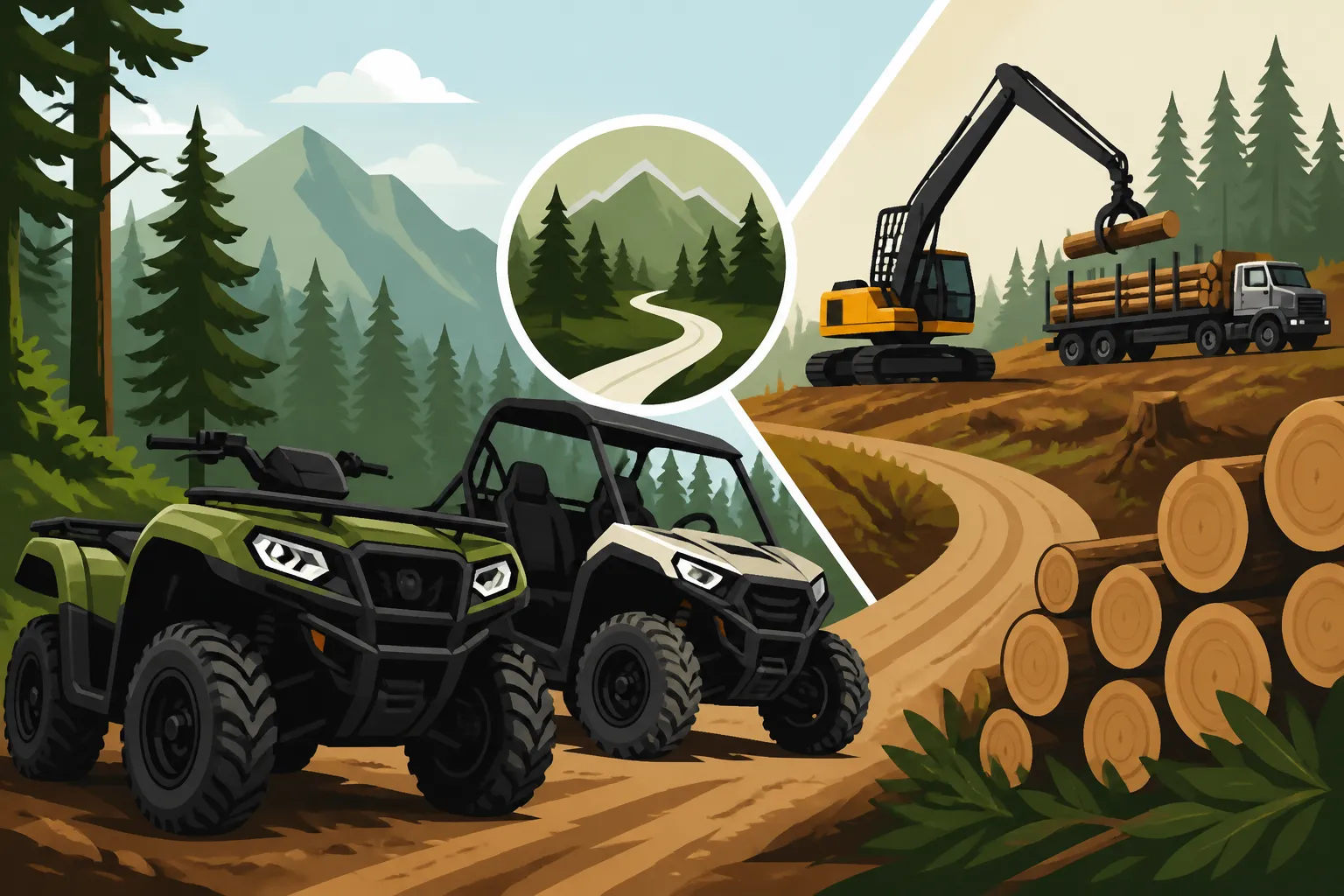
Logging trucks and other industrial vehicles may be wide, heavy, and difficult to stop quickly, particularly on steep grades or loose surfaces. Riders should never assume a truck can move aside or stop just because an ATV or UTV is smaller. Stay alert for engine noise, dust, tire tracks, and signs of recent hauling, and leave enough room to respond without making sudden moves.
When a truck approaches, move to a safe, visible place and yield. Avoid stopping where the road narrows, on a blind corner, near a steep drop, or where the driver has little room to pass. Do not pull onto soft shoulders or unstable ground simply to get out of the way. If there is no safe passing space, stop well in advance and follow any instructions from the driver or road crew.
When riding with a group, make sure everyone knows how to respond. A lead rider should signal the group to slow or stop, and the last rider should confirm that no one has been left behind. Keep the group together where it is safe to do so, but do not bunch up at a narrow spot or block a work area. Resource Roads and Industrial Traffic and Yielding to Loaded Trucks provide more detail on sharing roads with industrial vehicles.
Use extra care at blind corners and intersections
On a road with active hauling, the next vehicle may be hidden by a curve, a hill, dust, trees, or a cut bank. Slow down before entering a blind section rather than braking sharply once you are already in it. Stay to the right where it is safe, avoid cutting corners, and leave enough space to stop if another vehicle appears.
Intersections and junctions deserve the same caution. A truck may be turning into a spur or backing into a work area. Give the driver room and do not follow closely behind a large vehicle, where you may be difficult to see. If you are unsure whether the driver has noticed you, wait in a safe spot rather than trying to squeeze past.
Do not assume that a narrow vehicle can safely pass through every gap. A UTV with passengers, cargo, or a trailer may need more room than expected, and soft shoulders can be hazardous. If a bridge, culvert, or road surface looks unsuitable for your machine, do not force the crossing. Due Care on a Blind Corner and When Your Machine Is Too Wide for a Bridge cover these common trouble spots.
Follow road communication practices and respect closures
Use radios only when you understand the local procedure
Some resource roads post radio channels or communication instructions for road users. Where instructions are posted, follow them carefully. Learn the local procedure before entering, including what information to communicate and when to do so. A radio is useful only if it is on the correct channel, working properly, and used in a way that others can understand.
Do not assume that every road uses the same channel or that a general-purpose radio is set up correctly. If you are unfamiliar with the road’s practice, ask locally before you ride or choose a route where you can travel without relying on an unfamiliar procedure. Carrying a radio does not give you permission to enter a closed road, and a radio call does not make an unsafe pass safe.
If instructions call for reporting your location or direction of travel, be brief and clear. Use the road name or posted identifiers where available, and listen for other traffic before transmitting. For more guidance, read BC Resource Road Radio Practice and Calling Kilometres on a Channel. If you need equipment while travelling through a small community, Renting a Radio in a Small Town may also be useful.
Turn around when a road is closed or unsafe
A gate is not an invitation to go around, under, or over it. A closure may be in place because of active work, a hazardous surface, a washout, fire risk, or another condition that makes travel unsafe. Do not move signs, enter a work zone, or assume that an unmanned gate means the road is open. A closed route should be treated as closed unless the responsible authority clearly indicates otherwise.
Even without a formal closure sign, a road may be unsafe for recreational travel. Examples include heavy equipment moving through a narrow section, a road that is actively being graded, or a washout that leaves no safe passage. If you encounter those conditions, stop at a safe distance and turn around if you cannot proceed without interfering with work or taking an unreasonable risk. Active Hauling and Closed Roads explains why active work can change the access decision.
It helps to plan your ride with a clear turnaround point and an alternate route. If the planned road is closed, do not try to improvise by entering an unfamiliar spur or crossing private land without permission. onX Offroad can help you understand the surrounding mapped route network, but verify any alternative access before using it. A reliable plan includes enough time, fuel, and daylight to return the way you came if your chosen road is unavailable.
A practical pre-ride routine
Before heading out, use this simple sequence:
- Choose a route and identify the road type. Note where the route begins, where it branches, and which sections may be industrial or subject to restrictions.
- Check for current closures and access notices. Look for information from the road manager or relevant local authority, rather than relying only on an old map or a past trip report.
- Review the route and prepare a backup. Use a mapping tool such as onX Offroad to plan and orient yourself, while remembering that mapped roads do not confirm current access.
- Read every sign at the entrance and junctions. Stop if a sign is unclear or indicates a closure, and do not bypass a gate.
- Check your machine and ride plan. Make sure your group understands how to yield, where to regroup, and what to do if the road becomes unsafe.
- Adjust as conditions change. Turn around if you encounter active work, restricted access, or a hazard you cannot safely pass.
The key is to treat active logging roads as working transportation corridors, not as empty trails. Checking access before leaving, staying alert for industrial traffic, and respecting closures can prevent a recreational ride from becoming a dangerous interruption to road crews or a difficult situation for your group.
Disclaimer
This article is for general informational purposes only and does not constitute professional advice. Laws, prices and regulations vary by location and change over time. Consult a qualified professional for guidance on your specific situation.