Reporting Damage You Find
When you find a washout, broken gate, blocked trail, or fresh damage to a creek bank on a BC ATV ride, it can be hard to know whether to report it, who to contact, or whether you should help fix it. This guide explains how to document the problem, choose the right reporting channel, and avoid making the damage worse.
What Counts as Damage Worth Reporting
Not every rut or fallen branch needs an emergency call. The key questions are whether someone could be hurt, whether the damage is getting worse, and who may be responsible for managing the road, trail, or recreation site. When in doubt, make a clear note and report it through an appropriate channel rather than trying to investigate on your own.
Trail, road, and site damage
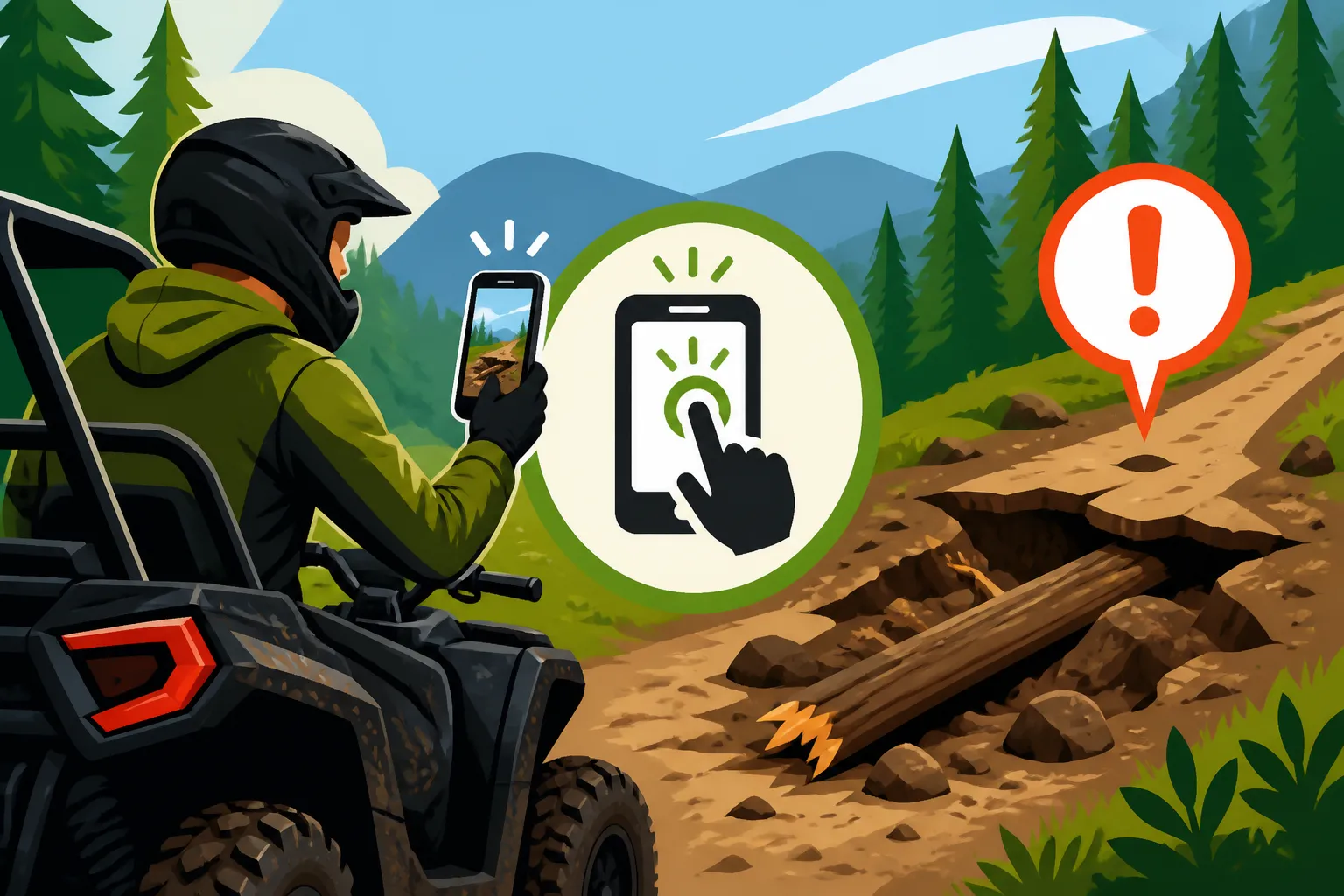
Report problems that could affect safe access or cause continuing harm. Examples include a washed-out trail edge, a damaged bridge or culvert, a blocked access road, a broken trail sign, a gate that appears to have been forced, or deep ruts that are diverting water onto a trail. A small obstruction can become a bigger hazard when riders create a new route around it.
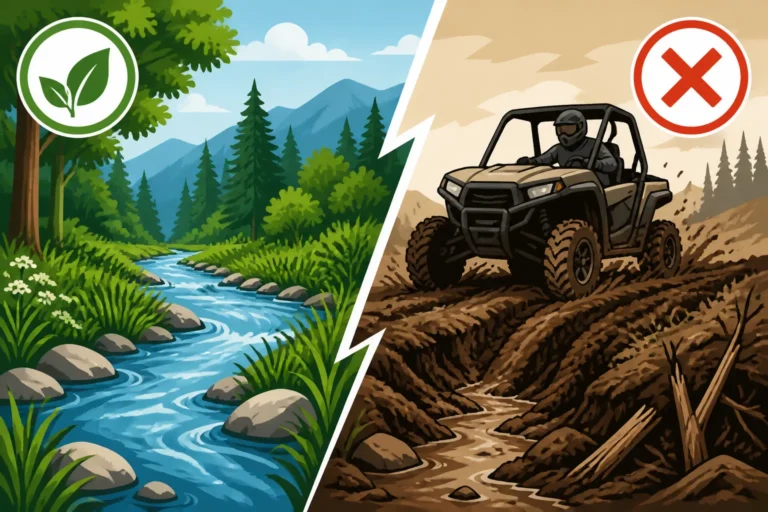
Damage to streamsides and wet ground deserves particular care. Repeated tire traffic can widen a muddy section, disturb vegetation, or push sediment into a creek. If you find that kind of impact, stop before riding through or around it. [BC Riparian Areas to Avoid] explains why these places are especially vulnerable, and [BC Trail Etiquette Locals Expect] covers the basic principle of staying on the established route instead of creating a bypass.
On a Forest Service Road, note whether the problem affects vehicle access, drainage, or a structure such as a bridge. A road may be used by industrial traffic as well as recreationists, so a damaged surface or blocked section can pose a risk beyond your riding group. For road-specific access concerns, [BC Forest Service Road Requirements] and [BC Resource Road Signage] provide useful context.
Immediate hazards versus routine damage
An unstable bridge, a fresh washout that could send a vehicle off the road, downed power lines, an active fire, or an injured person may require urgent attention. Move to a safe location and contact emergency services if there is an immediate threat to life or serious injury. Don’t put yourself or your group in danger to get a closer look.
A broken sign, an impassable trail, or damage that needs maintenance but is not an immediate emergency is usually a routine report. Contact the organization responsible for that specific location, which might be a land manager, a site operator, a local trail club, or a road operator. For a possible violation involving wildlife or pollution, use the appropriate provincial reporting channel rather than assuming the trail manager is responsible for enforcement.
| What you find | First priority | Likely reporting route |
|---|---|---|
| Immediate danger to people | Get to safety and alert emergency services | Emergency services |
| Damage at a managed recreation site | Keep riders away from the hazard | Site manager or managing agency |
| Damage on a marked trail | Avoid widening or bypassing the damaged area | Trail manager or local club |
| Problem on a Forest Service Road | Check for road signs and access restrictions | Road operator or responsible land manager |
| Suspected wildlife or pollution offence | Do not confront anyone or disturb evidence | Appropriate provincial reporting channel |
Who manages a location is not always obvious. A trail on public land may be maintained by a club or managed under a recreation program, while an industrial road may have a separate road operator. [Recreation Sites and Trails and What They Manage] can help explain the difference. Signs at the entrance, trailhead, or damaged location may also identify a contact or operator.
How to Document Damage Safely
A useful report gives the recipient enough information to identify the place and understand what needs attention. You don’t need to prove who caused the damage. Your job is to describe what you observed, when you saw it, and why it may need a response.
Record the location and conditions
Write down the trail or road name, the nearest junction, staging area, kilometre marker, bridge, or other landmark. If your phone can record coordinates, save them, but don’t rely on cell service being available when you need it. A screenshot of an offline map can help you explain where the damage is after you return to a connected area.
Include the date and approximate time, the weather or ground conditions if relevant, and whether the route was passable. “The trail is damaged” is hard to act on. “A washout has removed part of the uphill edge just beyond the second creek crossing, and there is no safe space for a side-by-side to pass” gives the recipient a clearer picture.
Take photographs from a safe place, preferably from more than one angle. Show the wider location as well as the specific hazard. Avoid standing on an unstable edge, walking into traffic, entering private property, or stepping into a sensitive creekside area just to improve a photo. If you’re riding with others, ask one person to record details while the rest stay in a safe position.
You can also note whether signs, barriers, or closure markers were present. If you saw fresh tracks or other possible evidence, describe what you observed without guessing about who was responsible. The same goes for a damaged machine: stick to visible facts rather than conclusions about how the damage happened.
Keep evidence intact and avoid further impact
Don’t move a barrier, drag a tree, pull apart a damaged structure, or ride around a muddy section to see how far the problem extends. These actions can make the hazard worse or alter evidence that a manager or enforcement officer may need to assess. [BC Motor Vehicle Closures and How to Find Them] is a helpful reminder to check restrictions before continuing along a route, especially after storms or other disruptive conditions.
If the trail is blocked, turn around where it is safe and practical. Don’t cut a new line through brush or ride across wet ground to get past it. If a recovery is needed to get your group out, focus on retrieving your own machine without disturbing the surrounding site. A winch, including a SuperATV winch, is not a reason to pull a fallen tree or shift a damaged structure yourself.
After leaving the area, check your own machine for signs of contact or impact and note anything that helps you describe what happened. If your ATV has aftermarket protection, such as a SuperATV skid plate, you can document visible damage to it as part of your own ride record. That information may help you recall whether the machine touched the hazard, but it does not establish who caused the damage at the site.
Who to Contact and What to Include
The right contact depends on the land and facility involved. A generic report sent to the wrong organization can sit without action, so take a moment to look for a trailhead sign, road notice, site information board, or posted contact details before you leave.
Match the report to the place
For a managed recreation site or signed trail, contact the site manager or trail organization responsible for maintenance. A local riding club may be able to identify the right manager or pass along a maintenance concern, even if the club does not control the land. [BC Trail Volunteer Days] is relevant if you want to learn about organized trail work, but don’t treat a maintenance volunteer as a substitute for reporting a dangerous hazard.
On a Forest Service Road or resource road, look for posted operator information and follow any access instructions. A closed road, active work zone, or road with industrial traffic needs particular caution. Don’t go around a gate to deliver a report in person. If you can’t identify the operator, provide the road name and location to the relevant land-management contact and ask where the report should go.
For a suspected offence, such as deliberate damage, illegal dumping, or harm to wildlife, report what you saw to the appropriate enforcement or provincial channel. Avoid confronting a person you believe may be responsible. If there is an immediate safety threat, prioritize getting away and contacting emergency services.
Use [BC Trail Closures After a Storm] as a reminder that conditions can change quickly, and check for current closures before setting out or returning to a damaged area. If you’re unsure whether the route is open, don’t assume that other riders’ tracks mean it is safe or permitted to continue.
Make the report easy to act on
A concise report can still be detailed. Include:
- The road, trail, or recreation-site name, plus the nearest landmark or coordinates.
- The date and approximate time you found the problem.
- A factual description of the damage and whether it blocks access or creates a safety risk.
- Photos taken from a safe location, if you have them.
- Any visible signs, closures, or barriers near the location.
- Your name and contact details if you are comfortable providing them.
For example: “I found a washout on the east approach to the bridge, about a short ride north of the marked staging area. The trail edge has collapsed, and a two-seat side-by-side could not pass safely. I took photos from the stable shoulder at approximately mid-afternoon. No closure sign was visible at the entrance.”
That kind of note separates what you observed from what you suspect. You don’t need to identify a culprit, estimate the cost of repairs, or claim that a specific person caused the damage. If you’re concerned that a machine or accessory may have contacted the site, describe that accurately. A SuperATV bumper or other part on your machine is simply a detail to record if it was involved; it is not a reason to omit relevant information or to speculate.
What to Do After You Report It
Once you have sent the report, give the responsible organization time to assess it. It may need to verify the location, determine who manages the land, arrange repairs, or post a closure. You might not receive a detailed response, particularly if your message was sent through a general reporting channel.
Don’t return just to check the repair
A reported hazard may still be present when another group arrives. If you ride the same area later, check posted signs and closures before proceeding. If the route appears unsafe or restricted, stay out and use another legal route rather than relying on the fact that it was open on your previous visit. [BC Crown Land Access Rules] offers broader context on access, but land status alone does not mean every road or trail is open for riding.
If you find the damage has worsened, send an updated report with the new date, location, and photographs. Don’t assume the original report was ignored; the manager may be assessing the situation or waiting for suitable conditions to do the work. Repeated calls or public posts with unverified claims are less useful than a factual update sent to the responsible contact.
Keep your group from adding to the problem
Before the next ride, talk through what your group will do if you meet a washout, blocked trail, or damaged creek crossing. Agree that riders will stop, avoid making a bypass, and identify a safe way to turn around. If the group has a map, mark the location privately so others can avoid it, but don’t post sensitive locations publicly when doing so could draw more traffic to a fragile area.
A SuperATV skid plate or other protective equipment may help shield a machine from ordinary trail contact, but it cannot make a damaged route safe. If you need to ride out cautiously, choose the safest established path and avoid forcing a machine through an unstable section. After the ride, review the damage you observed and make sure the report includes enough detail for someone else to locate it.
The simple rule is to protect people first, document only what you can safely see, and leave repair and enforcement decisions to the responsible people. That approach gives a manager useful information without turning one damaged spot into a larger problem.
Disclaimer
This article is for general informational purposes only and does not constitute professional advice. Laws, prices and regulations vary by location and change over time. Consult a qualified professional for guidance on your specific situation.