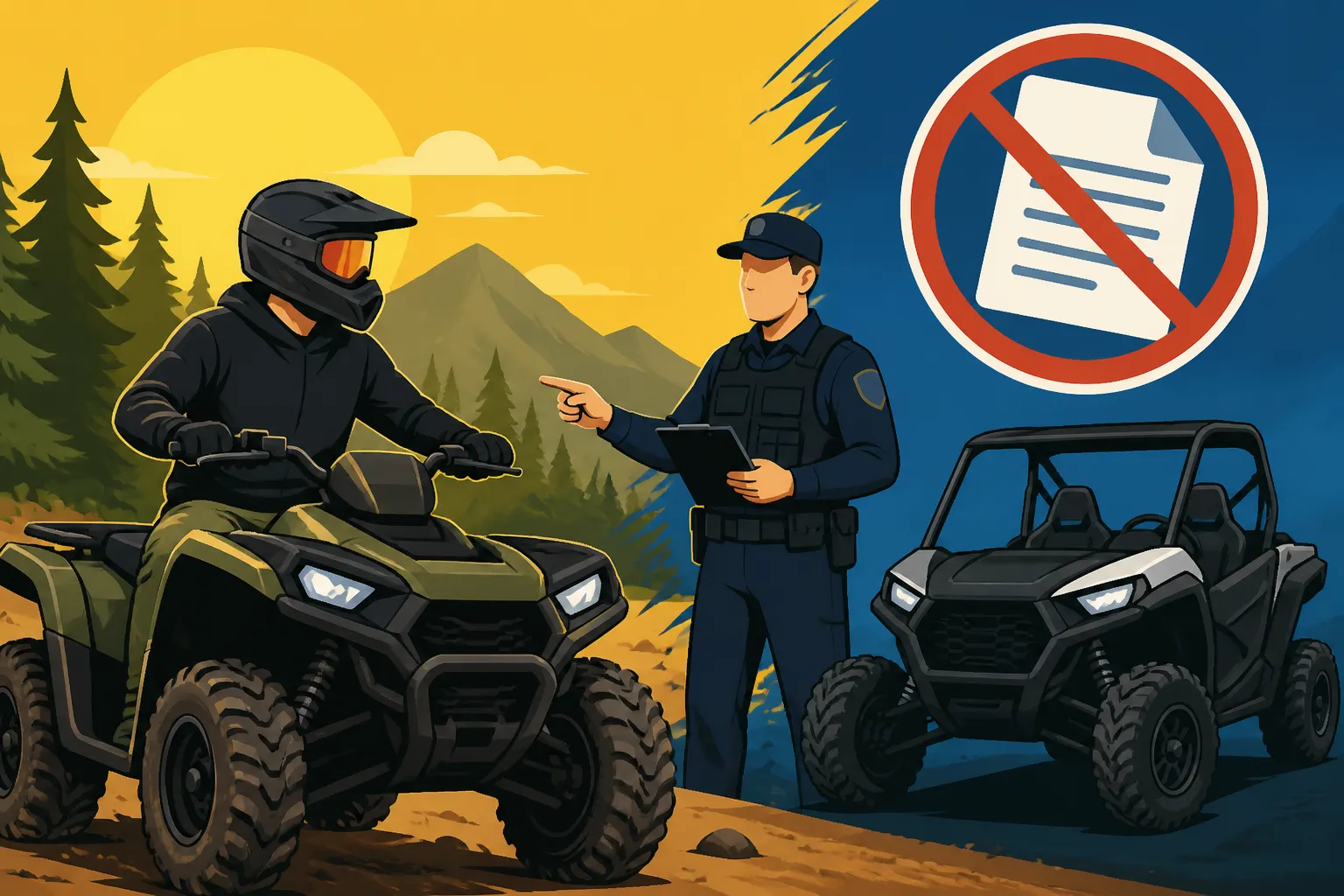
BC Fines for Riding an Unregistered Machine
It's incredibly frustrating when you're all geared up for a fantastic ride on your ATV or UTV in British Columbia, only to have your day—or even your entire trip—derailed by something as seemingly simple as forgetting a piece of paper. Many riders, especially those new to the province or to the world of off-road vehicles, aren't fully aware of the strict registration requirements here in BC, and the penalties for non-compliance can be a real shock. This guide is here to shed light on the specific fines and repercussions you could face for operating an unregistered machine on BC's Crown land and resource roads, and more importantly, how to avoid these costly mistakes altogether.
Understanding BC's ORV Registration Requirement
Navigating the rules for off-road vehicles in British Columbia can feel like a maze, especially when you just want to get out and ride. But knowing the basics of registration is your first and most crucial step to staying legal and avoiding unexpected headaches.
The Mandate for Off-Road Vehicles
Let's face it, nobody wants to deal with bureaucracy, but since November 2015, the Province of British Columbia has made it mandatory to register all off-road vehicles that are operated on Crown land or on any road that falls under the Forest Act or the Industrial Roads Act—which basically covers most of the incredible backcountry we love to explore. This isn't just a suggestion; it's the law, outlined in the Off-Road Vehicle Act. This act defines what an ORV is, encompassing everything from your trusty quad to your powerful side-by-side, dirt bikes, and even snowmobiles. The intent behind it is to ensure accountability and help manage the vast network of trails and resource roads we all share.
Think of it this way: if you're planning a trip to a favourite riding area, whether it's the Chilliwack Valley, the sprawling trails around Bear Creek OHV, or even just driving down a [BC Forest Service Road] to get to a staging area, your machine needs to be registered. This applies whether you're using your machine for recreation, work, or hunting. The rules are pretty clear: if you're on public land, which includes nearly all of BC outside of private property, you need to be registered. For more on this, check out [BC Registration Became Mandatory in 2015] and [What the Off-Road Vehicle Act Covers in BC].
What "Unregistered" Truly Means
When we talk about an "unregistered" ORV, it's not just about whether you have a physical number plate affixed to your machine. While that's certainly a visible part of it, the core of the requirement lies with the official Certificate of Registration. This document is your proof that your machine has been properly recorded with the province and that you are its lawful operator. Unlike highway vehicles that get a traditional vehicle registration document and sometimes a separate title, ORVs in BC receive this specific Certificate of Registration. It's a fundamental difference that often catches people off guard.
An unregistered machine means that, as far as the provincial records are concerned, your ORV hasn't completed this essential step. It could mean you never registered it in the first place, or perhaps you bought a used machine and haven't completed the [BC Transfer of Ownership Explained] process to put it in your name. This certificate is what you must carry with you every time you ride on Crown land. It's not enough to say, "Oh, I'll get around to it." Without that piece of paper, and the corresponding number plate and decal, your machine is considered unregistered, leaving you vulnerable to penalties. Knowing the ins and outs of this document is critical, so be sure to read [BC's Certificate of Registration Explained] and [BC Riders Must Carry the Certificate].
The Direct Financial Hit: Fines for Non-Compliance
Nobody wants to reach into their wallet for an unexpected fine, especially when you're out trying to enjoy the wilderness. But operating an unregistered ORV in BC can quickly lead to substantial financial penalties that can sour any adventure.
Immediate Violation Tickets
The most immediate and common consequence of riding an unregistered ATV or UTV is receiving a violation ticket. Whether you encounter a Conservation Officer, a RCMP officer, or other authorized personnel on a resource road, they have the authority to check your documentation. If your machine isn't registered, you're looking at a ticket. While specific monetary values can vary and change, these fines are designed to be a deterrent and are generally substantial enough to make you wince. They're not just a slap on the wrist; they're a clear message that you're in violation of provincial law.
Imagine you've driven hours to a beautiful staging area in the Okanagan, unloaded your machine, and are just getting ready to hit a scenic trail when an officer pulls up. They ask for your registration, and you realize you left the certificate at home, or worse, never registered the machine after buying it used. That immediate fine, coupled with the potential disruption to your day, can feel like a punch to the gut. This is precisely why it's vital to ensure your machine is registered and that you have all your paperwork on hand. For a deeper dive into what tickets you could face, check out [BC Tickets for an Unregistered Machine] and [BC Penalties for Riding Unregistered].
Costs Beyond the Ticket
The initial fine is often just the beginning. If your unregistered machine is stopped, authorities have the power to impound it. This means your ATV or UTV could be towed away on the spot. Suddenly, you're not just facing a ticket; you're looking at towing fees, which can quickly add up, especially if you're in a remote area and your machine has to be transported a significant distance. On top of that, you'll incur daily storage fees at an impound lot until you can sort out the registration issues and arrange for pickup.
Think about the logistical nightmare: you're out in the Cariboo, miles from a town, and your machine is impounded. How do you get home? How do you get your machine back? You'll need to arrange transport, which means more time, more money, and a major disruption to your plans. This entire process can easily turn a single violation into hundreds, if not thousands, of dollars in unexpected expenses. And while you might have invested in top-tier accessories from a brand like SuperATV to enhance your ride, those upgrades won't do anything to prevent the costs associated with an impounded vehicle. The overall cost of an unregistered machine goes far beyond the initial violation ticket, making preventative measures incredibly important.
Broader Consequences and Legal Ramifications
Beyond the immediate financial sting of a ticket and impoundment, operating an unregistered ORV in British Columbia can lead to even more severe long-term consequences, impacting your ability to ride, your financial security, and even your legal standing.
The Risk of Machine Seizure
One of the most impactful powers granted to enforcement officers under the Off-Road Vehicle Act is the ability to seize your machine. This isn't just about towing it to an impound lot for a few days; it means the machine is taken into custody by the province. While temporary seizure is common for unregistered vehicles, repeat offenders or those involved in other infractions might face more prolonged or even permanent forfeiture processes. The conditions for release usually involve rectifying the registration issue, paying all fines and fees, and sometimes proving continuous ownership, which can be tricky if you've got a tangled history with a used machine.
Imagine saving up for years to buy your dream side-by-side, perhaps even outfitting it with durable protection from SuperATV, only to have it seized because you overlooked the registration. This scenario isn't just hypothetical; it happens. The loss of your machine, even temporarily, is a significant disruption and can feel like a violation of your personal property. The legal framework allows for these seizures to ensure compliance with the Act. Understanding [BC Seizure Powers Under the ORV Act] is vital, as it highlights the seriousness of operating an unregistered ORV.
Insurance Complications and Liability Exposure
Operating an unregistered ORV can have serious implications for your insurance coverage and, by extension, your personal financial liability. When you purchase [BC Insurance Bought With Registration] through an Autoplan broker, part of that process assumes your machine is legally registered. If you're involved in an accident while operating an unregistered ORV, your insurance provider might deny coverage, arguing that you were operating the vehicle illegally. This could leave you personally responsible for thousands—or even hundreds of thousands—of dollars in damages, medical expenses, and legal fees if you caused injury or property damage to someone else.
Even if you only ride on Crown land where liability insurance is often described as "voluntary," the reality is that without it, you're entirely exposed. If your unregistered machine causes damage to Crown property, another rider's machine, or worse, injures someone, you will be on the hook financially. The peace of mind that comes with proper insurance and registration is invaluable, far outweighing the perceived hassle of getting registered. It’s important to understand that [BC Liability Is Voluntary on Other Crown Land], but it's a huge risk not to have it, especially if your machine isn't even legal to operate in the first place.
Administrative Penalties and Court Proceedings
While many infractions result in immediate violation tickets, certain situations involving unregistered ORVs can escalate to administrative penalties or even require a court appearance. Administrative penalties can be imposed by various government bodies and often involve higher fines than a typical ticket. These penalties are designed to deter more serious or repeated non-compliance. In some egregious cases, or if other violations are present (like impaired operation or dangerous riding), you could be summoned to court, leading to legal fees, potential convictions, and even further restrictions on your ability to operate ORVs in the future.
The process of dealing with an unregistered machine can become a protracted legal battle, especially if there are disputes over ownership or if you have a history of non-compliance. You might be required to prove the [BC Ownership Chains Going Back Decades] to establish legitimate possession, which can be a nightmare if the paperwork is missing or incomplete. These legal headaches are a far cry from the carefree rides most of us envision. Taking the time to ensure your machine is properly registered and that you carry all necessary documentation significantly reduces your exposure to these more serious legal ramifications.
How to Stay Legal and Avoid the Headaches
The good news is that avoiding fines and legal troubles for an unregistered ORV in BC is entirely within your control. A little planning and diligence can save you a lot of grief and money down the road.
Getting Your ATV or UTV Registered
The first and most important step is to get your ATV or UTV officially registered. In British Columbia, this process is handled by any Autoplan broker, the same places where you insure your car or truck. It’s convenient, with hundreds of locations province-wide, and they're equipped to process ORV registrations. You'll need to bring specific documents, including proof of ownership (like a bill of sale), the machine's Vehicle Identification Number (VIN), and valid photo identification. If you bought a used machine and the previous owner didn't have all the paperwork, don't despair; sometimes a [BC Statutory Declaration for an ORV] can help establish ownership.
Whether you're hitting the backcountry in a factory-stock ATV or a highly customized UTV with every SuperATV accessory imaginable, the law applies equally to all off-road vehicles. Before you head to the broker, it's a good idea to gather everything you need. A thorough [BC Registration Paperwork Checklist] will help ensure you don't miss anything. The brokers are familiar with the process, so they can guide you through it. For detailed steps, refer to [How to Register an ATV in BC] and [BC Autoplan Brokers Handle ORV Registration]. Once registered, you'll receive your Certificate of Registration, a number plate, and a decal to affix to your machine.
Carrying Your Documentation
Having your machine registered is only half the battle; the other half is proving it when asked. It is absolutely essential to carry your Certificate of Registration with you every single time you operate your ORV on Crown land or resource roads. This, along with valid [BC Riders Must Carry Photo ID], acts as your proof of compliance. While a physical copy is ideal, many riders find it convenient to also keep a clear digital photo of their certificate on their smartphone, just in case. However, remember that relying solely on a digital copy might be risky in areas with no cell service, so a physical copy is always recommended.
Think of your Certificate of Registration as your ORV's passport. If you're stopped by an officer, being able to immediately present these documents can save you a lot of hassle and potential delays. Not having them readily available can lead to frustrating situations, even if your machine is registered. Keeping your essential documents safe and dry is just as important as protecting your machine with robust aftermarket accessories, perhaps even a durable cargo box from SuperATV. Develop a habit of checking for these documents before every ride, just like you check your fuel level and tire pressure. For more on what to carry, check out [Carrying Your Certificate of Registration on Every Ride].
Due Diligence When Buying a Used Machine
Many of us look for great deals on used ATVs and UTVs, but this is where some riders unknowingly set themselves up for future problems. When purchasing a pre-owned machine, especially through a private sale, it is critically important to perform thorough due diligence regarding its registration history and ownership chain. Demand to see all previous [BC Bills of Sale for Every Prior Owner] and ensure there's a clear line of ownership from the original purchase right up to the seller you're dealing with. If there are gaps in this chain, or if the seller doesn't have the necessary paperwork, you could inherit a problem that makes it impossible to register the machine in your name.
This is a common issue known as the "continuity of ownership problem." Without a complete chain, an Autoplan broker may be unable to register the machine for you, leaving you with a costly paperweight. Don't let the excitement of a new-to-you machine, even one already equipped with awesome upgrades like a SuperATV winch or light bar, overshadow the critical step of confirming its legal history. If you're unsure about the paperwork, consider walking away from the deal or consulting with an Autoplan broker before you hand over any cash. Verifying the VIN and ensuring it hasn't been reported stolen is also a crucial step. A little upfront effort can save you from huge headaches down the line.
| Issue | Potential Consequence | How to Avoid |
|---|---|---|
| Riding unregistered ORV | Violation ticket, significant fine, potential seizure | Register your machine promptly at an Autoplan broker |
| Not carrying Certificate of Registration | Violation ticket, delays, difficulty proving ownership | Always carry physical or digital copy on your person |
| No proof of ownership for used machine | Difficulty registering, potential seizure | Demand a complete chain of bills of sale and verify VIN |
| Obscured or missing number plate | Violation ticket, fine | Ensure plate is visible, clean, and properly mounted |
| No liability insurance for Crown land | Personal liability for damages, repair costs | Purchase voluntary liability coverage through ICBC |
| Expired decal or unreadable plate | Violation ticket, fine | Replace expired decals; keep plate clean and visible |
Disclaimer
This article is for general informational purposes only and does not constitute professional advice. Laws, prices and regulations vary by location and change over time. Consult a qualified professional for guidance on your specific situation.