BC Crossings at a Stop Sign
It's incredibly frustrating, isn't it? You're out on your ATV or UTV, enjoying the vast backroads and trails of British Columbia, only to find yourself needing to cross a paved highway or even a small residential road to get to the next section of Crown land. Suddenly, that sense of freedom gets replaced by a nagging worry: am I even allowed to do this? And if so, how exactly? This guide is here to walk you through the specific rules and expectations when you encounter a stop sign on a paved road while riding your off-road vehicle (ORV) in BC, helping you navigate these moments with confidence and legality.
The Core Rule: Why Crossing is Necessary (and Tricky)
For many of us who love exploring BC's backcountry on an ORV, the paved roads are just obstacles between one trail system and another. They aren't where we want to ride, but sometimes, they're unavoidable. This need to cross, even for a short distance, introduces a whole layer of complexity and a lot of head-scratching for riders.
The Legal Reality of Off-Road Vehicles on Pavement
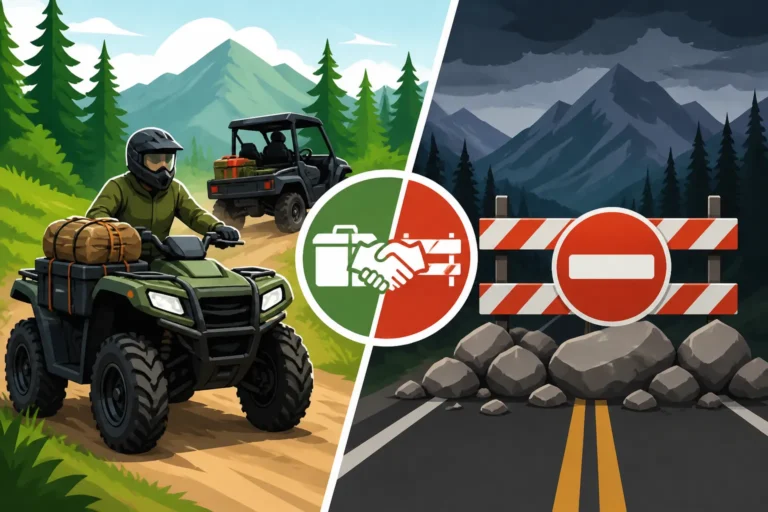
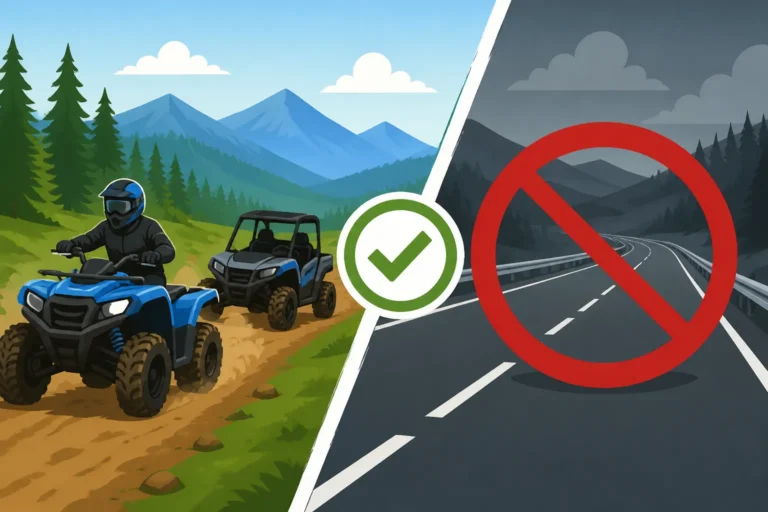
Here in British Columbia, the fundamental truth about your ATV or UTV is that it is not street legal for general highway use. This isn't just a suggestion; it's enshrined in law. The BC Off-Road Vehicle Act and its regulations primarily govern the operation of these machines on Crown land, forest service roads, and designated trails, not public highways. So, when you pull up to a stop sign on a paved road, you're essentially bringing a non-highway legal vehicle into a highway environment, even if just for a moment. This distinction is crucial because it dictates a specific set of behaviours and limitations that riders absolutely must understand and respect. It's why you can't just cruise down the highway on your quad like a car. The rules are designed to keep the main flow of traffic safe from vehicles that aren't designed or equipped for that environment.
This legal framework means that any time your wheels touch pavement that isn't specifically designated for ORV use, you are operating under a very tight set of allowances, not general permission. Think of it like bringing a boat onto a road; it has a very specific, limited purpose there, and that's usually just getting to the water. For an ORV, its "water" is the trail, and the road is just the portage. Ignoring this foundational principle is where many riders run into trouble, mistakenly thinking that a quick hop across a road is harmless or falls under some kind of unwritten rule. But the law is quite clear: your ORV's natural habitat is off-road, and any deviation requires strict adherence to specific allowances.
Why Just Crossing Can Feel Like a Major Obstacle
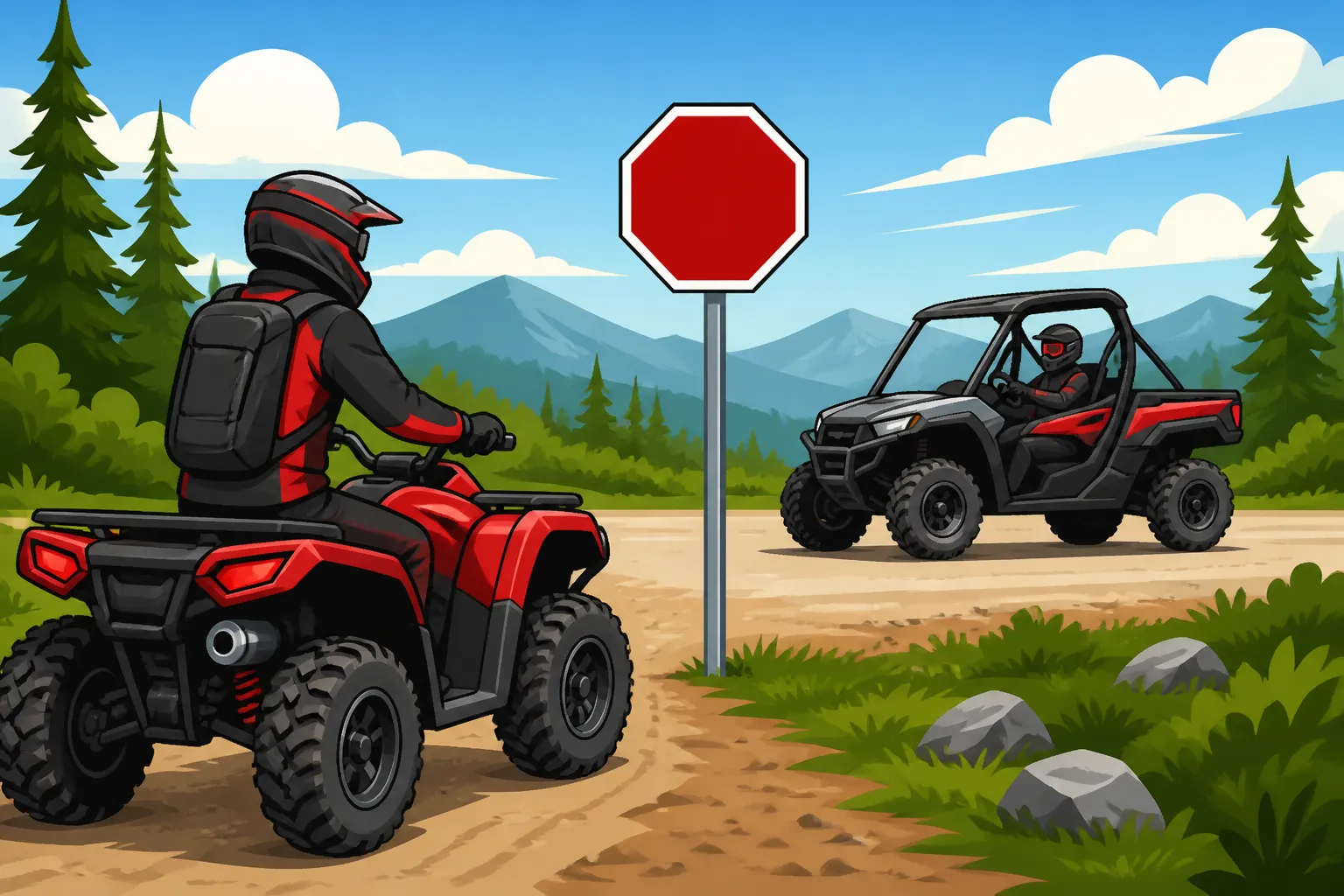
You've been riding for hours, enjoying the solitude, the views, and the challenge of the terrain. Then you see it: a paved road, and a big red stop sign looming ahead. All of a sudden, the simplicity of the ride evaporates, replaced by a mental checklist of "Am I allowed? Do I have my papers? Is my plate visible?" It feels like jumping through hoops just to go twenty feet. This feeling is entirely valid, because even a short crossing involves responsibilities that can feel disproportionate to the distance travelled. The perception that you're an anomaly on the road is correct, and that's why the rules are so stringent.
The problem isn't usually with the act of crossing itself, but with the lack of clarity and the fear of doing something wrong. What if a police officer is around the bend? What if you cause an accident because another driver doesn't expect an ORV at an intersection? These anxieties are legitimate, and they underscore why understanding the precise rules for a stop sign crossing is so important. It’s not just about avoiding a ticket; it’s about maintaining safety for yourself, other road users, and preserving access for all responsible riders. Many riders also wonder, [Can You Ride an ATV on the Road in BC?] and the simple answer is almost always no, unless for very specific, permitted reasons like crossing.
Understanding the "No Street Legal" Foundation in BC
Let's really cement this point: your ORV, whether it's an ATV, UTV, dirt bike, or snowmobile, is generally not permitted for general travel on public highways in British Columbia. Unlike some jurisdictions that offer "street legal" conversion kits for certain ORV types, BC does not have a comprehensive pathway to make an off-road vehicle fully street legal for regular use. This means you won't be registering it for highway plates, nor will you be buying full ICBC Autoplan coverage for continuous road use. The registration system for ORVs in BC provides a [BC's Certificate of Registration Explained] which is distinct from highway vehicle registration.
This fundamental lack of "street legal" status means that any time your ORV is on a paved road, it's operating under an exception, not a general right. These exceptions are strictly limited to actions like crossing a highway, riding on the shoulder for a very short distance to bypass an obstruction, or under specific [BC Police Operation Permits for Highway Travel]. The entire regulatory structure for ORVs is built around the premise that they are primarily for off-highway use. Therefore, every time you approach a stop sign at a paved road, you must approach it with the understanding that you are performing a highly controlled, limited manoeuvre. This context is vital because it explains why the rules for crossing are so specific and why enforcement can be swift if those rules are ignored.
Navigating the Stop Sign: Specific Rules for ORV Crossings
When you find yourself needing to cross a paved road at a stop sign, it's not just about stopping and going. There are specific expectations and legal requirements that apply to ORV operators. Treat this moment with the same seriousness you would any interaction with highway traffic.
Approaching the Intersection: What the Law Expects
As you approach a paved highway, even if it's just a small rural road you need to traverse, your ORV is required to have a visible [BC ORV Number Plates and Decals]. This plate must be mounted horizontally on the front, back, or left side of your machine, kept clean, and fully legible. An officer needs to be able to identify your machine clearly, so make sure it's not obscured by mud, equipment, or cargo. Additionally, you are legally required to carry your [BC Riders Must Carry the Certificate] of registration and valid photo identification with you at all times while operating your ORV on Crown land, which includes crossing paved roads that connect Crown land sections. Think of it as your ORV's driver's licence and registration rolled into one. Without these, even a perfectly executed crossing could lead to trouble.
Upon approach, you must slow down, be prepared to stop, and ensure you have full control of your machine. This isn't the time for last-minute braking or showing off. Visibility is paramount. Be aware of your surroundings, both vehicular and pedestrian traffic. A good rider makes their presence known well before they reach the painted line. If you're riding at dusk or dawn, or on an overcast day, ensure your ORV's lights are on. Even during the day, having your lights on can make you more visible to oncoming traffic that might not expect an ORV at that intersection. This cautious approach is not just a courtesy; it's a legal obligation under the Motor Vehicle Act rules that apply to any vehicle interacting with a highway, even for a crossing.
The Stop Sign Protocol: How to Make Your Move
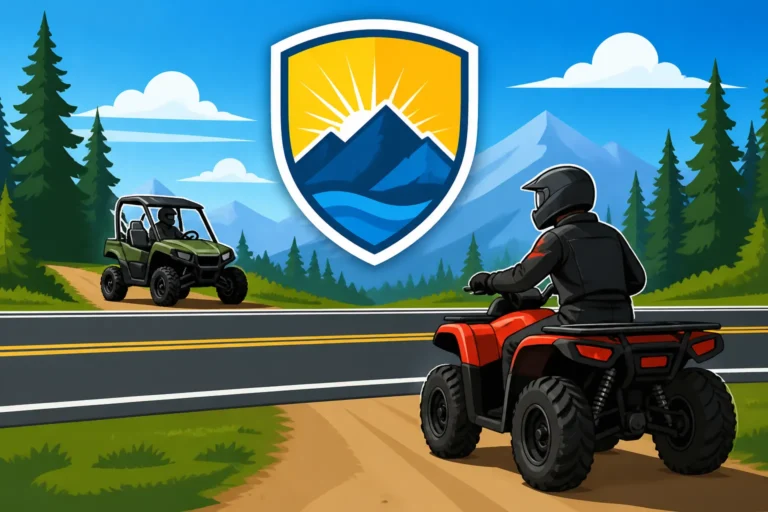
Once you arrive at the stop sign, you must come to a complete and full stop before the stop line, crosswalk, or edge of the intersecting roadway. This means all forward motion ceases, even if for just a second. Don't "rolling stop" it. From that stopped position, you must then yield the right-of-way to all traffic on the intersecting road. This means waiting until the road is absolutely clear of vehicles, or until oncoming traffic is far enough away that your crossing will not impede or endanger them. You are considered the junior party in this scenario, so the onus is entirely on you to ensure the crossing is safe.
When the path is clear, you must proceed directly across the highway at a right angle, without delay. The law specifies that you must take the most direct route across. This means you cannot turn and travel along the highway, even for a short distance, unless specifically authorized by a police operation permit. [BC Rules for Crossing a Highway] clearly lay this out. Your intention must be solely to get from one side of the paved road to the other, to continue your off-road journey. Accelerate smoothly and efficiently to minimize your time on the paved surface. If the intersection is complex, with multiple lanes or turns, take extra care to ensure you are only crossing directly and are not mistaken for a vehicle attempting to merge into traffic.
Safety First: Beyond the Letter of the Law
While adherence to the legal requirements is non-negotiable, true safety goes beyond simply ticking boxes. Always wear appropriate personal protective equipment, including an approved helmet, especially when you're interacting with highway traffic. [BC Helmet Law Covers Every Rider] when operating an ORV. Helmets are a lifesaver, and the brief exposure to a paved road's hazards is no time to compromise. Consider adding aftermarket safety features to your ORV like brighter LED lights (perhaps from a brand like SuperATV, known for robust accessories) or a loud horn, to enhance your visibility and audibility to other drivers. These aren't just for night riding; they are valuable assets even during the day, especially if you're coming out of a dusty trail onto a busy road.
Beyond equipment, cultivate a defensive riding mindset. Assume that other drivers might not see you or might not anticipate an ORV at that location. Make eye contact if possible. Use hand signals if your ORV doesn't have turn signals, clearly indicating your intention to cross. If there's any doubt about the safety of a crossing, wait. There's no prize for rushing, and the consequences of misjudging traffic can be severe. Remember, while you might feel like you own the trail, on a paved road, you are a guest, and guests must be extra courteous and cautious.
What Happens if You Don't Follow the Rules?
Ignoring the specific regulations for ORV crossings at stop signs isn't just a minor infraction; it can lead to significant penalties, financial costs, and even the loss of your machine. Enforcement officers are well-versed in the Off-Road Vehicle Act, and they don't take these violations lightly.
Common Missteps and Their Consequences
One of the most frequent mistakes riders make is treating a stop sign on a paved road like a yield sign, or worse, blowing through it entirely. This "rolling stop" or failure to stop completely is a direct violation of the Motor Vehicle Act, which applies to your ORV while it's interacting with the highway. The consequences can be a hefty fine, similar to what a car driver would receive for the same infraction. Another common issue is travelling along the highway after crossing, even for a short distance to get to a driveway or another trail. Unless you have a specific police operation permit, this is strictly forbidden and can result in significant [BC Fines for Careless Operation] and other charges for operating an unregistered or uninsured vehicle on a highway.
Furthermore, failing to carry your registration certificate and photo ID, or having an unreadable ORV plate, can also lead to fines. An officer needs to verify that your machine is properly registered and that you are the legal operator. If your ORV is deemed to be "carelessly operated" or if you're riding without the necessary personal protective equipment, like a helmet, additional penalties can apply. Riders often overlook the fact that these rules are in place not just for highway vehicles, but for any vehicle whose operation might impact highway safety. Your ORV, even briefly, falls under that umbrella.
Enforcement: Who's Watching and What They Can Do
Enforcement of ORV regulations on and around paved roads falls primarily to the Royal Canadian Mounted Police (RCMP) and municipal police forces. They are the primary agencies responsible for upholding the Motor Vehicle Act and can issue tickets for violations related to stop signs, right-of-way, and general highway use. In addition, Conservation Officers, while often focused on environmental and wildlife protection, also have the authority to enforce aspects of the Off-Road Vehicle Act, particularly when it comes to registration and permitted use on Crown land, including where it intersects with paved roads.
The powers of these officers are significant. Beyond issuing fines, they can impound your ORV if it's found to be operating illegally, for example, if it's unregistered, uninsured for its current use, or if you're an unlicensed driver. Machine seizure can be a nightmare, involving towing fees, storage fees, and administrative penalties to get your ORV back, assuming it's even released to you. Imagine your adventure ending abruptly, your machine being hauled away, and you being left stranded. That's a very real possibility if you don't adhere to the crossing rules.
Avoiding Tickets and Seizure: A Proactive Approach
The best way to avoid tickets and the potential seizure of your beloved ORV is to know the rules cold and always follow them. Before every ride, double-check that you have your [BC Riders Must Carry the Certificate] and your driver's licence or other valid photo ID. Ensure your ORV plate is clean, visible, and securely attached. If you're concerned about visibility, especially when coming out of dusty trails, a quick wipe-down of your plate before you hit the pavement is a smart move.
Educate yourself on all aspects of [BC Rules for Crossing a Highway] and [BC Rules for Riding a Shoulder] if you anticipate needing to use a shoulder to get around an obstruction (which is a very specific and limited allowance, not a general right to ride alongside a highway). If you're unsure about a specific crossing or a road's legal status, err on the side of caution. It's better to find an alternative route or even trailer your machine across a difficult section than to risk a violation. Remember, the rules are there to maintain safety and order, and demonstrating that you are a responsible rider goes a long way.
The Wider Context: Related Road Rules for ORVs
Crossing a stop sign is just one piece of the puzzle when it comes to ORVs and paved roads. Understanding the broader context of how and when your machine can interact with these surfaces is essential for comprehensive compliance and enjoyable riding.
Connecting Roads and Designated Riding Areas
One of the primary reasons ORVs encounter paved roads is that they serve as necessary connectors between different sections of Crown land or designated trail systems. In many parts of BC, especially in the Interior or on Vancouver Island, vast networks of forest service roads (FSRs) and informal trails are interrupted by short stretches of public highway. These paved sections are often the only way to get from "Point A" of your off-road journey to "Point B" without trailering your machine. The law recognizes this practical necessity and provides the specific, limited allowances for crossing. However, it's critical to understand that these are exceptions carved out for logistical reasons, not an open invitation to ride on pavement.
It's also worth noting that some communities or regional districts might have specific bylaws that designate certain low-traffic paved roads for ORV use, but these are rare and always require local research. Never assume. The vast majority of paved roads in BC are governed by the Motor Vehicle Act, which treats your ORV as an unwelcome guest unless performing a specific, legal crossing. So, while a short paved stretch might connect two amazing trail systems, that connection must be made via a legal crossing, not by riding down the middle of the road.
When a Permit Changes Everything (Briefly)
There's a specific, very limited scenario where an ORV can travel along a public highway for a short distance: with a valid [BC Police Operation Permits for Highway Travel]. These permits are issued by local police detachments (RCMP or municipal) and are generally granted for very specific, short-term purposes, such as getting to a gas station that's just off a trail, accessing private property from a highway, or participating in a community event like a parade. They are not a general licence to ride on pavement. The conditions of these permits are strict and can include specific routes, times of day, and duration.
If you anticipate needing to travel a short distance along a paved road rather than just crossing it, you absolutely must apply for and receive one of these permits before your trip. Showing up at a police detachment after the fact with a ticket in hand isn't going to help. These permits specify the conditions under which an ORV can temporarily be considered a highway vehicle, including requirements for basic Autoplan insurance (typically [BC Requires Basic Autoplan on a Highway]) and often a driver's licence, even if you wouldn't normally need one for off-road use. They are a rare exception, not a loophole.
Other Highway Crossings: Traffic Lights and Shoulders
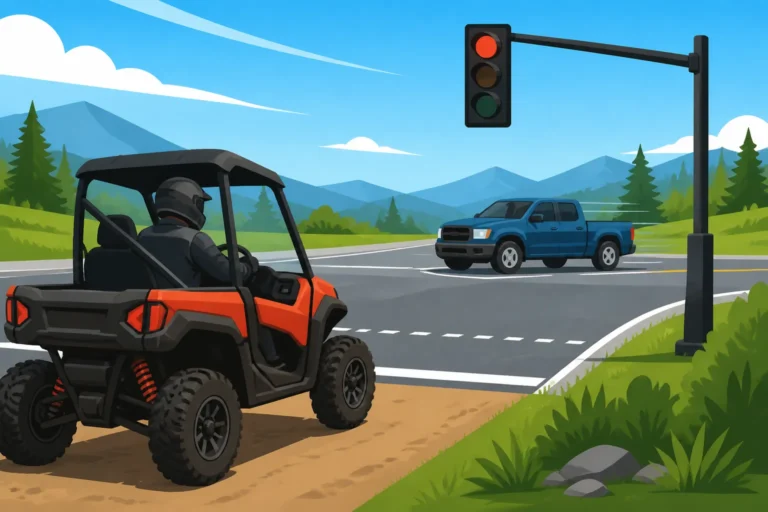
While the focus here is on stop signs, ORVs can also encounter other types of highway crossings, each with its own specific rules. If you find yourself at an intersection controlled by a traffic light, the same principle of direct, perpendicular crossing applies. You must obey the traffic light just as any other vehicle would, proceeding only when it is safe and legal to do so, and always taking the most direct route across. [BC Crossings at a Traffic Light] are handled similarly to stop signs, demanding absolute adherence to traffic signals.
The use of highway shoulders is another area where riders often get confused. Generally, ORVs are not permitted to travel on highway shoulders. The only exception, and it's a very narrow one, is if you need to bypass a temporary obstruction on an FSR or trail that forces you onto a short section of highway shoulder. Even then, you must take the shortest possible route, maintain a safe speed, and yield to all other traffic. This is not an allowance to ride the shoulder for extended periods to reach a distant trail. Always remember, the general rule is "no ORV on pavement," and any deviation is a specific, limited exception.
Equipping Your Machine for the Occasional Pavement Encounter
While your ORV isn't street legal, ensuring it's properly equipped for those unavoidable pavement crossings isn't just about compliance; it's about maximizing safety and visibility for both you and other road users. Think of it as preparing for a quick, necessary sprint through enemy territory.
Essential Safety Gear for Road Sections
Beyond the mandatory helmet (which should be worn at all times anyway), consider what other gear can make you safer during a brief road interaction. Reflective elements on your clothing or helmet can significantly increase your visibility to drivers, especially in low light conditions or against busy backgrounds. Brightly coloured riding gear is always a good idea. For your machine, making sure all your factory lights are operational and clean is step one. Many stock ORV headlights and taillights are sufficient for trail use but can sometimes be less impactful on a brightly lit paved road.
Consider enhancing your ORV's lighting with aftermarket solutions. LED light bars or auxiliary lights, perhaps from a reputable brand like SuperATV, can dramatically improve your front visibility. Rear-mounted, brighter LED brake lights can give drivers behind you more warning, which is especially important if you're pulling a utility trailer or have cargo on your rack. Having functional turn signals, even if not strictly mandated for every ORV model on a crossing, can be a huge asset in communicating your intentions to other drivers. While your ORV doesn't need to meet highway vehicle standards, a few thoughtful upgrades can make a world of difference for those brief moments on pavement.
Accessories That Help You Be Seen and Heard
Visibility is your best friend when briefly sharing space with highway traffic. Beyond brighter lights, consider adding a tall whip flag to your ORV, especially if you often ride in areas with rolling terrain or blind corners that might put your machine out of sight of oncoming vehicles. These flags, often seen in dune riding, can make your machine much more noticeable as you approach an intersection. Mirrors are also incredibly important. While many ORVs come with small mirrors or none at all, adding larger, more stable mirrors can give you a much better field of vision to check for traffic before and during your crossing. SuperATV offers a range of high-quality mirrors designed for ORVs that can withstand trail abuse while providing clear views.
Another critical, yet often overlooked, accessory is a loud, functional horn. The stock horn on many ATVs can be a bit anemic and easily drowned out by engine noise or ambient traffic sounds. Upgrading to a louder, more attention-grabbing horn can be a crucial tool for warning distracted drivers or making your presence known in an emergency. Remember, on a paved road, you're competing with vehicles traveling at much higher speeds, and anything that helps you stand out and communicate your presence is an investment in your safety.
Preparing Your Machine for the Unexpected
Even for a short crossing, it's wise to ensure your ORV is in good mechanical order. Check your tires for proper inflation, as operating on pavement with low pressure (meant for soft trails) can affect handling and tire wear. Ensure your brakes are in excellent working condition – you might need them more urgently than on the trail. A quick pre-ride check, including lights, brakes, and tire pressure, becomes even more important when you know you'll be interacting with highway traffic.
Always carry a basic tool kit and an emergency repair kit, even for "just a crossing." A flat tire or a stalled engine on the shoulder of a busy highway is a much more dangerous situation than the same problem deep in the woods. Having the means to make a quick repair or at least call for help (and having a fully charged cell phone or satellite messenger) can turn a potentially hazardous breakdown into a manageable inconvenience. Ultimately, preparing your machine means thinking ahead, anticipating potential issues, and equipping yourself to handle them safely, no matter how brief your interaction with the paved road might be.
Disclaimer
This article is for general informational purposes only and does not constitute professional advice. Laws, prices and regulations vary by location and change over time. Consult a qualified professional for guidance on your specific situation.