Hauling to a Staging Area
Getting your ATV or UTV out to a fantastic BC trail system is often half the adventure, but it's also where many riders face their first hurdle. It's not like you can simply hop on your machine and ride from your driveway to the rugged backcountry; that highway stretch is usually off-limits. This guide will walk you through the essential steps, legal requirements, and practical considerations for safely and efficiently hauling your off-road vehicle to a staging area in British Columbia, ensuring your adventure starts smooth and stress-free.
The Basics of Getting Your Machine to the Trailhead: Why Hauling Isn't Just Loading Up
The thrill of off-road riding in British Columbia often begins long before your tires hit the dirt of a forest service road or the loam of a single track trail. For most of us, that means a significant journey with our machines securely loaded onto a truck or trailer. It’s a process that has its own set of challenges, from understanding the sheer scale of BC’s wild spaces to ensuring every buckle and strap is just right. Ignoring these details can quickly turn excitement into frustration, or worse, a dangerous situation on the highway.
Understanding BC's Landscape and Distances
British Columbia is vast, stretching from the temperate rainforests of the coast to the dry interior and the towering peaks of the Rockies. This means that for many riders, accessing prime off-road terrain involves covering considerable distances, often across varying road conditions. You might be hauling your quad from Vancouver to the Okanagan, or from Prince George down to the Kootenays, and that's not a short drive. The notion that you can just ride your machine from your property to a world-class trail is a nice thought, but generally unrealistic and often illegal.
These journeys aren't always on smooth, multi-lane highways. You'll likely encounter mountain passes, winding provincial routes, and perhaps even some gravel sections before you even reach the start of the actual off-road adventure. For instance, getting to a place like [Bear Creek OHV: BC's Largest Recreation Site] from the Lower Mainland means navigating busy highways, and then often smaller, less maintained roads as you get closer. This long-haul reality dictates much of what you need to consider for safe transport.
The sheer scale of BC's riding regions means your machine will spend a significant amount of time being trailered. This constant movement, combined with diverse road conditions, puts a lot of stress on your hauling setup. It's why robust equipment and proper technique are absolutely non-negotiable. Trying to cut corners here is a recipe for a roadside disaster or unnecessary delays, costing you valuable riding time.
Essential Equipment for Safe Hauling
To safely transport your ATV or UTV, you'll need the right tools for the job. Most riders opt for a pickup truck, a suitable trailer, and a good set of tie-downs. For trailers, options range from simple open utility trailers to enclosed units, each with their own benefits. Open trailers are generally lighter and more affordable, making them a popular choice for many weekend warriors. Enclosed trailers offer protection from the elements and added security, but come with a higher price tag and increased weight.
Beyond the truck and trailer, don't skimp on the accessories that truly secure your load. Quality ramps are crucial for safe loading and unloading; they need to be strong enough for your machine's weight and long enough to provide a manageable incline. Heavy-duty, automotive-grade tie-downs are absolutely non-negotiable. Forget the flimsy straps from the bargain bin; cheap straps can stretch, fray, or even snap under the forces of highway travel, and suddenly your quad could be shifting precariously on a winding mountain road. Investing in good tie-downs with sufficient load ratings is paramount. Winches can also be invaluable for loading a stubborn or disabled machine, while a spare tire for your trailer is a wise precaution, as flats rarely happen in convenient locations.
Having the right gear isn't just about convenience; it's about safety. Imagine hitting a pothole on a busy highway and watching in your rearview mirror as your precious machine bounces precariously because a cheap strap gave way. That kind of stress, not to mention the potential for damage or an accident, is easily avoided with proper preparation and quality equipment. Think of your hauling setup as an extension of your safety gear – it's just as important as your helmet once you get to the trails.
Legalities of Hauling Your ORV in BC
Hauling your off-road vehicle in British Columbia involves more than just physically loading it up. There are a few legal considerations to keep in mind, even though your machine isn't directly on the road under its own power. First and foremost, your tow vehicle must be properly registered and insured. Your trailer also needs to be registered and have a valid licence plate. While your ATV or UTV isn't actively driving on the highway, it still needs its own provincial registration if you plan to ride it anywhere other than private property.
British Columbia made ORV registration mandatory in 2015. This means your quad or side-by-side needs to be registered with ICBC and you'll receive a unique [BC ORV Number Plates and Decals] and a [BC's Certificate of Registration Explained]. Even if you're just transporting it, carrying this documentation or having the plate visible is good practice. The registration you get for your ORV is a one-time thing; [BC ORV Registration You Pay Once] and [BC Registration Lasts as Long as You Own It], meaning there's [BC Has No Annual Renewal Sticker] to worry about. However, the initial registration is crucial.
Furthermore, pay attention to the weight limits and braking requirements for trailers in BC. If your trailer and load exceed a certain weight, it typically needs its own braking system, which must be in good working order. Overloading your trailer or tow vehicle isn't just illegal; it's extremely dangerous, affecting your ability to steer, brake, and maintain control, especially on BC's often hilly and winding roads. Always know your tow vehicle's capacity and your trailer's Gross Vehicle Weight Rating (GVWR) to ensure you stay within legal and safe limits.
Choosing the Right Trailer and Setup for Your Adventure
The type of trailer you use and how you set it up are pivotal for a successful and stress-free hauling experience. There's no one-size-fits-all solution, as your choice will depend on the size and number of machines you're transporting, your budget, and the specific conditions you anticipate encountering on your journey to the BC backcountry. Making an informed decision here can save you a lot of headaches, and potentially, a lot of money in repairs.
Open vs. Enclosed Trailers: Pros and Cons
When it comes to trailers, the most common debate among riders is whether to go with an open or an enclosed model. Both have their advantages and disadvantages, and understanding them will help you make the best choice for your needs.
Open trailers, like utility trailers or flat decks, are generally lighter, more affordable, and easier to load and unload. Their open design means less wind resistance, which can translate to slightly better fuel economy for your tow vehicle. They're also often more compact, making them easier to store when not in use. However, your machines are exposed to the elements – rain, snow, road grime, and flying debris from other vehicles. This exposure can mean more cleaning upon arrival and potential wear and tear over time. They also offer minimal security against theft, leaving your expensive equipment vulnerable during stops or overnight parking.
Enclosed trailers, on the other hand, provide excellent protection for your ATVs or UTVs from weather, road grit, and potential theft. Many come with interior lighting, storage cabinets, and even living quarters, making them a great option for longer trips or frequent use. They offer peace of mind, knowing your gear is safe and dry. The downsides include a higher purchase cost, increased weight (leading to more fuel consumption), and a larger footprint that can be challenging to maneuver and store. Side-by-sides, especially larger models, often necessitate an enclosed trailer due to their dimensions, making them a more significant investment. Ultimately, your decision here will hinge on your priorities: budget and ease of use versus protection and security.
Securing Your Machine for the Journey
Once you've chosen your trailer, the most critical step is properly securing your ATV or UTV. This is where attention to detail really pays off. You're not just preventing your machine from sliding around; you're counteracting the forces of acceleration, braking, sharp turns, and road vibrations that occur over hundreds of kilometers.
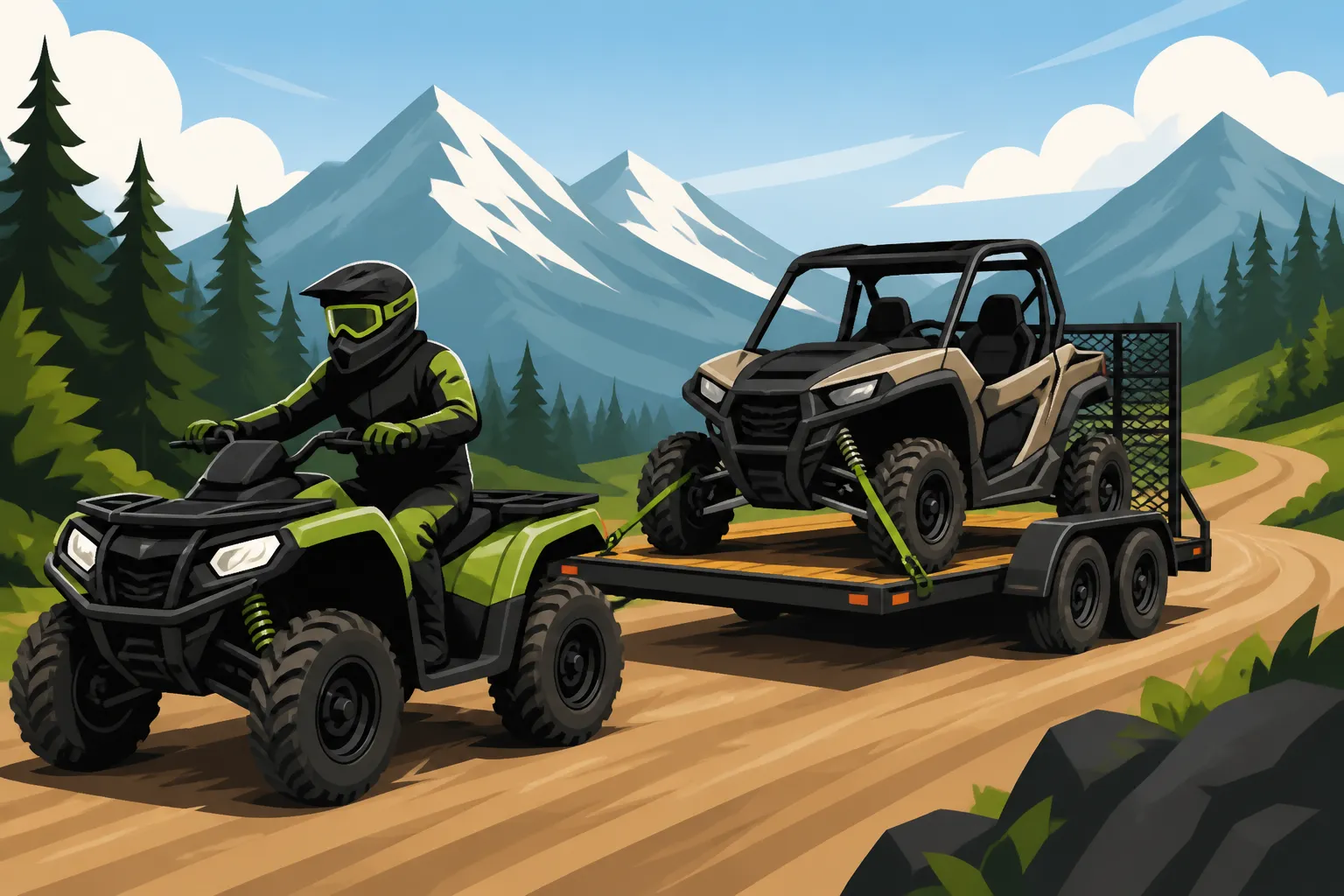
Start with heavy-duty, properly rated tie-downs. Ratchet straps are generally preferred over cam buckles for their superior tightening power. You'll want at least four straps, one for each corner of your machine, ensuring it's cinched down tightly. The goal is to compress the suspension slightly, reducing bounce and movement. Hook your straps to solid frame points on your ATV or UTV, avoiding plastic components or handlebars that could bend or break under pressure. Secure the other end to robust anchor points on your trailer. Cross-strapping (crisscrossing straps from opposite corners) can add an extra layer of stability.
Before every trip, and periodically during long hauls, check your straps. They can loosen due to vibration or suspension settling. A good habit is to pull over after the first 20-30 minutes of driving to give everything a quick once-over, then again every few hours. Imagine hitting a series of bumps on a gravel road, hours from civilization, and seeing your expensive machine shift significantly. That's a scenario you absolutely want to avoid, and it's preventable with proper securing techniques. Don't forget to tie off any loose ends of your straps to prevent them from flapping in the wind, which can cause damage to the straps themselves or annoy other drivers.
Weight Distribution and Towing Capacity
Understanding weight distribution and respecting your tow vehicle's capacity are non-negotiable for safe hauling. Every truck and SUV has a specified towing capacity, a Gross Vehicle Weight Rating (GVWR), and a Gross Combination Weight Rating (GCWR). Exceeding these limits is not only illegal but extremely dangerous, compromising your vehicle's braking, steering, and overall stability.
The key to good weight distribution lies in managing "tongue weight" – the downward force the trailer exerts on your hitch. Ideally, this should be about 10-15% of the total trailer weight. If the tongue weight is too low, the trailer can sway violently at speed, a terrifying experience known as "trailer wag." Too high, and it can overload your tow vehicle's rear axle, affecting steering and braking. To achieve proper tongue weight, position your ATV or UTV so that the majority of its weight is slightly forward of the trailer's axle(s). For multiple machines, strategic placement is crucial; heavier machines should generally be closer to the front of the trailer.
Always consult your truck's owner's manual for specific towing limits. Factor in not just the weight of your machines, but also the trailer itself, fuel, gear, and any passengers in your truck. Overloading can lead to premature wear on your vehicle's transmission and brakes, increased stopping distances, and a significant risk of losing control. That feeling when your trailer starts to push your truck on a downhill curve, or when you notice excessive sway at highway speeds, is a clear indicator that your setup is either overloaded or improperly balanced. Taking the time to weigh your loaded trailer and adjust your setup before a long journey is a small effort for a massive gain in safety and peace of mind.
Navigating Staging Areas and Post-Haul Setup
You've successfully hauled your machine across BC's highways and backroads, and now you're finally at the staging area. This is where the real fun is about to begin, but there are still a few crucial steps to ensure a safe and smooth transition from transport to trail. Knowing how to locate, access, and utilize these staging points efficiently will maximize your riding time and minimize any last-minute stress.
Finding and Accessing BC's Staging Areas
British Columbia boasts an incredible network of off-road trails, and with them, numerous designated staging areas. These are typically places where you can safely park your truck and trailer, unload your machines, and access the trails. Popular riding regions like the Chilliwack area, the Okanagan, and the Kootenays all have well-known staging points. For example, [Bear Creek OHV: BC's Largest Recreation Site] near Kelowna offers extensive trails and clearly marked staging points, but knowing how to get there and what to expect is part of the planning.
Before you head out, research your chosen riding area thoroughly. Online forums, local ATV club websites, and even apps can provide valuable information on staging area locations, access road conditions, and any seasonal closures. Forest Service Roads (FSRs) often lead to these areas, and while many are well-maintained, some can be rough, requiring a capable tow vehicle. Always pay attention to signage, respecting private land boundaries. [BC Private Land and the Registration Question] is a common query, but the rule of thumb is that if it's not clearly designated Crown land or a public access point, you need permission. Using paper maps in addition to GPS can be a lifesaver, especially in remote areas where cell service is non-existent.
Local ATV clubs are an invaluable resource for this kind of information. They often maintain trails, manage staging areas, and can provide up-to-date details on local conditions, potential hazards, and recommended routes. Joining a local club or checking their online resources before your trip can save you a lot of time and frustration trying to find suitable access points on your own.
Unloading and Pre-Ride Checks
Once you've arrived at the staging area, the next critical step is safely unloading your machines and performing essential pre-ride checks. This isn't the time to rush; patience and thoroughness here can prevent problems on the trail.
Start by parking your tow vehicle and trailer on level ground, well out of the way of other users. Ensure the parking brake is engaged on your truck. Use sturdy, appropriate ramps that are securely attached to your trailer. Many riders prefer to unload one machine at a time, ensuring maximum focus and safety. Once your ATV or UTV is off the trailer, move it to a safe, designated spot for your pre-ride ritual.
Before hitting the trails, conduct a thorough inspection:
- Tires: Check tire pressure, looking for any punctures or excessive wear.
- Fluids: Verify engine oil, coolant, and brake fluid levels.
- Controls: Test brakes, throttle, and steering for proper function.
- Lights: Ensure headlights, tail lights, and brake lights are working. This is especially important if you anticipate riding in low light or at night, as [BC Lighting and Seat Belt Requirements] are in effect.
- Fuel: Confirm you have enough fuel for your planned ride.
- Registration & Gear: Double-check that you have your [BC Riders Must Carry the Certificate] and [BC Riders Must Carry Photo ID] with you. Make sure your helmet fits properly and is securely fastened. Confirm your machine has a functional spark arrestor, as [BC Spark Arrestor Rules and Fines] can be significant, and it's vital for wildfire prevention.
Here's a quick table to help you organize your pre-ride checks:
| Item | Check | Notes |
|---|---|---|
| Tires | Pressure, Punctures, Wear | Adjust to terrain, inspect for damage |
| Fluids | Engine Oil, Coolant, Brake Fluid | Top up as needed, check for leaks |
| Brakes | Front & Rear Operation, Lever Feel | Ensure firm and responsive |
| Throttle | Smooth Operation, Return to Idle | No sticking or excessive play |
| Steering | Free Movement, No Excessive Play | Ensure full range of motion |
| Lights | Headlights, Tail Lights, Brake Lights | Test all functions, replace bulbs if necessary |
| Spark Arrestor | Clean & Intact | Mandatory for most riding areas, prevents wildfires |
| Fuel Level | Sufficient for Planned Ride | Consider extra fuel for longer excursions |
| Documentation | [BC's Certificate of Registration Explained], ID | [BC Riders Must Carry Photo ID] and registration on every ride |
| Safety Gear | Helmet, Eye Protection, Gloves, Boots | Ensure proper fit and condition |
| Suspension | Damage, Leaks | Look for bent components or fluid leaks |
| Battery | Secure, Connections Tight | Prevent unexpected power loss |
| Loose Items | Rack Bags, Tools, Cooler | Secure all cargo to prevent loss on the trail |
Temporary Storage and Security at the Staging Area
Once your machines are unloaded and ready to ride, you'll need a safe spot to leave your tow vehicle and trailer. Staging areas, particularly popular ones, can sometimes be targets for opportunistic theft, so security is a real concern.
Always park your truck and trailer in a designated parking area, ideally in a well-lit spot if you're planning to return after dark. Try to position your trailer in a way that makes it difficult to hitch up and drive away. Hitch locks, wheel locks, and even heavy-duty chains can add layers of security, deterring casual thieves. Removing valuables from your truck's cab or locking them out of sight is also a smart move.
While many BC riders are good people, it’s always better to be cautious. The reality is that remote areas can sometimes attract those looking to take advantage of unattended vehicles. If you're riding with a group, consider leaving one person to watch the staging area during brief periods. For longer rides, ensure your vehicle is as secure as possible. Some staging areas, especially at managed sites, may have surveillance or more robust security, but many are simply open parking lots in the wilderness. Taking these precautions allows you to enjoy your ride without constantly worrying about your rig back at the staging area.
Common Hauling Challenges and Smart Solutions in BC
Hauling your ATV or UTV across British Columbia isn't always a straightforward affair. The province's diverse geography and unpredictable weather can throw unexpected curveballs at even the most seasoned riders. Being prepared for these challenges and knowing how to navigate them effectively will not only make your trip safer but also far more enjoyable. From navigating treacherous mountain passes to ensuring you have all your legal ducks in a row, preparation is your best friend.
Dealing with BC's Diverse Terrain and Weather
British Columbia's landscape is breathtakingly beautiful, but it can also be incredibly demanding on drivers, especially those towing a heavy load. You might start your journey on a sunny coastal highway only to find yourself climbing a steep, winding mountain pass, or battling rain, hail, or even snow in the interior. These conditions require a heightened sense of awareness and a willingness to adjust your driving habits.
When towing, reduce your speed significantly, particularly on winding roads, steep inclines, and declines. Allow for much greater braking distances, as the added weight of your trailer will dramatically increase the time it takes to stop. On mountain passes, utilize lower gears to control your speed, rather than relying solely on your brakes, which can overheat. If you encounter adverse weather, such as heavy rain or snow, pull over if visibility is poor or conditions feel unsafe. Carrying emergency supplies like tire chains (even in summer if you're heading into high elevations), extra water, warm clothing, and a reliable communication device (a satellite messenger is excellent in areas without cell service) is always a good idea. That feeling of driving the Coquihalla Highway with a loaded trailer in a sudden snowstorm is a memory many BC drivers share – it's no joke, and preparation is key.
Paperwork and Preparedness for the Unexpected
Even if you've done everything right in terms of loading and securing your machine, the unexpected can still happen. Being prepared with the correct paperwork and emergency supplies can make a huge difference in how quickly and smoothly you can resolve any issues.
Always have your tow vehicle's registration and insurance documents readily accessible. For your ORV, you need to carry your [BC Riders Must Carry the Certificate] of registration whenever you're riding, and it's a good idea to have it in your tow vehicle as well, especially if you're transporting the machine to a new area. If you've recently purchased your machine, especially if it's a private sale, make sure you have a proper bill of sale. Sometimes, a missing bill of sale can cause headaches during future transactions, even if your machine is registered. Using a reliable online legal document service like LawDepot can help you create professional and legally sound bills of sale or other necessary declarations if you're buying or selling privately and want to ensure all your documents are in order.
Beyond legal documents, pack a robust emergency kit. This should include basic tools, a first-aid kit, a fire extinguisher (especially important with ATVs and UTVs in dry conditions), a spare tire for your trailer, jumper cables, and a small air compressor. Having emergency contact information easily accessible is also crucial. Should you encounter a breakdown or an accident while towing, having these items and documents at hand will help you manage the situation more effectively and comply with any requirements from emergency services or law enforcement.
Community Etiquette and Respecting the Land
As off-road enthusiasts, we share the trails and the surrounding communities with others. Demonstrating good etiquette and respect for the land is not just about being a good neighbour; it's essential for maintaining access to our beloved riding areas. The way we conduct ourselves while hauling our machines to and from staging areas directly impacts how the wider public views our sport.
When driving through small towns or rural communities en route to a staging area, make an effort to minimize noise and dust. Drive slowly and considerately, especially if your truck is loud or your trailer kicks up a lot of dust on gravel roads. These communities are often sensitive to the impacts of increased traffic, and a little courtesy goes a long way. Once at the staging area, and throughout your ride, adhere to the "Leave No Trace" principles: pack out everything you pack in, and ideally, leave the area cleaner than you found it. This includes all garbage, broken parts, and even organic waste that wouldn't naturally decompose in that environment.
Furthermore, understand and respect [BC Rules for Riding Crown Land] and any posted signage regarding closed areas or sensitive ecosystems. This often involves staying on designated trails, avoiding riparian areas near water bodies, and refraining from riding in recently planted or environmentally sensitive zones. Supporting local businesses in the towns near your riding areas, whether it's for fuel, food, or last-minute supplies, also helps foster positive relationships between riders and the communities that provide access to our recreational opportunities. Our collective actions reflect on the entire riding community, and by being responsible, we help ensure future generations can continue to enjoy BC's incredible backcountry.
Disclaimer
This article is for general informational purposes only and does not constitute professional advice. Laws, prices and regulations vary by location and change over time. Consult a qualified professional for guidance on your specific situation.