When a Ban Covers an Entire Fire Centre
A wildfire-related ORV ban can affect a much larger area than the trail or staging area you planned to visit. When a prohibition covers an entire BC fire centre, the key questions are whether your route falls inside the named area, which vehicles and activities are restricted, and whether the order has changed. Here’s how to check before you ride.
What an entire fire centre ban means
BC’s fire centres divide the province into regions for wildfire management. If a temporary ORV prohibition covers an entire fire centre, it can reach well beyond the immediate wildfire area: a trailhead or route may be affected even if there is no fire nearby.
The Province of British Columbia says recreational use of off-road vehicles on Crown land is temporarily prohibited in many fire centres during wildfire conditions. The listed vehicles include all-terrain vehicles, motorcycles and off-road side-by-side vehicles. Check the wording of the specific prohibition rather than relying on a short description or a general report about a fire ban. BC Fire Centre Closures for ORVs
A fire-centre-wide boundary tells you the geographic reach of a prohibition; it does not, by itself, tell you every detail about what is restricted. Read the official notice for the affected activity, land, vehicles, start time, duration and any stated exceptions. Don’t assume that a route is open because it is distant from a fire, or that a familiar trail remains available because it has not been individually named.
It also helps to separate an ORV restriction from other kinds of wildfire restrictions. The BC Wildfire Service issues fire prohibitions and restrictions and manages wildfire response. A restriction on campfires, for example, is not the same thing as a restriction on operating an ORV. Conversely, meeting fire-safety equipment requirements does not give you permission to ride in an area where vehicle use is prohibited.
The legal basis and coverage can vary. The Province of British Columbia says motor vehicle use on Crown land may also be prohibited or restricted under the Motor Vehicle Prohibition Regulation of the provincial Wildlife Act. Those broader motor vehicle prohibitions include private land unless specifically exempted. Don’t assume that every wildfire-related ORV notice has the same scope: check the exact order and map to see which land and activities it covers. BC Motor Vehicle Closures and How to Find Them
How to confirm whether your ride is inside the boundary
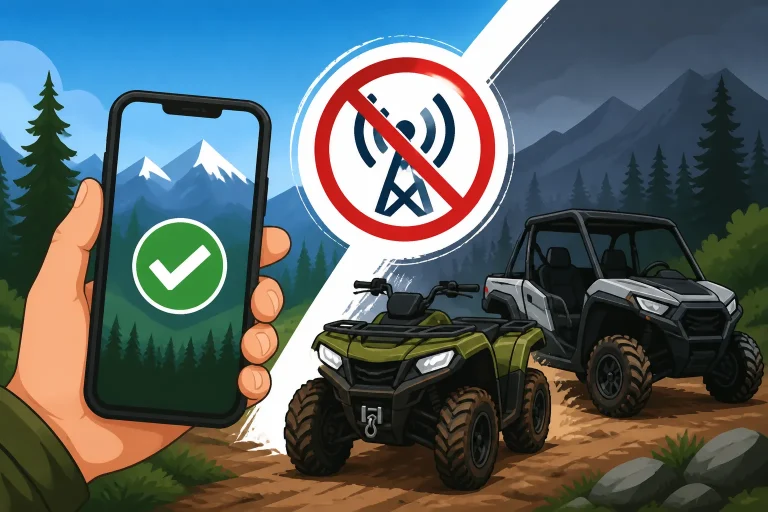
Start with the current notice from the BC Wildfire Service, not an old screenshot, a social media post or a trail report that may have been written before conditions changed. Find the notice for the relevant fire centre and read its details alongside the associated map. If the notice has been updated, use the latest version.
Then compare the mapped boundary with the whole trip you intend to make. Look beyond the trail itself to the access road, parking or staging area, campsite and any connecting route. If one part of your planned ride falls within the prohibition, don’t treat the rest of the route as automatically permissible. Check the notice for the affected land and activities, and change your plan if the status is unclear. Checking a Fire Ban Before You Ride in BC
A practical pre-ride check looks like this:
- Confirm the fire centre named in the notice and whether its boundary includes your destination.
- Read the restriction itself, including which vehicles and uses it covers.
- Check the map against your access route and intended riding area.
- Look for updates before leaving and again before unloading if conditions may have changed.
- If the boundary or wording is unclear, contact the responsible authority or choose a route outside the affected area rather than guessing.
This check matters because a fire-centre boundary and a trail or recreation-site boundary are not necessarily the same thing. A managed trail can sit inside a wider restricted area, and a route that crosses Crown land may be covered even if the trailhead is in a different kind of area. The Province of British Columbia says most Motor Vehicle Prohibition maps are available in the Hunting and Trapping Regulations Synopsis, but wildfire-related restrictions should still be checked in the current BC Wildfire Service notice. BC Crown Land Riding Explained
Be especially cautious about treating a road as an automatic way through a closed area. Resource roads are not built or maintained to the same standards as public highways, and a Forest Service Road is not automatically exempt from a land-use restriction. Before using one, check the specific closure and the road’s current access conditions. The Province of British Columbia requires ORV operators travelling on a Forest Service Road to hold a valid driver’s licence and carry at least $200,000 in third-party liability insurance; those requirements do not cancel a separate prohibition. BC Forest Service Road Requirements
What the restriction means for riders
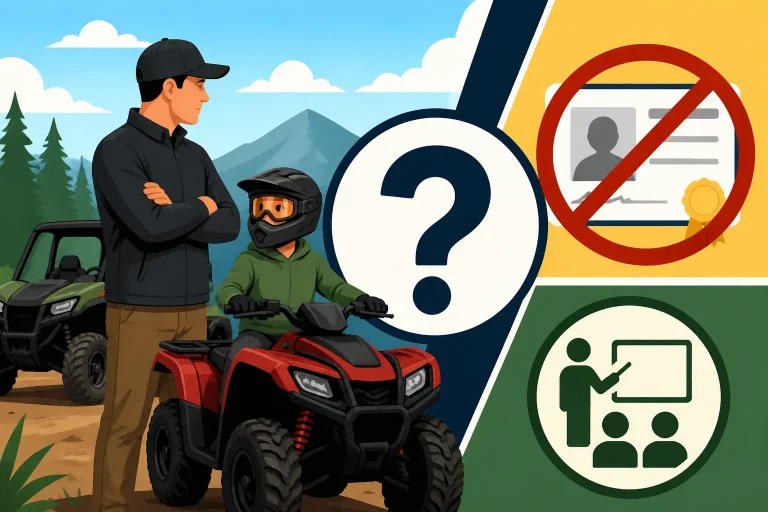
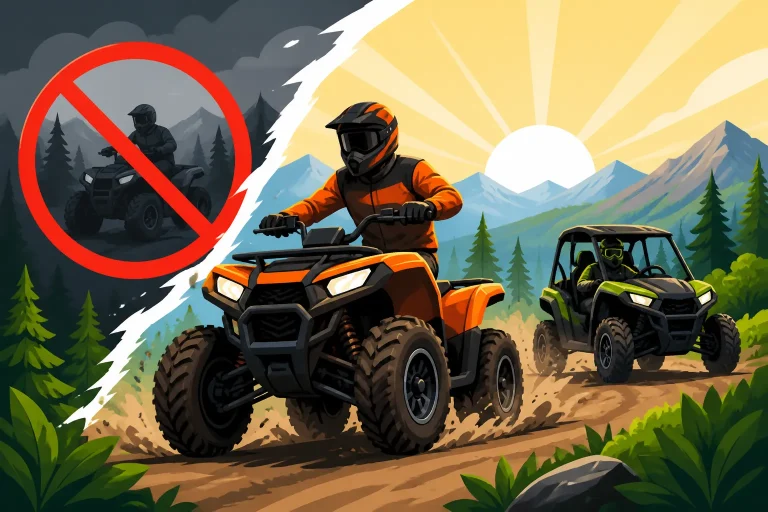
If a notice prohibits recreational ORV use in the area where you planned to ride, the safe approach is to treat the affected riding as off limits unless the notice clearly says otherwise. Don’t rely on a technical distinction between “riding the trail” and travelling a short distance across covered land. Read the order’s wording and follow its boundaries and conditions.
A vehicle’s registration is not an access permit. The Province of British Columbia requires owners to register prescribed ORVs used on Crown land and display the required plate or sticker, but registration does not authorize operation in a closed area. Operators must also carry a copy of the Certificate of Registration or Transfer of Ownership. These are separate responsibilities: having your paperwork in order does not make a prohibited ride legal. BC Registration Before Riding Crown Land
The same is true of wildfire equipment. The Province of British Columbia requires all off-road vehicles to have a spark arrestor installed during wildfire conditions. A spark arrestor is an equipment requirement, not an exception to a temporary riding prohibition. If the area is closed to the recreational use of your machine, having the required arrestor does not make it open.
If you are checking or replacing a spark-arrestor part, match it to the vehicle and the manufacturer’s requirements instead of assuming that a generic component will fit or comply. If comparing parts on Amazon, treat a listing as a starting point for checking specifications, not proof that the part is suitable or correctly installed. More on the separate equipment rule is covered in BC Spark Arrestor Requirements.
Also check for overlapping closures. A wildfire-related restriction may not be the only rule affecting a destination: a motor vehicle closure, hunting-related closure, park rule or local access restriction may apply independently. A trail appearing open on a recreation map does not necessarily mean it is open under every current order. If restrictions overlap, follow the rule that applies to your activity and location, and do not remove, alter or ignore posted access-management signs.
Conservation Officers are responsible for enforcing motor vehicle laws and regulations, according to the Province of British Columbia. The consequences depend on the specific offence and the applicable rule, so don’t base a decision on a guess about whether enforcement is likely. If you want to understand possible consequences, see BC Fire Centre Prohibition Tickets.
Adjusting plans while the prohibition is active
The easiest way to avoid an accidental violation is to make the closure check part of trip planning, rather than waiting until you reach a gate or staging area. Keep a backup destination outside the affected boundary, and verify its access separately. A nearby location can have a different status, but proximity alone does not establish that it is open.
If your usual route is closed, consider postponing the ride or choosing a location whose current access status you can confirm. Don’t detour onto an unfamiliar road or private property without checking whether vehicle use is allowed and whether you have permission. A different route may cross another closure, an area with posted restrictions or land where access is not authorized. BC Parks That Ban Motorized Recreation
Avoid relying on older printed maps or downloaded information as the final word on a changing wildfire restriction. They can help you understand the general geography, but they may not show a new or revised prohibition. Confirm the active notice through the BC Wildfire Service before travelling, and check again if conditions or notices change. If you discover a wildfire, the BC Wildfire Service says it can be reported by calling 1 800 663-5555 or *5555 from a cell phone.
When the restriction is lifted, check the updated notice rather than assuming the whole area reopened at once. Restrictions can be changed or removed, and separate access closures may remain in place. Make sure the route, staging point and riding area are all open under the current rules before unloading.
A fire-centre-wide ban is best treated as a regional access closure, not a warning that applies only beside visible flames. Check the official boundary and wording, distinguish the ORV prohibition from other fire restrictions, and remember that registration and safety equipment do not override a closure. If any part of the route is unclear, choose a confirmed open alternative.
Sources
- Province of British Columbia — Off-road vehicles – Province of British Columbia (checked November 3, 2026)
- Province of British Columbia — Motor Vehicle Prohibitions – Province of British Columbia (checked November 3, 2026)
- Province of British Columbia — Improved road access for ORVs – Province of British Columbia (checked November 3, 2026)
- Insurance Corporation of British Columbia — incidental_access_mv1445.pdf (checked November 3, 2026)
Disclaimer
This article is for general informational purposes only and does not constitute professional advice. Laws, prices and regulations vary by location and change over time. Consult a qualified professional for guidance on your specific situation.