BC Visitors From Alberta
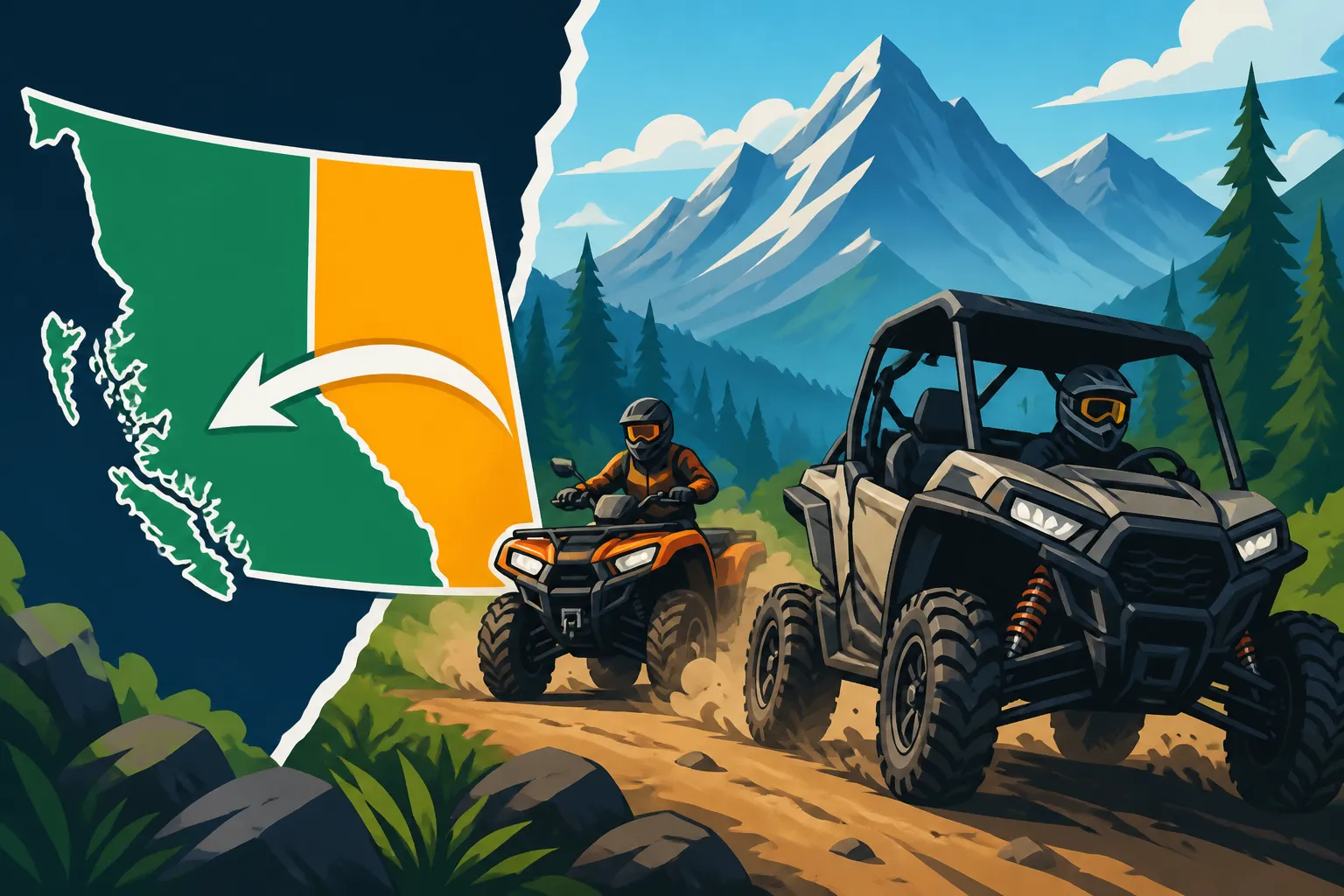
If you’re bringing an Alberta ATV or UTV into British Columbia, you may not need to register it in BC—but that does not mean you can ride anywhere without extra checks. The key is to arrive with the right Alberta paperwork, then follow BC rules for the land, road, insurance, equipment and riders on your route.
What Alberta visitors need for registration and proof
BC generally does not require a visitor to register an out-of-province off-road vehicle in BC. A qualifying Alberta machine can use its Alberta registration and plate while visiting; BC registration is not a substitute requirement simply because you cross the provincial boundary. The distinction is explained in BC Does Not Register Non-Resident Machines and BC Riders From Alberta Use Alberta Plates.
That does not make an unregistered machine automatically acceptable. You remain responsible for meeting the rules that apply to the machine in Alberta, and BC rules may require proof that it is registered in its home jurisdiction. Confirm that the registration is current and that the plate is attached as required before you travel.
Carry the documents rather than relying on a phone photo alone. A sensible document set includes:
- The machine’s current Alberta registration document.
- Proof that you own the machine, such as a bill of sale or other ownership record.
- Photo identification for the person operating it.
- Insurance documents, including details of coverage for off-road and resource-road use.
- Written permission if the machine is borrowed or operated under an arrangement where the owner is not present.
The registration document and proof of ownership serve different purposes. Registration shows that the machine is registered in Alberta; it may not establish the full ownership history if questions arise. If you recently bought the ATV or UTV, bring the purchase paperwork as well. For more detail, see BC Proof of Ownership for Visitors.
Check that the machine’s identifying number is legible and matches the paperwork. A missing, damaged or hard-to-read vehicle identification number can create delays if an officer, broker or insurer needs to identify the vehicle. It is easier to sort out a document discrepancy at home than at a trailhead.
| Before the trip | What to check |
|---|---|
| Alberta registration | Confirm the document is current and matches the machine |
| Plate | Make sure it is attached securely and can be read |
| Ownership | Carry a bill of sale or other proof, especially after a recent purchase |
| Insurance | Ask your insurer about the specific roads and land you plan to ride |
| Route | Check road access, closures, local permits and managed-site requirements |
| Riders | Confirm age, supervision, passenger and helmet rules for everyone |
Do not treat Alberta registration as permission to ride on every BC road. Registration identifies the machine for the purposes of the applicable system; it does not make an ATV or UTV street legal in BC, authorize access to private property, or override a closure. The route and type of land determine many of the rules.
Where you can ride, and when a permit may matter
BC rules depend on where you ride. Crown land, a forest service road, private land, a managed recreation site and a public highway are not interchangeable categories. A trail that appears open on a map may be subject to a road restriction, seasonal closure, land-use rule or local requirement.
On Crown land, visitors should check that motorized use is allowed in the specific area and on the intended route. A general right to access public land is not the same as permission to ride every track across it. Follow posted signs and closures, and do not assume that an old trail or open gate means vehicle access is currently permitted. BC Rules for Riding Crown Land covers the broader access question.
Forest service roads need separate planning. They can carry logging and other industrial traffic, and the rules for an ATV or UTV may differ from the rules on a recreation trail. Check for posted restrictions, active hauling, road conditions and insurance requirements before setting out. A route-planning app or paper map can help with navigation, but it may not show a current closure. See BC Rules for Riding a Forest Service Road for the road-specific issues to check.
Highway travel is a separate issue
An Alberta plate does not let you drive an ATV or UTV along a BC public highway. These machines are generally not treated as street-legal vehicles simply because they are registered in another province. Do not plan a route that depends on using the highway as an ordinary connector.
There can be limited situations where an off-road vehicle may cross or travel on a highway under specific rules or an operation permit. Those permissions are not blanket authority to ride along any road. The permitted route, conditions and issuing authority matter. If your planned route involves a highway, contact the local police detachment or relevant authority before riding and ask what applies to that exact location. A permit for one purpose or stretch should not be assumed to cover another.
Where a crossing is allowed, follow the applicable crossing rules and use the designated point if one is specified. Do not ride on a shoulder or through a parking area as though it were a legal trail connection. BC Rules for Crossing a Highway explains why crossing rules and ordinary highway travel are different.
Private land and managed riding sites
You need permission to ride on private land. An Alberta registration document does not give access rights, even if the land looks unused or connects two public routes. Be especially careful around farms, ranches, cabins and private roads.
Some managed recreation areas require their own day or season pass. These site passes are separate from provincial registration and insurance. Check the rules for the particular site before unloading, including whether the pass must be bought in advance, whether each rider or machine needs one, and how proof must be carried. BC does not have one province-wide trail pass that automatically covers every riding area. BC Passes Exist Only at Managed Sites explains this distinction.
Insurance and equipment for a BC ride
Do not assume your Alberta policy covers every kind of BC riding. Ask the insurer specifically about off-road use in British Columbia, Crown land, forest service roads and any highway crossing you are considering. Confirm the coverage in writing and carry proof with you.
Forest service roads deserve particular attention because BC requires a minimum amount of liability coverage for off-road vehicles on these roads. Ask your insurer whether your policy meets the applicable requirement for the road you plan to use. A policy that covers recreational riding may still have exclusions, limits or conditions that matter for resource-road use. Do not rely on a verbal assumption that “the machine is insured” without checking the type and amount of coverage.
Insurance, registration and permission answer different questions:
- Registration identifies the machine under the applicable registration system.
- Insurance addresses financial responsibility for certain losses or claims.
- Permission or a permit determines whether you may use a particular road, property or site.
- Safety equipment and riding rules govern how the machine is operated.
Having one does not replace the others. For example, a valid Alberta registration does not prove that your liability coverage meets BC requirements for a forest service road, and insurance does not authorize access to private land.
Before departure, inspect the equipment and confirm that it meets BC requirements for the kind of machine and riding involved. Helmet rules apply, and side-by-sides have requirements that differ from ride-astride machines. Check that required lights work, belts and seats are in safe condition, and the machine is suitable for the route. The detail matters: a helmet rule for a quad is not necessarily the same as the restraint rule for a UTV. See BC Helmet Law Covers Every Rider and BC Rules for Riding a Side-by-Side.
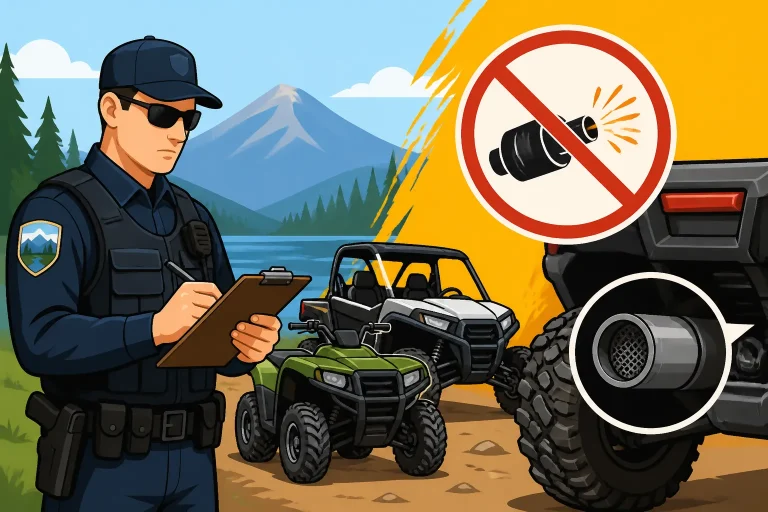
Spark-arrestor requirements and wildfire restrictions can also affect where and when you ride. Check whether the machine’s exhaust system meets the rules for your destination and whether an active fire-related prohibition applies. A machine may be properly registered yet still be barred from a particular area during a closure. Read local and posted restrictions before unloading, and check again if conditions change during the trip. BC Spark Arrestor Requirements provides more detail about equipment checks.
A practical checklist for Alberta riders
A little preparation helps avoid the two most common problems: arriving without proof of registration or insurance, and assuming a legal machine can ride on any road or trail.
- Confirm the paperwork. Check that the Alberta registration matches the machine, the plate is attached and readable, and ownership documents are available. If the vehicle is borrowed, carry the owner’s contact information and written permission.
- Call your insurer. Explain that you will ride in BC and name the types of roads you expect to use. Ask about liability limits, exclusions and proof of coverage for forest service roads.
- Plan the route by land type. Identify which parts are managed trails, Crown land, forest service roads, private property or highways. Verify current closures and access restrictions rather than relying only on a saved map.
- Resolve highway questions in advance. If the route needs a crossing or other highway access, ask the local authority whether a permit or special conditions apply. Do not interpret a permit as general street access.
- Check site-specific rules. Find out whether your destination requires a pass, has sound or equipment restrictions, limits vehicle types, or has a seasonal closure.
- Prepare every rider. Check age and supervision requirements, passenger limits, helmets or restraints, and the machine manufacturer’s age, weight and passenger guidance. BC rules may differ from what riders are used to in Alberta. BC Youth Riding Rules Explained is useful if children or teenagers are coming along.
- Carry the proof while riding. Keep registration, ownership and insurance documents accessible, along with photo identification. Protect paper copies from water and mud, but do not leave the only copy back at the truck or campsite.
- Recheck conditions on the day. Fire restrictions, road activity and access notices can change. Follow signs and instructions on site, even if your earlier route research suggested the road was open.
If you are unsure about a particular access point, machine or policy, ask the relevant authority or insurer about that exact situation. A general answer about “riding in BC” may not resolve a road-specific restriction or an insurance exclusion. Good preparation is not just carrying the right plate; it is making sure the machine, documents and route all fit the rules where you intend to ride.
Disclaimer
This article is for general informational purposes only and does not constitute professional advice. Laws, prices and regulations vary by location and change over time. Consult a qualified professional for guidance on your specific situation.