BC Day Passes at a Managed Site
A day pass can look like a simple trail fee, but riders often need to know exactly where it applies, who needs one and what else to bring. In BC, pass rules can differ between managed riding sites. Here’s how to check what a pass covers and avoid arriving without the access or paperwork you need.
What a day pass covers at a managed site
A day pass is usually permission to use a particular managed site or trail network for a limited visit. It is not a province-wide permit to ride anywhere in BC, and it does not replace registration, insurance or other legal requirements.
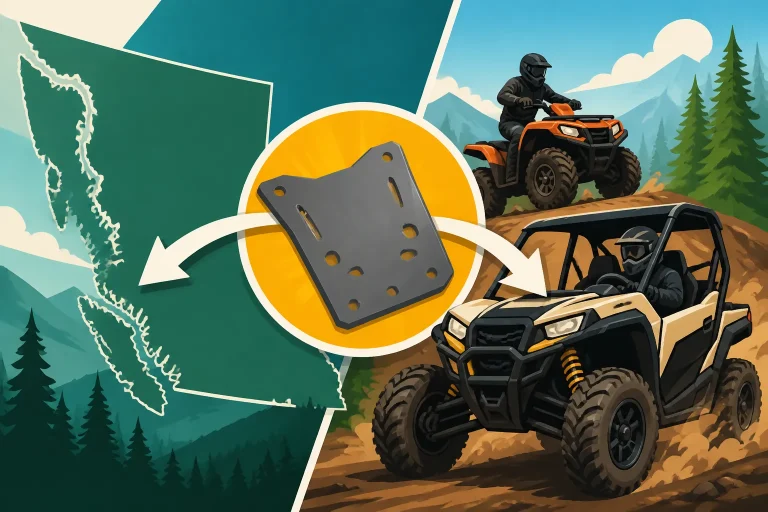
BC does not have one pass that covers all ATV and UTV trails across the province. Passes are generally connected to particular managed sites, where a club or site operator sets the access system and explains which areas it applies to. For background, see BC Has No Province-Wide Trail Pass and BC Passes Exist Only at Managed Sites.
That distinction matters if your trip includes more than one riding area. A pass purchased for one site should not be assumed to cover another site nearby, a connecting resource road or an informal route across Crown land. Check the boundaries and access information supplied by the site before you ride.
A day pass also does not make an otherwise prohibited route legal. Closures, local restrictions, fire-related prohibitions and rules for roads or private land still apply. If you are planning a longer route beyond the managed area, confirm that you have permission and meet the rules for each part of the trip.
| Access or document | What it generally relates to | What it does not replace |
|---|---|---|
| Managed-site day pass | Access to the named site or trail network under its pass rules | Registration, insurance, or permission to ride elsewhere |
| Club membership | Membership in a riding club and any benefits it offers | A site pass, unless the site’s rules specifically say it includes access |
| ORV registration | Registration requirements for the machine when applicable | A trail pass or permission to use a managed site |
| Insurance | Financial protection required or recommended for the type of riding | A pass, registration or route permission |
| Road or area authorization | Access to a particular road or area where required | General access to all trails |
The table is a practical distinction, not a substitute for the operator’s terms. Each site can set its own pass arrangements, and access may also depend on current conditions.
A pass is not the same as club membership
A club may maintain trails, help operate a riding area or sell passes for a managed site. Those roles can overlap, but membership and day-use access are not automatically the same thing. A membership may support trail work or provide member benefits while a separate pass is still required to ride at a site.
Before paying, check whether the pass is sold by the operator, a local club or another authorized seller. Read what the purchase includes rather than relying on a general statement that a trail is “club maintained.” Why Club Membership Is Not the Same as a Pass explains the distinction, and What a Local Club Trail Pass Gets You is useful if you want to understand the scope of a club-issued pass.
How to buy a day pass and keep proof handy
The site operator’s own instructions are the best place to start. Look for the name of the managed area, the pass options, where to purchase, and how proof must be shown. If the information is unclear, contact the operator or club before driving to the staging area. Do not assume a pass will be available on arrival or that a third-party listing reflects the current rules.
A straightforward buying process is:
- Confirm the exact riding area. Check that the pass applies to the site you intend to use, not just a nearby trail system or club.
- Read the access terms. Look for the valid period, eligible users or machines, and any conditions attached to use.
- Check how many passes are needed. Some sites may charge by person, machine or another basis. Confirm whether a driver, passenger, youth rider or each machine needs separate proof.
- Use the seller named by the site. Follow the operator’s current instructions for online, in-person or other sales.
- Save proof before leaving. Keep a confirmation email, receipt or other required evidence where it can be shown without relying on cell service.
- Bring a backup if practical. A printed confirmation can help if a phone battery dies, a screen is damaged or the riding area has poor reception.
Pass rules can be easy to misread when a group has several machines or riders. If a family is sharing a vehicle, check whether the pass is tied to the machine, the occupants or both. If people in the group are arriving separately, confirm whether each person needs proof in their own name or whether one purchaser can show the pass for the whole group.
Do not assume a screenshot is sufficient just because it worked at another riding area. The site may specify a particular receipt, confirmation or display method. If it accepts digital proof, save it to the phone before leaving home rather than expecting to open a website at the trailhead. For additional options, see Buying a Site Pass Straight From a Club and Proof Carried on a Phone.
A printed copy is a useful backup, but it does not excuse a rider from following the site’s instructions. Keep the confirmation legible and accessible, and make sure the pass details match the date and location of the visit. If the pass is meant to be displayed on a vehicle or kept by a rider, follow that direction.
Plan for weak cell service
Many trailheads and backcountry staging areas have limited or no cell reception. Online purchase pages, payment services and email accounts may not load once you arrive. Complete the purchase and download or save the proof in advance. Tell other members of your group where the pass confirmation is stored, especially if the person who bought it will not be riding in the same vehicle.
Also think about battery life. Navigation, photos and group messages can drain a phone during a long day. A printed confirmation can serve as a backup, while a charged power bank can help keep digital proof accessible. These are practical preparations, not a substitute for whatever proof the site requires.
What to check before riding
A pass settles only the site-access question. Before unloading, confirm that the machine, route and group are ready for the day. Requirements can come from provincial rules, the managed site, road operators or temporary closures, so check each relevant source rather than treating the pass as an all-access document.
First, verify registration. BC’s registration rules apply separately from trail-pass arrangements, and riders may need to carry the registration certificate and photo ID. See BC Registration Before Riding Crown Land for more on the registration question, and Carrying Your Certificate of Registration on Every Ride for the documents to keep with you.
Next, check the riding area’s operating conditions. A site may post restrictions on vehicle types, noise, speed, direction of travel, parking, campfires or group use. Seasonal closures and fire restrictions can change access even after you have bought a pass. Check the operator’s updates shortly before departure, especially during dry conditions or when the area has active trail work.
If your route uses a Forest Service road or another resource road, find out which rules apply there. A trail-site pass does not itself provide road insurance or authorize travel on a restricted road. Review BC Forest Service Road Requirements and BC Resource Road Signage if your ride includes industrial roads. Conditions can change with active hauling, gates or posted restrictions.
For riding on Crown land beyond the managed site, confirm that the route is open and that your planned use is allowed. The rules can differ between a managed trail, a public road and other Crown land. BC Crown Land Access Rules and BC Motor Vehicle Closures and How to Find Them can help you check the wider route.
Consider these questions before setting out:
- Does the pass name the exact site you will use?
- Is the pass valid for your planned visit and every person or machine that needs one?
- Do you have the required proof saved or printed?
- Is the staging area open, and are there current closures or restrictions?
- Does your route leave the managed site or use a resource road?
- Do you have required registration documents, insurance and safety equipment?
- Have you checked weather, fire conditions and any site-specific notices?
If any answer is uncertain, resolve it before unloading. That is easier than discovering a missing pass or road restriction after the group has arrived.
Common pass questions and situations
Does one pass cover an entire group?
Not necessarily. The site may define a pass by rider, vehicle, visit or another unit. Check the operator’s wording before purchasing, especially if your group has passengers, multiple machines or youth riders. Ask directly if the terms do not say whether one pass covers everyone in the party.
Can a day pass be used at a second managed site?
Do not assume so. A pass generally applies to the location and terms specified by its seller. If the route crosses into another managed area, confirm whether that area has a separate pass requirement. A trail appearing to continue on a map does not prove that one site’s pass covers the next.
Does buying a pass guarantee the trail will be open?
No. A pass is not a promise that every route will remain open throughout the day. Weather, fire conditions, maintenance, land-use restrictions or other notices may affect access. Check current information before leaving and again when you reach the staging area.
Is a club membership enough?
Only if the site’s current rules explicitly include access through that membership. Some memberships support a club without serving as a pass to a specific managed site. Read BC Club Membership Benefits alongside the site’s own pass terms, and confirm whether a separate day pass is needed.
What if the site does not clearly explain its pass rules?
Contact the site operator or the club responsible for the pass before travelling. Ask what the pass covers, how it is counted, what proof to carry and whether it applies to the route you intend to ride. Keep the response with your trip information, but follow any updated instructions posted by the site.
A day pass is easiest to handle when it is treated as one part of trip planning, not as permission for every road or trail on the map. Confirm the site, understand how the operator counts riders or machines, save proof for offline use and check registration, closures and route rules separately. That way, you can arrive knowing what access you have and what still needs attention.
Disclaimer
This article is for general informational purposes only and does not constitute professional advice. Laws, prices and regulations vary by location and change over time. Consult a qualified professional for guidance on your specific situation.