Limited Cell Service at a Staging Area
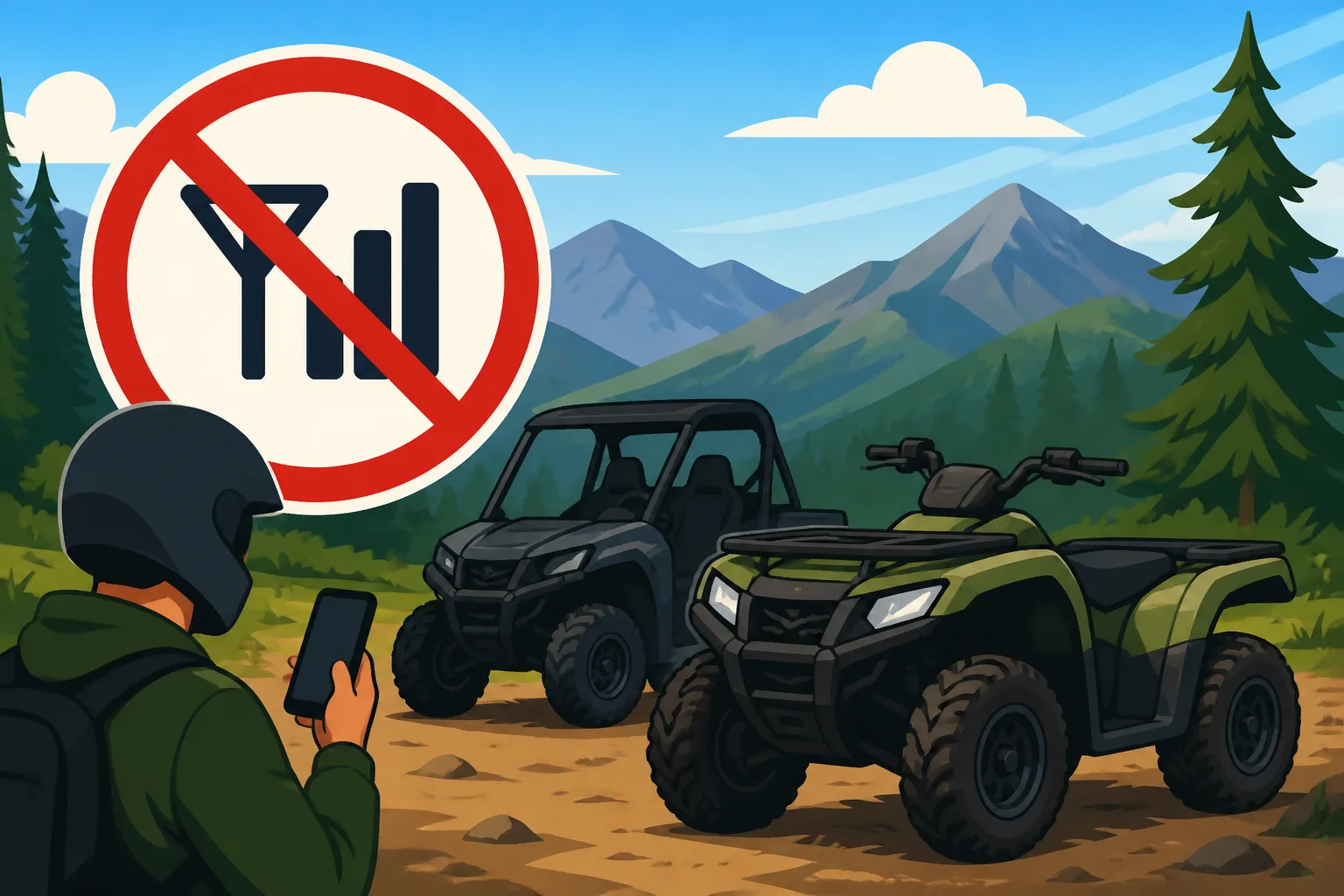
A phone that worked all the way up the highway can suddenly show “No Service” at a BC ATV staging area. That matters when your group gets separated, a trail is blocked, or someone needs help. This guide explains how to prepare offline maps, share a route, communicate without cellular coverage, and make a practical emergency plan before you unload.
Why cell service disappears at BC staging areas
Terrain, distance and busy trailheads all play a part
Cell coverage can change quickly in the backcountry. A staging area may sit in a valley, behind a ridge, or among thick trees that block or weaken a signal. Even when you had service on the drive in, a short turn onto a forest road can put you outside reliable coverage. A map showing a nearby community or highway does not tell you whether your phone will work at the trailhead.
There is also a difference between seeing a signal icon and being able to use your phone. A weak signal may let a text through after several tries but fail when you try to load a map, send a photo, or make a call. If several groups arrive at a popular staging area, network congestion may make a marginal connection less dependable. Don’t build your riding plan around being able to check a weather forecast or send a message once you arrive.
This can catch riders off guard at well-known riding areas as well as remote ones. Whether you are meeting at Bear Creek, Tabor Mountain near Prince George, or a trailhead in the Chilliwack area, prepare as if your phone may be offline. Use local trail information to plan the route, but don’t assume that a named staging area has dependable service.
Treat the staging area as the last reliable check-in point
Before leaving home or the last place with service, tell someone who is not riding where you plan to go, who is in your group, and when you expect to return. Give them a specific time to expect your check-in, not just “later today.” If your plan changes, tell them while you still have a connection. A vague itinerary is difficult for anyone to act on if the group does not come back when expected.
At the staging area, take a few minutes before unloading to confirm the group’s route, turnaround point, and regrouping plan. If there is service, send a final message with the trailhead or area name and your expected return time. If there is no service, don’t spend half an hour walking around with your phone held in the air hoping to find a signal. Treat the lack of connection as a normal condition and use your offline plan.
For more planning ideas, see BC Group Ride Planning and BC Trailhead With Trailer Parking. Those details can help you sort out the practical trailhead logistics before the group arrives. They do not replace checking the specific site’s access, closures, and conditions before you ride.
Prepare maps and route details before you lose service
Download maps while you still have a connection
An online map is not an offline map. If you can see the route at home but have not downloaded the relevant area, it may disappear or become incomplete when your phone loses data service. Before driving out, open your mapping app while connected, download the area you intend to use, and check that it remains visible with your phone in airplane mode or with mobile data turned off.
If you use onX Offroad, check in advance that the area and map details you need are available in the app, then download them before your trip. Don’t wait until the staging area to discover that the selected map layer or route requires a connection. App coverage and map details may differ by location, so check the specific riding area rather than assuming every trail is represented.
A second map source is useful, but it should not create false confidence. Compare your route with reliable local information, posted signs, and any applicable closure notices. BC ATV Trail Map Downloads can be a useful starting point for finding map resources. Save the route in more than one form when practical, such as an offline digital map and a written list of key turns or road names.
Make the route understandable without a moving blue dot
A phone’s GPS can often show your location without mobile data if the device and map are set up for offline use. But a blue dot is not a route plan. Save or write down the trailhead name, intended roads or trails, major junctions, turnaround point, and any alternate route the group has agreed to use. Record details that are useful on the ground, such as a signed road name or a distinctive intersection—not just “turn left after a while.”
Before the ride, compare your offline map with the route on another rider’s device. If your phones display different map details, settle that disagreement before leaving the staging area. Keep the group together at junctions, and stop somewhere safe to check the route rather than having each rider continue while looking down at a screen. A paper map can be a helpful backup, especially if a phone battery fails or the device is damaged.
Here is a simple pre-ride comparison:
| What to prepare | Why it matters | Check before leaving |
|---|---|---|
| Offline map of the riding area | Lets you view saved map information without mobile data | Open it with data turned off |
| Saved route or key junctions | Makes it easier to recognize where the group is headed | Confirm everyone knows the planned route |
| Written trailhead and return details | Helps if a phone fails or riders become separated | Share a copy with someone outside the group |
| Backup navigation device or paper map | Reduces reliance on one phone or battery | Keep it accessible and protected |
| Current closure and access information | A saved route may not reflect a new restriction | Check before the trip and obey posted signs |
For a known riding area, download enough map area to include likely detours and the route back—not only the planned loop. A blocked road, mechanical issue, or change in weather can make the return route different from the one you expected.
Set up communication for a group without cell service
Agree on simple rules before anyone rides away
If riders in a group become separated, a phone call may not be an option. Agree in advance where the group will stop and wait, how long the lead rider will wait at major junctions, and what everyone should do if they lose sight of the others. A straightforward rule is often safer than improvising: stop at the next agreed meeting point, stay with your machine, and do not take an unplanned trail to catch up.
Choose a turnaround time as well as a destination. If the group has not reached a certain point by that time, turn back together rather than trying to squeeze in one more spur road. That can feel frustrating when the trail is fun and the day seems young, but it helps prevent a late return caused by a wrong turn, slow travel, or a repair.
On a mixed-experience ride, the lead and sweep riders should understand their roles. The lead should avoid leaving the group behind at junctions, while the sweep should make sure no one is unintentionally left out of sight. For a larger group, count riders at stops. It sounds basic, but a quick headcount can catch a separation before the group has travelled far.
Use radios thoughtfully on resource roads
A two-way radio can help riders communicate where there is no cell coverage, but it is not a substitute for understanding local road conditions. A handheld radio is only useful if it is charged, set up correctly, and being used on a channel that the group has agreed to use. Do not assume that your group’s channel is the same one used by industrial traffic or other road users.
On a resource road, follow posted instructions and local radio practices. Some roads have specific procedures or channels, while others may not. Read signs, listen carefully, and don’t transmit over safety-related traffic. BC Resource Road Radio Practice explains why communication matters around industrial traffic, but riders should follow the requirements and instructions for the particular road they are using.
A radio is also limited by terrain, distance, obstructions, and battery condition. Test the devices together before the ride and agree on plain-language messages, such as “stopping at the junction” or “turning back to the staging area.” Keep messages brief and avoid treating radio contact as proof that a road is open or safe. Yield to industrial traffic and obey posted restrictions.
Build a no-service safety plan
Prepare for a breakdown or injury before it happens
A dead battery or minor mechanical problem can become a serious problem when the group is far from help and no one can call out. Before leaving, check each machine, carry basic repair supplies appropriate to the ride, and make sure the group has water, suitable clothing, and a first-aid kit. Bring enough supplies for a delay, not only for the expected length of the ride. Weather and travel time can change, especially on rough or unfamiliar routes.
Decide how the group will respond if someone is hurt. Keep the injured rider with a companion, make the scene as safe as possible, and assess what help is needed. If a phone has no service, trying to call repeatedly from the same spot may not solve the problem. If it is safe to do so, a designated person may need to travel to a location with coverage or to get help, while another capable person stays with the injured rider. Avoid splitting the group casually; decide who goes, who stays, and what information they need to communicate.
A satellite messenger or a phone with satellite emergency features may be worth considering for remote trips, but check that the device and service are suitable for your route and know how to use them before departure. Carrying a device without setting it up, charging it, or understanding its limits is not a complete emergency plan. Your plan should still work if the device is unavailable.
Make your return and emergency details easy to find
Leave your itinerary with a trusted person who knows when to act if you do not check in. Include the trailhead, planned route, vehicle and trailer details, names of riders, and the time you expect to be back. Agree on what “overdue” means and when they should contact local emergency services. Make sure the person has enough information to describe where you went; “somewhere near the lake” may not narrow things down enough.
Keep important details accessible to the group, not only on the phone of the lead rider. A written note in a protected place can include a contact name, the planned route, and key meeting points. On the ride, stick to the itinerary or send an update before leaving service if you make a significant change. BC Accident Reporting on Crown Land is relevant reading for understanding what to consider after an incident; follow the applicable reporting requirements and instructions.
Before heading out, check for access restrictions, weather concerns, and road information that could change the route. BC Forest Service Road Requirements can help you prepare for riding on those roads, while BC Trail Closures After a Storm is a reminder that conditions and access can change. A saved map is a navigation aid, not permission to use every road or trail shown on it.
Use this final check at the staging area
Before unloading or starting the ride, run through these questions with the group:
- Does everyone know the planned route, turnaround time, and meeting points?
- Are the offline maps downloaded and visible without data service?
- Does someone outside the group have the itinerary and expected return time?
- Are radios or other communication devices charged, tested, and set up?
- Does the group have water, appropriate clothing, basic tools, and first aid supplies?
- Has someone checked for posted restrictions and relevant access information?
- Does everyone know what to do if the group separates or someone is injured?
If one answer is no, take a moment to fix the gap before you ride. A short delay at the staging area is far less stressful than realizing halfway through a remote loop that nobody saved the map or knows the agreed meeting point. The best plan assumes the phone may be offline, keeps the group coordinated, and leaves someone at home with enough information to notice if you do not return on time.
Disclaimer
This article is for general informational purposes only and does not constitute professional advice. Laws, prices and regulations vary by location and change over time. Consult a qualified professional for guidance on your specific situation.