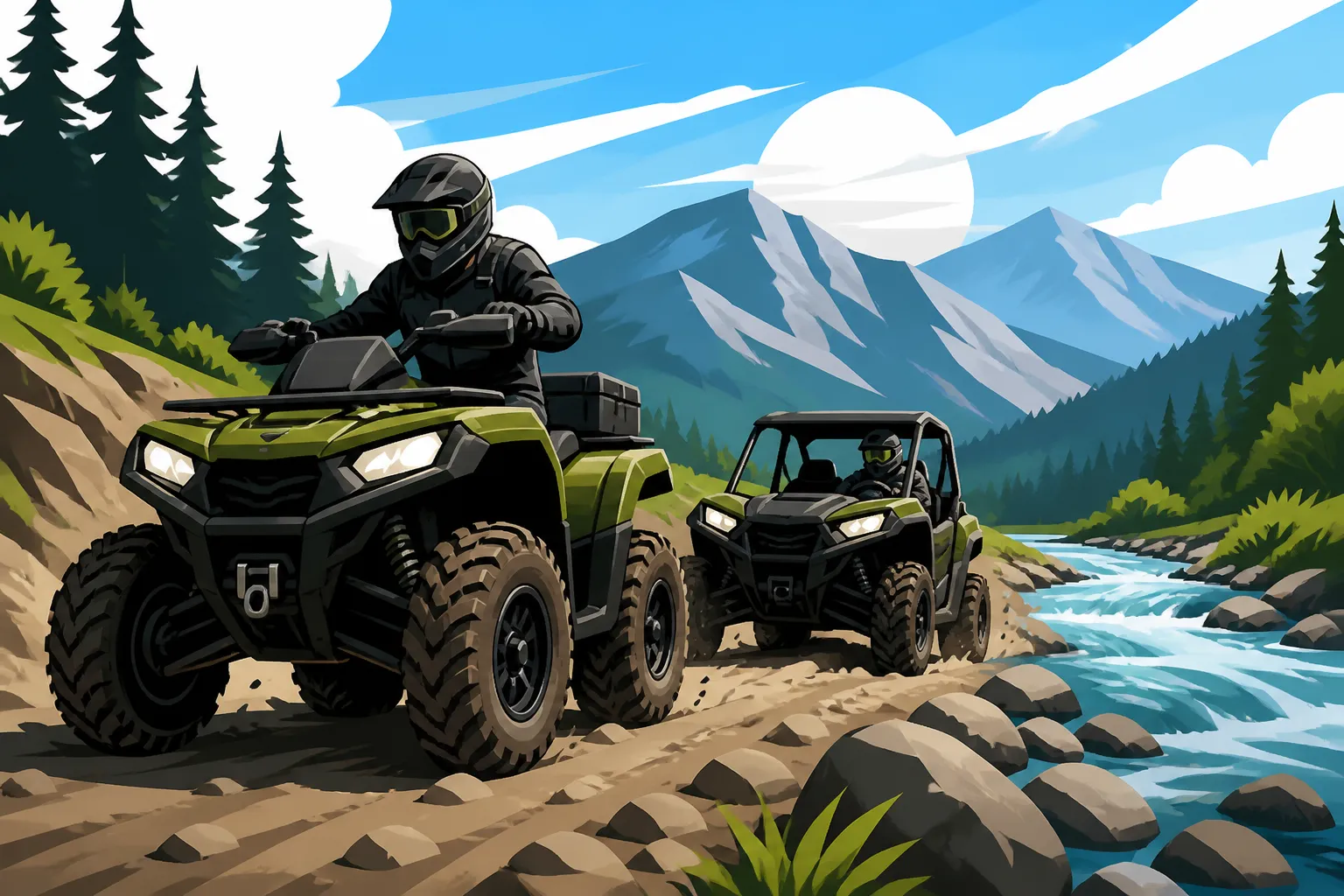
BC Riding on the Oyster River Roads
Oyster River roads can look like an easy way to explore central Vancouver Island, but a mapped line is not automatically an open ATV route. Logging activity, gates, changing road conditions and unclear staging options can complicate a ride. This guide explains how to plan carefully, check access, ride responsibly and make a day around the Oyster River area safer and less stressful.
What to Expect From the Oyster River Roads
A network of working roads, not a single managed trail
The Oyster River area sits between Courtenay and Campbell River, near communities such as Black Creek and Merville. Here, “the Oyster River roads” can mean a mix of forest roads, resource roads and other routes through a working landscape. It is better to think of them as a network to assess than as one signed, maintained ATV trail with a single entrance and a predictable surface.
That distinction matters. A road may be wide and gravelled but still serve industrial traffic, pass through land with access restrictions or be temporarily closed. A route that worked for a friend last summer may have changed since then. Before choosing a line, check the road’s status and any posted signs, gates or restrictions at the access point. For background on the legal setting, see [BC Forest Service Road Rules for ORVs] and [BC Resource Road Signage].
Expect changing surfaces and conditions
On central Vancouver Island, surface conditions can vary substantially over a single outing. You might encounter compact gravel, loose rock, potholes, washboard, mud, standing water or sections that have been freshly graded. Rain can make a familiar road slick, while dry stretches may become dusty enough to reduce visibility. A route that feels simple in a side-by-side can also be more tiring on a quad, especially if the road is rough for several kilometres.
Plan around the conditions you find, not the conditions you hoped for. If the road is rutted, water-covered or visibly damaged, slow down and avoid charging through the problem. A deep puddle can hide a hole, debris or a soft shoulder. If you cannot tell how deep it is, turning around is often the sensible choice. On wet ground, staying on the established road rather than widening it around a muddy section helps protect nearby vegetation and drainage.
| What you encounter | Why it matters | A practical response |
|---|---|---|
| Logging trucks or other industrial traffic | Large vehicles may need the full road width and have limited stopping room | Slow down, use appropriate radio practices where required or advised, and yield safely |
| A gate or posted restriction | Access may be limited or closed for a reason | Do not go around the barrier; confirm whether the road is open to your kind of use |
| Muddy or water-covered sections | The surface may be softer or deeper than it appears | Assess from a safe position and turn back if you cannot judge the crossing |
| Dust behind another machine | Visibility and following distance can become poor | Increase space and wait for dust to settle if needed |
| Weak or absent cell service | Online maps and calls may not work reliably | Carry an offline route plan and tell someone where you expect to ride |
Check Access Before You Ride
Confirm that the road is open and appropriate for an ATV
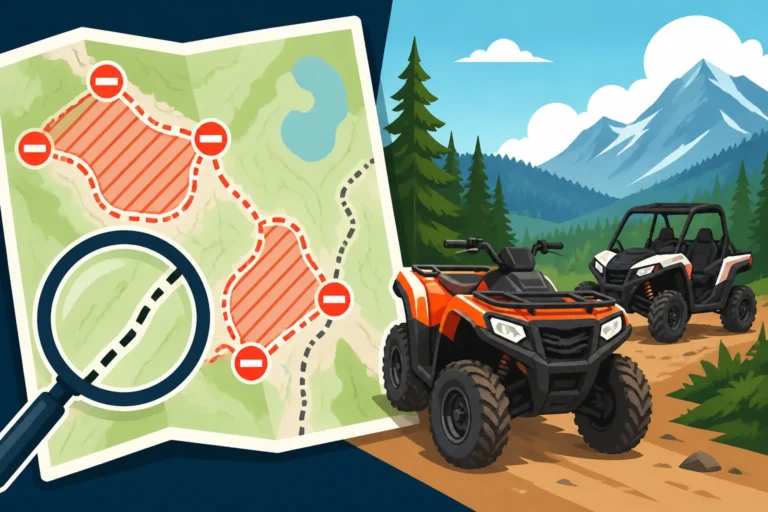
A line on a map is a planning clue, not permission to ride. Before setting out, look for current closures, posted restrictions and local information that applies to the specific road or recreation area. This is especially important where forestry operations, road maintenance, fire conditions or other land-use decisions can affect access. If you reach a gate or a sign you do not understand, do not assume that a nearby open-looking track is an acceptable detour.
A route may cross Crown land, leased land or private property, and each situation can involve different access considerations. Riding on Crown land does not mean every road is open to every use. If your plan includes a section that may cross private property or leased range, get permission where it is required rather than treating the route as a public shortcut. [BC Crown Land Access Rules] and [BC Private Land Permission] are useful topics to review when you are sorting out the difference.
Use maps as a planning aid, not a legal guarantee
Offline mapping can be valuable when cell service drops, especially if you are unfamiliar with the roads. Apps such as onX Offroad can help riders visualize routes and prepare a ride plan, but a map should not be treated as confirmation that a road is currently open or legally accessible. Map data can be incomplete or out of date, and a route line may not show a new gate, temporary closure, active work area or local restriction.
A practical approach is to compare more than one source before leaving. Use a mapping app such as onX Offroad to understand the general layout, then check available local notices and pay attention to signs on the ground. Download the map area in advance if the app supports offline use, and keep a written note of your intended route and turnaround point. The goal is not to follow a screen blindly; it is to have enough context to make a good decision when the road changes.
Another useful habit is to identify a few alternatives before the ride. If a planned road is closed, a backup should be a known, appropriate route—not an unverified trail that appears nearby. If you cannot confirm that an alternate is open, choose a shorter ride or head back. An enjoyable day is not worth turning an access question into a trespass problem or a conflict with a working operation.
Plan Around Industrial Traffic and Road Conditions
Treat active roads as workplaces
Some resource roads exist primarily to support forestry or other industrial activity. A loaded truck can be difficult to stop, and the driver may not be able to see a small ATV quickly around a bend, over a rise or through dust. Ride as though you may meet a large vehicle at any point. Keep to a predictable line, avoid stopping where sightlines are poor, and leave room for trucks to pass without forcing them onto a soft shoulder.
Radio procedures may apply on particular roads, and local signs or road operators may provide instructions. Check those requirements before riding and follow the posted direction. If you are unsure which channel or practice applies, do not improvise based on something you heard on a different road. [BC Resource Road Radio Practice] explains why communication matters, while [BC Riders Meeting a Logging Truck] covers the practical safety issue of sharing a route with industrial vehicles.
Ride for the surface you have, not the speed you want
Even a broad gravel road can become unpredictable at ATV speed. Loose gravel can shift under braking, washboard can unsettle a machine and blind corners reduce the time you have to react. On a side-by-side, passengers may not anticipate a sudden stop or rough patch. On a quad, fatigue can build as you absorb repeated bumps and make constant steering corrections.
Set a conservative pace and leave room between machines. Dust can hide potholes and make a rider behind you lose sight of the road, so avoid riding close together just to keep the group compact. If someone falls behind, stop only where you are visible and out of the active travel lane. For a longer outing, agree on regrouping places before you begin. That way, a brief gap does not prompt anyone to speed up or take an unfamiliar turn to catch up.
Turn back before a small problem becomes a major one
A sensible turnaround point is part of route planning, not a sign that the ride failed. Turn back if conditions deteriorate, a road becomes restricted, the group is running low on fuel, or someone is cold, tired or uncomfortable. Do the same if a machine develops a warning light, mechanical noise or steering problem. Continuing because the group is “almost there” can leave you farther from help with fewer options.
It also helps to agree in advance that any rider can call for a stop or a change of plan. That can be especially important for mixed-experience groups, where a confident rider may be comfortable with rough ground while a newer rider is quietly struggling. Shortening the route is better than pressuring someone to keep going. [BC Trail Etiquette Locals Expect] offers useful principles for sharing riding areas respectfully and keeping a group considerate of other users.
Prepare Your Machine, Group and Route
Match the ride to the least experienced person
Before choosing a route, talk honestly about the group’s experience, the machines being used and what everyone is comfortable handling. A ride that is straightforward for a local rider who knows the roads may feel very different to someone new to central Vancouver Island. Consider the length of the outing, the condition of the surface, the possibility of industrial traffic and whether every rider can manage the planned terrain.
For a group, agree on basic rules before starting: who leads, who rides at the back, how often you regroup and what to do if someone loses sight of the group. A lead rider should not assume that everyone behind has the same range, skill or appetite for rough conditions. If a rider is uneasy, adjust the plan rather than treating caution as a nuisance. If children are riding, confirm that supervision and machine requirements are met; [BC Supervision Required Under 16] is a useful place to start.
Carry essentials for a ride that may take longer than expected
A short-looking route can take much longer if the road is rough, a gate requires a change of plan or the group stops to let traffic pass. Bring water, food, weather-appropriate layers, a first-aid kit and basic tools suited to your machine. Check fuel range before departing and leave enough reserve for an unexpected detour or a slow return. A phone is useful, but it should not be your only navigation or emergency tool if reception is unreliable.
Before leaving, tell someone where you are riding, who is with you and when you expect to be back. Keep a charged phone and consider a communication device appropriate to the remoteness and length of the trip. Carry your required documents and ensure your machine is properly registered for the riding you plan to do. [Carrying Your Certificate of Registration on Every Ride] explains the practical value of having your paperwork with you.
A quick machine check can catch small issues while you are still at the staging point. Look over tires, brakes, steering, lights and visible leaks. Make sure cargo is secured and cannot shift into the wheels or block visibility. For a side-by-side, check seat belts and ensure passengers know when to buckle up. For a quad, confirm that the rider has a properly fitting helmet and the right clothing for the conditions.
Build a route plan with clear decision points
Before the ride, note where you plan to start, the roads you intend to use, any known access points and where you will turn around. Save an offline map if possible and make sure everyone can identify the route—not just the person leading. If using onX Offroad, review the planned line together before leaving so riders understand the general direction and possible alternatives. Do not assume that everyone’s phone will have the same map detail or battery life.
It is useful to mark decision points rather than trying to predict every minute of the trip. For example, decide that the group will turn back if a road is signed closed, if active work makes travel unsafe, or if a rider’s fuel or comfort level becomes a concern. Share the plan with someone who is not on the ride. If you change the route significantly, let that person know when you can.
Make the Ride Respectful and Recheck the Plan
Keep the road usable for other people
Oyster River-area roads may be shared with forestry workers, other drivers, cyclists, hikers and local residents. Keep noise and speed appropriate, especially near homes and communities. Do not block gates, pullouts or access points while stopping. If you need to regroup, choose a place where the whole group can get off the travelled portion of the road without creating a hazard.
Stay on established routes and avoid widening the road to get around mud, brush or a barrier. Do not ride around a closed gate or move a sign. Those choices can damage land, create conflict and make access harder for everyone who uses the area responsibly. If a road is closed, respect the restriction and choose another verified option or end the ride.
Check for changes close to departure
A route that was passable on a previous visit may not be suitable today. Weather, maintenance, logging activity, fire conditions and local restrictions can all affect access. Check for relevant updates shortly before leaving and remain alert for signs once you arrive. If a notice is unclear, treat it as a reason to pause and find out more rather than as an invitation to guess.
Mapping tools can make this process easier, but they work best as one part of preparation. A service such as onX Offroad can help you keep route information available when cell coverage is poor; it does not replace checking current closures or obeying signs. The most reliable plan combines an offline map, local information, a realistic turnaround point and the willingness to change course.
Leave the area in good shape
Pack out anything you bring in, including food wrappers, broken straps and vehicle-related debris. Avoid spinning tires, cutting new tracks or disturbing wet ground and streamside vegetation. If you see a hazard or damage, note its location and report it through an appropriate local channel rather than creating a bigger problem by trying to fix it yourself.
A good ride is not only one where the machines make it back. It is also one where the group leaves the road open for legitimate users, respects access restrictions and avoids unnecessary damage. On the Oyster River roads, that mindset is particularly important because recreation and industrial use can occupy the same broader landscape. Careful planning helps protect both your day out and the chance for others to enjoy the area responsibly.
Disclaimer
This article is for general informational purposes only and does not constitute professional advice. Laws, prices and regulations vary by location and change over time. Consult a qualified professional for guidance on your specific situation.