First Aid on a Remote Interior Loop
A minor fall can become a serious problem when you’re miles from a road, cell service, or the nearest community. On a remote BC Interior ATV loop, a first-aid kit is only part of the plan: you also need a way to call for help, keep an injured rider warm, and explain where you are. This guide helps you prepare for those moments.
Plan for the distance before you ride
Assume your phone may not work
In parts of the BC Interior, cell service can disappear as soon as you leave a highway corridor or head behind a ridge. Do not treat a phone’s emergency-call feature as a complete backcountry communications plan. It may help where a compatible network is available, but it cannot create coverage where none exists.
Before the ride, identify how your group will contact help if someone is badly injured. Depending on your route and equipment, that might mean carrying a satellite messenger or satellite phone, or arranging a reliable check-in plan with someone who is staying home. Learn how the device sends an SOS and how to confirm that the message went through. A device that is packed away, uncharged, or unfamiliar is much less useful in a crisis.
If you rely on a mobile mapping app, prepare it before leaving service. For example, check that the areas you expect to ride are available offline in onX Offroad, and test that the downloaded map opens with your phone in airplane mode. Keep the phone charged and protected from rain, dust, and impacts. A map can help you orient yourself, but it does not replace a separate emergency communication method. See Cell Dead Zones in the Interior and Carrying a Satellite Messenger when building your communications plan.
Make your route and check-in plan easy to use
Share your route with a person who is not riding with you. Include the planned staging area, the route or general loop, your expected return time, and what that person should do if you miss your check-in. “We’re going somewhere near the lake” is not enough information for someone trying to alert responders. A clear plan should identify the area and include a map or route description that another person can understand.
Agree on a turnaround time before the group leaves. Set it for the slowest reasonable pace, not the fastest rider’s estimate. If the group stops for a repair, changes routes, or decides to ride farther, update the person at home whenever you can. The point is not to predict every delay; it is to avoid leaving someone unsure whether you are late, lost, or in trouble.
Save useful details in more than one form. Keep your route on a device, but also make sure someone in the group can describe the nearest road, trail junction, staging area, or landmark without relying on a working phone. When planning unfamiliar trails, BC ATV Trail Map Downloads can be one part of your preparation. If you use onX Offroad, check that your downloaded map shows enough surrounding area to help you identify a route out, not just the line you intend to follow.
Match the ride to the group and the conditions
A remote loop becomes more demanding when the group includes inexperienced riders, children, older adults, or anyone with a health condition that could affect riding or evacuation. Ask about relevant limitations privately before the ride, and make sure the plan allows for regular stops. Avoid pressuring someone to continue because the group has already travelled a long way.
Conditions can change the risk as well. A route that seems straightforward when dry may become difficult after heavy rain, snowmelt, or a storm. Mud, washouts, and damaged crossings can slow the group and complicate an evacuation. Check access and closures before departure, and be prepared to shorten the ride rather than pushing through a questionable section. BC Riding After Heavy Rain offers related planning considerations.
Group size matters, too. Riders should know who is carrying the first-aid kit and communications device, who will stay with an injured person, and who can guide responders toward the site if that becomes necessary. Discuss these roles before anyone is hurt. BC Group Ride Planning can help you think through responsibilities and logistics.
Pack first aid for realistic ATV injuries
Build a kit around likely problems
A remote-ride first-aid kit should be accessible, protected from moisture, and suited to the number of riders and length of the trip. A compact kit is better than an elaborate one left at camp or buried under cargo. Check it before each ride, replace used or expired supplies, and keep anything you may need quickly near the top.
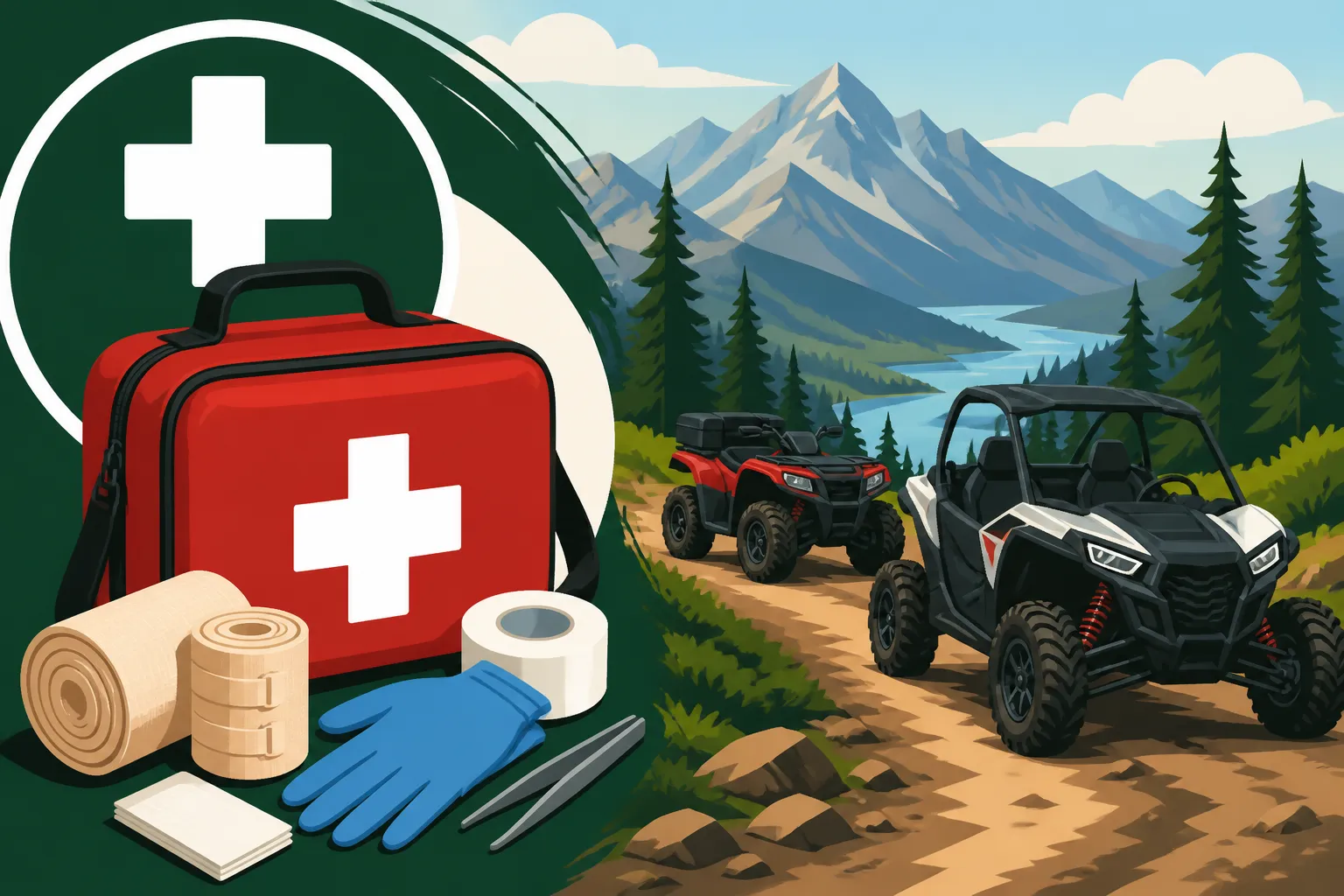
For a general group kit, consider including disposable gloves, gauze pads, roller bandages, adhesive dressings, medical tape, an elastic wrap, antiseptic wipes, tweezers, trauma shears, and a thermal blanket. Include any personal medication that a rider may need, stored and used according to its instructions. Add a simple first-aid reference card if it helps your group, but do not expect written instructions to replace practice.
| Situation | Useful preparation | First response |
|---|---|---|
| Cut or scrape | Gloves, gauze, dressings, tape | Control bleeding, clean and cover the wound when appropriate |
| Suspected fracture or sprain | Padding, bandage, splinting material | Keep the injured area still and seek medical advice |
| Cold or wet rider | Dry layer, thermal blanket, shelter plan | Get the person out of wind and wet clothing when safe |
| Serious injury | Communication device, route details, first-aid supplies | Contact emergency help and follow the dispatcher’s instructions |
| Delayed group | Water, food, light, extra insulation | Stay together and conserve warmth and battery power |
These are broad preparation ideas, not a diagnosis or a substitute for professional training. The right response depends on the injury, the person, and the setting. If you are unsure how to treat a problem, focus on immediate safety, contact emergency services when possible, and follow the guidance you receive.
Prioritize serious bleeding and suspected head or spine injuries
A crash can cause injuries that are not obvious at first. Watch for heavy bleeding, trouble breathing, confusion, loss of consciousness, repeated vomiting, severe pain, weakness, numbness, or a person who is becoming increasingly drowsy. Treat these as reasons to seek urgent medical help. Do not assume someone is fine just because they can stand or speak after a fall.
For severe external bleeding, use protective gloves if available and apply firm, direct pressure with clean gauze or cloth. If blood comes through, add more material rather than pulling away the first layer. Contact emergency help for serious bleeding and follow the dispatcher’s instructions. A first-aid course can teach riders how to respond to bleeding safely and what additional steps may be appropriate.
If a rider may have a head, neck, or back injury, encourage them to stay still and keep them as comfortable as possible while you arrange help. Do not move them just to make the scene more convenient. Moving may be necessary if there is an immediate danger, such as fire or exposure to another collision, but avoid unnecessary movement and follow professional instructions. Keep the helmet on unless there is a compelling reason to remove it or a trained responder directs you to do so.
Protect the injured person from cold and shock
Even on a warm day, an injured rider can become cold after lying still, getting wet, or waiting in shade. Pain, stress, and blood loss can make someone feel weak or chilled. Once immediate hazards are controlled, protect the person from wind and ground moisture. Use a thermal blanket, spare jacket, or other dry insulation, and keep monitoring their condition while help is arranged.
Do not give food or drink to someone who is unconscious, confused, seriously injured, or likely to need urgent medical care. Keep the person calm, explain what you are doing, and avoid leaving them alone. If the group must split to seek help, make that decision carefully: at least one capable person should remain with the injured rider when it is safe to do so, while someone else goes for assistance or communicates with responders.
A first-aid course is especially valuable for remote riding because it gives you a chance to practise decisions before they are stressful. Consider training that covers outdoor emergencies, bleeding control, cold exposure, and how to manage an injured person while waiting for help. BC ATV Safety Training Options is a useful place to start when considering rider preparation.
Manage an emergency on the trail
Stop the scene from becoming more dangerous
After a crash, first check for immediate hazards before approaching: moving machines, unstable ground, falling debris, fire, or traffic on a resource road. If it is safe, stop other riders and keep machines away from the injured person. Switch off engines and make the area visible to approaching traffic without putting anyone in its path.
Have one person take the lead and speak calmly. Too many people crowding around can make it harder to assess the situation, find equipment, or hear instructions. Ask another rider to retrieve the first-aid kit and communication device. If someone has first-aid training, have them assess the injured person while the rest of the group follows clear tasks.
Avoid moving a damaged machine or lifting a rider unless doing so is needed to prevent immediate harm. Do not attempt a complicated extraction with improvised equipment if it could worsen the injury or injure someone else. If there is no immediate danger, staying put and waiting for professional help may be safer than carrying an injured person over rough terrain.
Communicate your location clearly
When contacting emergency services, give the clearest location information you can. State the general area, the trail or road name if known, the nearest recognizable junction or landmark, and the number of injured people. Explain the type of injury and whether the person is conscious and breathing. Be ready to describe access obstacles such as locked gates, washed-out crossings, narrow bridges, or active industrial traffic.
Use a map to orient yourself, but do not make the caller guess from a vague pin if you can provide more detail. A mapping app such as onX Offroad may help you identify nearby roads or trail junctions if you prepared the map beforehand, but confirm your location with whatever landmarks you can see. If your device cannot connect, follow your group’s communication plan and send a rider for help only when that can be done safely.
Keep the communication device available and conserve its battery. If responders give instructions, repeat them back if needed and follow them. Ask one person to watch for responders at a safe, agreed-upon point if the location is difficult to find. The injured rider should not be left unattended simply because someone wants to meet help farther down the route.
Prepare for an evacuation that takes time
In remote terrain, reaching a road or staging area can take longer than expected. Do not promise an injured rider that help will arrive within a particular timeframe unless responders have told you so. Keep them warm, continue monitoring changes in their condition, and record useful details such as when the injury happened and what symptoms have changed. That information can help responders understand the situation.
If the group has to wait, manage people and equipment deliberately. Keep riders together where practical, protect the injured person from weather, and avoid unnecessary engine use that wastes fuel or makes communication harder. If the route is near active hauling, keep the group out of the travel path and follow posted road rules. BC Resource Roads With Active Hauling is relevant when your route shares space with industrial traffic.
Once responders take over, give a clear account of the incident, the care provided, and any changes you observed. After the emergency, check that everyone has a safe way back to the staging area and that the person at home has been updated. When you return, review what worked and what did not: a dead battery, missing supplies, unclear directions, or a route change that was never shared can all be corrected before the next ride.
Use a pre-ride checklist
A dependable first-aid plan is built before the group reaches the trailhead. The following checklist can help you catch common gaps without turning the ride briefing into a long lecture:
- Confirm the route, expected return time, and check-in plan with someone at home.
- Check access conditions, closures, weather, and the expected demands of the route.
- Download the map area you need and test it offline; keep a second source of route information available.
- Charge communication devices and make sure riders know how to use them.
- Pack a first-aid kit that is accessible, dry, and appropriate for the group.
- Identify who has first-aid training and who will take the lead in an emergency.
- Carry extra warm layers, drinking water, and enough practical supplies to manage a delay.
- Tell the group when to turn around, and agree to stop if conditions or a rider’s ability change.
First aid on a remote Interior loop is not about expecting a disaster. It is about making sure a fall, a cut, or a long delay does not catch the group without a plan. A practiced response, clear location information, and a way to call for help can make a difficult situation more manageable.
Disclaimer
This article is for general informational purposes only and does not constitute professional advice. Laws, prices and regulations vary by location and change over time. Consult a qualified professional for guidance on your specific situation.