BC Riders From Alberta Use Alberta Plates
An Alberta plate does not automatically mean you can ride anywhere in British Columbia, but visitors generally do not need to register their Alberta machine again just because they cross the provincial border. The practical questions are whether the machine is properly registered at home, what proof to carry, and which BC rules still apply once you unload.
Can You Ride an Alberta-Plated ATV or UTV in BC?
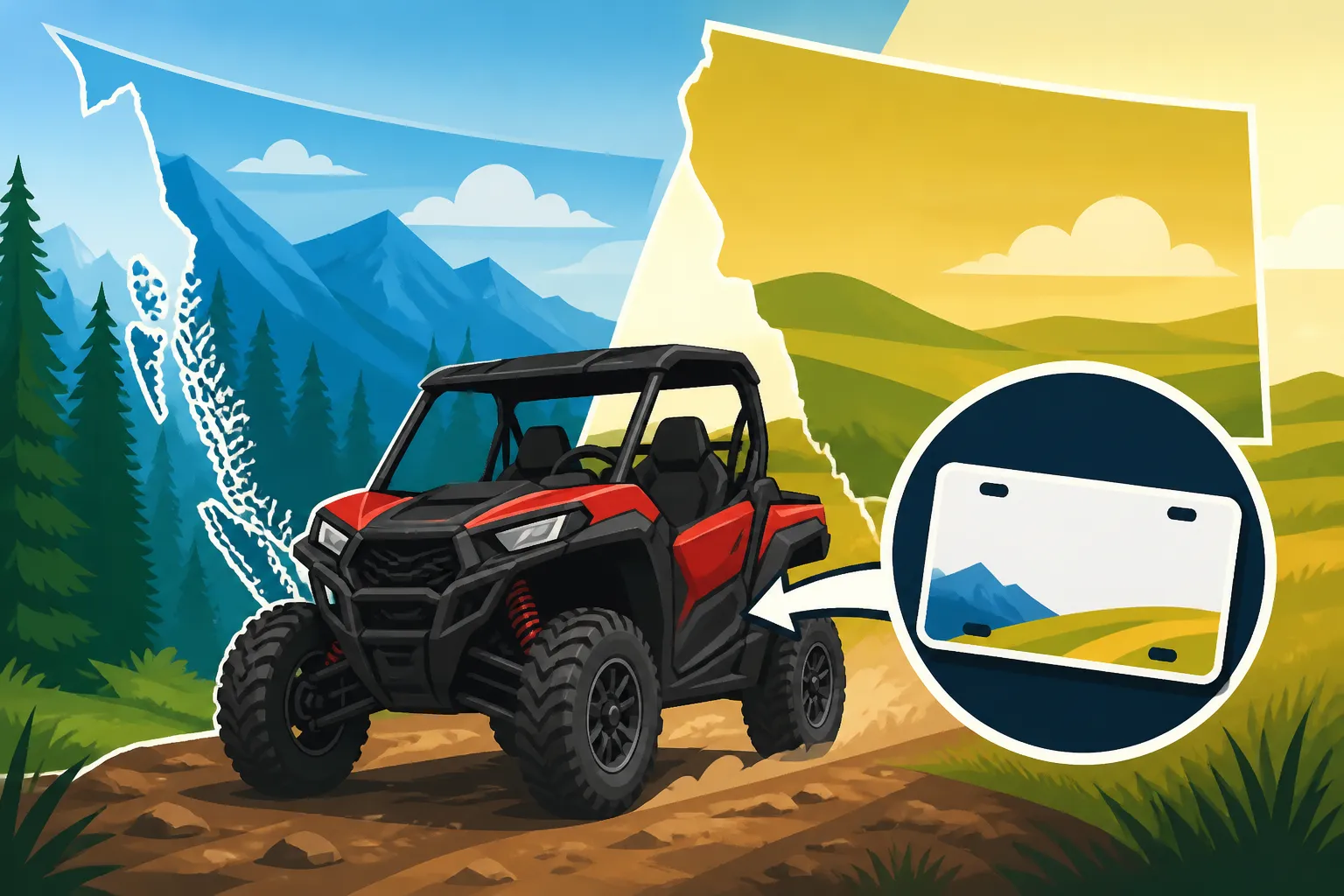
In general, a visitor riding an ATV or UTV that is registered in Alberta can use that registration while riding in BC. BC does not normally require a non-resident to register a machine a second time simply for a visit. This is a reciprocity arrangement: visitors use the registration from their home province, rather than obtaining BC registration for a temporary stay.
That does not make an Alberta plate a universal riding permit. It shows that the machine is registered in Alberta; it does not by itself grant permission to use a road, trail, private property, recreation site or other land. You still need to follow the rules that apply to the location and activity.
The distinction is easiest to understand this way:
| What the Alberta registration does | What it does not do |
|---|---|
| Shows the machine is registered in its home province, where required | Give permission to ride on every BC trail or parcel of land |
| Lets a visitor rely on home-province registration for a temporary visit, subject to applicable rules | Replace a required insurance policy, local permit or trail pass |
| Helps establish which machine you are operating | Exempt the rider from BC helmet, passenger, youth or impaired-operation rules |
| Provides useful documentation during a roadside or trail check | Make an ATV or UTV street legal in BC |
The arrangement is for visiting riders, not a way to avoid BC requirements after moving here. If you have moved to BC, bought a machine here to keep, or will operate it as a local rather than as a visitor, ask an Autoplan broker what registration applies to your circumstances. The rules for residents and temporary visitors are not interchangeable. For more on the visitor framework, see BC’s Rule Keys on Whether Home Has a Registry.
Your home registration also needs to be valid for the machine and its use under Alberta requirements. Do not assume that a plate or decal still attached to a used machine proves that its registration is current or that it belongs to the seller. Before travelling, check the machine’s status and make sure the registration documents match the vehicle identification number.
What to Carry When You Cross the Border
Carry the paperwork that connects you, the machine and its Alberta registration. A useful starting point is the registration certificate or other official registration record issued for the machine. Keep it accessible while riding, not buried under camping gear in a trailer.
You should also carry photo identification. If you are not the registered owner, bring documents showing why you are entitled to use the machine. That could mean written permission from the owner or paperwork connecting the machine to a rental, business or family arrangement. The goal is to answer ordinary questions clearly without relying on someone else to produce documents later.
Before leaving, check that:
- The machine’s VIN or serial number agrees with the registration record.
- The name on the registration makes sense for the person travelling with the machine.
- Any required Alberta plate, decal or other identifier is attached and readable.
- Your documents are protected from water and mud.
- You have a way to show the records if your phone has no signal or runs out of power.
A paper copy is useful even if you also keep a digital version. Many BC riding areas have limited cell service, and an image saved online may not load when you need it. A waterproof document pouch in your riding kit is a simple backup.
If you bought the machine shortly before travelling, bring the bill of sale and any transfer paperwork as well as the registration record. A plate from the previous owner does not necessarily show that the ownership transfer has been completed. If the machine has gaps in its paperwork, resolve them before the trip rather than expecting a roadside conversation to settle the ownership question. BC Visitors From Alberta and BC Proof of Ownership for Visitors cover the documentation issue from the visitor’s perspective.
Rental machines are different from machines you own. The rental company is responsible for the vehicle’s registration arrangements, but you should still ask what documents and insurance information the operator provides and what you must carry. Keep the rental agreement with you. It can help establish that you have permission to operate the machine, but it is not a substitute for following the operator’s restrictions or the rules of the place where you ride.
Alberta Plates Do Not Override BC Riding Rules
Once you are riding in BC, local operating rules matter. Home registration does not exempt you from BC requirements for helmets, passengers, young riders, insurance, road use or closures. A visitor should plan around the rules for the actual route, not just the paperwork needed to cross the border.
Registration and proof are only one part of compliance
BC’s registration framework generally does not require a temporary Alberta visitor to obtain a second BC registration for a properly registered home-province machine. That answers the registration question, not every other legal question.
Carry your registration documents and photo ID while riding. If an officer or other authorized official asks to see them, having the records available makes it easier to show who you are and that the machine is registered at home. The same practical advice applies whether you are riding a quad, dirt bike, snowmobile or side-by-side: do not treat a plate as the only paperwork you need.
Insurance depends on where you ride
Insurance requirements can change with the type of land or road. Riding on a forest service road, for example, can involve requirements that are different from riding on other Crown land or on private property. A policy that is adequate for one setting may not meet the requirement for another.
Before leaving Alberta, call your insurer and describe the trip plainly:
- You will be taking the specific ATV or UTV into British Columbia.
- You may ride on Crown land, forest service roads or managed recreation areas.
- You want to know what liability coverage applies to each type of riding.
- You want to know whether the policy has geographic, vehicle-use or road restrictions.
Do not rely on a vague answer such as “the machine is insured.” Ask what the coverage actually applies to, and request written confirmation if there is any uncertainty. BC has particular insurance requirements for some resource-road use; confirm the current requirement and make sure your policy meets it before you ride there. BC Resource Road Insurance explains why this setting deserves a separate check.
A trail pass, day-use payment or site-specific permission is also separate from insurance. Some managed riding areas require their own pass even when the machine is properly registered and insured. A pass from one site does not necessarily cover another, and Alberta registration does not replace a BC site pass. See BC Passes Exist Only at Managed Sites for the difference between provincial registration and site-level access requirements.
Rider and machine rules still apply
A ride-astride ATV or similar machine can have helmet requirements in BC. A side-by-side has its own occupant-protection rules, including seat-belt requirements where applicable. Passenger limits and age restrictions also depend on the vehicle and circumstances. Check the current rules for your machine rather than assuming Alberta’s standards control the trip.
The same applies to young riders. A child who is allowed to operate a machine under one province’s rules may still have to meet BC supervision, permission and passenger requirements while riding here. Confirm the rules before putting a young rider on the machine. The relevant starting points are BC Youth Riding Rules Explained and BC Rules for Riding a Side-by-Side.
Impaired operation is not made lawful by being on an ATV rather than in a car. Do not ride after drinking or using impairing drugs, and do not let another impaired person operate your machine.
Where an Alberta-Plated Machine May Be Ridden
An Alberta plate does not decide whether a route is open to off-road vehicles. Access depends on the land, posted restrictions, closures and any required permission. A route that appears on a recreational map may cross more than one kind of land, so check the route rather than assuming that the entire ride has the same rules.
Crown land and forest service roads
BC has extensive Crown land, but Crown land is not automatically open for every kind of riding. Restrictions, seasonal closures, active work, environmental protections and other rules can limit access. Forest service roads are also working roads, not simply ATV trails. Logging trucks and other industrial traffic may be present, and road users may be subject to specific insurance and operating requirements.
Before setting out, check current access information for the area, including signs at the trailhead or road entrance. If the route includes a forest service road, look into its road rules, insurance requirements and radio practices. BC Rules for Riding Crown Land and BC Rules for Riding a Forest Service Road are useful next steps.
A resource road may be open to some traffic but still unsuitable or restricted for your machine. Road conditions can change quickly, especially with hauling, construction, weather or fire activity. If you encounter a gate or a closure sign, do not assume that the Alberta plate allows you through.
Private property and managed trails
On private land, get permission from the landowner or the person authorized to grant access. A public-looking track is not necessarily public, and permission to cross one property does not automatically extend to adjoining land. If you are riding on a lease or other land with a specific manager, check who can authorize access.
Managed recreation sites may have their own rules, passes, sound limits, machine restrictions or seasonal closures. Read the site information before travelling and obey signs on arrival. Carry proof of a pass if one is required; download or print confirmation if you expect poor cell coverage.
Provincial parks and other protected areas may restrict or prohibit motorized riding. Do not use a general map or a nearby trailhead as proof that machines are permitted inside a park boundary. Check the specific park’s rules and route boundaries before entering.
Highways, streets and short crossings
An Alberta registration plate does not make an ATV or UTV street legal in BC. Off-road vehicles are generally not allowed to travel along ordinary public highways as if they were road-registered cars. In some circumstances, a limited crossing or local permit may be possible, but that is not the same as permission to ride along the road.
Do not assume you may use a shoulder, travel between staging areas on pavement or ride through town because the machine is registered in Alberta. Check whether a specific crossing is permitted and whether an operation permit is required. If the route depends on using a public road, confirm the conditions with the appropriate local authority before you go. BC Has No Street-Legal Path for an ATV explains the important difference between off-road registration and highway use.
When transporting your machine between riding areas, use a suitable trailer or other lawful transport method rather than riding the road connection. Check the trailer’s own registration and lighting requirements separately; the ATV’s plate does not cover the trailer.
Preparing for a BC Ride From Alberta
A little planning can prevent the common mistake of arriving at a trailhead with valid registration but no legal route, adequate coverage or access permission. Work through the trip in order: machine documents, coverage, route access and rider equipment.
Before loading the machine
- Confirm the Alberta registration. Check that it is current and applies to the machine you are bringing. Compare the VIN on the machine with the registration record.
- Confirm who owns and may use it. Bring a bill of sale, rental agreement or written permission if the registered owner is not travelling with you.
- Call your insurer. Explain where you plan to ride, especially if the route includes a resource road. Ask whether your coverage meets the relevant BC requirements.
- Check route access. Look for closures, land restrictions, road work, fire-related limits and site-specific rules close to your departure date.
- Confirm permits and passes. Find out whether a local road permit, managed-site pass or other permission applies. Do not assume one pass covers the whole trip.
- Review rules for every rider. Check helmet, seat-belt, passenger and youth requirements for the specific machines in your group.
- Pack the records. Carry registration, identification, insurance information and access confirmation in a dry, accessible place.
- Make a backup plan. Have an alternate route or riding area in case a road is closed, a site is full or conditions change.
If you need replacement paperwork or are unsure what a BC official will accept, contact the relevant Alberta registration authority or a BC Autoplan broker before travelling. A broker can help clarify whether the question is about a visitor’s home registration, a BC registration application, insurance or a transfer of ownership. Those are separate issues, and getting the correct one identified can save a wasted trip.
Amazon can be a convenient place to find a waterproof document pouch, but choose one that seals securely and fits your registration papers without folding them into unreadable shapes. A phone mount or power bank bought through Amazon may help with navigation, but neither replaces printed access details or a paper copy of essential documents when service is unreliable.
At the trailhead
Pause before unloading or riding away. Read the posted information, check whether the trail or road is open to your machine, and look for any pass or equipment requirement. If you are entering an area with industrial traffic, follow posted radio instructions and give large vehicles room. A route that was open when you planned the trip may be closed when you arrive.
Keep your plate or other Alberta-issued identifier visible and in good condition. Do not cover it with cargo, mud or an accessory. If the machine’s identifier is damaged or missing, sort that out before riding rather than relying on the registration paper alone to explain the problem.
If an officer asks about the machine, answer directly and provide the registration record and identification. If there is a question about land access or insurance, the plate will not settle it; show the relevant permit, pass or policy information as well. Stay calm, and do not continue onto a route until you have confirmed that you are allowed to use it.
Common Mistakes Alberta Visitors Can Avoid
The most frequent misunderstanding is treating reciprocity as a blanket exemption. It is narrower: a visiting rider can generally rely on their home-province registration rather than registering the machine again in BC. It does not cancel BC operating laws or access restrictions.
Other common mistakes include:
- Assuming any Alberta plate is valid. A plate attached to a machine may belong to a previous owner or may not represent current registration.
- Leaving the registration at home. Carry the record and identification, even if the plate is easy to see.
- Riding a resource road without checking insurance. Coverage that works for ordinary trail riding may not satisfy the requirements for a particular road.
- Confusing a site pass with registration. A pass may allow use of one managed area; it does not register the machine.
- Treating a road crossing as permission to ride along the road. Crossing rules and highway travel are different questions.
- Assuming a marked road is open to ATVs. Roads can be closed or restricted, and active industrial traffic creates additional risks.
- Relying on old maps or saved screenshots alone. Closures and access conditions change. Check current notices and signs.
- Bringing a machine after a permanent move without checking local requirements. A visitor arrangement may not apply once you become a BC resident or keep the machine in BC as a local.
The simple rule is to use the Alberta registration for what it is: proof that a visiting machine is registered at home, where required. Then check BC’s separate requirements for insurance, road use, rider safety and access. If any part of the trip depends on a road, private crossing or managed site, confirm that part before unloading.
Disclaimer
This article is for general informational purposes only and does not constitute professional advice. Laws, prices and regulations vary by location and change over time. Consult a qualified professional for guidance on your specific situation.