Staying Off Wet Alpine Ground
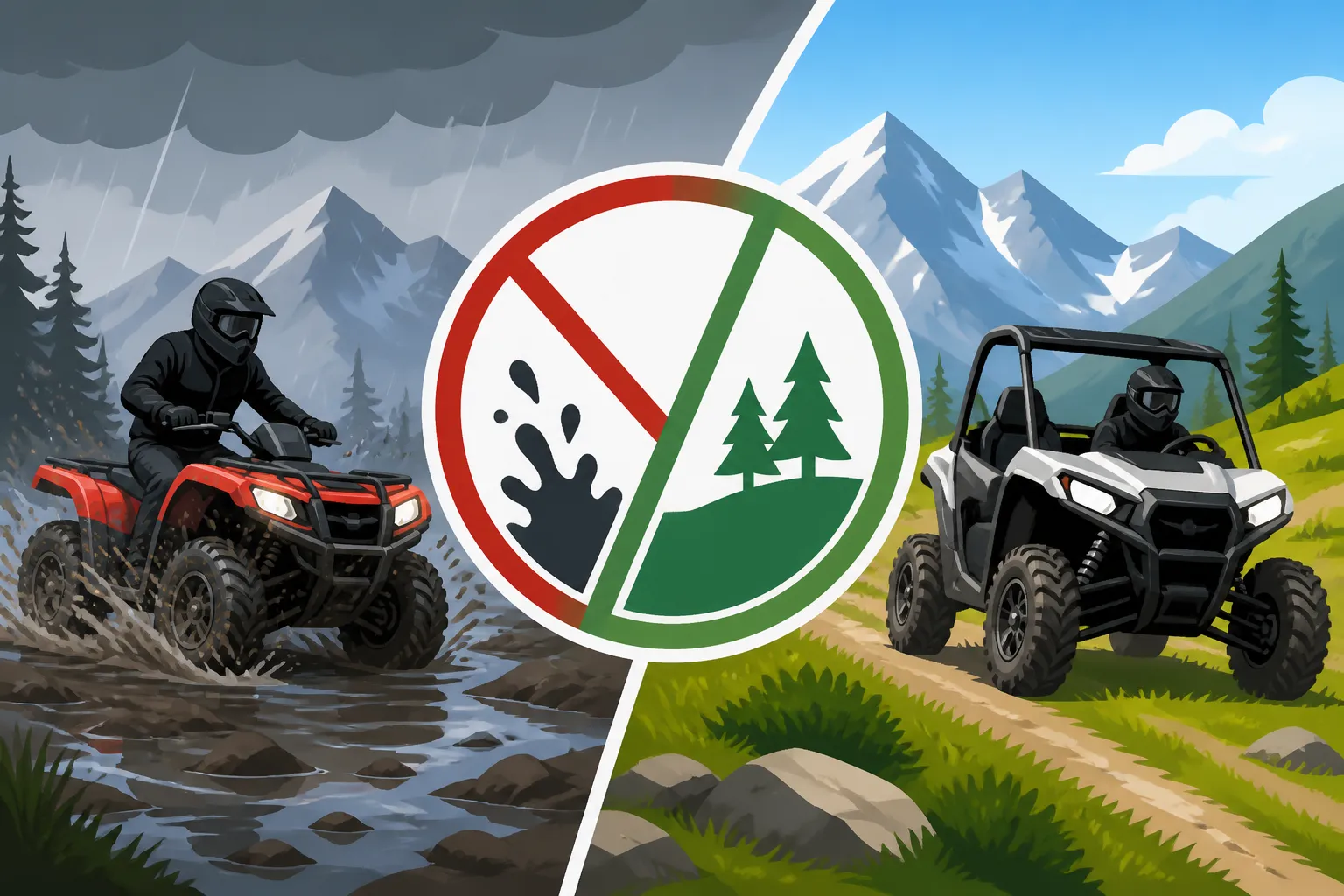
Wet alpine ground can look like a broad, harmless meadow, but a single ATV or UTV pass may leave deep ruts, flatten plants and send muddy water downhill. In British Columbia, the safest choice is often to turn around before tires touch saturated turf. This guide explains how to recognize fragile ground, choose a route and ride without leaving lasting damage.
Why wet alpine ground is so vulnerable
A meadow is not a durable trail
Above the treeline, a grassy or mossy opening can seem like an easy shortcut around rocks or a muddy trail. The surface may hide a thin layer of soil over gravel, bedrock or a waterlogged root mat. When that layer is saturated, tires can break through it quickly. The result may be deep ruts, torn vegetation and exposed soil that takes a long time to recover.
Alpine plants also grow in a short, demanding season. Cold temperatures, wind and a brief growing period make recovery slow compared with a well-established forest trail. A track that looks small from the seat can become a visible scar, especially when riders follow the same line or spread out to avoid one another.
The risk is not limited to the ground directly under the machine. Ruts can collect rain and snowmelt, then guide water downhill. That flow can carry loose soil into creeks and wetlands, or widen the damaged area as it cuts across the slope. If you’re riding above the treeline, [BC Riding Above the Treeline] and [BC Alpine Meadows and Damage] offer useful related context on why these landscapes need extra care.
Moisture changes what a trail can handle
A route that felt firm last weekend may be soft after overnight rain, a warm spell or rapid snowmelt. The same location can also vary over a short distance: a sunny ridge may be dry while a shaded hollow still holds water. In spring, frost can leave the surface deceptively firm early in the day, only for it to soften as temperatures rise.
Pay attention to the ground itself rather than assuming a route is suitable because it appears on a map or because another machine has already crossed it. Existing tire marks are not proof that a meadow is a designated trail. They may be signs that the area is being damaged.
After rain or a storm, conditions can change sharply even on familiar routes. Check for fresh washouts, standing water, slumped edges and soft shoulders before proceeding. [BC Riding After Heavy Rain] and [BC Trail Closures After a Storm] can help you think through changing conditions before you set out.
The best test is whether the ground can support a light step
Before entering an uncertain area, stop on a firm, established surface and look ahead. If the ground is visibly wet, spongy, glossy with water or covered in delicate vegetation, don’t ride across it to “see how it goes.” Walking onto a fragile patch to test it can cause damage too, so assess from the durable trail edge where possible.
Notice what your tires are doing on the existing route. If the tread is leaving deep impressions, the trail is pumping water or the machine is sinking, conditions are telling you to turn around. A small amount of wheel spin can quickly become a trench, particularly on a slope.
When a route is no longer firm enough to support responsible travel, treat that as a stop sign even if there is no physical barrier. [BC Trail Etiquette Locals Expect] is a helpful companion for making decisions that protect access and respect other trail users.
How to recognize a route you should avoid
Look for fragile surfaces and signs of water movement
Alpine ground is not always a bright green meadow. Fragile areas can include mossy patches, wet turf, sedge-filled hollows, boggy margins and narrow strips of vegetation beside a stream. The surface may be uneven or mixed with rock, but that does not make it durable. Water can sit between rocks or under a thin covering of plants.
Watch for small channels where runoff is already moving. Crossing one can break its edges and divert water into a new path. Avoid driving through wetlands, along creek banks or over soft ground that drains toward a watercourse. For a closer look at protecting wet areas, see [BC Riparian Areas to Avoid].
A route may also be unsuitable because of its location, not only its texture. A clear track across open ground could be unauthorized, closed or outside a managed riding area. Before a trip, check local access information and any posted signs; a line on a map does not necessarily mean motorized travel is permitted. [BC Crown Land Riding Explained] provides additional background on access and responsible use.
Use a simple stop-and-decide check
When you reach a questionable section, pause before committing the machine. Ask yourself whether the route is clearly established, whether the surface is firm, whether water is moving across it and whether there is a durable alternative. If the answer is unclear, don’t test the ground with your tires.
A practical decision table can help keep the choice simple:
| What you see | What it may mean | Safer response |
|---|---|---|
| Deep tire marks or a rut holding water | The surface is soft or already eroding | Turn around or use a clearly established firm route |
| Water moving across the trail | Tires may widen channels or carry sediment downhill | Avoid the wet section and do not create a bypass |
| Moss, wet turf or standing water beside the route | The area may be a fragile meadow or wetland | Stay on the durable trail and keep wheels out of the vegetation |
| A new track across open ground | The route may be unauthorized or informal | Check local access information and posted restrictions |
| Snowmelt over a soft shoulder | The trail edge may collapse under machine weight | Keep to the firm centre if safe, or turn back |
| A marked closure or barrier | Travel is restricted | Do not pass the barrier or ride around it |
The table is a field aid, not a substitute for local rules or closure information. When conditions are borderline, choose the option that avoids leaving a mark. Getting home with a shorter ride is better than adding a new track that other riders may follow.
Don’t create a wider trail to get around trouble
A common mistake is steering around a muddy rut into grass or low plants. That may feel like the gentler option because the bypass looks smooth, but it creates a second track and encourages the next rider to do the same. Soon, one narrow trail becomes a wide, damaged corridor.
If the established route is wet enough that you cannot pass without digging in, don’t widen it. Stop in a safe place, communicate with your group and turn back together. Avoid parking or gathering on soft vegetation while deciding. A group can cause more damage while standing around than a single machine would on a firm trail.
Use trail difficulty information as a planning aid, not a promise about current conditions. [BC Trail Difficulty Ratings] can help you judge whether a route matches your group and machines, but recent rain, snowmelt or a closure can change what is appropriate on the day.
How to ride responsibly when conditions are damp
Choose a firm line and keep the group together
On a wet but established trail that remains firm enough to travel, stay on the existing track rather than weaving between puddles. Repeatedly leaving the route to avoid a small wet patch can widen the trail. If a puddle is shallow and the trail edges are fragile, riding straight through the established line may do less harm than making a new bypass—but only if the ground is firm and travel is allowed.
Keep enough space between machines to avoid rushing, sudden braking or crowding at a narrow section. Follow the line of the lead rider only if it is clearly an established route and remains safe. If the first machine begins to sink or spin, the rest of the group should stop rather than follow into the same soft patch.
Talk through turnaround points before the ride. A simple agreement—such as stopping when the trail begins to rut—can prevent the familiar pressure to keep going because the group has already travelled a long way. On remote routes, turn around while everyone still has enough daylight, fuel and energy to return comfortably.
Use smooth inputs instead of trying to power through
Wheel spin is especially damaging on wet soil. If you feel the tires slipping, ease off the throttle and avoid repeatedly applying power in the hope of climbing through. Spinning tires can dig rapidly, expose roots and make the route worse for everyone behind you.
Approach firm trail features at a controlled pace. Sudden acceleration, sharp turns and hard braking can tear up a soft surface even when the machine is not deeply bogged. If you cannot cross a section without losing traction or disturbing the ground, the sensible choice is to stop and retreat rather than push through.
Machine setup can help you maintain control, but equipment cannot make fragile terrain suitable to ride. Riders researching tires, skid protection or other parts from companies such as SuperATV should focus on correct fitment and the terrain they actually ride. A suitable setup may protect the machine or improve handling, but it does not justify crossing wet meadows or bypassing a closed trail.
Know when weather changes the plan
Check the forecast and recent conditions for the specific area, not just the nearest town. A dry forecast in a valley does not guarantee a dry alpine route. Snowmelt, overnight showers and shaded terrain can keep high-elevation ground saturated even when the staging area feels warm and dry.
Build a turnaround option into the route before leaving. Identify a firm route back, a lower-elevation alternative or a point where the group can safely stop. If clouds, rain or fog reduce visibility, the surface is getting softer, or a stream crossing has changed, shorten the ride rather than improvising a new route across vegetation.
If your planned trail is closed or deteriorating, choose a different destination instead of trying to reach it from another direction. Avoidance is most effective before the group is deep into a route and reluctant to turn back. For broader spring planning, [BC Riding in Spring Melt] discusses the seasonal conditions that can make otherwise familiar ground vulnerable.
What to do when you find damage or an unexpected closure
Stop before the damage becomes worse
If you find a fresh rut, washout, soft meadow crossing or newly posted closure, stop on firm ground. Don’t ride around a barrier, cross wet vegetation to get a better look or park where your machines will deepen the damage. Take note of the location and any signs that explain the restriction.
If the route is already damaged, do not attempt to reshape it with your tires or tools. That can make erosion worse, and riders may not know the drainage or restoration plan for the area. Turn back using the established route if it is safe to do so. If the safe exit is unclear, pause and make a careful plan rather than creating a shortcut.
For travel on resource roads, a marked road or trail can still have changing industrial conditions and restrictions. Check access information before your trip, and respect signs and gates you encounter. A designated riding area does not mean every nearby opening is available for motorized use.
Help your group make the conservative choice
It can be awkward to suggest turning around when everyone is excited to reach a viewpoint or campsite. Make the decision about the ground, not about anyone’s skill: “The surface is soft and the tires are starting to mark it, so we’re heading back.” That keeps the conversation practical and makes it easier for newer riders to speak up too.
Agree on a regrouping point on firm ground, then make sure no one is left behind. A rider who is inexperienced, fatigued or operating a larger machine may need extra time to reverse or turn around without spinning the tires. Be patient and avoid crowding the soft section while offering help.
If you’re considering replacement tires or protection before future trips, SuperATV is one example of a brand riders may encounter while researching ATV and UTV components. Compare options for your exact make and model, and treat equipment as a way to manage machine wear—not permission to ride across sensitive ground. SuperATV products, like any accessories, cannot replace good route choices or current local access information.
Make the next ride easier to plan
Before leaving home, confirm the intended route is open and appropriate for motorized travel. Check conditions, closures, trail difficulty and any site-specific requirements. Pack for a turnaround: enough fuel, water, warm layers and communication options to return without depending on reaching the planned destination.
At the trailhead, review the plan with everyone and identify where the group will turn back if the ground is soft. Carrying a map or offline route information can help prevent the group from following informal tracks when cell coverage disappears. Keep the actual trail—not a convenient-looking gap in the vegetation—as your reference.
After the ride, inspect your machine and clean mud where appropriate without washing sediment into a creek or wetland. If you noticed a closure, severe rutting or a damaged crossing, pass the information to the relevant local land manager or trail organization. The goal is not just to avoid causing damage during one ride; it is to help keep routes usable and alpine ground intact for the next season.
Disclaimer
This article is for general informational purposes only and does not constitute professional advice. Laws, prices and regulations vary by location and change over time. Consult a qualified professional for guidance on your specific situation.