BC’s ORV Act Does Not Reach Highways
It's a dream many of us share: hopping on our ATV or side-by-side and just riding it straight from our driveway down to the local trails, perhaps even grabbing a coffee on the way. But here in British Columbia, that dream usually crashes hard against the reality of the province's Off-Road Vehicle (ORV) Act. This comprehensive guide is here to clarify a common and often frustrating misconception: why BC's ORV Act, despite its broad reach, distinctly draws a line when it comes to paved public highways, ensuring you understand where you can and absolutely cannot ride.
The Fundamental Divide: Why Highways Are Different
Let's be real, it can be confusing. You've got your shiny ORV, you've registered it, maybe you've even got your [BC ORV Number Plates and Decals] proudly displayed. So why can't you just take it on the road like a car or motorcycle? The core of the issue lies in the fundamental legal distinction BC makes between an "off-road vehicle" and a "motor vehicle" designed for highway use. These aren't just different categories; they operate under entirely separate legislative frameworks.
Defining an ORV in BC
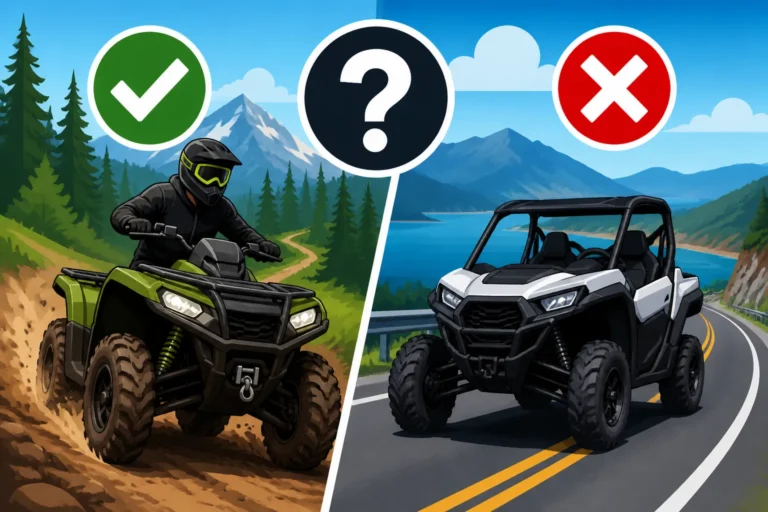
In British Columbia, an off-road vehicle is defined quite broadly under the Off-Road Vehicle Act. It includes vehicles like ATVs, side-by-sides (UTVs), dirt bikes, and snowmobiles, all designed primarily for operation on unpaved terrain. These machines are engineered for rugged conditions, high clearance, and aggressive tires, features that make them excellent for tackling trails, mud, and snow. However, these very characteristics often make them ill-suited, and outright illegal, for use on public highways where different safety and operational standards apply. The Act is clear that these vehicles are intended for specific environments, and paved roads generally aren't among them.
Think about the difference: an ATV is built to climb a rocky ascent or power through a creek bed, while your family sedan is designed for smooth asphalt and predictable braking distances. The two are fundamentally different machines with different purposes and capabilities, and the law reflects that distinction.
The Motor Vehicle Act's Domain
Highways, on the other hand, fall squarely under the Motor Vehicle Act in BC. This act governs everything from vehicle construction standards, driver licensing, insurance requirements, and rules of the road for conventional cars, trucks, and motorcycles. For a vehicle to be legally operated on a highway, it must meet stringent safety standards, including specific lighting, braking, tire types, and emissions controls that most ORVs simply don't possess from the factory. More importantly, it must be designed and certified for highway use, and the driver must hold a valid driver's license appropriate for that class of vehicle.
This is where the rubber meets the road, or rather, where the knobby tire doesn't meet the pavement legally. An ORV, by its very nature and design, does not typically meet these requirements. Trying to use an ORV on a highway is like trying to use a snowmobile on the ocean; it's simply not what it was made for, and the legal framework is just as ill-fitting. This legislative separation ensures public safety by keeping specialized off-road machines off roads designed for high-speed, multi-vehicle traffic.
What the ORV Act Does Cover
While the ORV Act might seem restrictive concerning highways, its true power and purpose come alive when you're off the beaten path. This is where your registered ATV or side-by-side truly belongs and where the Act provides the framework for responsible and legal riding. Understanding these areas is crucial for every BC rider.
Crown Land as the Legal Trigger
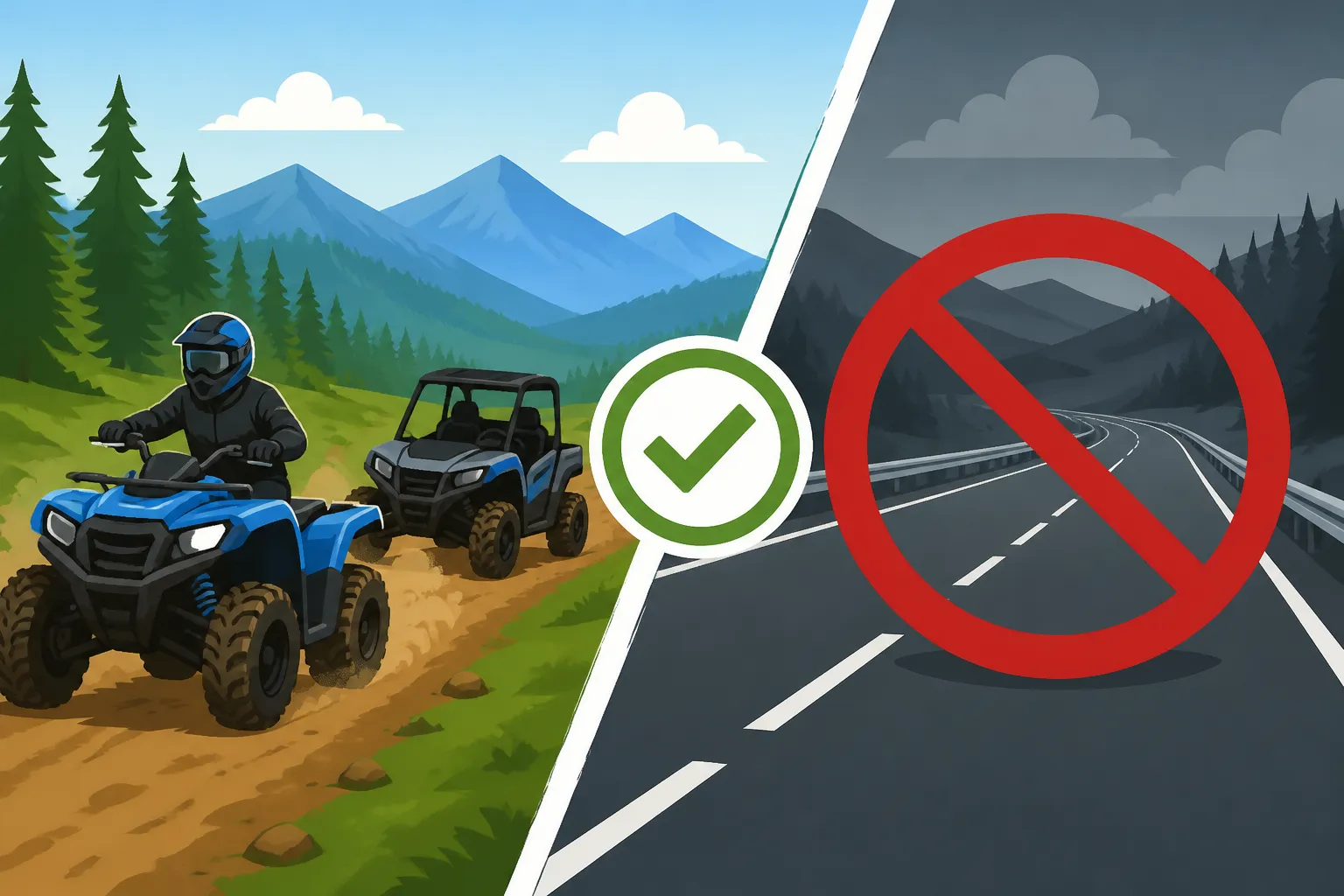
The ORV Act primarily applies to "Crown land" – that's public land owned by the provincial government. This vast expanse of British Columbia's wilderness, from dense forests to alpine meadows, is where most off-road adventures take place. The moment your wheels touch Crown land, the ORV Act's rules, including registration, insurance, and safe operation, kick in. This is a crucial point many riders, especially those new to BC, sometimes overlook.
It’s not just remote wilderness, either. Even designated recreation sites managed by the province, such as those popular spots around Chilliwack or the Okanagan, fall under this umbrella. If you're planning a trip to one of [BC ATV Trails: Where to Ride] and expect to use staging areas or access points on public land, your ORV absolutely needs to be properly registered.
BC Resource Roads Count as Crown Land
One of the most common places ORV riders find themselves is on resource roads, often called Forest Service Roads (FSRs). These roads, carved through the wilderness for industrial purposes like logging, mining, or hydroelectric projects, are typically also Crown land. This means that while they might look like roads, they are not classified as "highways" under the Motor Vehicle Act. Therefore, ORVs are generally permitted on them, provided they are registered and insured, and all other ORV Act rules are followed.
However, resource roads come with their own set of unique challenges and rules. They are active industrial sites, meaning you could encounter heavy logging trucks or other industrial vehicles at any moment. This is why [BC Resource Road Radio Practice] is so important, and why you need to carry proper liability insurance, often at least $200,000, for riding on these roads. They are a fantastic gateway to incredible backcountry riding, but they demand respect, caution, and adherence to specific safety protocols beyond just basic ORV registration.
Private Land Considerations
When it comes to private land, the ORV Act takes a different stance. If you're riding solely on land you own, or on private land with the express permission of the landowner, the registration requirements of the ORV Act generally do not apply. This means you don't need to register your machine with ICBC if it never leaves private property.
However, even on private land, other provincial laws still apply, particularly regarding reckless operation, noise bylaws, or environmental damage. And if your private land involves crossing any public right-of-way, even a dirt road that is technically Crown land, then the ORV Act's registration requirements immediately become relevant. It's a fine line, and it's always safer to err on the side of caution and ensure you have permission and are operating responsibly, whether on your own acreage or a friend's farm. Just because the ORV Act might not require registration, it doesn't mean you can disregard safety or common courtesy.
The Strict Rules for Crossing a Highway
While riding along a highway is almost universally prohibited for ORVs in BC, there are very specific and limited circumstances under which an ORV may cross a highway. These are exceptions, not entitlements, and they come with strict conditions that must be met to ensure safety and legality. This isn't a loophole for joyriding on the pavement; it's a practical provision for moving from one section of trail or private property to another.
BC Crossings at a Stop Sign
If you're out riding and your trail or resource road is intersected by a paved public highway, you might be allowed to cross it, provided there's a stop sign governing your approach. The rules are clear: you must come to a complete stop, look both ways, and yield to all traffic on the highway. You must cross the highway at as close to a 90-degree angle as possible, proceeding directly from one side to the other without travelling any distance along the highway itself. This isn't a moment for admiring the view or pausing for a chat; it's a quick, direct transition.
It's a high-risk manoeuvre, as ORVs are often less visible to highway traffic, and their acceleration and braking characteristics are different from street-legal vehicles. Even if you're meticulously following all the rules, drivers on the highway might not expect to see an ORV crossing, so extreme caution is paramount. This rule is about minimizing the time your ORV spends in the flow of highway traffic, making the interaction as brief and predictable as possible.
BC Crossings at a Traffic Light
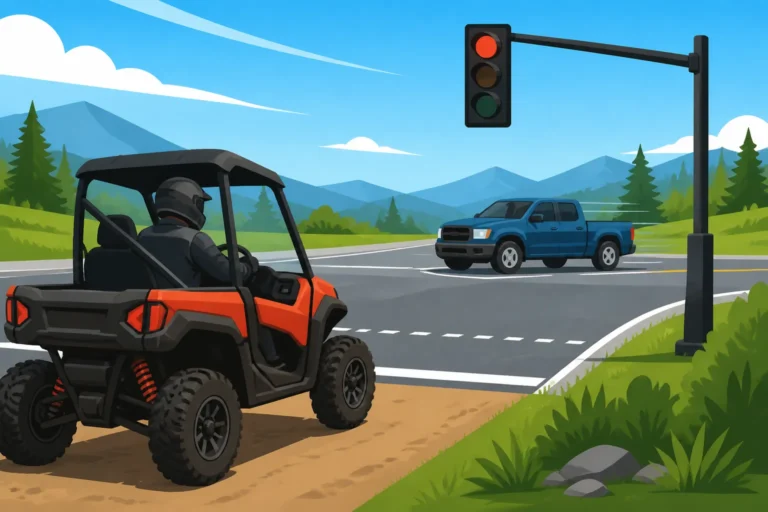
Similar to stop signs, ORVs may cross a highway at an intersection controlled by a traffic light, again with strict adherence to the signals. You must obey the traffic light, waiting for the green signal before proceeding. Just like with a stop sign, the crossing must be as direct as possible, at a 90-degree angle to the highway, without driving along the highway's shoulder or lane for any distance.
This scenario is perhaps even more challenging, as traffic lights often govern busier intersections. The onus is entirely on the ORV operator to ensure the crossing is safe, quick, and executed without impeding traffic. Any deviation from the direct crossing, or lingering on the highway, could lead to a ticket or worse. The intent of these crossing rules is not to facilitate ORV travel on highways, but to provide a narrow, regulated path for riders to connect legal riding areas separated by a highway.
Shoulder Riding and Parking Lots
Let's be absolutely clear on this: generally, you cannot ride your ORV along the shoulder of a highway in British Columbia. The rules for crossing are just that – for crossing. They do not grant permission to ride on the shoulder, even for a short distance, to reach another trail or property entrance. The shoulder is considered part of the highway right-of-way and falls under the Motor Vehicle Act, which prohibits ORV use.
The only exception might be if you are in a designated parking lot that is off the main highway, preparing to load or unload your ORV onto a trailer. In such cases, you might operate your ORV within the confines of the parking lot to get it onto or off your transport vehicle, provided it’s not interfering with other traffic or creating a hazard. But even then, this is not "riding on the highway." Once you exit the immediate loading/unloading area and enter any part of the highway right-of-way, including shoulders, you are likely in violation. Always aim to transport your ORV to a legal staging area rather than trying to use shoulders as a shortcut.
When a Permit Might Allow Limited Highway Travel
While the general rule is "no ORVs on highways," there's a very specific, limited exception for highway travel that some riders might encounter: the Operation Permit. This isn't a blanket pass, and it's certainly not something you'll get for casual riding, but it's an important detail in the overall landscape of BC's ORV regulations.
BC Operation Permit Application Steps
An operation permit allows an ORV to operate on a highway for a very specific purpose, usually tied to accessing otherwise unreachable off-road areas, or for certain industrial or agricultural activities. These permits are not issued by ICBC or through the general ORV registration process. Instead, they are issued by local police detachments (RCMP or municipal police) and are entirely at their discretion. You won't find a standard form online that applies province-wide; it's typically a direct application to your local police.
To apply, you would generally need to present a compelling reason why your ORV must use a highway, and for what specific route and duration. For instance, a farmer needing to move a quad a short distance between fields separated by a highway, or a forestry worker needing to access a remote worksite. The police will assess the safety implications, traffic volume, and the necessity of the request. They are not granted for recreational riders to commute or connect trails for fun. It's a serious process for serious, specific needs. [Getting a Free Operation Permit From Your Local Detachment] means having a legitimate reason, not just wanting to avoid trailering.
Conditions and Limitations of Permits
If a police detachment does issue an operation permit, it will come with very strict conditions and limitations. These might include:
- Specific Routes: The permit will likely outline the exact section of highway you are allowed to use.
- Time Restrictions: You might only be allowed to operate during specific hours, perhaps off-peak traffic times.
- Duration: Permits are typically valid for a limited period, often up to two years, but usually for a single, defined purpose or short series of tasks.
- Safety Equipment: The permit may stipulate additional safety equipment requirements, beyond standard ORV gear, to enhance visibility or stability on pavement. This could include specific lighting configurations or even a requirement for orange safety flags.
- Driver Requirements: You will still need a valid driver's licence and basic liability insurance. [BC Requires a Driver's Licence on a Highway], even with a permit.
- No Passengers: Many permits will restrict carrying passengers, especially if the ORV is not designed for highway passenger transport.
It's crucial to understand that even with a permit, your ORV is not suddenly "street legal" in the way a car is. You are simply granted a temporary, highly restricted exemption for a very specific purpose. Any deviation from the permit's conditions could result in fines, the permit being revoked, or even seizure of your machine. These permits are rare and reflect a unique, necessary use rather than a general right to ride on highways.
Equipment and Readiness for Any Road Interaction
Even though full highway use is largely off-limits, there are times your ORV might briefly interact with regulated roads – think those quick highway crossings or permitted movements. For these instances, and for general safety on resource roads and trails, ensuring your machine is properly equipped for maximum visibility and control is paramount. You don't want to get caught unprepared, or worse, unseen.
Lighting and Visibility
Visibility is your first line of defense, especially when your ORV might encounter other traffic, even briefly. While not all ORVs come from the factory with robust lighting, the ORV Act does have requirements for lights when operating in low-light conditions or after dark, even on Crown land. This usually means a white light to the front and a red light to the rear. When crossing a highway, even during the day, having fully functional and bright lights can significantly increase your presence to other drivers.
Many riders choose to upgrade their lighting systems for improved safety. Aftermarket lights, such as those you might find from a supplier like SuperATV, can dramatically improve your visibility from both the front and rear. Whether it's brighter LED headlights, additional floodlights for trail navigation, or more prominent taillights, investing in better illumination is a smart move. Remember, even if you are only crossing, being seen is critical.
Mirrors and Signals
While not typically mandatory for off-road use, adding mirrors to your ORV can be incredibly beneficial, especially if you anticipate any highway interaction. Rearview mirrors, both side-mounted and a central one, give you crucial awareness of traffic approaching from behind. This is invaluable when preparing for a highway crossing or when operating on busy resource roads where industrial traffic is a real concern.
Directional signals (turn signals) are not standard on most ORVs, and they are generally not required for ORV Act compliance on Crown land. However, if you are granted a special operation permit for highway travel, the permit conditions might specifically require them. Even without a permit, if you are making a highway crossing, clear hand signals indicating your intentions are essential. For those seeking to enhance their machine's road-readiness for legal crossings or specific permits, exploring aftermarket options like those offered by companies such as SuperATV for turn signal kits can be a proactive step towards safety and compliance.
Rider Gear and Safety
Beyond the machine itself, your personal protective equipment is non-negotiable, especially if you're ever near any type of public road. A DOT-approved helmet is legally required for all ride-astride ORV operators and passengers in BC, whether on Crown land or in a crossing scenario. This is not just a suggestion; it's the law. Beyond the helmet, sturdy boots, gloves, and appropriate riding gear that offers protection against abrasions and impacts are vital.
When considering highway crossings, think about enhancing your personal visibility too. High-visibility vests or jackets can make a significant difference in how quickly other drivers spot you. Remember, even a brief encounter with a highway demands maximum alertness and preparation. [BC Helmet Law Covers Every Rider], so ensure your lid is up to standard and properly worn before you even think about approaching any paved road.
The Consequences of Misunderstanding the Rules
It's tempting to think that "just a short hop" on the highway won't hurt, or that local law enforcement might turn a blind eye. But I'm here to tell you, based on what I've seen and heard from other riders, that this kind of thinking can lead to some truly expensive and frustrating consequences. Ignoring the strict separation between ORV trails and highways isn't just a minor infraction; it's a serious breach of the law with significant penalties.
BC Fines for Careless Operation
Operating an ORV on a highway in British Columbia when not explicitly permitted (either by a crossing rule or a specific police-issued permit) can result in substantial fines. These fines aren't just for being on the highway; they can also be issued for related infractions like not having proper registration or insurance if discovered during the incident. Imagine getting a ticket not just for being on the road, but also for operating an unregistered machine, even if your machine is registered for off-road use, simply because it's in the wrong place.
The fines vary depending on the specific violation, but they can quickly add up. Beyond the immediate monetary penalty, you could also face demerit points on your driver's license, even if you weren't operating a highway-legal vehicle. This can lead to increased insurance premiums for your actual car or truck. It's a cascade effect that starts with a seemingly minor decision to break the rules.
BC Machine Seizures by Police
One of the most severe consequences, and one that sends a chill down any ORV owner's spine, is the potential for your machine to be seized by law enforcement. Under the Off-Road Vehicle Act and the Motor Vehicle Act, police have the authority to impound vehicles operated illegally. This means if you're caught riding your ATV or side-by-side on a highway without proper authorization, an officer can have your machine towed and impounded.
Getting your machine back from impound is not a simple or cheap process. You'll be on the hook for towing fees, daily storage fees, and any administrative release fees, which can quickly climb into the hundreds or even thousands of dollars. On top of that, you still have to deal with the fines and any other legal repercussions. It's a huge headache and a significant financial hit that no rider wants to experience. [BC Machine Seizures by Police] are a very real threat, designed to deter illegal highway use and protect public safety. It’s far better to trailer your ORV to a legal staging area than to risk losing it and facing a mountain of fees.
Comparative Overview: ORV Act vs. Motor Vehicle Act on BC Roads
To help clarify the distinctions we've discussed, here's a quick comparison of how the ORV Act and the Motor Vehicle Act apply to different types of roads in British Columbia. This isn't exhaustive, but it highlights the core differences that can land you in trouble if you're not careful.
| Feature / Location | ORV Act (Off-Road Vehicles) | Motor Vehicle Act (Highway Vehicles) |
|---|---|---|
| Primary Domain | Crown Land, Resource Roads, Private Land (with permission) | Public Highways, Municipal Roads |
| Registration Required | Yes, for Crown Land/Resource Roads ([BC ORV Registration You Pay Once]) | Yes, for all highway use (ICBC Autoplan) |
| Insurance Required | Yes, liability for Crown Land/Resource Roads | Yes, mandatory Basic Autoplan for all highway use |
| Driver's Licence | Not always required for off-road operation (age rules apply) | Yes, mandatory valid driver's licence for all highway use |
| Permitted Travel | Extensive on designated trails, FSRs, and specific Crown land areas | Extensive on all public highways/roads, unless restricted |
| Highway Crossing | Limited, direct crossings at stop signs/traffic lights allowed | Standard operation |
| Highway Riding (Along) | Generally Prohibited | Permitted |
| Operation Permits | Police-issued, highly restricted for specific highway use (rare) | Not applicable; standard licensing/registration is the permit |
| Equipment Standards | Basic lighting, spark arrestor ([BC Spark Arrestor Rules and Fines]) | Extensive (lights, brakes, tires, emissions, mirrors, signals, etc.) |
| Fines/Penalties | Fines for unregistered/uninsured operation, careless riding, seizures | Fines for speeding, careless driving, unregistered/uninsured vehicles, seizures |
Disclaimer
This article is for general informational purposes only and does not constitute professional advice. Laws, prices and regulations vary by location and change over time. Consult a qualified professional for guidance on your specific situation.