When a Court Can Impose a $1 Million Fine
A court fine of up to $1,000,000 sounds like a penalty for an ordinary riding mistake, but the stated maximum is tied to a specific event: a wildfire started due to an off-road vehicle. Knowing how that consequence differs from a ticket or an administrative penalty helps riders focus on the rules that matter most: preventing fires, respecting closures and keeping a machine properly equipped.
When the $1,000,000 maximum can apply
According to the Province of British Columbia, if a wildfire starts due to an off-road vehicle, the operator may receive a court fine of up to $1,000,000 and/or up to three years in jail. The Province gives this consequence for a wildfire caused by an ORV; it is not the stated penalty for every equipment defect, rule violation or ride during a restriction.
The phrase “up to” matters. It describes a maximum a court may impose, not a guaranteed fine for every incident. Nor does the possibility of a serious court penalty mean that a rider who receives a spark-arrestor ticket automatically faces the same outcome. The facts are different: a ticket for an equipment contravention is one kind of penalty, while the potential court consequence described by the Province is tied to an ORV starting a wildfire.
The legal distinction is worth keeping clear:
- A missing spark arrestor can lead to a violation ticket or an administrative monetary penalty.
- A wildfire that starts due to an ORV may lead to a court fine and/or jail.
- A temporary fire prohibition may make recreational ORV use unlawful in an affected area, even if a machine is registered and equipped.
These consequences can sit within a broader set of riding rules, but they are not interchangeable. For example, a rider can be in breach of a restriction without having caused a fire. Conversely, a fire-related incident can have consequences beyond the usual equipment ticket. The exact outcome depends on the facts and the legal process, so do not treat a listed maximum as a prediction of what a court will decide in a particular case.
It also helps to separate the spark-arrestor rule from the wildfire-causation consequence. According to the Province of British Columbia, all off-road vehicles must have a spark arrestor installed during wildfire conditions. If an ORV starts a wildfire, the potential court penalty is much more serious than the stated ticket for not having a spark arrestor. A properly installed arrestor is an important precaution, but it should not be treated as a guarantee that a machine cannot start a fire.
For more on what the equipment rule requires and the penalties attached to it, see BC Spark Arrestor Rules and Fines. For the broader consequences that may apply to riders, BC Wildfire Penalties for Riders puts the fire-related rules in context.
How fire-related penalties differ
The figures below describe different enforcement outcomes, not steps that automatically follow one another. According to the Province of British Columbia, the listed ticket and administrative penalty amounts apply to specific contraventions, while the court maximum is associated with a wildfire started due to an ORV.
| Situation | Possible consequence described by the Province of British Columbia |
|---|---|
| ORV used without a required spark arrestor | Violation ticket fine of $460 |
| ORV used without a required spark arrestor | Administrative monetary penalty of up to $10,000 |
| ORV starts a wildfire | Court fine of up to $1,000,000 and/or up to three years in jail |
| ORV operated while unregistered when registration is required | Violation ticket fine of $230 |
| Careless operation or property damage | Violation ticket fine of $368 |
The table is not a penalty calculator. It does not mean that a rider receives all listed penalties for one incident, or that a ticket amount is a court fine. The relevant rule and the circumstances matter. The Province of British Columbia describes the spark-arrestor administrative penalty as “up to” a maximum, just as it describes the wildfire-related court fine as “up to” a maximum.
A missing arrestor is a concrete equipment problem that riders can address before setting out. A fire ban or restriction is a separate access issue: riding may be prohibited even if the machine is in good working order. According to the Province of British Columbia, recreational ORV use is temporarily prohibited on Crown land in many fire centres during fire conditions. The BC Wildfire Service issues fire prohibitions and restrictions and manages wildfire response. Check the current local restriction before travelling, rather than relying on what was allowed on an earlier visit. Checking a Fire Ban Before You Ride in BC and BC Fire Centre Riding Bans cover how these restrictions affect a planned ride.
Other rules can apply at the same time. According to the Province of British Columbia, motor vehicle use on Crown land may be prohibited or restricted under the Motor Vehicle Prohibition Regulation of the Wildlife Act. A fire restriction is therefore not the only reason a route may be closed. Riders can use BC Motor Vehicle Closures and How to Find Them to understand how access restrictions fit into trip planning.
Registration is another separate obligation. According to the Province of British Columbia, an ORV used on Crown land must be registered and display its ICBC number plate or sticker, and the operator must carry a copy of the Certificate of Registration or Transfer of Ownership. Registration does not authorize riding in a closed area or during a fire prohibition. For help with that requirement, see BC ATV Registration Requirements and BC Crown Land Riding Explained.
Reduce fire risk before and during a ride
A practical approach is to treat fire prevention as part of trip planning, machine checks and on-trail decisions—not as a task to handle only after a warning appears.
Check restrictions for the exact riding area
Before leaving, check for current fire prohibitions and local access restrictions that apply to the route. Restrictions can affect an area even if nearby roads or trails remain open. The BC Wildfire Service is the agency identified by the Province as responsible for issuing fire prohibitions and restrictions. If a notice is unclear, confirm how it applies to your intended riding area rather than guessing from a map or an old trip report.
Do not assume that registration, a trail pass or permission to use a route overrides a fire prohibition. Those may be separate requirements. If recreational ORV use is temporarily prohibited where you plan to ride, choose another permitted activity or postpone the ride.
Check the arrestor and the rest of the machine
The Province of British Columbia requires all off-road vehicles to have a spark arrestor installed during wildfire conditions. Check that the part is present, correctly fitted and appropriate for the machine. If it is missing, damaged or has been changed, resolve that before riding in conditions where the requirement applies.
If you need a replacement, a retailer or marketplace such as Amazon may help you compare available parts, but confirm compatibility with your exact machine and check that the replacement meets the applicable requirement. Do not assume that a part’s product description alone establishes compliance. If you are unsure whether the arrestor is suitable or properly installed, ask a qualified mechanic or check with a knowledgeable parts supplier.
A spark arrestor is only one part of a responsible pre-ride check. Inspect the machine for obvious damage, secure loose material and carry the required safety equipment. For other ORV obligations, including registration and what documents to carry, see BC Registration Paperwork Checklist. A valid registration document does not replace a fire check, but having the required paperwork can prevent separate compliance issues.
Choose a route that remains open and appropriate
Confirm that the route is open for the type of vehicle you are riding. A map may show a road or trail without making clear whether motorized use is allowed there now. The Province of British Columbia notes that motor vehicle restrictions can apply on Crown land, and that restrictions may also apply to private land unless specifically exempted. Do not bypass a closed gate or remove, damage, alter or destroy a sign posted in support of access management; the Province identifies that conduct as an offence under the Wildlife Act.
Terrain and riding choices matter too. The Province of British Columbia says it is illegal under the Forest and Range Practices Act to cause environmental damage, including a change to soil that adversely alters an ecosystem. Avoiding damage is a legal responsibility as well as a way to reduce the chance that a ride harms a sensitive area.
Ride with changing conditions in mind
A route that seems manageable at the start can become a poor choice if conditions change. Be prepared to turn back if a restriction takes effect, the route becomes unsafe or you encounter a closure. Follow posted signs and avoid riding through areas where your machine could cause damage.
If you are riding on a Forest Service Road, additional requirements apply. According to the Province of British Columbia, ORV operators on a Forest Service Road must hold a valid driver’s licence and carry at least $200,000 in third-party liability insurance. Resource roads are not built or maintained to the same standards as public highways, so plan for conditions and traffic that may be different from those on a regular road. See BC Forest Service Road Requirements before using one as part of a ride.
If you see smoke or a possible fire
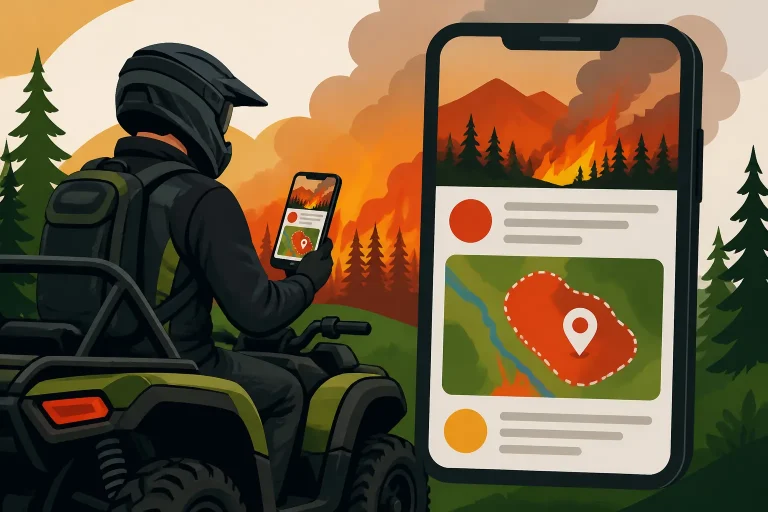
If you see smoke, flames or a fire that may be spreading, prioritize personal safety. Move away from immediate danger and avoid putting yourself or others at risk while trying to investigate or control it. Note the location as accurately as you can and report it promptly.
The BC Wildfire Service says wildfires can be reported by calling 1 800 663-5555 or *5555 from a cell phone. Give the information you have about the location and what you observed. If you are uncertain whether it is a wildfire, reporting the concern lets the appropriate service assess it.
If your ORV may be connected to an incident, avoid speculating about the cause. Keep the machine and any relevant records available, and seek qualified legal advice if you need guidance about your own situation. A court’s decision cannot be determined from a penalty maximum alone. The key practical steps remain straightforward: use a properly equipped machine, check current fire and access restrictions, ride within the rules and report a possible wildfire without delay.
Sources
- Province of British Columbia — Off-road vehicles – Province of British Columbia (checked November 3, 2026)
- Province of British Columbia — Motor Vehicle Prohibitions – Province of British Columbia (checked November 3, 2026)
- Province of British Columbia — Improved road access for ORVs – Province of British Columbia (checked November 3, 2026)
- Insurance Corporation of British Columbia — incidental_access_mv1445.pdf (checked November 3, 2026)
Disclaimer
This article is for general informational purposes only and does not constitute professional advice. Laws, prices and regulations vary by location and change over time. Consult a qualified professional for guidance on your specific situation.