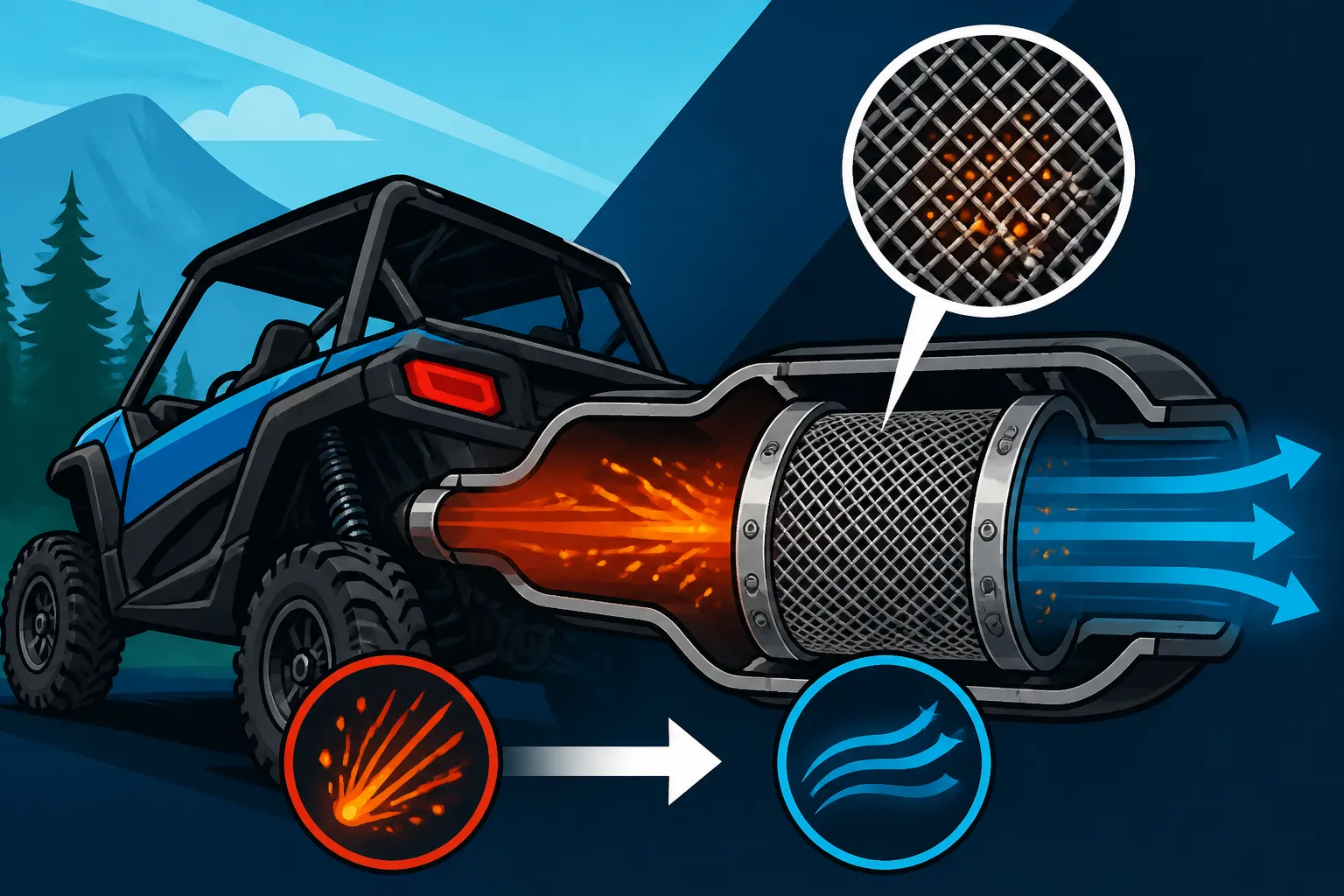
How a Spark Arrestor Screen Actually Works
A spark arrestor screen is a small part with a serious job: help keep hot particles from leaving your ATV or UTV exhaust and starting a fire. It can be easy to mistake it for a noise-control part or assume any piece of mesh will do. Here’s how the screen works, what can go wrong, and what to check before riding in BC.
What a spark arrestor screen does
An engine burns fuel and air, then pushes exhaust out through the exhaust system. That exhaust can carry glowing carbon particles, especially if the engine is running poorly or has deposits inside. A spark arrestor is designed to stop or cool those particles before they leave the exhaust.
In a screen-style arrestor, the exhaust passes through a metal mesh. The openings are small enough to catch larger glowing particles, while the mesh also gives them a surface to strike and lose heat. Particles that are trapped may cool and break down inside the exhaust instead of being thrown into dry grass or forest debris.
The screen is usually fitted inside the muffler or at its outlet. On some machines, it is part of a removable insert or end cap. Its exact location and design depend on the make and model, so check the owner’s manual or service information rather than assuming every ATV or UTV is built the same way.
A spark arrestor is not a filter for all exhaust pollutants, and it is not intended to make the exhaust safe to touch. It also does not guarantee that a machine cannot start a fire. It is one piece of equipment intended to reduce the chance of hot particles escaping.
Why the screen has to balance capture and exhaust flow
The screen needs openings small enough to catch particles but enough open area for exhaust to pass through. A screen that is damaged, missing, or replaced with an unsuitable part may not perform as intended. A screen clogged with carbon and debris can restrict exhaust flow.
That restriction may affect how the engine runs. A machine might feel less responsive, struggle to rev, or run differently than usual. Those symptoms can have many causes, so they do not prove the arrestor is blocked. Still, a dirty screen is a reasonable item to inspect when performance changes, following the manufacturer’s instructions.
The screen is not a substitute for a properly maintained engine. Excessive carbon deposits, incorrect tuning, damage to the exhaust, or poor-quality replacement parts can all affect how the system works. If the screen has a hole, is loose, or no longer fits securely, cleaning alone will not fix the problem.
A spark arrestor is not a muffler
The muffler reduces exhaust noise. A spark arrestor helps keep hot particles from exiting the exhaust. Some exhaust systems combine the parts in one assembly, but they have different jobs.
A machine can sound quiet and still have a missing or damaged spark arrestor. Conversely, a machine with a spark arrestor can still be too loud for a particular riding area. Do not remove a screen to change sound or performance; that can undermine its fire-prevention function and may make the machine unsuitable for places with spark-arrestor or noise rules.
For more on the equipment requirements, see BC Spark Arrestor Requirements and What Exhaust Screen the Wildfire Rules Require. If you ride at a managed site, check its rules separately; an area may have sound limits in addition to equipment requirements, as explained in BC Sound Limits on a Managed Site.
How to check and maintain the screen
A quick visual check can catch obvious problems, but it does not replace the manufacturer’s maintenance procedure. The screen and exhaust may become extremely hot during use, so let the machine cool fully before handling any exhaust component.
- Park the machine safely and switch off the engine. Wait until the exhaust is cool to the touch.
- Find the arrestor location in the owner’s manual or service information. Do not remove parts based on guesswork.
- Look for a missing insert, loose fastener, visible hole, broken mesh, heavy buildup, or a screen that does not sit securely.
- If the manual allows removal and cleaning, follow its instructions for the correct tool and cleaning method.
- Reinstall the screen exactly as directed and confirm that it is secure before starting the machine.
Do not probe a hot exhaust with a tool, run the engine with the screen removed, or modify the mesh to make the exhaust flow more freely. Avoid improvised repairs such as adding household wire mesh or welding in a piece that merely looks similar. The fit, material, opening size, and installation all matter.
Cleaning instructions vary. Some manufacturers specify a particular way to remove carbon; others recommend replacement when the screen is damaged or badly clogged. Follow the machine’s manual rather than using a torch, harsh chemical, or aggressive tool that could damage the mesh or exhaust. If the part is corroded, torn, distorted, or difficult to reinstall correctly, replace it with the specified component or ask a qualified repair shop.
For a guided pre-ride check, see Checking an Arrestor Before a Ride. If you are unsure where the screen is or what part belongs in your exhaust, Finding the Spec Stamped on Your Muffler can help you identify what to look for before contacting a dealer or repair shop.
| What you find | Why it matters | Sensible next step |
|---|---|---|
| Screen is present, secure, and undamaged | No obvious defect is visible, though this does not prove the whole exhaust system is in perfect condition | Continue routine checks and follow the manual’s service schedule |
| Carbon or debris covers much of the mesh | The screen may be restricted, and exhaust flow may be affected | Clean it only as the manufacturer directs |
| Mesh is torn, missing, or badly corroded | Particles may pass through, or the screen may not stay in place | Replace it with the specified part before riding where an arrestor is required |
| Insert or fastener is loose | The screen may shift or come out during use | Reinstall or repair it according to the manual |
| You cannot identify the correct screen | A generic-looking part may not fit or meet the machine’s requirements | Confirm the model and part specification with a dealer or qualified shop |
Choosing a replacement
Start with the machine’s make, model, and year, then confirm the part number or specification through the owner’s manual, manufacturer, or an authorized parts source. A replacement that physically fits is not automatically the right arrestor. Check that it is intended for the specific exhaust and is suitable for the applicable riding requirements.
If you shop on Amazon, use the listing as a place to compare options, not as proof that a part is correct. Verify compatibility against the manufacturer’s information, read the description carefully, and be cautious of listings that do not identify the machine fitment or arrestor specification. When the correct part is unclear, a dealer or repair shop can help confirm it before you buy.
Avoid treating a universal screen or a piece of mesh as an acceptable replacement just because it can be made to fit. An improvised part may not capture particles effectively, could loosen, or may interfere with exhaust flow. Keep any documentation that identifies the replacement part, especially if you ride in a place where an officer or site operator may inspect the arrestor.
What the screen means for riding in BC
In BC, spark-arrestor requirements can depend on the rules that apply to the land and the activity. Wildfire rules, local restrictions, and managed riding-site requirements may all matter. Do not assume that a screen is optional because the machine is used only for recreation, or that having one automatically permits riding during a restriction.
A compliant spark arrestor does not override a fire-centre prohibition or a closure. Restrictions can limit ORV use even when the machine is equipped and maintained properly. Check current conditions and posted notices before leaving, and follow any site-specific rules. BC Fire Centre Riding Bans and BC Fire Centre Closures for ORVs cover the separate issue of restrictions that can close riding areas.
The same distinction applies to inspections. A screen that looks intact is useful, but an officer or site operator may check whether the arrestor is present and whether the machine meets the applicable requirement. The details of an inspection can depend on the location and circumstances; see When an Officer Checks Your Spark Arrestor Screen for what to expect.
A few practical habits help reduce risk:
- Check the screen before a ride if the machine has been stored, repaired, or used in dusty or dirty conditions.
- Make sure the insert and fasteners are secure after cleaning or exhaust work.
- Do not ride with a damaged or missing arrestor where one is required.
- Check closures and fire restrictions independently of your equipment checks.
- Use extra care around dry grass, brush, and other easily ignited material, even when riding is allowed.
The screen is a small component, but it works only when it is the right part, in good condition, and installed correctly. Treat it as routine safety equipment rather than a one-time compliance item. For more detail on inspection and enforcement, see BC Spark Arrestor Rules and Fines.
Disclaimer
This article is for general informational purposes only and does not constitute professional advice. Laws, prices and regulations vary by location and change over time. Consult a qualified professional for guidance on your specific situation.