BC Commercial Guiding Permits
Planning to lead paid ATV or UTV rides on Crown land in British Columbia? The key issue is not just whether each machine is registered. Commercial touring and guiding can require a separate land-use authorization, and the route may also be affected by vehicle restrictions, road rules, or fire prohibitions. Here’s how to separate those requirements and what to check before taking clients out.
What a commercial guiding permit covers
For commercial operators, “permit” can mean permission to conduct a business activity on public land, not permission to operate an individual ATV or side-by-side. The Ministry of Forests / Government of British Columbia says a Land Act tenure is required for commercial recreation operators conducting off-road vehicle touring and guiding on provincial Crown land when the activity involves compensation or reward.
That makes the commercial arrangement important. If clients pay for a guided ride, or the operator receives another form of compensation or reward for providing the activity, don’t assume that ordinary recreational access is enough. Confirm what tenure or authorization applies to the specific operation and location with the responsible provincial office before advertising or running trips.
A land tenure and vehicle registration solve different problems:
| Requirement | What it addresses | What it does not replace |
|---|---|---|
| Land Act tenure for paid guiding on provincial Crown land | Authorization for the commercial recreation activity on the land | Registration of the ATVs or UTVs |
| ORV registration | Identification and registration of each vehicle used on Crown land | Permission to conduct a commercial guiding business |
| Access restrictions and closures | Whether motor vehicle use is allowed in a particular area or at a particular time | A commercial tenure or vehicle registration |
| Forest Service Road requirements | Conditions for operating an ORV on a Forest Service Road | Permission to guide on Crown land |
The tenure requirement does not mean every trail or road is automatically available for guided use. Crown land may be subject to access management, environmental rules, temporary closures, or restrictions for motor vehicles. The Province of British Columbia says motor vehicle use on Crown land may be prohibited or restricted under the Motor Vehicle Prohibition Regulation of the provincial Wildlife Act. Check the route as well as the business authorization.
For the difference between public-land access and vehicle registration, see BC Crown Land Riding Explained and BC Crown Land Access Rules. If the operation includes a Forest Service Road, BC Forest Service Road Requirements is also relevant.
Plan the route and confirm authorization
Before you submit an application, promote a tour, or take clients onto a route, make a clear plan of where the operation will go and how it will run. This helps identify which land-use and access questions need answers. Don’t treat a general statement that an area is Crown land as confirmation that commercial guiding is allowed there.
Ask the responsible provincial office to confirm the tenure process and conditions for your proposed activity. Be prepared to describe the route, staging locations, the type of guided activity, and how clients will access the area. Ask whether the proposed route crosses or uses land with separate access restrictions, and whether the tenure has limits on where or how the activity can operate. The available facts establish that a Land Act tenure is required in the stated commercial Crown land situation, but they do not establish the application form, processing time, or conditions for a particular operation. Confirm those details directly rather than relying on another operator’s arrangement.
A practical pre-trip review includes:
- Land authorization: Confirm the applicable Land Act tenure for commercial guiding on provincial Crown land and check that the proposed activity fits its conditions.
- Access status: Check whether motor vehicle use is restricted or prohibited along the route. The Province of British Columbia says motor vehicle prohibitions can apply to private land unless specifically exempted, so don’t assume a route is open simply because it crosses private property.
- Road status: Identify Forest Service Roads and other resource roads in the itinerary. The Province of British Columbia notes that resource roads are not built or maintained to the same standards as public highways.
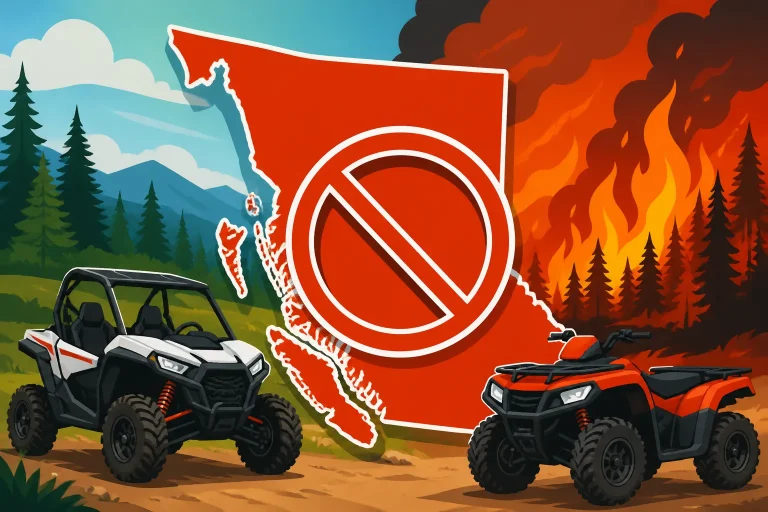
- Seasonal conditions: Check for temporary ORV restrictions and wildfire-related prohibitions before each trip. The BC Wildfire Service issues fire prohibitions and restrictions, and the Province of British Columbia says recreational ORV use on Crown land is temporarily prohibited in many fire centres.
- Environmental care: Plan routes that avoid causing damage. The Province of British Columbia says it is illegal under the Forest and Range Practices Act to cause environmental damage, including a change to soil that adversely alters an ecosystem.
The Province of British Columbia says the majority of Motor Vehicle Prohibition maps can be found in the Hunting and Trapping Regulations Synopsis. Use the applicable maps and current notices to check the intended area, and don’t remove, alter, or damage access-management signs. The Province of British Columbia says doing so is an offence under section 83(2) of the Wildlife Act.
For more on seasonal restrictions, see BC Motor Vehicle Closures and How to Find Them, BC Fire Centre Riding Bans, and Checking a Fire Ban Before You Ride in BC. A route that was usable on a previous trip may not be usable when you return.
Keep vehicle and client requirements separate
A land authorization for guided activity does not register the fleet. The Province of British Columbia requires owners to register prescribed ORVs used on Crown land and display an ICBC number plate or sticker. This applies to ATVs and side-by-side ORVs, as well as the other prescribed vehicle types. Registration services are provided by ICBC Autoplan brokers; see Registering a Side-by-Side in BC or BC Registration for a Rental Fleet for related details.
The Province of British Columbia also requires an ORV operator to carry a copy of the Certificate of Registration or Transfer of Ownership. Operators must carry government-issued photo identification, and riders aged twelve and older must carry it. Keep the necessary documents accessible for the operator, including when vehicles are being used by clients rather than only by the business owner.
If a machine is registered outside British Columbia, its owner must register it in the home jurisdiction if registration or licensing is available there, according to the Province of British Columbia. If the home jurisdiction does not offer registration, the owner must carry proof-of-ownership documentation when riding on B.C. Crown land. These requirements are separate from the commercial land authorization.
For paid tours, set out clear procedures for checking each machine before departure. The Province of British Columbia requires safety-approved helmets for operators on ride-astride ORVs, seatbelts when installed by the manufacturer, and lights in low-visibility conditions. If an ORV was not manufactured with lights, the Province of British Columbia says bicycle lights are acceptable. It also requires all ORVs to have a spark arrestor installed during wildfire conditions. Confirm that equipment is present and working, and check fire restrictions before the ride rather than assuming an otherwise equipped machine can be used.
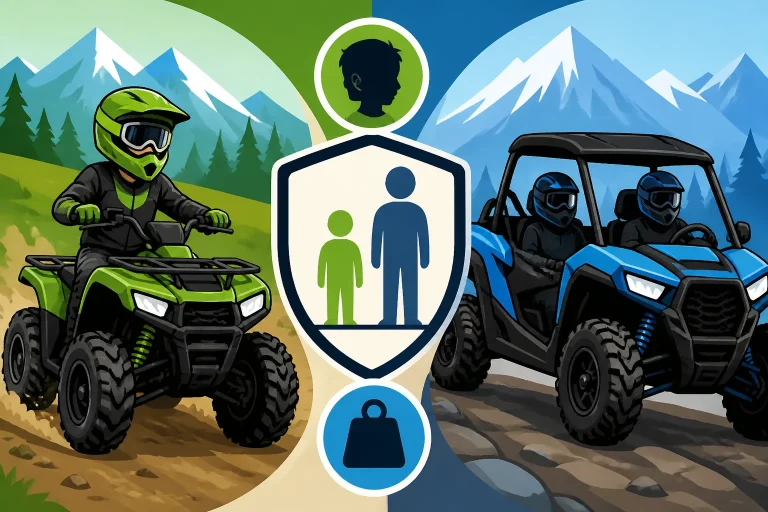
Age and passenger rules need attention when a tour may include young riders. The Province of British Columbia says children under sixteen must have mandatory adult supervision and may ride only if they meet the vehicle manufacturer’s minimum age and weight requirements. A child cannot drive an ORV with a passenger. These requirements do not disappear because the ride is guided; make sure the operator understands the rules and the machine is suitable for the rider.
If your itinerary uses a Forest Service Road, the Province of British Columbia requires ORV operators on that road to hold a valid driver’s licence and carry at least $200,000 in third-party liability insurance. On other Crown land, third-party liability insurance is voluntary but recommended, according to the Province of British Columbia. Confirm that the business’s insurance arrangements apply to the actual vehicles, activity, and routes. A policy for recreational use may not address every risk of commercial guiding, so check the coverage with the insurer and a qualified insurance professional.
Avoid common planning mistakes
One common mistake is treating an ORV plate as a commercial operating authorization. Registration identifies the vehicle for Crown land use; it does not grant the business permission to guide there. The reverse is also true: a land-use authorization does not remove vehicle registration or safety requirements.
Another mistake is assuming that a tenure makes every nearby trail or road available. Access rules, closures, and temporary fire restrictions can affect the route independently. The Province of British Columbia says motor vehicle use can be restricted under the Wildlife Act, while the BC Wildfire Service manages fire restrictions and wildfire response. Make route checks part of trip planning, not just the initial setup of the business.
Don’t assume a Forest Service Road is simply another trail. The Province of British Columbia requires a valid driver’s licence and at least $200,000 in third-party liability insurance for ORV operators travelling on these roads. Resource roads may also have industrial traffic and conditions unlike those on public highways. Review BC Resource Road Radio Practice and BC Riders Meeting a Logging Truck if your route includes roads used for industrial activity.
Finally, don’t make clients responsible for figuring out the rules at the trailhead. Give them practical instructions before the trip: what documents they need, what safety equipment is required, whether they may carry a passenger, and what will happen if a closure affects the route. Keep a procedure for checking current restrictions and communicating a change of plan. Commercial permission, access, vehicle compliance, and client readiness are related, but each needs its own check.
Sources
- Province of British Columbia — Motor Vehicle Prohibitions – Province of British Columbia (checked November 3, 2026)
- Province of British Columbia — Improved road access for ORVs – Province of British Columbia (checked November 3, 2026)
- Insurance Corporation of British Columbia — incidental_access_mv1445.pdf (checked November 3, 2026)
Disclaimer
This article is for general informational purposes only and does not constitute professional advice. Laws, prices and regulations vary by location and change over time. Consult a qualified professional for guidance on your specific situation.