BC Private Land Permission
Riding an ATV or UTV on private land in BC may seem straightforward, but a property line can be hard to identify, and permission from one person may not cover every route or activity. The key is to confirm who controls the land, get consent that matches your plans, and check what other rules apply before you ride.
Who Can Give You Permission to Ride
Start by finding out who has authority over the specific land you want to use. The registered owner may be able to give permission, but the person you speak with could instead be a tenant, caretaker, farm manager, company representative or recreation-site operator. Ask whether they have authority to approve motorized access. A friendly invitation from someone who does not control the property may not be enough.
If the land has more than one owner, is used by a business, or is managed under an agreement, ask who needs to consent. You may need permission from more than one person. If a property is rented or leased, do not assume that the person living or working there can authorize ATV use; ask them to confirm their authority with the owner or land manager.
Permission also needs to cover the route you plan to ride. A landowner might allow access across a driveway or field but not through a wooded area, across a creek, or onto a neighbouring parcel. A trail that looks continuous may cross several properties. Consent for one section does not grant access to the next.
Be especially careful where private property meets Crown land, a road allowance, a recreation site, a park or land under lease. A gate, trail marker or worn track does not tell you who controls the land or whether public motorized access is allowed. For more on the difference between land access and the applicable riding rules, see BC Crown Land Riding Explained and BC Leased Crown Land and Permission.
| Situation | What to confirm before riding |
|---|---|
| You own the property | Whether co-owners, tenants or other agreements affect access |
| A friend invites you | That they own the land or are authorized to approve riding |
| The property is rented or managed | Who has authority to grant motorized access |
| A trail crosses several parcels | Permission for each private section, plus the status of any connecting land |
| The route reaches Crown land | Whether access is allowed and what rules apply there |
| You are using a shared or access road | Whether it is private, public, or subject to separate access conditions |
If you are unsure where the boundary lies, pause and verify it rather than relying on a fence, a map pin or someone else’s memory. Property lines may not follow the visible trail. A route can also cross an easement or right of way, where access rights may be different from the owner’s permission to use the rest of the property.
Permission from a neighbour is not permission from everyone
A neighbour can generally only give consent for land they control or are authorized to manage. If a trail crosses an adjacent parcel, a road allowance or a utility corridor, ask who has authority over that section. Do not treat an informal custom, an open gate or an old trail as proof that riding is permitted.
For shared driveways and private access roads, clarify whether the permission includes ATV or UTV use, not just walking or vehicle access. An owner may allow a person to reach a home or worksite without allowing recreational riding along the road.
What to Put in a Permission Agreement
A verbal agreement may be convenient, especially for a one-time ride with someone you know. Written permission is often more useful because it makes the boundaries and conditions clear to everyone, including other riders in your group. It can be as simple as a dated message or letter; there is no need to assume that a particular form is required.
Ask for permission before unloading or riding, and make sure the answer comes from someone with authority over the land. A clear written agreement should identify:
- The land or route covered, with a map or description if helpful
- Who is allowed to ride, including guests or family members
- The permitted machines, such as ATVs, UTVs or both
- Whether riding is limited to a particular trail, field or access road
- When permission begins and ends, or how it can be withdrawn
- Any speed, noise, group-size, parking or operating restrictions
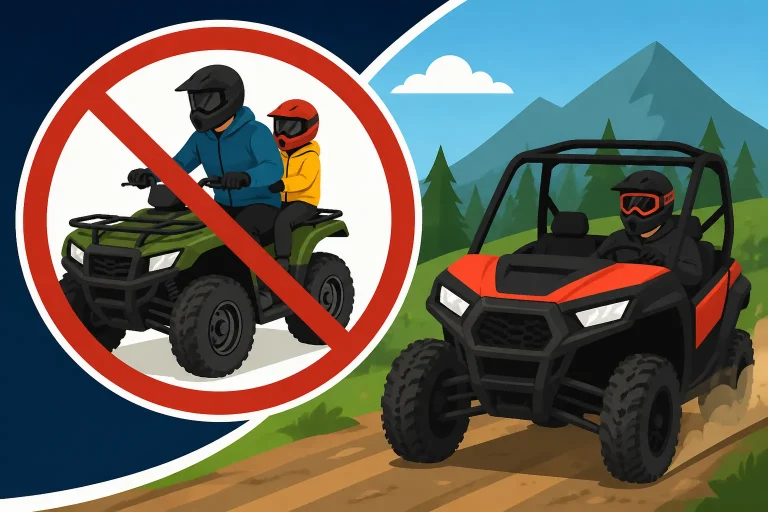
- Whether passengers, towing, camping, hunting or other activities are allowed
- Who to contact if plans change or a problem arises
Be precise about activities beyond riding. Permission to travel across a property does not necessarily mean permission to camp, make a fire, hunt, bring other guests, cut branches, use a winch on trees or leave equipment there. If you need to do something other than ride through the approved area, ask first.
A map can prevent misunderstandings, but it should be easy to interpret. Mark the approved route and any areas to avoid. Include useful landmarks, such as a gate or staging area, without assuming that a line drawn on a phone map precisely matches a legal boundary. If the landowner gives you an updated route, follow the latest instructions.
Make sure each guest knows the conditions. If the owner agrees to let you ride but does not know that you plan to bring a group, do not assume the invitation covers them. Share the written permission and restrictions with everyone before leaving. Keep a copy available offline in case there is no cell service; a printed copy or a waterproof document pouch, including one available through retailers such as Amazon, can help protect the paperwork.
Permission is not permanent unless the owner clearly says so. Owners may change access conditions, close a route for maintenance, or ask riders to leave. Confirm that permission still applies when you return, particularly if a long time has passed or property use has changed. If the owner says access is withdrawn, leave promptly and do not return without renewed consent.
Private Land Does Not Settle Every Legal Question
Permission answers one question: whether the landholder allows you to use the property. It does not automatically establish that the machine is registered, insured, properly equipped or allowed on every connecting road. Nor does it cancel local rules or the conditions of another land manager.
Registration is one area where riders can confuse private-property access with Crown land access. Private land by itself is not the same as Crown land, but a ride that leaves the property can bring different requirements into play. If your route continues onto Crown land or a resource road, check the rules that apply there before setting off. The distinction is explained further in BC Private Land and the Registration Question and BC Registration Before Riding Crown Land. Do not assume that a machine is exempt from every requirement simply because the ride begins on private property.
A farm or rural location does not automatically make every ATV a work machine or take it outside the rules for an off-road vehicle. If you are using a quad for farm work, recreation, or both, check the machine’s classification and where it will operate. BC Farm Quads Are Not Exempt covers why the word “farm” alone does not answer the registration question.
Insurance needs separate attention too. Landowner permission is not a promise that your policy covers a crash, damage to the property or injury to another person. Read your policy or ask your insurer what applies to the machine and the location. This matters even on familiar land: a collision with a fence, building or another person may create costs that permission does not address. For a broader overview, see BC ATV Insurance Requirements.
Public-road rules are also separate. Permission to cross or travel along private property does not authorize riding on a public highway. Where a route reaches a public road, check the rules for that road and the point of crossing rather than treating landowner consent as road permission. Can You Ride an ATV on the Road in BC? explains the limits on ATV road use.
Other rules can apply even when all the land involved is private. Depending on the location and activity, you may need to consider local noise or nuisance rules, fire restrictions, wildlife protections, and requirements that apply to a workplace or organized event. Permission from an owner does not override those rules. If a site has posted conditions, follow them; if conditions are unclear, ask the person responsible for managing the land.
A Practical Check Before You Ride
Use a short check before each ride, especially if you are visiting new property, bringing a group or following a trail that continues beyond the landowner’s driveway.
- Identify the land and its boundaries. Confirm which parcel or route you have permission to use. Do not rely on a trail appearing open or on a gate being unlocked.
- Confirm who controls it. Ask the owner or authorized manager, and check whether another owner, tenant or land manager needs to approve access.
- Get the conditions in writing. Record the route, dates, permitted machines and any limits on guests or activities.
- Check what lies beyond the property. Confirm whether the route crosses Crown land, a resource road, a public road, a park or another private parcel. Each may have separate access and operating rules.
- Check the machine and coverage. Confirm that registration, insurance and equipment requirements match the route you intend to ride.
- Tell everyone in the group. Make sure every rider understands the approved route, restrictions, parking instructions and contact arrangements.
- Respect changes and closures. If the owner or land manager closes the route, follow the request. Avoid riding around a gate or taking an alternate route without permission.
It is sensible to keep the owner’s contact information with the permission record. If a gate is locked, a road is blocked, or the route looks different from what you were told, contact the person who granted access rather than improvising. Conditions can change because of logging, maintenance, livestock, fire danger or other land use.
Riding responsibly also helps preserve access. Stay on the approved route, keep noise and speed appropriate, avoid damaging fields and watercourses, and leave gates as instructed. Do not assume a landowner will welcome repeated visits just because they allowed one ride. A quick check-in before returning is a practical way to confirm that access is still acceptable.
When there is no permission, do not enter to “just have a look” or follow tracks made by other riders. If you are uncertain whether the land is private or whether the person who invited you can authorize access, resolve that question before unloading. BC Trespass Rules for Riders explains why access assumptions can create problems even when a route is familiar.
Disclaimer
This article is for general informational purposes only and does not constitute professional advice. Laws, prices and regulations vary by location and change over time. Consult a qualified professional for guidance on your specific situation.