Showing Registration to an Officer
Picture this: you're out on a gorgeous BC trail, enjoying the hum of your engine and the breathtaking scenery, when suddenly, blue and red lights flash in your rearview mirror. Your heart jumps. What do they want? A common concern for many off-road vehicle (ORV) riders in British Columbia is knowing exactly what documents to present and how to handle an interaction with an officer. This guide is here to help you navigate those moments, ensuring you're prepared and confident when showing your ATV or UTV registration to an officer.
Why Officers Stop Riders for Registration Checks
It's a familiar sight on popular trails or staging areas: an officer from the RCMP, Conservation Officer Service, or even a local bylaw officer stopping riders. While it might feel like an inconvenience, these checks are crucial for ensuring everyone is riding legally and safely, protecting both the environment and other recreational users. They're not just looking for troublemakers; they're upholding the rules that keep our riding areas open and accessible.
The Off-Road Vehicle Act in Action
The bedrock of these checks is the Off-Road Vehicle Act, a pivotal piece of legislation that became mandatory for ORV registration in 2015. Before this, many quads and side-by-sides freely roamed our vast landscapes without any provincial tracking. The Act changed all that, requiring almost every ORV operating off private property to be registered. This includes ATVs, UTVs, dirt bikes, and snowmobiles. The primary trigger for this registration requirement is often riding on [BC Crown Land Triggers the Registration Rule] or [BC Resource Roads Count as Crown Land], which covers the vast majority of our province's riding opportunities.
Officers are empowered to enforce the various sections of this Act. This isn't just about revenue generation through fines; it's about accountability. Knowing who owns a machine helps in cases of environmental damage, illegal activity, or even finding stolen property. When an officer pulls you over, they’re essentially verifying that you and your machine are compliant with this fundamental provincial law. If you're out on a forest service road (FSR) or a designated trail, you can almost always expect that an officer is within their rights to ask for proof of registration and identification.
Proactive Checks vs. Incident-Based Stops
You might encounter an officer in a few different ways. Sometimes, they're set up at a trailhead or staging area, performing proactive checks on a number of riders as they come and go. These are often routine and straightforward. They simply want to see your papers, ensure your machine has a visible plate and decal, and maybe offer some advice on current trail conditions or fire bans. Think of it as a friendly but firm reminder of your obligations as a responsible rider.
Other times, a stop might be incident-based. This happens if an officer observes a potential infraction, such as [BC Fines for Careless Operation] of your machine, riding without a helmet (which is mandatory for ride-astride machines under [BC Helmet Law Covers Every Rider]), excessive speed, or even simply your ORV plate being obscured by mud or cargo. In these situations, the officer will address the primary concern but will almost certainly follow up with a registration check as part of their standard procedure. Regardless of the reason for the stop, being prepared with your documents makes the interaction smoother and quicker, allowing you to get back to your ride with minimal delay.
What Documents You Absolutely Must Carry
When an officer signals you to pull over, the immediate question in your mind will probably be, "What do I need to show them?" Knowing exactly which papers are essential, and having them readily accessible, can turn a potentially stressful situation into a quick, routine check. Don't underestimate the power of preparation here; fumbling for documents or, worse, not having them, can significantly prolong the stop.
Your Certificate of Registration is Key
The single most important document you must carry is your Certificate of Registration. Unlike other jurisdictions that might issue a "title," BC doesn't operate that way for ORVs. As explained in [BC's Certificate of Registration Explained] and [Why BC Does Not Title an ATV], this certificate is your official proof that your off-road vehicle is registered with the province. It's a small, paper document issued by an Autoplan broker, showing your name as the registered owner and the details of your machine, including its Vehicle Identification Number (VIN).
It's absolutely critical that [BC Riders Must Carry the Certificate] whenever you're operating your ORV off private property. This means having the actual physical document or a clear, legible copy on your person or stored securely on your machine. Don't leave it at home in a filing cabinet! Many riders laminate their certificate or keep it in a waterproof pouch to protect it from the elements. Imagine being deep in the backcountry, soaked from a sudden rain shower, and needing to present a disintegrating piece of paper to an officer – it's a frustrating scenario easily avoided. The officer will want to see this document to verify that the machine you're operating is legally registered to you.
Photo Identification and Other Essentials
Beyond your Certificate of Registration, you'll also need to provide government-issued photo identification. This is vital for the officer to confirm that you are indeed the person named on the registration document. Your driver's license is the most common and acceptable form of ID, but any official photo ID will generally suffice. Remember, [BC Riders Must Carry Photo ID] is not just a good idea, it’s a necessary step in proving your identity and right to operate the machine.
Depending on where you're riding and your specific situation, other documents might also be required or highly recommended:
- Proof of Insurance: While basic registration covers some administrative aspects, liability insurance is a separate requirement, especially if you're riding on FSRs. [BC Insurance Bought With Registration] is typically arranged through an Autoplan broker at the time of registration, but some riders opt for additional private coverage. Carrying proof of this coverage, whether a physical card or a digital copy, is smart practice.
- Youth Rider Documentation: If a young rider is operating the ORV, particularly if they are between 14 and 15 years old, they might need written permission from a parent or guardian, and possibly proof of an approved safety training course. [BC Rules for a 14-Year-Old Rider] provides more detail on these specific requirements.
- Highway Operation Permit: In very specific circumstances, such as when you need to cross a short section of highway or ride on a highway shoulder to access another trail, you might need a special Operation Permit from the local police detachment. While not for general trail riding, if you're utilizing such a permit, you'll need to present it. You can learn more about applying for these in [BC Operation Permit Application Steps].
Gathering these documents into a small, waterproof kit that you always take with you on your rides will save you a lot of hassle and ensure a smooth interaction with any enforcing officer.
What to Expect During a Registration Check
When an officer initiates a stop, it can be a little nerve-wracking, even if you know you're fully compliant. The key is to remain calm, cooperative, and understand the process. Officers are professionals doing their job, and a respectful interaction goes a long way in ensuring a quick and pleasant experience for everyone involved.
Remaining Calm and Cooperative
The first thing to do when an officer signals you to pull over is to do so safely and promptly. Find a safe spot on the side of the trail or road where you're not obstructing traffic or creating a hazard. Turn off your engine immediately. This shows respect and allows for clear communication, as the roar of an ATV engine can make it difficult to hear. Keep your hands visible, perhaps resting them on the handlebars. Avoid sudden movements that might be misinterpreted.
When the officer approaches, listen carefully to their instructions. They will typically introduce themselves and explain why they've stopped you. Maintaining a polite and cooperative demeanour is paramount. Arguing or becoming defensive will only prolong the stop and escalate the situation unnecessarily. Remember, they are simply enforcing the law, and your compliance makes their job, and your experience, much easier. Many officers are also riders themselves and understand the passion for the sport; they just want to ensure everyone is following the rules.
Presenting Your Documents
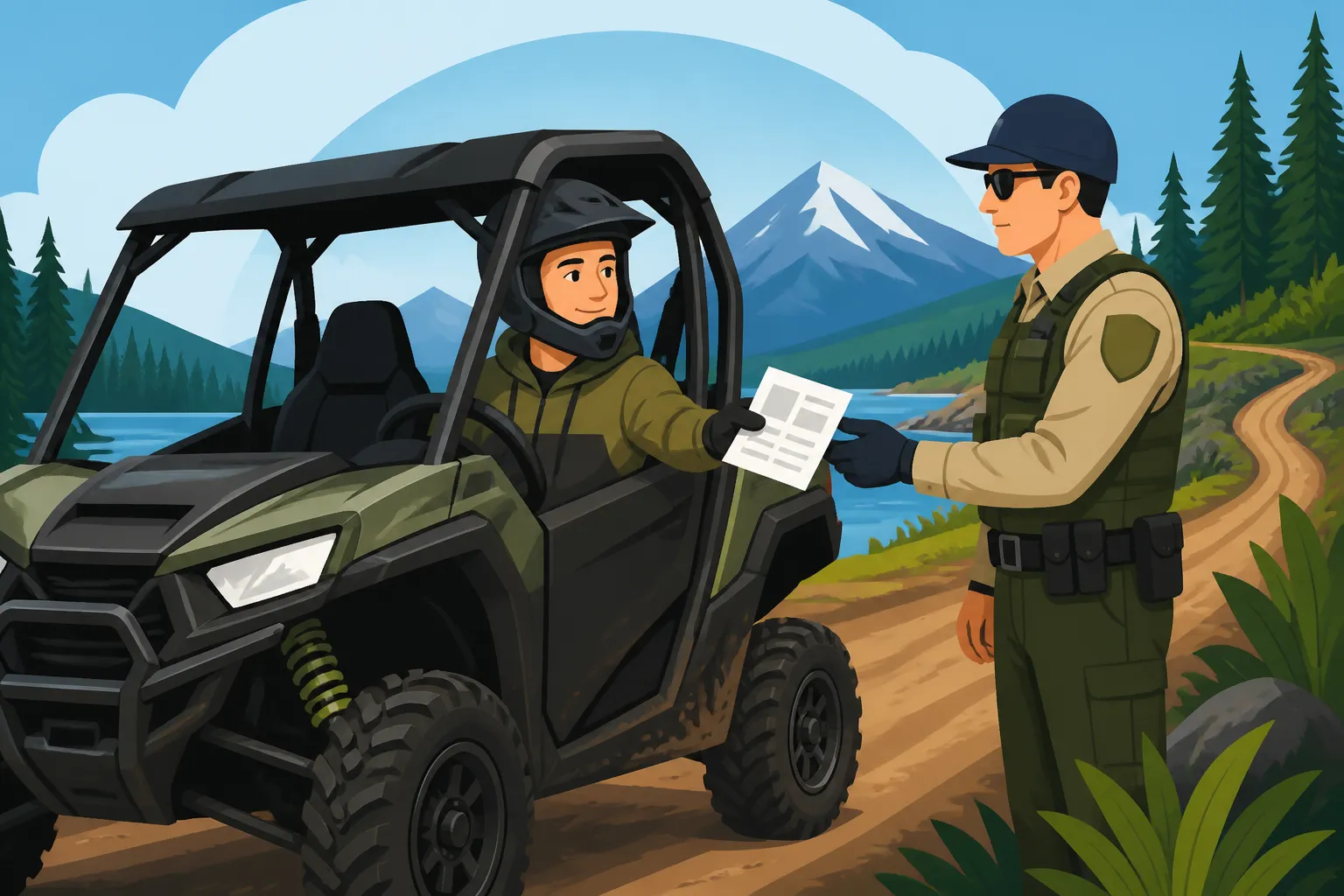
Once the officer asks for your documents, retrieve your Certificate of Registration and your photo ID calmly. Hand them over directly to the officer. If you have a copy of your Certificate of Registration, ensure it's a clear, legible one. The officer will typically take a moment to review these documents.
A common part of this check involves the officer verifying the Vehicle Identification Number (VIN) on your machine against the VIN listed on your Certificate of Registration. This is a critical step to ensure that the document matches the actual ORV you are operating. Officers are trained to locate VINs, which can sometimes be hidden or difficult to read depending on the machine. You might need to point it out or even clean off some mud for them to get a clear view. For more on this, you can refer to [Serial Numbers and Where They Hide]. This step is vital in preventing the operation of stolen or improperly registered machines. This is where having a clear, documented chain of ownership from the start truly saves you headaches, whether you're using a simple bill of sale or needed to create a statutory declaration, perhaps using a template from a service like LawDepot, to prove ownership for initial registration.
Common Questions and Verifications
Beyond simply checking your documents, an officer might ask a few questions to gather more context. These could include:
- "Is this your machine?" (Even though you've presented registration, they're confirming verbally).
- "Where are you heading today?"
- "Are you aware of the rules for riding in this area?"
- "Do you have a spark arrestor on your exhaust?" (This is particularly common during fire season).
They might also visually inspect your machine for other compliance points. They'll likely check your ORV plate and decal to ensure they are properly affixed and visible. The regulations specify that plates must be mounted on the front, back, or left side of the machine, as detailed in [BC Plate Placement on Front, Back or Left], and decals must be placed clearly. If your plate is obscured by mud, cargo, or is missing, that could lead to another infraction. Similarly, they'll check for proper lighting, especially if it's nearing dusk or operating in low visibility.
Answer all questions honestly and concisely. There's no need to offer excessive detail. Once the officer is satisfied that your documents are in order and your machine meets basic compliance standards, they will return your documents, and you'll be free to continue your ride. It's usually a quick process if everything is in order.
Consequences of Not Having Proper Registration
Riding an off-road vehicle in British Columbia without proper registration is not just a minor oversight; it's a violation of provincial law that can lead to significant penalties. The goal of enforcement is not to punish recreational riders unfairly, but to ensure safety, accountability, and proper management of our shared outdoor spaces. Understanding the repercussions can be a powerful motivator to ensure your paperwork is always in order.
Fines and Penalties
The most immediate consequence of being caught with an unregistered ORV is a violation ticket, commonly known as a fine. While the exact amount can vary, [BC Tickets for an Unregistered Machine] and [BC Penalties for Riding Unregistered] can be substantial. These aren't just small nuisances; they're designed to deter non-compliance. A ticket for an unregistered machine can quickly put a damper on your day and your wallet.
However, fines are just the beginning. In more serious or repeated instances of non-compliance, officers have the authority to take more drastic measures. This could include seizing your machine. Imagine having your ATV or UTV impounded on the spot, leaving you stranded in the backcountry. This is a very real possibility under the Act, as detailed in [BC Machine Seizures by Police]. Getting your machine back from impound can be a lengthy, costly, and complicated process involving storage fees, administrative hurdles, and potentially further fines. It's a scenario every rider wants to avoid.
Beyond registration, other infractions like riding without a helmet, careless operation, or lacking proper insurance on a Forest Service Road can incur their own separate fines, potentially compounding your woes during a single stop.
Addressing Missing Documents After the Fact
If you find yourself in the unfortunate position of receiving a ticket because you didn't have your Certificate of Registration or other required documents with you, don't panic, but do take immediate action. In some cases, if you can present valid registration to the issuing authority (e.g., the court or police detachment) within a certain timeframe, the fine might be reduced or even cancelled, though this is not guaranteed and often depends on the specifics of the ticket and local policies.
The first step is to get your registration in order. If your machine isn't registered at all, you'll need to go through the full registration process with an Autoplan broker. This might involve obtaining a [BC Statutory Declaration for an ORV] if you don't have a complete bill of sale history for the machine, or tracing [BC Ownership Chains Going Back Decades] if you acquired an older machine. Services like LawDepot can provide templates for statutory declarations, which become essential when you're trying to prove a historical ownership chain to the registry office. If you simply lost your Certificate of Registration, you'll need to apply for a replacement, which is a much simpler process. For information on replacing a lost plate or decal, you can look at [BC Plate Replacement If Lost].
The hassle, time, and money involved in dealing with tickets and subsequent administrative processes far outweigh the simple act of keeping your documents organized and with you during every ride. It’s an easy preventative measure that ensures your riding adventures remain stress-free and enjoyable.
| Document Type | Requirement Level | Why It's Needed | Where to Get It / Keep It |
|---|---|---|---|
| Certificate of Registration | Mandatory | Proof your ORV is legally registered in BC | Autoplan broker; keep on person or machine (waterproof) |
| Government-Issued Photo ID | Mandatory | Confirms your identity matches the registration | Driver's License/BCID; keep on person |
| Proof of Insurance (Liability) | Mandatory (FSRs) | Required for FSRs; covers damage to others | Autoplan broker; keep on person or machine |
| Youth Rider Documentation | Conditional | Written permission/safety course proof for youth operators (age 14-15) | Parent/Guardian; approved training provider; keep on youth/supervisor |
| Highway Operation Permit | Conditional | Allows crossing short highway sections | Local police detachment; keep on person |
| Bill of Sale | Recommended | Proof of purchase (useful for registration or ownership questions) | Seller; keep a copy with other machine documents (not necessarily on ride) |
| Emergency Contact Info | Highly Recommended | For safety in case of accident or emergency | Laminated card on person/machine; phone |
Disclaimer
This article is for general informational purposes only and does not constitute professional advice. Laws, prices and regulations vary by location and change over time. Consult a qualified professional for guidance on your specific situation.