BC Registration for a Machine From Ontario
Bringing an off-road vehicle (ORV) like an ATV or UTV from Ontario to British Columbia can feel like navigating a maze, especially when you’re trying to figure out what paperwork you need to satisfy BC’s unique registration requirements. Many riders get frustrated because Ontario's system is quite different from BC's, and what was perfectly legal and sufficient in one province might not cut it in the other. This guide will walk you through the specifics of registering your Ontario-sourced machine in BC, clarifying the documents you’ll need and the process you’ll follow, so you can hit BC's amazing trails with peace of mind.
The Unique Challenge of Bringing an Ontario Machine to BC
If you're making the move to British Columbia and bringing your trusty ATV or UTV with you from Ontario, you're probably already aware that things work a little differently out here. It’s not just a matter of changing your driver’s licence; our provincial registration system for off-road vehicles has its own set of rules that can catch even experienced riders off guard. The biggest head-scratcher for many coming from Ontario is the fundamental difference in what constitutes "ownership" and "registration."
In Ontario, you're accustomed to an annual plate renewal system through the Ministry of Transportation (MTO). You get a plate, you renew it yearly, and that’s largely that. While there's a permit and an ownership document, it doesn't function quite like the "title" system found in some other jurisdictions or even the Certificate of Registration we have in BC. The Ontario system focuses on the current operator and the legality of riding on designated trails or areas. It's a cyclical process, tied to annual fees and sticker renewals.
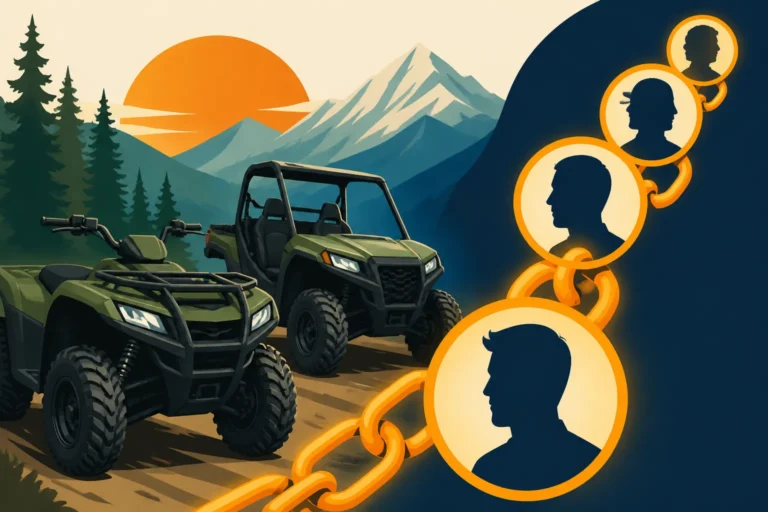
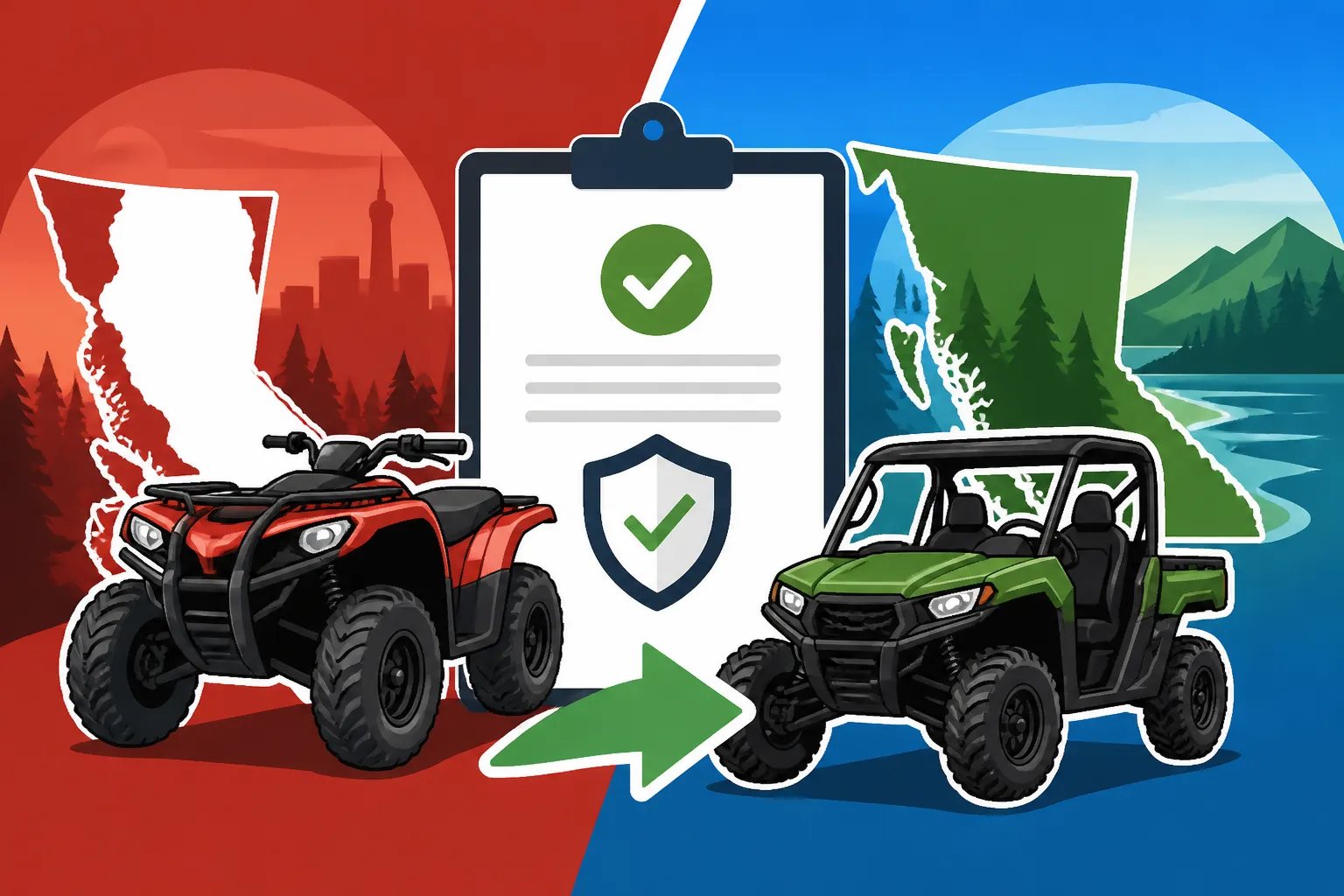
British Columbia, on the other hand, implemented its Off-Road Vehicle Act in 2015, establishing a one-time registration system for ORVs. Once registered, your machine receives a permanent BC ORV plate and a Certificate of Registration. You pay a fee once, and as long as you own the machine, you're good to go – no annual renewals, no yearly stickers. This is a huge shift from the Ontario model. But here’s the kicker: BC is absolutely obsessed with the chain of ownership. We want to see how that machine passed from every owner to the next, all the way back to its very first sale. This is where many Ontario riders hit a snag, as their provincial paperwork might not always reflect this detailed history.
Why Ontario's System Is Different from BC's Needs
The primary difference lies in the concept of a "title" or comprehensive ownership history. Ontario's ORV registration is more about operating permission and current ownership, without necessarily tracking the full lineage of every transaction in a centralized database in the same way BC's system implicitly demands. When you visit an Autoplan broker in BC to register your out-of-province machine, they aren't just looking for proof that you bought it from the last owner. They're looking for an unbroken line of documentation that connects you to the person who sold it to you, that person to their seller, and so on, right back to the original dealership sale. This is explained in detail in [BC Ownership Chains Going Back Decades].
For many Ontario riders, especially those with older machines, this can be a significant hurdle. You might have a bill of sale from the person you bought it from, and perhaps even their previous ownership permit, but what about the person they bought it from? And the person before that? This deep dive into a machine's history is unique to BC's ORV registration process, designed to curb theft and ensure clear legal ownership. It's a system built to provide an ironclad record of who has owned the machine, differentiating it from a simple permit to operate.
Validating Your Frustration with the Process
It’s completely understandable to feel a bit of whiplash when encountering BC’s ORV registration process after coming from Ontario. You’ve done everything right in your home province – kept your registration current, had a bill of sale for your purchase, and responsibly enjoyed your machine. Then you arrive in BC, ready to explore new trails, only to be met with demands for paperwork that you might not even realize exists, let alone have in your possession. You might be thinking, "Why do they need all of this? I'm the owner, plain and simple!"
This frustration is common because many provincial systems, including Ontario’s, don't require or track such a comprehensive ownership history for ORVs. You’re used to a simpler transaction, and the idea of needing documentation from owners two or three steps removed from you can feel like an unnecessary bureaucratic burden. Rest assured, you’re not alone in this sentiment. The key is to understand why BC requires this and then gather the necessary documents, or appropriate alternatives, to satisfy the system. It’s a hurdle, but one that’s absolutely surmountable with a little preparation and knowledge.
Essential Paperwork from Ontario for BC Registration
When you're ready to register your Ontario-bought ATV or UTV in British Columbia, the success of your visit to an Autoplan broker largely hinges on the paperwork you bring with you. Because BC requires an unbroken chain of ownership, you’ll need more than just your current Ontario ownership permit. This section outlines the documents you'll need and what to do if some are missing.
The primary goal is to establish a clear line of legal transfers, from the original sale of the machine right up to your current ownership. Think of it like a family tree for your ORV, with each bill of sale representing a marriage certificate proving the transfer of ownership. For a complete list of general requirements, you can check out [BC Registration Paperwork Checklist].
Proof of Ownership: Bills of Sale and Transfers
For every change of ownership, you'll need a bill of sale or a similar transfer document. This is critical. Ideally, you’ll have:
- Your Bill of Sale: This is the document from the person or dealership you bought the ORV from. It should clearly state the buyer's name (your name), the seller's name, the date of sale, the purchase price, and a detailed description of the ORV, including its make, model, year, and crucially, the Vehicle Identification Number (VIN) or serial number.
- Previous Bills of Sale: This is where Ontario machines often present a challenge. BC registration requires proof of all prior sales. So, if you bought your machine from a private seller in Ontario, you’ll need their bill of sale from their purchase, and so on. You’ll also need the ownership permits or any other transfer documents they received from MTO.
The more complete your ownership history, the smoother the process will be. If you have an older machine that's changed hands many times, tracking down every single bill of sale can be difficult. It's not uncommon for private sellers in Ontario to simply hand over the MTO ownership permit with a signature, without always providing a formal bill of sale from their own purchase. This is a common pain point for new BC residents.
Dealing with Missing Documentation: Statutory Declarations
What happens if you don't have every single bill of sale in the machine's history? This is a very common scenario, especially for machines bought second-hand many years ago. BC's system offers a solution: the statutory declaration.
A statutory declaration is a legal document where you solemnly declare, under oath or affirmation, the truth of certain facts. In this case, you would be declaring how you acquired the machine, who you bought it from, and why you don't have all the historical bills of sale. This document essentially fills the "gap" in your ownership chain. You might need to declare that you bought it from a specific person, but they didn't have the original bill of sale from their purchase, or that you've lost some of the documentation.
You'll need to sign this declaration in front of a lawyer, notary public, or commissioner for taking affidavits. Some Autoplan brokers may have staff who are commissioners for taking affidavits and can assist, but it’s best to have it prepared beforehand. Services like LawDepot can provide templates for statutory declarations, helping you draft the document correctly before you get it witnessed. This can save you time and ensure all the necessary information is included. You can learn more about this process in [BC Statutory Declaration for an ORV].
Other Supporting Documents
Beyond bills of sale and statutory declarations, consider bringing:
- Your Ontario ORV Permit/Ownership: While not sufficient on its own, this shows you were the last registered owner in Ontario.
- Your Photo Identification: Your current driver’s licence or other government-issued photo ID is always required.
- Proof of BC Residency: If you're a new resident, you might need documents like a utility bill or rental agreement showing your BC address.
- Vehicle Information Number (VIN) Verification: The broker will verify the VIN on your machine matches the paperwork. If the VIN is difficult to read or in an unusual spot, it might be helpful to have a clear photo of it.
Remember, the goal is to provide the Autoplan broker with a complete and convincing narrative of your machine's ownership history. Any gaps or inconsistencies will need to be addressed, likely through a statutory declaration.
The BC Registration Process for Out-of-Province ORVs
Once you've gathered all your paperwork, the next step is to visit a BC Autoplan broker. These are the same offices where you would register a car or get car insurance. They handle all ORV registration matters in British Columbia. While the process is generally straightforward, having an out-of-province machine adds a few extra considerations. [BC Autoplan Brokers Handle ORV Registration] explains their role in more detail.
Step-by-Step at the Autoplan Broker
Here’s a breakdown of what you can expect when you walk into a broker’s office to register your Ontario ORV:
- Present Your Documents: Hand over all the bills of sale, your Ontario ORV permit, your photo ID, and any statutory declarations you’ve prepared. The broker will meticulously review these documents to trace the ownership history. This is often the longest part of the process, as they need to ensure the chain is complete, or adequately explained by declarations.
- VIN Verification: The broker will physically verify the VIN or serial number on your ORV against the documents. In some cases, if you brought the machine to the office, they might step outside to check it. If the machine isn't present, they may ask for a clear photo of the VIN. This step is crucial to ensure the machine you're registering is indeed the one described in your paperwork.
- Completion of Forms: You’ll fill out a form declaring your ownership and providing details about the ORV. This form will capture your personal information, the machine’s details, and affirm your claim of ownership.
- PST Assessment (If Applicable): If you’ve just moved to BC and are bringing your ORV with you, you generally won't pay Provincial Sales Tax (PST) on the value of the machine if you’ve owned it for a certain period before becoming a BC resident. However, if you purchased the machine very recently and brought it immediately to BC, or if the broker suspects tax hasn't been paid, they may assess PST based on the fair market value or the last purchase price, whichever is higher. Be prepared to discuss when and where you acquired the machine.
- Payment of Registration Fee: You’ll pay the one-time registration fee. This fee covers the administrative costs of processing your registration and issuing your plate and certificate. [BC ORV Registration Cost] outlines the nature of this fee.
- Issuance of Certificate and Plate: Once everything is approved and fees are paid, the broker will issue you a permanent BC Certificate of Registration and a BC ORV number plate. This certificate is your official proof of ownership and registration in BC. You'll need to carry this document, or a copy, whenever you’re riding your ORV. [BC Riders Must Carry the Certificate] explains this requirement.
The broker acts as a gatekeeper, ensuring that all aspects of the Off-Road Vehicle Act are met before your machine is officially recognized in British Columbia. Their attention to detail, especially regarding the ownership chain, is critical.
What Happens to Your Ontario Plate and Permit?
Once your ORV is successfully registered in BC, your Ontario ORV plate and permit become obsolete for that machine in British Columbia. You won't be required to surrender them to the BC broker, but they no longer hold any legal standing for operating the machine in BC. You can typically keep your old Ontario plate as a memento, or if you plan to ever take the machine back to Ontario, you might hold onto it. However, for riding anywhere in BC, your new BC ORV plate is what matters.
Table: Ontario vs. BC ORV Registration Differences
To help you visualize the key distinctions that impact out-of-province registrations, here’s a quick comparison:
| Feature | Ontario ORV Registration | BC ORV Registration | Impact for Ontario Riders Moving to BC |
|---|---|---|---|
| System Type | Annual permit/plate renewal | One-time permanent registration | No annual renewals in BC, but initial process is different. |
| Ownership Focus | Current operator, recent transfer permit | Full, unbroken chain of ownership from original sale | BC requires extensive historical proof of sale. |
| Key Document | MTO Vehicle Permit (annual) | Certificate of Registration (permanent) | Ontario permit is not a BC "title" equivalent. |
| Primary Agency | Ministry of Transportation Ontario (MTO) | ICBC Autoplan Brokers | Must visit an Autoplan broker in BC. |
| Proof of Sale Needed | Typically current bill of sale & permit | Every bill of sale in machine's history | Missing historical bills of sale is a major hurdle. |
| Missing Documentation | Less stringent for older machines | Often requires statutory declarations | Be prepared to use LawDepot or a lawyer for declarations. |
| Plate | Annual renewal sticker | Permanent plate & decal | New BC plate issued; old Ontario plate is obsolete in BC. |
This table highlights why simply having your current Ontario permit isn't enough to satisfy BC's requirements. The focus on the full ownership chain is the biggest differentiator.
Common Hurdles and How to Overcome Them
Registering an ORV from Ontario in BC isn't always a walk in the park. Many new BC residents encounter specific challenges due to the differences in provincial regulations. Knowing these hurdles beforehand can help you prepare and overcome them efficiently.
Gaps in the Ownership Chain
This is, by far, the most common and frustrating obstacle. You might have your bill of sale, and perhaps even the previous owner's MTO permit, but if there's a missing bill of sale further back in the machine's history, the Autoplan broker will flag it. For example, if your seller bought the machine privately a decade ago and can't produce their bill of sale, that's a gap. The BC system truly wants to see proof of sale for every transaction the machine has undergone. This concept is foreign to many, but it's crucial in BC. Check out [Why Every Past Sale Has to Be Documented] for more on this.
Solution: This is precisely where a statutory declaration comes into play. You will need to prepare a detailed declaration explaining the circumstances of the missing document. For instance, you would declare that you purchased the machine from person X on date Y, and that person X did not have a bill of sale from their purchase, or that you've diligently tried to contact previous owners without success. You'll need to affirm the truth of this statement before a legal professional. Utilizing resources like LawDepot to draft your declaration can streamline this process, ensuring all legal requirements are met before you get it witnessed.
Unreachable Previous Owners
Sometimes, you know there's a missing bill of sale, but the previous owner (or owners) have moved, changed phone numbers, or simply aren't responding to your attempts to get the paperwork. This feels like a dead end, but it doesn't have to be.
Solution: Again, a statutory declaration is your best friend here. In your declaration, you would detail your sincere efforts to contact previous owners, including dates and methods of communication (e.g., phone calls, emails, certified letters if applicable). The key is to show the broker that you have made a genuine, good-faith effort to obtain the documentation, but it was simply not possible. This helps to establish your claim to ownership despite the missing physical evidence.
Misunderstanding the "Certificate of Registration" vs. "Title"
Ontario doesn’t have a "title" for ORVs in the same way some US states do, or even a system quite like BC's Certificate of Registration. Many people from Ontario expect their MTO permit to be sufficient, or they expect to receive a "title" document in BC. This can lead to confusion. [Why Your Quad Gets a Certificate and Not a Title] further clarifies this.
Solution: Understand that BC's Certificate of Registration is the official proof of ownership, analogous to a title in other contexts, but unique to BC's ORV system. It's a single document, issued once, that stays with the machine as long as the owner retains it. Embrace this document as your primary proof of ownership for your ORV in British Columbia.
PST Implications for Newly Imported Machines
While long-term residents moving their belongings, including ORVs, usually get an exemption from PST, new purchases or situations where the machine was acquired just before moving can trigger PST.
Solution: Be prepared to provide the date you acquired the machine and the purchase price. If you believe you qualify for an exemption (e.g., you owned the machine for at least 30 days before moving to BC, and it was for personal use), have documentation ready to prove your prior ownership duration. If PST is assessed, it's typically based on the declared purchase price or the fair market value, whichever is greater.
By anticipating these common issues and having the right tools (like well-prepared statutory declarations, potentially using a LawDepot template) and a clear understanding of BC’s requirements, you can navigate the registration process for your Ontario ORV with much less stress. Welcome to BC, and enjoy the ride!
Disclaimer
This article is for general informational purposes only and does not constitute professional advice. Laws, prices and regulations vary by location and change over time. Consult a qualified professional for guidance on your specific situation.