BC Requires Basic Autoplan on a Highway
It’s a common misconception among ATV and UTV riders in British Columbia: can you actually take your off-road machine onto a public highway? The short answer is usually no, but there are very specific, limited circumstances where it’s permissible, and that’s precisely when you’ll encounter the requirement for Basic Autoplan. This guide will clarify the ins and outs of highway access for your ORV, what "Basic Autoplan on a highway" truly means, and how to stay legal when pavement factors into your ride.
Understanding BC's Stance on ORVs and Highways
Let’s be brutally honest right from the start: British Columbia isn't exactly rolling out the red carpet for ATVs and UTVs on its public roads. The province has a very clear distinction between vehicles designed for off-road use and those built for highway travel, and this distinction forms the bedrock of all our regulations. Many riders move here from other jurisdictions, or even just hear anecdotal stories, and mistakenly believe their quad or side-by-side can be made "street legal" with a few modifications. Unfortunately, that's almost never the case.
The Core Rule: ORVs Are Off-Road
In BC, an Off-Road Vehicle (ORV) is defined quite broadly, covering everything from your typical quad and side-by-side to dirt bikes and snowmobiles. The name itself, "off-road," tells you the primary intention behind the legislation: these machines belong off the paved roads. The Off-Road Vehicle Act governs how and where you can operate these vehicles, and it explicitly carves out highways from their typical domain. You won't find a straightforward path to making your UTV or ATV fully street legal here, unlike in some other provinces or states. Trying to outfit your machine with turn signals, horn, and mirrors in the hope of registration for highway use is generally a dead end. [BC Has No Street-Legal Path for an ATV] is a reality many new riders struggle to accept.
Think of it this way: your ORV is like a specialized tool. You wouldn't use a chainsaw to cut your lawn, even if you could rig it up to do so. Similarly, an ORV is designed for trails, mud, gravel, and rough terrain, not the smooth, high-speed environment of a highway. This is why when you register your machine, you receive a [BC's Certificate of Registration Explained] rather than a vehicle title that would typically facilitate road registration. It’s fundamentally different paperwork for a fundamentally different class of vehicle.
Why the Distinction Matters
The clear separation between ORVs and highway vehicles isn't just bureaucratic red tape; it's rooted in safety, infrastructure, and liability. Highways are designed for vehicles that meet stringent safety standards for higher speeds, crash protection, and signaling capabilities. ORVs, while robust in their own environment, typically lack many of these features. Imagine a nimble, exposed dirt bike or a wide, slow-moving side-by-side trying to keep pace with highway traffic. The risks, both to the ORV operator and other road users, are significant.
Furthermore, the wear and tear ORVs inflict on paved surfaces, combined with their different braking and handling characteristics, present challenges for highway engineers and traffic flow. This is why provinces like British Columbia, despite their vast network of resource roads and trails, maintain strict controls over highway use. It protects everyone on the road and ensures that specialized off-road equipment, like some of the rugged components you might find from a brand like SuperATV, remains in its intended environment where it truly shines. Understanding [What the Off-Road Vehicle Act Covers in BC] helps clarify these boundaries, emphasizing where your machine is meant to be operated and where it isn't.
The Specifics of "BC Requires Basic Autoplan on a Highway"
Now, for the big question: if ATVs and UTVs aren't street legal, why does BC require Basic Autoplan on a highway? This requirement doesn't magically make your ORV street legal for joyrides; it applies to extremely limited and specific situations where your off-road machine must briefly intersect with or cross a public highway. It’s a crucial distinction, often misunderstood, and failure to grasp it can lead to tickets, fines, and even vehicle seizure.
When Basic Autoplan Becomes Relevant for ORVs
The instances where your ORV might legally touch a highway are few and far between. Primarily, these are short, direct crossings of a highway to get from one section of Crown land or trail network to another. Think of it as bridging a gap in your off-road journey. You might be riding on a network of trails or [BC Crown Land Triggers the Registration Rule], only to find a paved road separating you from the next section you want to explore. In such a scenario, you are permitted to cross the highway, but not to travel along it for any significant distance.
It's during these very specific moments – when your wheels briefly touch the pavement of a public highway – that the requirement for Basic Autoplan kicks in. This isn't optional; it's mandatory. Without it, you are operating an uninsured vehicle on a public thoroughfare, which carries severe penalties. [Basic Autoplan on a Quad] provides the minimal third-party liability coverage required by law for these fleeting moments of highway interaction, ensuring that if an accident occurs during such a crossing, there's at least a basic level of protection for damages or injuries to others.
The Limited Scope of Highway Use
It’s absolutely vital to understand that "Basic Autoplan on a highway" does not grant you permission to ride your ORV down the highway to the corner store, to visit a friend, or to access a different trail system miles away. The intent is strictly for very short, direct, and unavoidable crossings. Imagine you're at a staging area like Aspen Trail Head at Bear Creek; you've unloaded your UTV, you're registered, and you've got your [BC ORV Number Plates and Decals] proudly displayed. You might need to cross a short section of paved road to access the main trail network. This is the kind of situation we're talking about.
The regulations are very precise about these movements. You're typically expected to take the most direct path across, stop where required, and proceed safely without impeding traffic more than absolutely necessary. Prolonged travel along the shoulder, even if you’re “just getting to the next gravel road,” is generally prohibited unless explicitly permitted by a police-issued permit (which we’ll get to). The moment you start treating a highway as an extension of your trail, you're breaking the law, regardless of whether you have Basic Autoplan. The coverage is for the crossing, not for general travel.
Navigating Limited Highway Access for ORVs
Since outright street legality is largely a myth for ATVs and UTVs in BC, understanding the precise, limited ways you can interact with public roads is critical. This isn't about finding loopholes; it's about knowing the very narrow set of circumstances where brief highway involvement is permitted and how to execute it legally and safely.
Crossing a Highway at a Stop Sign or Traffic Light
One of the most common and legally permitted highway interactions for an ORV is crossing a paved road at a designated intersection. Whether it's a stop sign or a traffic light, the rules are clear: you must obey all traffic laws applicable to that intersection. This means stopping at a stop sign, yielding to traffic, and proceeding only when safe. At a traffic light, you wait for the green light and then make your crossing. [BC Rules for Crossing a Highway] are unequivocal on this point – you are a vehicle, albeit a limited one, and you must act accordingly.
When you're making such a crossing, remember you're sharing the road with much larger, faster vehicles. Visibility is key. Make eye contact with drivers if possible, and ensure your machine's lights are on, even in daylight, to maximize your presence. This is where durable lights, perhaps even aftermarket ones from a provider like SuperATV, can really help your visibility to others. The goal is to get from one side to the other as efficiently and safely as possible, minimizing your time on the paved surface. This is a fleeting moment where [BC Requires a Driver's Licence on a Highway] becomes applicable, as you're operating on a public road, even if only for seconds.
Riding the Shoulder: When It's Allowed (and When It's Not)
This is where things get even trickier. Generally, riding the shoulder of a highway on your ORV is not permitted. The shoulder is usually considered part of the highway and subject to the same restrictions as the main lanes. However, there are very specific, geographically limited exceptions or special designations that might allow shoulder use in certain areas, often where no other practical crossing or access point exists. These are rare and usually clearly marked or locally understood, not a general right. [BC Rules for Riding a Shoulder] are very restrictive for ORVs.
For instance, some remote areas might have bylaws or specific provincial designations that permit limited shoulder travel to connect to resource roads or trails. But these are the exception, not the rule. Never assume you can use a shoulder unless you have clear, documented proof of permission. If you're caught riding a highway shoulder without explicit authority, you risk a ticket for illegal operation on a highway. Even with your [BC ORV Registration You Pay Once] and Basic Autoplan, the permission to ride on the highway shoulder is a separate and much rarer privilege. If in doubt, don't do it. Instead, consider if you can load your machine onto a trailer and haul it to the next legitimate staging area.
Police Operation Permits for Highway Travel
Here's a less common, but important, exception: you can apply for an "Operation Permit" from a local police detachment. This permit grants you specific, limited permission to operate your ORV on certain highways or parts of highways for particular purposes. These permits are usually issued for things like agricultural operations, resource management, or connecting very isolated communities where no other practical route exists. They are not for recreational trail access in urbanized areas. [BC Permits Issued by Local Police] are tailored to specific needs.
An Operation Permit will outline the exact route, times, and conditions under which your ORV can be on the highway. It's a formal, written permission, often valid for a specific duration, sometimes up to [BC Permits Valid Up to Two Years]. To apply, you'd typically need to demonstrate a legitimate need that cannot be met by other means, such as trailering your machine. While it’s possible, remember this is a rare pathway. The police retain full discretion to grant or deny these permits, and they will want to see your ORV is registered, insured, and in safe operating condition.
Beyond Basic Autoplan: Other Insurance Considerations for ORVs
While Basic Autoplan covers those rare highway crossings, it's just one piece of the puzzle for responsible ORV ownership in BC. Your machine spends most of its life off the pavement, and that's where other insurance requirements and recommendations come into play. Ignoring these can leave you exposed to significant financial risk.
The ICBC $200,000 Liability Rule for Resource Roads
Most ORV riders in British Columbia spend their time on what are known as Forest Service Roads (FSRs) or other designated resource roads. These are working roads, often shared with heavy industrial traffic like logging trucks. The risks here are different from a dedicated trail – you're dealing with blind corners, dust, active hauling, and the potential for serious collisions. For this reason, operating an ORV on a resource road (which falls under the broader definition of Crown land, but has specific additional rules) carries a mandatory insurance requirement: you must carry at least $200,000 in third-party liability insurance. [BC Requires $200,000 on a Forest Service Road] is not a suggestion; it’s the law.
This liability coverage protects you if your ORV causes damage or injury to another party while you're operating on an FSR. This could be hitting a private vehicle, damaging road infrastructure, or injuring another rider or worker. Many riders obtain this coverage directly through ICBC when they register their ORV, as it's typically offered as an add-on to the basic registration. It’s a vital safety net, especially on roads where industrial activity and vehicle sizes differ so drastically from what you encounter in recreational areas. For those who frequently venture onto these working roads, ensuring your machine has robust components, perhaps from a trusted supplier like SuperATV, is also a consideration for both safety and durability.
Voluntary Private Liability for Other Crown Land
What about other Crown land, like vast tracts of wilderness, designated recreational trails, or areas not classified as FSRs? Here's where it gets interesting: while registration is mandatory for almost all ORV use on Crown land (with some specific exemptions), third-party liability insurance is generally voluntary for recreational use on these non-resource road sections of Crown land. [BC Liability Is Voluntary on Other Crown Land] means you aren't legally compelled to buy it, but it would be incredibly unwise not to.
Consider the potential for damage: you could accidentally collide with another ORV, damage someone's property (a fence, a cabin, or even an outbuilding on leased Crown land), or cause an injury to another person. Without voluntary liability coverage, you would be personally responsible for all those costs. A simple fender-bender between two quads or a misjudged turn causing property damage could easily run into thousands of dollars. Many private insurers offer specific ORV liability policies, which can also include coverage for collision, theft, and other perils. While not legally required for general Crown land, taking out this voluntary coverage is a cornerstone of responsible ORV operation, protecting your assets and giving you peace of mind.
Essential Gear and Rules for Any Road-Related ORV Movement
Whenever your ORV touches public pavement, even for those permitted crossings, you're entering a different legal and safety environment. It's not just about having the right insurance; it's about being prepared, visible, and compliant with other critical regulations that suddenly become applicable.
Carrying Your Papers: Registration and Photo ID
This is non-negotiable. Anytime your ORV is on a highway, even for a brief crossing, you must be able to prove both your identity and your machine's legal status. This means carrying your government-issued photo identification – typically your driver's licence (which, as mentioned, is required for any highway operation). Alongside that, you must carry your ORV's Certificate of Registration. [Carrying Your Certificate of Registration on Every Ride] is a foundational rule, regardless of whether you're on Crown land or briefly on a highway.
If you're stopped by law enforcement during a highway crossing and cannot produce these documents, you could face fines for various infractions, including operating an unregistered or uninsured vehicle, or failing to produce documents. It’s a simple step to put your Certificate of Registration and driver's licence in a waterproof pouch or a secure pocket before every ride. Don't rely on having it "at home" or "in the truck." You need it on your person or securely on the machine.
Helmets and Seat Belts: Safety First
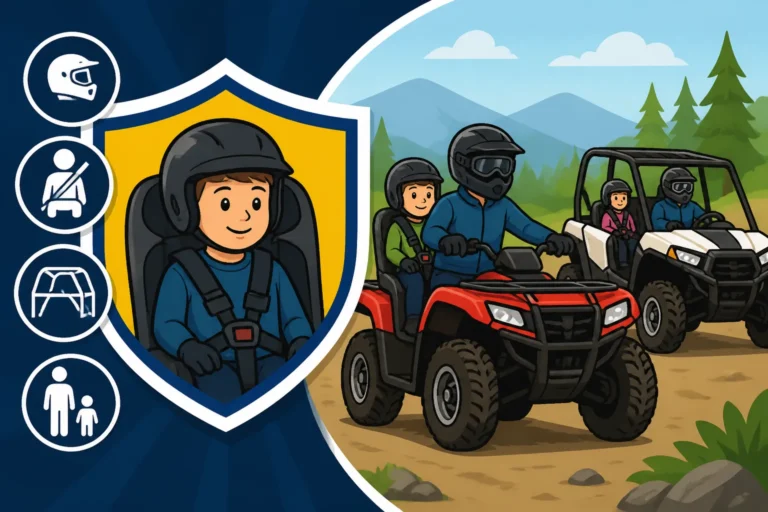
Safety gear isn't just a suggestion; it's a legal requirement in many ORV operating contexts, and absolutely so when interacting with highways. If you're on a ride-astride machine like a quad or a dirt bike, [BC Helmet Law Covers Every Rider] – and that includes you during a highway crossing. The helmet must meet approved safety standards and be properly secured. This is not the time to be casual about head protection.
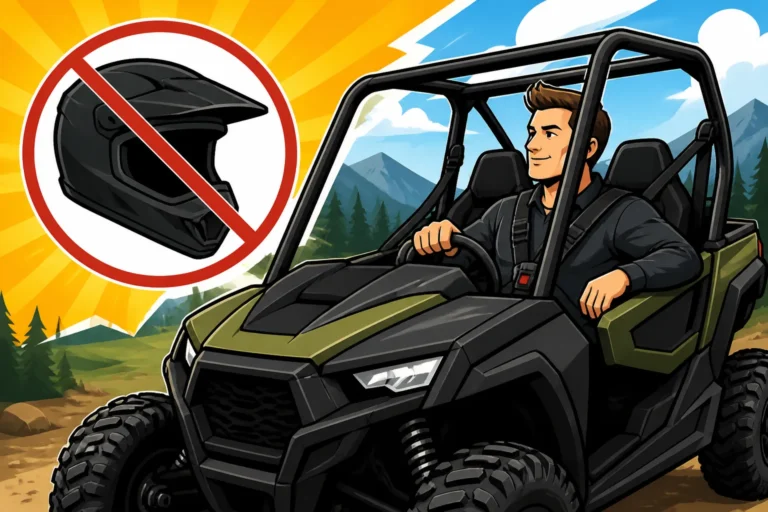
For side-by-sides (UTVs) that come equipped with seat belts and rollover protection systems (ROPS), the rules shift slightly. In these machines, seat belts are mandatory for all occupants when provided. While some jurisdictions might allow helmets to be optional in a belted side-by-side, it's always wise to check local specifics and err on the side of caution. For any highway interaction, ensuring all occupants are securely belted in is paramount. You can find robust harnesses and safety equipment to enhance your UTV's safety from companies like SuperATV, ensuring maximum protection for all riders. [BC Lighting and Seat Belt Requirements] are in place to save lives and prevent serious injuries.
Lighting and Visibility Requirements
When your ORV enters the highway environment, even briefly, it needs to be seen. This means your machine must be equipped with working headlights and taillights. [BC Lighting Rules in Low Visibility] and even during daylight hours for safety are critical. If you're riding at dusk, dawn, or in adverse weather, your lights become even more important.
Consider adding reflective tape or brightly coloured accents to your helmet or machine to further enhance your visibility. While standard ORV lights are generally sufficient for highway crossings, some riders add auxiliary lights, especially if their typical riding involves dark trails. The goal is to make sure drivers of other vehicles can spot you clearly and react appropriately, minimizing the risk of a collision during those short, necessary moments on the pavement.
| Activity | BC Requirement for ORV on Highway | Additional Key Points |
|---|---|---|
| Highway Crossing | Basic Autoplan (ICBC) + Driver's Licence | Must obey all traffic laws (stop signs, lights). Most direct path. |
| Riding Highway Shoulder | Generally NOT permitted | Rare, specific exceptions may exist with explicit local authorization or police permit. |
| Police Operation Permit | Basic Autoplan (ICBC) + Driver's Licence | Issued for specific routes/purposes, not general recreation. Must carry permit. |
| FSR/Resource Road Use | $200,000 Third-Party Liability (ICBC or Private) | Mandatory for all FSRs. Industrial traffic present. |
| General Crown Land Use | Voluntary Third-Party Liability (Private) | Highly recommended for all recreational use to cover potential damages/injuries. |
| Carrying Documents | Certificate of Registration + Photo ID | Mandatory for any ORV operation on Crown land or highway. |
| Head Protection | Helmet required for ride-astride machines | Helmets for side-by-sides are recommended but seatbelts are mandatory when provided. |
| Lighting | Functional Headlight & Taillight | Essential for visibility, especially during crossings or low light conditions. |
Disclaimer
This article is for general informational purposes only and does not constitute professional advice. Laws, prices and regulations vary by location and change over time. Consult a qualified professional for guidance on your specific situation.