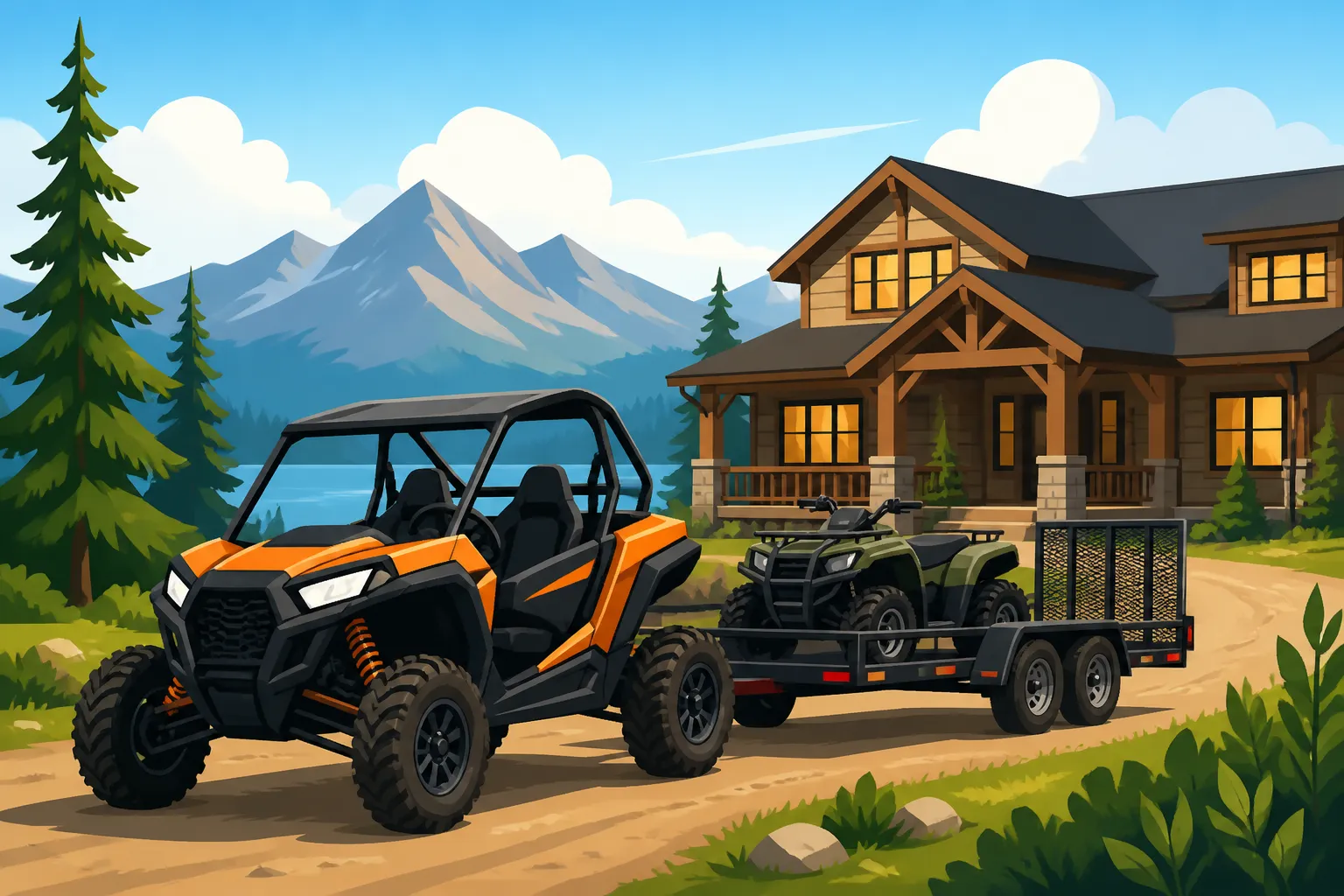
BC Lodging That Welcomes Trailers
Arriving at a BC riding area with a truck, trailer and several machines can turn a relaxing trip into a parking headache if your lodging cannot accommodate the whole setup. This guide explains how to find trailer-friendly places to stay, what to confirm before booking, and how to match your overnight plans with nearby trails and staging areas.
Match your accommodation to your riding plan
Start with the trailhead, not just the town
A place that welcomes trailers is only useful if it makes sense for the riding you want to do. Before comparing rooms or campsites, choose a likely riding area and identify where you will stage, unload and leave your tow vehicle. The nearest town may be a convenient base, but the drive from your accommodation to the trailhead can add time, fuel use and stress—especially if you are towing a long trailer on unfamiliar roads.
Look at the whole route, not only the final kilometre to a trailhead. Some approaches use narrow roads, steep grades, tight corners or roads shared with industrial traffic. A large trailer that fits in a highway motel parking lot may feel much less manageable after a long day of towing on a winding access road. Check the route and road conditions, then contact the lodging provider if you are unsure about the access.
It can also help to compare the accommodation’s location with nearby riding options. The guides to [BC ATV Trails: Where to Ride](BC ATV Trails: Where to Ride) and [BC Riding Areas Reachable in a Day](BC Riding Areas Reachable in a Day) can help you narrow down a destination before you reserve. If your plans depend on one specific staging area, check whether it has room for your trailer and whether you can leave your tow vehicle there while riding. [BC Trailheads With Trailer Parking](BC Trailheads With Trailer Parking) is another useful topic to review when planning that part of the trip.
Decide whether you need a campsite, cabin or motel
A campground may be the simplest option when you want to park your trailer beside your own campsite, but confirm that the site itself can fit both your camping setup and your tow vehicle. A listed campsite length may not describe the total space available for your truck, trailer and any extra vehicle. Ask how the site is measured and whether parking is included beside the site or somewhere else in the campground.
Cabins and motels can work well if you prefer a real bed and a hot shower after a dusty ride. Their trailer arrangements vary widely. One property might have an open gravel area where longer rigs can turn around; another might have a small paved lot with no room to leave a trailer attached. A listing that says “free parking” does not necessarily mean oversize parking is available.
If you want to sleep close to the riding area, compare lodging with campgrounds near your intended staging point. [BC Campgrounds Near a Staging Area](BC Campgrounds Near a Staging Area) can help frame the search. Consider what matters most to your group: a shorter morning drive, electrical hookups, wash facilities, a restaurant nearby or a place to leave the trailer securely. There is no single best setup. A couple travelling with one machine may be comfortable at a motel, while a group with several rigs may be better off booking a campground with suitable sites and turning space.
Confirm trailer details before you book
Ask precise questions about space and access
“Do you take trailers?” is a good start, but it may not get you a useful answer. The person booking rooms may picture a small utility trailer, while you are arriving with a long enclosed trailer and a full-size truck. Describe your setup as clearly as you can, including the approximate combined length, trailer width, whether it has a turning axle or tight turning radius, and whether you plan to unhitch.
Ask where the trailer will be parked and whether the space is reserved. Find out if you need to back into a stall, turn around in a confined area, park on a slope or leave the trailer attached overnight. If your vehicle and trailer cannot be separated, say so. A property may have room for a trailer but not enough room for a truck and trailer together.
It is also worth asking about the driveway surface and the route into the property. Loose gravel, a sharp entrance or a narrow lane can be difficult with a heavy load, particularly in poor weather. If the answer is vague, ask whether staff can describe the parking area or direct you to a more suitable option nearby. A brief call before paying is usually easier than trying to solve a parking problem after arriving late.
| What to confirm | Why it matters | A useful question |
|---|---|---|
| Trailer length and width | “Trailer parking” may refer to smaller setups | “Can a truck and trailer of this approximate combined length fit?” |
| Turning and backing space | A parking spot is not helpful if you cannot reach it | “Can I turn around on site, or would I need to back in?” |
| Attached or separate parking | Some lots can fit a trailer only after unhitching | “Can the truck stay attached overnight?” |
| Reserved space | Busy weekends may change what is available | “Will a suitable space be held for my booking?” |
| Surface and slope | Gravel, mud or a steep grade can complicate parking | “Is the parking area level and suitable for a loaded trailer?” |
| Security and access | You may leave valuable machines in or on the trailer | “Is the parking area gated, monitored or accessible to other guests?” |
| Washing and cleanup rules | Muddy machines can create problems for hosts | “Are there restrictions on washing or bringing muddy equipment onto the property?” |
Think about security, noise and cleanup
A trailer carrying ATVs or a side-by-side may attract attention, so ask how parking is arranged rather than assuming it will be beside your room or cabin. Some travellers prefer to keep the machines locked in an enclosed trailer; others bring separate locks or use a covered parking area. Find out what the property provides, but make your own security plan and avoid treating a general parking area as secure storage.
Be considerate about unloading, loading and early starts. Ramps, tie-downs and engines can be noisy, particularly in a small motel lot or campground where guests are close together. If you need to load before sunrise or return after dark, ask whether there are quiet-hour rules and where you can work without disturbing other guests.
Mud and dust are part of riding, but properties may have rules about washing machines, parking on lawns or tracking dirt through shared spaces. Ask before rinsing a machine or trailer. If washing is important, look for a designated wash area nearby and confirm its availability rather than assuming a hose or drain will be provided. The topic [BC Riding Areas With Wash Stations](BC Riding Areas With Wash Stations) may help you plan this practical part of the trip.
Plan the journey and the riding day together
Check access, closures and services
A trailer-friendly room does not guarantee that the route to your riding area is open or suitable. Before leaving, check access information for the roads and trails you intend to use. Conditions can change after storms, washouts, logging activity or seasonal restrictions. If the plan depends on a particular road or trail connection, have another option in mind. [BC Trail Closures After a Storm](BC Trail Closures After a Storm) is a useful reminder to treat route conditions as part of trip planning, not as an afterthought.
Use maps to understand the layout, but confirm important access details through official notices or the relevant local land manager. Tools such as onX Offroad can help you view riding routes and organize a trip, but a map display should not be treated as permission to ride or as a guarantee that a road is open. Check current restrictions, signs and land-use rules before heading out, and be ready to change plans if conditions do not match what you expected.
Think beyond the trailhead, too. A long ride can leave you needing fuel, groceries, food or a place to repair a loose strap before the next day. If you are comparing accommodation in a few different communities, use [BC Riding Areas With Fuel Nearby](BC Riding Areas With Fuel Nearby) as one planning consideration. Note where fuel and basic supplies are available, especially if the riding area is remote or your group has machines with different ranges.
Build a realistic overnight schedule
Towing, unloading and riding all take longer than they look on a map. If you are driving from the Lower Mainland toward the Fraser Valley or continuing into the Interior, leave room for traffic, fuel stops and breaks. A late arrival can make backing into an unfamiliar campground or motel lot harder, especially when other guests are already parked around you.
For a weekend trip, consider whether it is easier to book one base for both nights or move between communities. Staying in one place can reduce the amount of loading and unloading, while changing locations may put you closer to a second riding area. If you are travelling with a group, agree in advance on who is responsible for booking, confirming the trailer space and sharing directions. [BC Weekend Riding Itineraries](BC Weekend Riding Itineraries) can help you think through how much riding and travel to fit into a short getaway.
Before you depart, save the accommodation address, the parking instructions and the route to your staging area where you can access them without relying on a strong cell signal. onX Offroad may be useful for organizing the riding portion of a route, but keep accommodation details and backup directions available separately. Make sure everyone in the group knows the plan for parking, departure time and where to meet if a vehicle or machine needs attention.
Use a simple booking checklist
Confirm the important details in writing
Once you find a possible place to stay, confirm the trailer arrangements directly with the property. If you book online, follow up by phone or message and describe your setup. Keep the reply with your reservation details so you can refer to it if the person on duty has not seen the original conversation.
Ask whether the parking arrangement changes on busy weekends, whether you need to reserve an oversize space, and whether there are limits on running engines or loading machines at certain hours. If you are travelling with several trucks and trailers, provide the number of rigs rather than only the number of guests. One trailer space will not solve the problem if your group arrives with three.
The same care applies to campgrounds. Confirm the site’s dimensions, vehicle rules, hookups and whether the trailer can remain attached. A campground may have a separate overflow parking area, but that could mean moving machines or equipment farther from your campsite. If that setup does not suit your group, it is better to learn before arriving.
Keep a backup option
Even a well-confirmed reservation can meet an unexpected obstacle: a road closure, a trailer problem, weather or a change in the group’s plans. Keep the contact details for a backup campground or lodging option in the same general area. Do not assume another property will accept a large trailer without checking first.
It is also sensible to choose a fallback riding area that does not depend on the same access road. onX Offroad can help you keep potential routes organized, but double-check any alternate route for access rules, road conditions and suitability for your machine. A second line on a map is not automatically a legal or practical route for a loaded truck and trailer.
Finally, take a moment before booking to compare the full trip rather than the nightly rate alone. A place farther away may require extra towing and fuel; a nearby option may have tighter parking or no safe place to leave the trailer. The best fit is the one that gives your group a workable place to stay, a realistic route to the riding area and enough room to park without turning arrival night into a stressful manoeuvring exercise.
Disclaimer
This article is for general informational purposes only and does not constitute professional advice. Laws, prices and regulations vary by location and change over time. Consult a qualified professional for guidance on your specific situation.