BC Campgrounds Near a Staging Area
Arriving at a BC trailhead with a trailer, tired riders, and nowhere suitable to camp can turn a weekend ride into a stressful scramble. The key is to plan for both the campground and the staging area: they may be close on a map but separated by rough roads, access restrictions, or rules that don’t allow riding between them. This guide explains how to choose and check a campsite.
How to choose a campground near an ATV staging area
Start with the ride, then find a place to camp
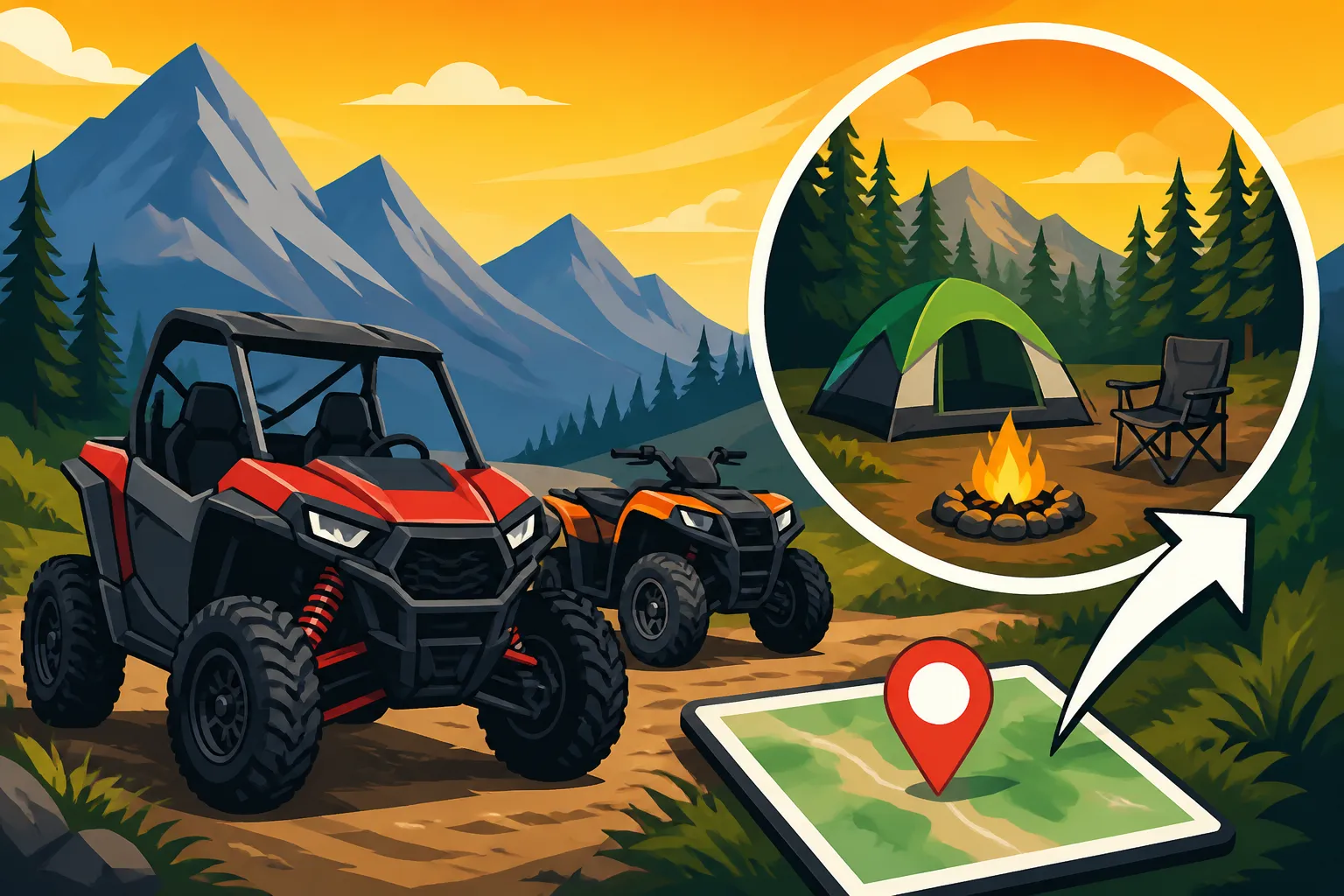
A campground that looks close to a trailhead on a map may not be convenient for an ATV weekend. The access route might be a narrow or rough forest road, the campground may not allow off-highway vehicles, or there may be no legal way to ride from the campsite to the staging area. Plan around the actual route you’ll travel with your truck and trailer, not just the distance between two map pins.
First, choose the riding area and identify its staging location. Then look for a campground that works as a base for transporting your machine to the trailhead. If you’re considering a managed site, check the operator’s rules and pass requirements before you go. [BC ATV Trails: Where to Ride] can help you explore possible riding areas, while [BC Campgrounds Near a Riding Area] is a useful related topic when comparing places to stay.
Think through a typical morning. You wake up at camp, eat breakfast, pack water and riding gear, load the machine, and drive to the staging area. If the route involves a rough road or a slow trailer haul, a campground that appears a few kilometres away may still add a significant amount of time. Conversely, a campground farther away but reached by a straightforward paved route might make the day easier.
Check what “nearby” means on the ground
There are several different ways a campground can be near a staging area. It might be beside the staging lot, within a short drive, along the same forest service road, or simply in the same general region. Those are not interchangeable. Before booking or setting out, confirm the exact road route, where you can leave a trailer, and whether the route is suitable for your vehicle and load.
Pay attention to the campground’s access road as well as the trail access road. A rough road may be manageable for a high-clearance truck but unpleasant with a long trailer, especially after rain or during busy periods. Check for narrow sections, steep grades, tight turns, limited room to pass, and any posted restrictions. If you’re relying on a map app such as onX Offroad to assess roads and terrain, treat it as a planning aid rather than confirmation that a route is open or appropriate for your setup. Cross-check road access and restrictions before leaving.
It’s also worth asking whether you can park a truck and trailer at the campground while riding elsewhere for the day. Some campgrounds have clear parking arrangements; others have limited space or rules about trailers. If the site and trailhead are separate, plan to keep the machine secured at camp or transport it to the staging area rather than assuming you can ride directly between the two.
BC riding areas to consider when planning a camping base
Bear Creek and the Kelowna area
Bear Creek is a well-known riding destination in the Kelowna area, with staging locations and trails that riders may use as a base for a day out. If you’re looking for a campground nearby, compare camp options by driving route, not only by straight-line distance. Westside Road and the roads leading toward a staging area can make a major difference to how convenient a campground feels when you’re towing.
Before settling on a site, confirm that it can accommodate your trailer and that its camping rules fit your plans. Then check the staging-area arrangements, including any required pass and where to park. Bear Creek may be a strong option for riders seeking established trail access, but the right campground depends on your group, vehicle, and comfort with the access road. For area-specific background, see [Bear Creek OHV: BC's Largest Recreation Site] and [Staging at Aspen Trail Head in BC].
Use onX Offroad or another mapping tool to sketch the route from your prospective campground to the staging area, noting road connections and possible detours. Then verify those details with the campground or local recreation contact. A line on a map does not establish that an ATV can legally travel that road, that a gate will be open, or that a particular parking area has space for a trailer.
Chilliwack and Chipmunk Creek
The Chilliwack area offers another possibility for a camping-and-riding weekend. Riders looking at Chipmunk Creek should distinguish between the riding site, its staging facilities, and nearby places to camp. A campsite in the general Chilliwack Valley may be useful as a base, but it isn’t automatically connected to the riding area by a legal or practical ATV route.
Check your intended drive carefully, especially if your trip includes forest service roads. Conditions and access can vary, and roads used by industrial traffic may require extra attention. Confirm whether the campground is open for your intended dates, what facilities it offers, and whether your group can bring the trailer. Also check the riding area’s access conditions and any site-specific requirements before you leave home.
For planning context, review [Chilliwack Area Riding in BC], [Chipmunk Creek's 60 BC Kilometres], and [Camping at Chipmunk Peninsula in BC]. These topics can help you understand the regional options, but confirm the specific campground location and route you intend to use. A campsite with the right amenities but an awkward trailer approach may be less practical than a simpler site with easier access.
| Planning question | Why it matters | What to confirm |
|---|---|---|
| How far is camp from the staging area by road? | Map distance may not reflect the actual drive | Driving route, road surface, and likely detours |
| Can the campground fit your trailer? | Sites and parking areas vary in size | Trailer dimensions, parking rules, and turning room |
| Is there a legal route between camp and the trail? | Nearby locations may not be connected for ATV use | Whether riding between locations is allowed |
| Are passes or fees required at the riding site? | Camping and trail access may be managed separately | Current site requirements and where to obtain proof |
| Are roads open and suitable for your setup? | Conditions and restrictions can affect access | Posted closures, gates, traffic, and road condition |
Tabor Mountain and the Prince George area
Tabor Mountain near Prince George is another area riders may consider when searching for a weekend base. The first step is to identify which staging location you plan to use and then look for camping options that suit the group’s needs. A campground that serves Prince George as a whole may still involve a longer tow to the trailhead, so compare the full drive rather than choosing based on a broad regional label.
Think about the kind of camping your group needs. A family may value washrooms, a predictable place to park, and space to settle in after riding. A group carrying several machines may care more about trailer access, secure parking, and a simple route to the staging area. Don’t assume that a campsite allows machines to be unloaded or stored on the site; ask about those details directly.
For an overview of riding in the area, see [Prince George Riding on Tabor Mountain] and [Staging at Burke Trail Head in BC]. If you’re comparing several options, onX Offroad can help you visualize the area and organize route ideas, but use official or local information to confirm access and restrictions. A map is most useful when you treat it as one part of the check—not the final word.
What to verify before you book or drive
Campground rules, space, and facilities
Before committing to a campground, confirm the basics that can make or break a trip: whether it is open for your dates, how reservations or first-come arrangements work, whether your trailer is allowed, and where you’re expected to park it. Ask whether the campsite itself has room to maneuver. A site can technically accept a trailer but still be difficult to use if the access road is tight or the parking area is awkward.
Check the facilities your group will rely on. Water, toilets, garbage disposal, fire rules, and cell service can vary significantly between developed campgrounds and more basic sites. If you’re traveling with children, older relatives, or riders who need to manage medication or other essentials, be realistic about the distance to services. Carry a backup plan in case the campground is full or closed when you arrive.
It’s helpful to write down the campground’s directions and contact information before leaving. Cell coverage can be limited in some riding areas, and a saved map may not show a closure or a last-minute access issue. If your group uses onX Offroad to prepare offline maps, make sure everyone knows how to use the saved information and where it may not reflect current road conditions.
Staging-area access and ride-day logistics
A campground and a staging area are separate parts of your plan. Verify the staging location, available parking, and any pass or access requirements independently from the campground. A campsite does not grant trail access, and staying near a trailhead does not necessarily mean you can ride on every connecting road. [BC Trails That Allow Side-by-Sides] may be helpful if your group includes UTVs, while [BC Trailheads With Trailer Parking] can guide your search for suitable launch points.
Plan how you’ll move your machines. If you intend to tow them to the staging area, confirm that the lot can accommodate your vehicle and trailer and that overnight parking is permitted if you need it. If you expect to ride from camp, check the route and applicable rules first rather than relying on a short distance or a visible track on a map. When a route includes a forest service road, road traffic and posted restrictions deserve particular attention; [BC Forest Service Road Rules for ORVs] is a useful place to explore that part of the planning.
Finally, build a backup into the itinerary. Keep an alternative campground or staging option in mind, and agree on a meeting point in case members of the group arrive separately. Tell someone where you plan to ride and when you expect to return. A little preparation can prevent a late-night search for an open campsite or a morning spent sorting out a trailer where it doesn’t belong.
A practical checklist for a smoother weekend
Before you leave home
Write down the campground’s location, arrival instructions, and relevant rules. Confirm that the site suits your trailer and group, and check whether you need to arrange anything in advance. Separately confirm the riding area, staging point, access requirements, and any closures or restrictions that affect your intended route. Keep the campground and staging-area information together so you don’t mistake one set of rules for the other.
Check your vehicle and trailer for the drive, particularly if your route includes rough or remote roads. Secure the machines, bring tie-downs and basic recovery supplies, and make sure you have the tools you normally need for a trail ride. Save directions or maps for offline use where possible, but remember that a saved map cannot tell you whether a gate is open today or whether a road is suitable for your trailer.
If you’re meeting friends at the campground, share the same route and arrival plan. One person may assume the group is staying near the trailhead, while another may have booked a site in town. Agree on where the trailer will be parked, when you’ll head to staging, and how you’ll reconnect if someone loses cell service.
On arrival and during the ride
Before unloading, take a moment to check the campground layout and confirm where your vehicle and trailer belong. Keep access lanes clear and follow the site’s rules for noise, fires, and waste. If the campground is much farther from staging than expected, pause before changing the plan; check that any alternate route is permitted and suitable rather than improvising an ATV connection.
At the staging area, follow the posted instructions and park so others can load, unload, and turn around safely. Carry whatever proof or pass the site requires. If your ride takes you onto a resource road, be alert to industrial traffic and use the practices appropriate to the road and local conditions. [BC Resource Road Radio Practice] is a relevant topic to review when your route involves shared resource roads.
A good campground near a staging area is not simply the closest one. It is the place that fits your group, vehicle, trailer, and riding plan while keeping camping access, trail access, and road rules clear. Confirm those pieces separately, and the weekend is far more likely to start with an easy setup instead of a rushed search for somewhere to park.
Disclaimer
This article is for general informational purposes only and does not constitute professional advice. Laws, prices and regulations vary by location and change over time. Consult a qualified professional for guidance on your specific situation.