BC’s Federation Sells Membership, Not Passes
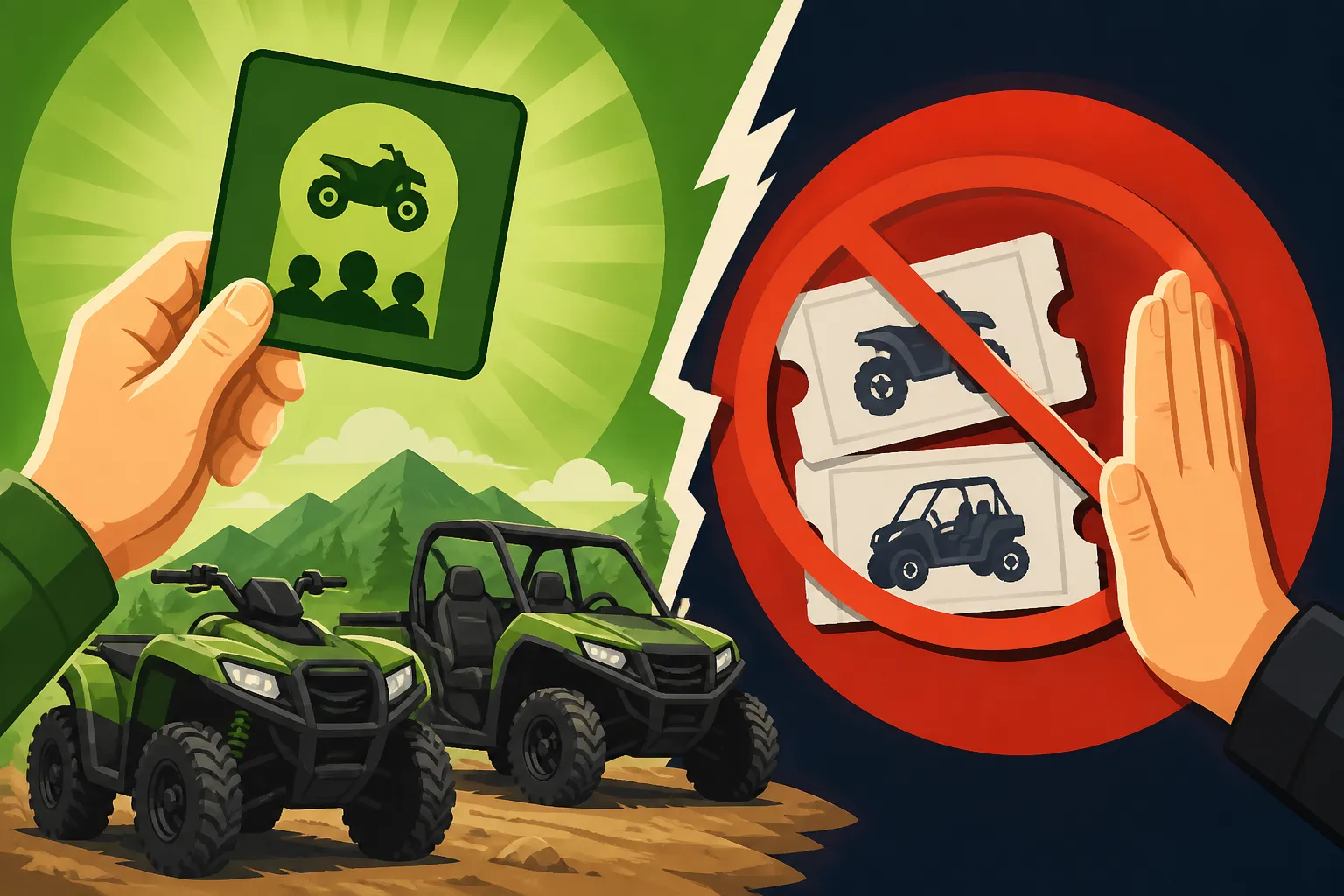
A provincial ATV federation and a trail pass can sound like two names for the same thing. They are not. Membership generally supports a federation or club; a pass is permission required by a particular managed riding area. Knowing which one you need helps avoid paying for the wrong thing—or arriving at a trailhead without the access authorization that site requires.
What the federation sells and what a pass does
A federation represents and supports ATV clubs and riders. It may coordinate advocacy, share information, support trail work, or offer benefits through its member network. Joining the federation, directly or through a member club, is a way to take part in that work and access whatever benefits are currently included.
A trail pass serves a different purpose. It is an access requirement set for a particular managed riding site, trail network, or event. Depending on the area, the pass may help fund trail maintenance, facilities, signage, or site operations. It does not automatically come with federation membership.
In short:
| Item | What it is for | What it does not automatically provide |
|---|---|---|
| Federation membership | Supporting a provincial organization and receiving the membership benefits it offers | Permission to ride every managed site |
| Club membership | Supporting a local club and participating in its activities and member benefits | A pass for every trail system |
| Site or trail pass | Meeting an access requirement for a specific managed area | Province-wide access or membership in a federation |
| Vehicle registration | Showing that a machine is registered where required | A trail pass, insurance coverage, or permission to use a closed road |
The distinction matters because British Columbia does not have one province-wide ATV trail pass that covers every riding area. Some places may have no pass requirement, while a club-managed or otherwise managed site may require its own pass. The site’s current rules are what matter.
This is also separate from provincial requirements for operating an off-road vehicle. For example, registration rules can apply when riding in situations covered by the provincial rules, whether or not the rider belongs to a club. See BC’s Rule Keys on Whether Home Has a Registry and What the Off-Road Vehicle Act Covers in BC for the difference between registration and site access.
Why the wording causes confusion
Riders often hear that a club or federation “has a pass” and assume that buying membership grants access to all the trails connected with that organization. Sometimes membership may include a benefit at a particular site, or a club may arrange access for a ride or event. But that does not make membership a general pass.
The reverse confusion happens too: someone sees a pass for sale at a trailhead and assumes it is the same as joining the local club. A pass may simply meet the site’s access requirement for a ride. It may not include a vote, club participation, volunteer opportunities, insurance benefits, or any other membership feature.
The safest question is not “Does the federation sell passes?” but “What does this specific site require today, and who issues that authorization?” A federation membership page, a club page, and a site’s access instructions may describe different things.
Membership can still be worthwhile
“Membership is not a pass” does not mean membership has no value. A local club may organize group rides, maintain trails where it has permission to do so, provide local route knowledge, or help riders understand closures and access conditions. A federation can represent shared interests and connect clubs across the province.
Those benefits are different from permission to ride a specific location. Think of membership as participation and support; think of a site pass as a condition of access. You may want one, the other, both, or neither, depending on where you ride and what the organization offers.
Membership terms and benefits can change. Before joining, check whether you are joining a local club, the provincial federation, or both, and read what the current membership actually includes. Do not infer that a pass is included unless the relevant club or site says so clearly.
How to find out whether your riding area requires a pass
Pass requirements are local, so start with the destination rather than buying a general membership and hoping it covers the ride. Some managed sites sell day passes; some offer other pass options; and rules can differ between a club’s trails, neighbouring public land, and roads used to reach the staging area.
Check the site that manages the riding area
Identify the exact trail system and its manager. It may be a local club, a recreation site operator, a land manager, or another organization. Then look for current access instructions from that source.
Check for:
- Whether a pass is required for the riding area you plan to use
- Whether the requirement applies to every rider or machine in your group
- Which pass types are available and where they can be purchased
- How the site wants riders to show proof of payment or authorization
- Whether pass requirements differ for youth riders, organized events, or particular trail sections
- Whether a closure, fire restriction, or other temporary condition affects access
An old ride report, a social media comment, or a friend’s memory can be useful background, but it may not reflect current rules. A trail network can change managers, access conditions, or pass arrangements. Confirm close to the ride, especially if you are travelling a long distance.
The article BC Passes Exist Only at Managed Sites explains why a site-specific pass is different from a province-wide system. For a closer look at how a particular managed area may handle access, see Buying a Site Pass Straight From a Club.
Keep different kinds of permission separate
A pass answers only the question it was created to answer. It does not settle every other legal or practical requirement for the ride.
You may still need to consider:
- Registration: Whether your machine must be registered for the land or road where you will operate it.
- Insurance: Whether coverage is required on the road you plan to use, and whether your policy meets the requirement.
- Land access: Whether the route is open to motorized use and whether permission is required.
- Closures: Whether a road, trail, park, or area is temporarily or seasonally closed.
- Equipment and rider rules: Whether helmet, lighting, passenger, age, or supervision requirements apply.
- Event rules: Whether an organized ride requires additional permission or arrangements.
For example, a paid pass does not make a closed trail open, and a federation membership does not replace registration. Likewise, having registration paperwork does not mean you have permission to enter private land or use a managed trail that requires a pass.
If your route uses Crown land or a resource road, check the relevant rules separately. BC Crown Land Riding Explained and BC Forest Service Road Requirements cover access questions that a site pass alone cannot answer.
Ask a precise question
If the site’s information is unclear, contact the manager and describe the trip you have in mind. Useful questions include:
- “Is a pass required for this particular trailhead and route?”
- “Does this membership include the pass, or are they separate?”
- “Does each rider need a pass, or is access arranged another way?”
- “How should I carry or display proof?”
- “Does the pass cover the whole route, including the staging area?”
- “Are there any current closures or restrictions?”
A clear answer is more useful than a broad question such as “Does the federation have passes?” The federation may explain its membership, while the site manager controls the pass requirement. If the answers conflict, ask which organization has authority over the exact trail or facility you plan to use.
Membership, club support, and site access are different choices
The right purchase depends on what you want to do. If you want to support organized ATV work, meet local riders, or take part in club activities, membership may be a good fit. If you simply need permission to ride one managed site for a particular visit, the site’s pass may be the relevant item. Some riders choose both because they want to support a club and use its managed trails.
Joining a federation or local club
Before joining, check the name of the organization and the membership pathway. A provincial federation and a local club may have related but distinct memberships. A club might collect membership applications and connect members to the federation; another may explain its own membership separately. Confirm what your payment covers instead of assuming that “club member” and “federation member” mean exactly the same thing.
Useful details to check include:
- Which organization receives the membership payment
- Whether the membership is individual, household, or otherwise structured
- What benefits are included
- Whether any insurance-related benefit has conditions or limits
- Whether membership includes a site pass or only offers a separate way to buy one
- Whether volunteer work, meetings, or club rides are open to members
- When the membership starts and ends
Do not rely on a benefit mentioned in an older forum post. If a membership includes an insurance discount, event access, or a special site arrangement, ask how it works now and whether it applies to your situation. Membership benefits are not a substitute for reading your actual insurance policy or the access rules at the destination.
Buying a site pass
A site pass is the practical choice when the destination requires one. Follow the site manager’s directions for buying it and carrying proof. Some systems may provide an electronic confirmation; others may use a different method. The important thing is to know what the site accepts before setting out.
If you purchase online, save the confirmation where you can retrieve it without a strong cell signal. Take a screenshot or download the file if the provider permits it, and consider carrying a printed copy as a backup. Keep the pass details with your other ride documents, but do not assume that showing a payment receipt is enough if the site specifies another form of proof.
For riders who want a simple way to protect paper documents from mud or rain, a small waterproof sleeve—available from many outdoor retailers, including Amazon—can keep printed confirmation and emergency contact information together. A sleeve does not replace any proof the site specifically requires; it just helps keep paper readable.
If the site sells a pass at the staging area, do not assume that every location has staff, a working payment terminal, or cell coverage. Verify whether you can buy it before arriving. BC Pass Proof Without Cell Service has more on planning for proof when service is limited.
Donating or volunteering is not the same as purchasing access
Clubs often depend on volunteers and member support. You may be able to help with trail work, events, advocacy, or local information even if you are not riding a pass-controlled area that day. Conversely, buying a site pass does not necessarily make you a club member or volunteer.
This distinction is useful when deciding how to spend your money. If your goal is to support trail maintenance, ask whether the local club accepts memberships, donations, or volunteer help. If your goal is to comply with a specific site’s access rules, buy the pass that site requires. If both goals matter to you, treat them as separate contributions unless the organization confirms that one purchase covers both.
Avoid treating informal donations, a club sticker, or a membership card as proof of access unless the site manager explicitly says that is accepted. A friendly conversation with a volunteer can explain local practice, but the posted requirement or direct instruction from the manager should guide your decision.
Visitors, reciprocity, and out-of-province machines
For visitors, there are two separate questions: whether the machine’s home registration or ownership documents are accepted under the applicable rules, and whether the destination requires a local pass. Reciprocity between jurisdictions can affect vehicle documentation, but it does not automatically create access to a managed trail.
A rider arriving from another province or the United States should not assume that a home plate, registration card, or membership in a home riding organization is a substitute for a BC site pass. Nor should a visitor assume that buying a BC site pass resolves registration, insurance, or road-use requirements. Confirm each item independently.
A useful way to plan is to make a short list:
- Machine documentation: Check what proof of registration or ownership you should carry for your machine and circumstances.
- Insurance: Confirm that the coverage applies to the roads and land you expect to use.
- Site access: Ask the local manager whether a pass is required and whether non-residents follow the same pass process.
- Route conditions: Check closures, road restrictions, and any special rules for the area.
- Proof: Save the relevant documents and pass confirmation so they are available offline.
Relevant articles include BC Non-Resident Riding Rules, BC Riders From Alberta Use Alberta Plates, and BC Riders From Washington Use Home Plates. Use them for the vehicle-documentation side of the question, then check the destination separately for its access requirements.
Membership from home may not travel with you
A visitor’s home club membership may provide valuable benefits at home, but it does not necessarily transfer to a BC club or managed site. Even if two organizations cooperate, ask whether the arrangement applies to the specific location and dates of your trip. A reciprocal club benefit, where one exists, is not the same thing as a general right to ride anywhere in the province.
Likewise, a BC club membership should not be treated as a pass for every managed area. One club’s trails may have one arrangement, while another site uses a different process. Keep the site name and pass instructions with your trip plan.
A practical pre-ride check
The easiest way to avoid confusion is to check membership and access as separate lines on your ride checklist. Before leaving, confirm the site’s current rules and gather the documents required for the machine and route.
Use this quick process:
- Choose the exact area. A nearby trail network or road may have a different manager and different rules.
- Find the manager’s current access instructions. Do not rely only on old posts or a general federation page.
- Confirm whether a pass is required. If it is, ask who issues it, what it covers, and how to show proof.
- Decide separately whether to join. Consider membership for the benefits and support it provides, not as an assumed substitute for a pass.
- Check the rest of the ride requirements. Registration, insurance, closures, land access, and rider or equipment rules remain separate.
- Save proof offline. Store a permitted digital confirmation or printed copy where it will stay legible.
A small document wallet can also keep your registration certificate, insurance information, emergency contacts, and any required pass proof together. If you are assembling a ride kit, Amazon is one option for a basic waterproof document pouch; choose something that protects paper without making required information difficult to retrieve. For longer rides, a simple paper map stored in a water-resistant map case can be useful when your phone loses signal. A map case from Amazon may help protect it, but always use current route and closure information from the relevant manager.
Do not put every original document in a place where it could be lost with the machine or damaged in a spill. Keep an accessible backup of important contact and route details, and make sure the group knows who has the relevant paperwork. These are small preparations, but they make it much easier to answer questions at a trailhead or during a roadside stop.
Common assumptions to avoid
- “I joined the federation, so every trail is covered.” Membership is not a province-wide access pass.
- “I bought a pass, so I can ride any nearby road.” The pass covers only what its issuer says it covers.
- “My plate proves I can use this trail.” Registration and site permission serve different purposes.
- “The trail was open last time.” Closures and access rules can change.
- “A friend’s membership gets the whole group in.” Check whether the pass or membership applies to each person, machine, or visit.
- “There is no pass sign, so access is guaranteed.” Verify the manager’s instructions, especially at a managed site.
- “A club sticker is proof.” Carry the actual proof the site requires.
The central point is simple: the federation sells or coordinates membership, while individual sites or managers determine whether a riding pass is required. Membership may support the people and organizations that help make riding possible, but it does not create universal access. Check the destination, buy the correct authorization if needed, and treat registration, insurance, and land-use rules as separate parts of the plan.
Disclaimer
This article is for general informational purposes only and does not constitute professional advice. Laws, prices and regulations vary by location and change over time. Consult a qualified professional for guidance on your specific situation.