BC Spark Arrestor Rules and Fines
A spark arrestor is easy to overlook until a trail check, equipment problem or wildfire restriction brings it into focus. For ATV and UTV riders in British Columbia, the practical questions are where one is required, what counts as a compliant arrestor, and what can happen if you ride without one. This guide explains how to check your machine and reduce the risk of a costly mistake.
What British Columbia’s spark arrestor rule means for ATV and UTV riders
A spark arrestor is a device in an exhaust system designed to stop hot particles from escaping and starting a fire. It is not just a sound-reduction part. An effective arrestor is a wildfire-prevention measure, and its condition matters as much as whether one is fitted.
British Columbia’s wildfire rules address operating engines in places where a fire may start, including forest and grassland areas. For riders, that means you should not assume an ATV or UTV is exempt just because it is a recreational vehicle, because the ride is short, or because the machine is being used on a road rather than a trail. The relevant requirements can depend on the land, the machine and any restrictions currently in effect.
A useful starting point is to treat a working spark arrestor as part of your machine’s required fire-safety equipment whenever you ride in the backcountry. Check the applicable rules for the specific riding area, and follow any more restrictive requirements posted by a site operator or imposed during wildfire season.
This is separate from registration, insurance, trail passes and riding access. Having an arrestor does not make a closed road or prohibited area open to motorized use. It also does not replace any equipment or conduct rules that apply to your ride. For an overview of the broader access picture, see BC Crown Land Riding Explained and BC Forest Service Road Requirements.
The term “spark arrestor” is sometimes used loosely in product listings and rider conversations. A muffler, catalytic converter or quiet exhaust is not automatically proof that the machine has an effective spark arrestor. Nor does a part’s appearance alone confirm that it meets the relevant standard. Check the manufacturer’s information and the rules that apply where you plan to ride.
| Situation | What to do |
|---|---|
| Your machine has a factory exhaust | Check the owner’s manual or manufacturer information to confirm it has an arrestor and that the exhaust remains in the specified configuration. |
| Your exhaust has been modified | Confirm that the replacement system includes an appropriate spark arrestor and is installed and maintained as required. |
| You cannot identify the arrestor | Ask a qualified powersports shop or the machine’s manufacturer before riding in a fire-risk area. |
| A recreation site posts an additional equipment rule | Follow the site’s rule as well as applicable provincial requirements. |
| A fire restriction or closure is in effect | Check what it prohibits. A spark arrestor does not grant permission to ride during a closure. |
Requirements and restrictions can change. Before a trip, confirm the current rules with the responsible official source or site operator, especially if you are riding in an area affected by wildfire risk.
Where the rule matters and why location is important
A spark arrestor is particularly important wherever an operating engine could ignite dry vegetation, forest litter or grass. Those conditions can occur beside a trail, on a resource road or at a staging area, not only in remote wilderness. A ride through apparently green terrain can also pass through a dry patch or an area where vegetation has cured.
The land category and the current restrictions help determine what rules apply. Public land, private land, a managed recreation site and an industrial road can each have different access conditions. A landowner or site manager may set additional requirements, while fire-related restrictions can temporarily limit vehicle use in a much wider area. Do not rely on a map label alone to settle the question; check the current access and fire notices for the route.
Crown land and resource roads
Riding on Crown land does not remove fire-safety responsibilities. A route can cross different types of land or be subject to a closure that is not obvious from the trail itself. Forest Service roads may also have active industrial traffic, posted restrictions or temporary closures. A working spark arrestor is only one part of deciding whether a ride is allowed and safe.
For broader context on where Crown land access rules come into play, read BC Crown Land Riding Explained. If your route uses a Forest Service road, review the road requirements before you go rather than assuming that an open gate means every type of vehicle use is permitted.
Managed recreation sites
A managed riding site may have its own posted equipment rules, inspection practices or conditions of use. Those rules can be more specific than what a rider assumes from general provincial requirements. For example, a site may require equipment to be in good repair, impose a noise limit, or restrict access to certain types of machines.
Check the site’s current information before loading the ATV or UTV. If it operates a pass system, do not confuse a pass with permission to ignore its safety conditions. BC Passes Exist Only at Managed Sites explains why a local trail pass is not the same as a province-wide authorization. For noise-specific requirements at a managed location, see BC Sound Limits on a Managed Site.
Private land is not a reason to ignore fire risk
The rules that apply on private property can differ from rules for Crown land or a managed site, but a fire can spread beyond the property where it starts. Follow the landowner’s conditions, any applicable wildfire restrictions and sensible fire-prevention practices. If you are unsure whether a particular rule applies to the land you are crossing, ask the owner or responsible authority instead of guessing.
Fire bans and closures are separate
A compliant spark arrestor does not override a fire prohibition, vehicle restriction or area closure. Restrictions may apply across a fire centre, to a specific activity or to a particular area, and they can change as conditions change. Before heading out, check current notices for both your destination and your route. BC Fire Centre Riding Bans and Checking a Fire Ban Before You Ride in BC cover that separate but related issue.
What counts as an effective spark arrestor
The practical standard is not simply “there is something inside the muffler.” The arrestor must be the appropriate type for the exhaust, installed in the required configuration and kept in effective working order. A damaged, missing, clogged or improperly modified component may not do the job even if the machine once came with one.
An arrestor is usually part of, or fitted into, the exhaust system. Some designs use a screen to catch hot particles; other arrangements may use a different manufacturer-specified design. Avoid assuming that every machine uses a removable screen or that one universal part fits all ATVs and UTVs. The exact design depends on the machine and exhaust.
For a plain-language explanation of the component, see How a Spark Arrestor Screen Actually Works. If you need to identify what the rules or product documentation require of an exhaust screen, What Exhaust Screen the Wildfire Rules Require is a useful next step.
Factory equipment is a starting point, not a guarantee
A stock machine may have been built with an appropriate exhaust system, but its condition can change. Previous owners may have replaced the muffler, removed a screen, drilled or altered the exhaust, or fitted an aftermarket part. A machine that sounds quiet is not necessarily compliant. A machine that sounds loud may have several problems, but sound alone does not tell you whether an arrestor is present.
If the ATV or UTV is used, ask the seller whether the exhaust has been modified and request any documentation for replacement parts. Inspect the actual system instead of relying only on a verbal assurance. If the configuration is unclear, have a qualified mechanic identify it before riding in an area where the requirement applies.
Aftermarket exhausts need careful checking
Aftermarket parts can change how an exhaust performs, and some systems are sold in configurations that require a separate arrestor or insert. Read the manufacturer’s installation information for the exact part and machine. Do not assume a listing’s use of words such as “off-road,” “performance” or “quiet” proves that the system includes a compliant spark arrestor.
If you shop online, including through Amazon, use the listing as a starting point for finding the manufacturer and part number, not as the final authority on compliance. Check the manufacturer’s documentation and confirm that the part is intended for your exact machine and exhaust configuration. A generic screen that appears to fit may not be the correct component.
Noise control and spark arresting are different jobs
A muffler reduces exhaust noise. A spark arrestor is intended to prevent hot particles from leaving the exhaust. A component can contribute to both functions, but the terms are not interchangeable. A quiet machine may still have a missing or ineffective arrestor, and a functioning arrestor does not automatically bring an exhaust within a site’s noise limit.
Likewise, a catalytic converter is not something to treat as a substitute without confirming the manufacturer’s configuration and the applicable requirement. Avoid removing, bypassing or altering exhaust components unless a qualified professional confirms that the resulting system remains appropriate for the machine and legal where you ride.
Inspect the whole exhaust, not just the outlet
Look for obvious signs of modification, damage, loose fasteners, missing inserts, corrosion or parts that do not match the manufacturer’s documentation. If the design uses a screen, check that it is present and in good condition. Do not reach into a hot exhaust or attempt to inspect or service it while the machine is running. Follow the manual’s cool-down and maintenance instructions.
The visible end of the muffler may not show the complete arrangement. Some arrestors are internal or require access through a service point. If you cannot tell whether the required part is installed, do not improvise an answer. Consult the manual, manufacturer, dealer or a qualified repair shop. Finding the Spec Stamped on Your Muffler and Checking an Arrestor Before a Ride offer practical guidance for identifying and checking the component.
How to check your ATV or UTV before a ride
A short pre-ride check is far easier than discovering an exhaust problem at a trailhead or during an inspection. Make it part of your routine whenever the machine has been repaired, modified, borrowed or bought used. Repeat it if a ride includes a long stretch of rough terrain that could loosen or damage exhaust parts.
- Identify the exhaust system. Find out whether it is the original equipment or an aftermarket replacement. Note the manufacturer and part information where available.
- Check the manual or manufacturer documentation. Confirm whether the machine has a spark arrestor, what type it uses and whether the required part is integral to the muffler or separately installed.
- Look for alterations. Watch for a missing insert, non-standard hardware, a different muffler or signs that a previous owner opened or changed the exhaust.
- Check condition and fit. Look for damage, loose parts, heavy corrosion or a screen that is absent or clearly compromised. Follow the manual for any inspection or cleaning method.
- Confirm the riding area’s rules. Check site conditions, road notices, wildfire restrictions and closures. Do this close to departure because conditions can change.
- Get help if anything is uncertain. A dealer or qualified powersports mechanic can check the system and identify the right replacement part.
- Carry useful records. Keep the manual or part information accessible, particularly if the machine has a non-factory exhaust. Documents do not substitute for required equipment, but they can help explain what is installed.
If your machine has a removable screen
Some spark arrestors use a removable screen that needs periodic inspection or cleaning. Follow the manufacturer’s service instructions and use the correct part for the exhaust. A screen that is damaged, missing or installed incorrectly may not provide the intended protection. Do not replace it with an improvised mesh material based only on a visual resemblance.
If you buy a replacement screen online, including from Amazon, verify the exact manufacturer part number and machine fitment before ordering. Check the seller’s description against the exhaust manufacturer’s own information, and do not treat customer reviews as proof that the part meets the relevant requirements. A powersports shop may be a better option when the exhaust model is unclear or the system has been modified.
If you have an aftermarket exhaust
Check whether the system includes an arrestor, whether it must be purchased separately and how it is installed. Keep the product information and installation instructions. If the system is missing a required component, restore the specified configuration before riding where an arrestor is required.
An online marketplace such as Amazon can help you locate a replacement or identify a product name, but a listing can be incomplete or refer to a different exhaust version. Confirm compatibility directly with the part maker or a qualified shop. Do not ride on the assumption that a seller’s use of “spark arrestor” settles the legal question.
If you are buying a used machine
Look beyond the seller’s claim that the quad or side-by-side is “trail ready.” Ask whether the exhaust is stock, whether any parts have been removed and whether the arrestor has been serviced. If the seller cannot answer, inspect the exhaust with a mechanic before the sale or make the inspection a condition of purchase.
If the machine arrives with missing paperwork or an uncertain history, resolve the exhaust question separately from registration and ownership documentation. A machine’s registration status does not certify that its exhaust is compliant. Likewise, proof of ownership is not proof of a spark arrestor. For the registration side of a used-machine purchase, see Buying From a Private Seller in BC.
Keep the part information with your maintenance records
Record the exhaust make and model, the arrestor part number and any service date. This is especially helpful if different family members use the machine or if it spends part of the year in storage. A photo of the product label or a copy of the manual can save time when ordering a replacement, but it is not a replacement for an actual inspection.
Tickets, penalties and what enforcement can mean
Riders often ask for a single fixed fine. A specific violation ticket amount may apply to a spark-arrestor offence, and the listed ticket amount is commonly identified as $460. Legal amounts and enforcement rules can change, so confirm the current amount through an official source before relying on it. The key practical point is that a ticket is not the only possible consequence of ignoring wildfire requirements.
The serious maximum penalties associated with wildfire offences can be much higher. Administrative penalties may reach $10,000, while court-imposed fines can reach $1 million and imprisonment can reach three years for offences that qualify under the legislation. These are maximums, not the expected outcome for every spark-arrestor issue. The precise consequences depend on the conduct, the applicable provision, the circumstances and the enforcement process.
Do not interpret the maximums as a prediction that a rider will receive the highest penalty for a missing or damaged screen. At the same time, do not treat a ticket amount as a cap on every possible consequence. A fire-related offence can be assessed in light of what happened, the risk created, any damage and other relevant facts. BC Wildfire Penalties for Riders and How an Administrative Penalty Differs From a Court Fine explain the broader penalty framework.
A ticket is not the same as an administrative penalty or court case
A violation ticket is one way an offence may be handled. An administrative penalty is a separate enforcement tool, while a court case can involve a different process and potential consequences. The maximum court penalty is not automatically imposed when a ticket is issued, and the available enforcement response may depend on the particular offence.
If you receive a ticket, read the details carefully. Check the offence described, the response instructions and any deadline printed on the ticket. If you believe the ticket is wrong, use the dispute process described by the issuing authority rather than ignoring it. If the allegation could carry serious consequences, consider getting qualified legal advice.
A fire can make the consequences much more serious
The risk is not limited to the cost of replacing an exhaust component. If a machine is operated in a way that starts or contributes to a wildfire, the resulting investigation, damage and potential legal exposure may be substantial. A spark arrestor is one part of prevention; riding during a ban, disregarding a closure or operating carelessly can create additional problems.
Even without a fire, riders should expect enforcement officers to take required equipment seriously in areas where the risk is elevated. A missing arrestor, a visibly altered exhaust or a refusal to follow posted conditions can draw attention. Do not assume that a remote location means there will be no inspection.
What an officer may check
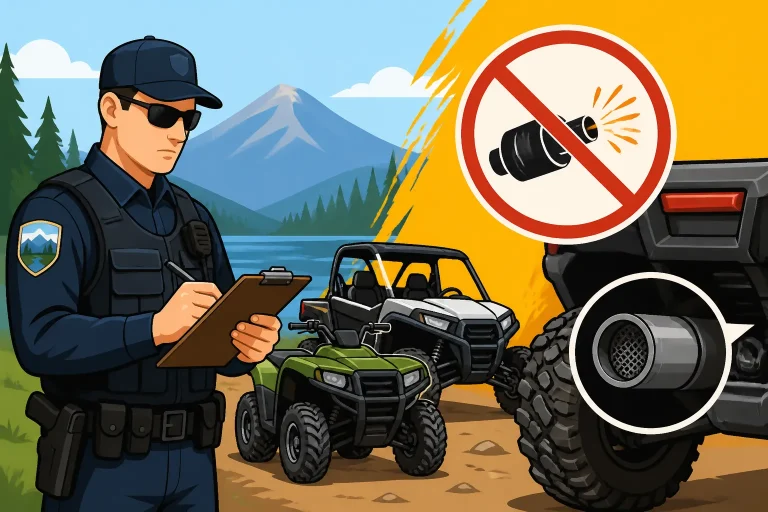
An officer may examine the exhaust or ask about the machine’s equipment, particularly when checking compliance with wildfire rules or site conditions. A rider may be asked to identify the arrestor or show that the system is in the required condition. Keep your answers factual. If you do not know whether a modified exhaust meets the requirement, do not claim certainty you cannot support.
The exact inspection procedure can vary with the situation and authority involved. Do not rely on a particular officer’s past practice as a guarantee about what will be checked on your next ride. When an Officer Checks Your Spark Arrestor Screen explains what to expect and how to prepare.
Common spark arrestor mistakes to avoid
Most problems are preventable. They often begin with an assumption: that a stock muffler must still be compliant, that a quiet exhaust must be safe, or that a trail is too damp for fire rules to matter. Use the following mistakes as a final check before heading out.
Assuming the factory exhaust is still intact
A machine may have been modified by an earlier owner. Confirm the actual configuration on the ATV or UTV, particularly if you bought it used or do not recognize the exhaust. The model year alone does not prove that the original parts are still installed.
Treating a muffler as proof
A muffler primarily reduces noise. It may contain or work with an arrestor, but the presence of a muffler does not answer whether the required spark-arresting component is installed and effective. Verify the system using manufacturer information.
Installing a generic screen
A screen that looks similar may have the wrong dimensions, material or design. Use the specified replacement part or have a qualified shop identify an appropriate option. Avoid home-made substitutions and modifications that can change how the exhaust works.
Riding with a damaged or clogged component
An arrestor needs to be maintained according to the manufacturer’s directions. A neglected screen or damaged exhaust can fail to perform as intended. Do not wait for a trailhead inspection to learn that servicing is overdue.
Thinking an arrestor makes a closed area legal
Equipment compliance and access permission are separate issues. A machine with a perfect exhaust may still be prohibited from a road or trail. Confirm both the equipment rule and whether your route is open to your type of machine.
Relying on old information about fire conditions
Restrictions can change with weather and fire danger. A route that was open last weekend may be closed today, and a regional prohibition may apply beyond a single trail. Check current notices before departure and again if your plans change.
Assuming wet weather means no requirements
Wet conditions can reduce some fire risks, but riders should not decide on their own that an equipment rule no longer applies. Follow the applicable rule and current restriction. If an official notice changes the requirements, use that notice rather than a general assumption about the weather.
Confusing an inspection with a full mechanical certification
An officer’s inspection or a past ride without comment does not guarantee that the machine is compliant for every future trip. Equipment can deteriorate, rules can change, and different locations can impose additional conditions. Keep checking the system and the rules.
A practical plan before you ride
Use this routine whenever you are preparing for a backcountry trip, especially if the ATV or UTV has a modified exhaust or will be used during a dry period.
- Confirm the machine’s exhaust configuration. Identify whether it is factory or aftermarket and determine how the arrestor is fitted.
- Verify the component. Use the manual, manufacturer details or a qualified mechanic to confirm that the correct arrestor is present and in working condition.
- Check maintenance needs. Inspect and clean or replace parts only as directed by the manufacturer.
- Review the destination’s conditions. Check access notices, managed-site requirements, road restrictions and any wildfire-related closure or prohibition.
- Pack the right information. Keep the part details and relevant maintenance records accessible in case you need to identify the system.
- Do not ride if the equipment is uncertain. Resolve the question before entering an area where a spark arrestor is required.
- Recheck when plans change. A detour, new staging area or changing fire restriction can alter which rules apply.
If you are purchasing a replacement online, including through Amazon, compare the product number with the exhaust maker’s documentation and confirm that the seller’s listing matches your exact system. If you cannot establish that match, ask a shop before buying or installing the part. The cheapest or fastest-looking option is not useful if it does not fit or does not satisfy the requirement.
Finally, remember that fire safety is shared. Stay within posted routes, obey closures, avoid unnecessary idling in dry vegetation and report a developing fire through the appropriate emergency channel. A properly maintained arrestor reduces one avoidable risk; it does not make careless riding safe.
Disclaimer
This article is for general informational purposes only and does not constitute professional advice. Laws, prices and regulations vary by location and change over time. Consult a qualified professional for guidance on your specific situation.