BC Has No Province-Wide Trail Pass
A rider can register an ATV, load it onto a trailer, and still discover at the trailhead that a particular site requires its own pass. British Columbia has no single province-wide ATV or UTV trail pass, so access requirements depend on where you ride and who manages the area. This guide explains how to tell what you need before heading out.
What “no province-wide trail pass” actually means
A trail pass is not the same as registration
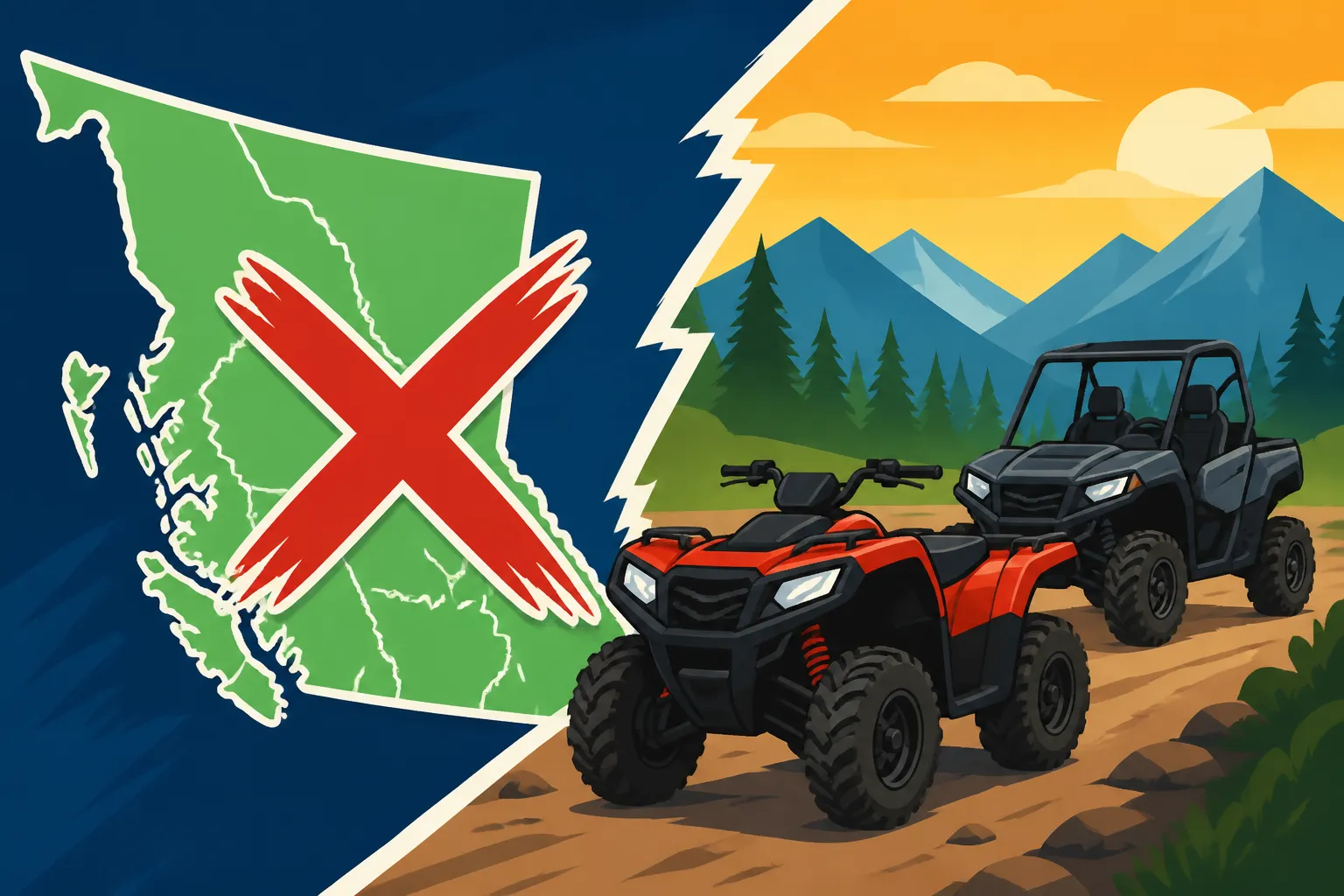
British Columbia does not issue one province-wide pass that grants access to every ATV or UTV trail. A pass is usually an access requirement set by a particular managed recreation site, trail network, club, or event. A local pass may support trail maintenance or apply to a specific riding area, but it does not function as a universal licence for the province.
Registration is a separate matter. An off-road vehicle may need to be registered even when no trail pass is required for the place you plan to ride. Conversely, having valid registration does not automatically let you use a managed trail that requires a site-specific pass. The two requirements answer different questions: registration concerns the machine, while a trail pass concerns access to a particular place.
It helps to think of your ride as a set of separate checks rather than a single permission slip. You might need to confirm the vehicle is properly registered, check whether the route is open to motorized use, obtain a local pass, and carry proof of insurance or ownership where applicable. Sorting those out separately is less frustrating than assuming one card or sticker covers everything.
For a deeper look at the registration side, see BC Registration Before Riding Crown Land. It explains why the absence of a province-wide trail pass does not remove other legal requirements for riding an off-road vehicle.
“No pass” does not mean “ride anywhere”
The phrase can be misleading if it sounds like every trail in BC is freely available to every rider. It only means there is no single provincial trail-pass system that covers all riding areas. Access can still be limited by land ownership, seasonal closures, industrial activity, local rules, wildlife protections, fire restrictions, or a managed site’s own conditions.
For example, a trail network near Kelowna may have different arrangements from a staging area near Chilliwack or a managed riding site in the Cariboo. A route that appears on a map may cross private property, leased Crown land, a provincial park, or a road with posted restrictions. The map alone does not prove that motorized access is allowed.
Before you unload, confirm that the specific trail or road is open to your machine type and intended use. Look for signs at the access point, review the land manager’s information, and ask the local club or site operator when the rules are unclear. That small bit of preparation can prevent a long drive ending at a locked gate or a conversation with an enforcement officer.
Where a local trail pass may be required
Managed sites can set their own access rules
Some riding areas are managed by clubs, recreation-site operators, or other local organizations. They may require a day pass, annual pass, event pass, or another form of permission for use of a particular site. The details are local rather than province-wide: the pass may cover one area, a defined trail network, or a particular activity, and it may come with conditions such as where to display proof.
A managed site may use pass revenue to support trail work, signage, staging areas, washroom facilities, or other visitor services. Requirements can vary even between nearby locations, so do not assume that a pass bought for one site will be accepted at another. Confirm the coverage area and whether the pass applies to the machine, the rider, or the visit.
This is especially important when your route includes more than one trail system. A weekend itinerary might start at one managed staging area and continue onto roads or trails managed by someone else. Ask whether the pass covers the full route, only the first site, or none of the connecting areas. BC Passes Exist Only at Managed Sites offers a useful way to understand why local passes and a province-wide pass are not interchangeable.
Public land and managed recreation sites are not the same thing
Riders often use “Crown land” and “recreation site” as if they describe the same access arrangement. They do not. Crown land is land held by the provincial government, while a recreation site may have specific facilities, a designated manager, and rules that apply to its use. A trail can pass through or beside Crown land without every area having the same access conditions.
A site-specific pass requirement does not necessarily apply to all surrounding land. The reverse is also true: not seeing a pass kiosk does not establish that a route is open or that no other conditions apply. Posted closures, land-use restrictions, active logging, fire-related prohibitions, and local access rules may still affect where you can ride.
When in doubt, identify the actual managing body for the place you intend to visit. A local ATV club may manage or maintain certain trails, while another agency or landholder controls the surrounding land. Ask which routes the pass covers and what happens when a trail crosses into another area. BC Crown Land Riding Explained provides more background on the distinction between Crown land access and the rules that apply to individual routes.
Pass requirements can change from one trailhead to the next
A common source of confusion is arriving at a familiar area and finding that the access arrangement has changed. A pass may be required at one trailhead but not another, or a route may be temporarily closed because of a storm, fire risk, road work, wildlife management, or industrial traffic. A pass does not override a closure.
Treat the trailhead as a place to verify your plan, not just a place to park. Read all posted notices before unloading, check whether the designated staging area has its own rules, and confirm that your intended route is open. If a sign limits access to a certain class of machine or prohibits motorized use, do not assume your pass gives you an exception.
It is also wise to make a quick check shortly before leaving home. Conditions can change between the day you plan a ride and the morning you arrive. For a closer look at what to ask when buying access to a managed area, see Buying a Site Pass Straight From a Club. The useful questions are practical: where it applies, how proof is shown, and whether a temporary closure changes your plans.
How to find out whether your ride needs a pass
Start with the exact staging area and route
“Are passes required in the Okanagan?” is too broad a question to get a reliable answer. Start with the name of the staging area, recreation site, trail network, or forest service road you intend to use. Then trace the full route you expect to ride, including any connectors between the trailhead and your destination.
A ride may begin on a managed trail and continue onto a road with separate rules. Another route may start at an informal pullout but enter a signed recreation site farther along. If you only check the parking area, you can miss a requirement that applies to the trails themselves. If you only check a trail map, you may miss a pass requirement at the staging area.
Write down the route in plain language before you call or search for information: “We are unloading at this site, riding this marked loop, then returning along the same connector.” That description gives a club or site operator something specific to confirm. It also helps you spot route sections where management changes.
Ask direct questions instead of relying on vague wording
When you contact a local club, site manager, or land manager, ask whether a pass is required for the exact area and date you have in mind. Then clarify what the pass covers. Some arrangements may be per rider, per machine, per group, or tied to a particular site, so avoid guessing based on what another rider did somewhere else.
Useful questions include:
- Is a pass required for this staging area or trail network?
- Does the pass cover the full route, or only a designated section?
- Is proof accepted on a phone, or should I carry a printed confirmation?
- Are there separate rules for youth riders or passengers?
- Is the route currently open to my type of machine?
- Are there any temporary closures, access restrictions, or special equipment rules?
A quick call can save a wasted trip, especially if you are travelling from another region. It can also uncover practical details that are not obvious from a map, such as limited parking, a gate schedule, active hauling, or an alternate route around a closure.
Use maps as planning tools, not proof of permission
Maps are valuable for finding staging areas, estimating distances, planning fuel stops, and understanding how trails connect. They are not always a complete record of current access conditions. A line on a map can represent a road or trail without confirming that it is open to ATVs, that the route is suitable for a UTV, or that no local pass is required.
Check the map publisher’s update notes and compare the route with signs and information from the relevant land manager. If your phone loses service, have the important details available offline or on paper. A waterproof phone pouch or document sleeve can help keep a printed route plan and pass confirmation dry; riders sometimes look for these practical accessories through retailers such as Amazon, but the key is choosing something durable enough for dust, rain, and trail use.
For route planning resources, BC ATV Trail Map Downloads is a useful related topic. Remember to carry enough information to navigate back to the staging area without relying on a live connection. In remote parts of the province, that simple backup can matter more than having the newest-looking map on your screen.
How local passes, club memberships, and day passes differ
A club membership is not automatically a trail pass
Joining an ATV club can be worthwhile for community, trail information, organized rides, and volunteer opportunities. But membership does not automatically grant access to every managed riding area, nor does it necessarily replace a site-specific pass. The club may maintain one network while another organization manages the site you plan to visit.
Before treating membership as proof of access, check exactly what it includes. Some club arrangements may offer a pass as a separate purchase or provide access only to certain trails. Others may have no pass benefit at all. A membership card is not a universal permission document simply because it carries the name of a local riding organization.
This distinction prevents an awkward moment at a trailhead: you have paid dues and expect them to cover access, but the site requires a separate pass. Ask the club what your membership supports and whether any local pass is included. Why Club Membership Is Not the Same as a Pass explains the difference between supporting a club and obtaining permission to ride a particular managed site.
Day passes and annual passes serve different plans
A day pass may suit an occasional visit, a one-off ride with friends, or a trip through an area you do not visit often. An annual pass may make more sense for someone who returns to the same managed site throughout the season. Neither type is automatically better; the practical choice depends on how often you ride there and what area the pass covers.
Read the pass conditions before purchasing. Confirm its validity period, the site or routes it applies to, whether it can be transferred, and what proof you need to show. Do not rely on the label alone. “Annual” can describe a period defined by the operator rather than a rolling year, and “day” may have conditions about the date or place of use.
If you are planning a group ride, make sure every participant understands what is required. One rider’s pass may not cover the whole group. A simple message before the trip can prevent a convoy from reaching the trailhead and learning that several riders still need to arrange access.
Pass proof needs to be easy to produce
Some sites may accept digital proof, while others may ask riders to display a pass or provide confirmation in another way. Follow the specific instructions from the operator. A screenshot can be useful where reception is poor, but it is not a substitute if the site requires a physical pass or a different form of display.
Keep proof accessible without exposing your phone to mud, rain, or a fall. Save the confirmation offline, note the pass details somewhere you can find them quickly, and consider carrying a printed copy as a backup. If you prefer a waterproof phone sleeve, Amazon is one place riders may look for options, but check that it still allows you to operate the screen and that it fits securely on your ride.
Do not assume that an email buried in your inbox will be easy to retrieve at a trailhead with no service. Before leaving home, open the confirmation, save or print what you need, and make sure everyone in the group knows who is carrying the proof. A little organization helps keep a routine check from turning into a group-wide delay.
What visitors from outside BC should know
A local pass does not replace your home registration rules
Visitors should keep the vehicle’s home-jurisdiction requirements separate from BC site access. A rider travelling from Alberta, Washington, or another province or state may have to meet the registration, ownership-document, and equipment requirements that apply to the machine where it is registered or normally based. BC does not create a universal visitor trail pass that replaces those obligations.
Do not assume that a machine is exempt from all paperwork because it is visiting. Carry the documents that apply to your situation and verify that your registration or ownership proof is sufficient for the trip. If your home jurisdiction does not register a particular class of off-road vehicle, that does not mean you should travel without any evidence connecting you to the machine.
For Alberta riders, see BC Riders From Alberta Use Alberta Plates. Riders arriving from Washington can review BC Riders From Washington Use Home Plates. These topics help explain why a visitor’s home registration arrangement and a BC site’s pass requirement are separate issues.
Check whether the riding area accepts your machine type
A pass does not necessarily mean every vehicle can use every trail. Narrow trails, bridges, gates, trail structures, or local rules may limit access for some UTVs or larger machines. A route suitable for a quad may be too narrow or technically difficult for a side-by-side, and a posted restriction still applies even if you have the right pass.
Ask about width limits, turning areas, bridge capacity, and trail classifications before setting out. This is especially important when travelling with a group that includes both ATVs and UTVs. A route can be open to motorized recreation but still unsuitable for a particular machine or too challenging for the least experienced rider.
Carry out the same checks you would make at home: confirm the route is open, check the machine requirements, and make sure the operator has the relevant documents. If you are new to BC riding, BC Non-Resident Riding Rules is a helpful companion topic for understanding how visitor status fits into the broader rules.
Plan for unfamiliar access systems
A visitor may not know which local club maintains a trail or where to buy a site pass. That is normal in a province with many different riding areas and no universal pass office. Start with the exact destination and search for its named operator, site manager, or local club rather than looking for a single provincial pass.
If the destination is remote, arrange access before you leave your home area. Do not count on buying a pass at a staffed counter; some trailheads are unstaffed, and cell reception can be limited. Confirm whether online purchase is available, whether proof can be saved offline, and whether the access point has a machine or sign-in process.
It is also sensible to build a backup plan. If the site is closed or the pass system cannot be confirmed, know another legal place to ride or be prepared to change plans. Travelling with a trailer, fuel, and a group makes a last-minute discovery more frustrating, so a few advance calls can make the difference between a smooth day and a drive back down the mountain.
A practical pre-ride pass checklist
Confirm the land and the manager
Start by identifying where your route goes and who manages each section. A route can cross different land types or management areas, and the access rules may change along the way. Make sure you are not relying on a pass issued by one organization to cover a separate trail system.
Check for current closures and restrictions shortly before departure. Look for notices relating to fire danger, logging activity, road work, hunting-season closures, or other local conditions. Do not treat an old trip report or a friend’s memory as confirmation that the route is open now.
If your route includes a forest service road or another road used by industrial traffic, review the road-specific rules as well. A pass for a managed trail does not replace insurance, equipment, safe operating practices, or any requirements that apply to the road. For more on this distinction, see BC Forest Service Road Requirements.
Confirm the pass details
Once you know a pass is required, verify the coverage and proof rules. Make sure the pass is for the right site, dates, and type of use. If you are riding with passengers, children, or a mixed group of machines, ask whether any additional pass or access condition applies.
Keep the confirmation where you can access it without a signal. If the operator asks for a displayed pass, attach it in the required place. If the instructions say to carry proof, keep it secure and available for inspection rather than buried under gear in a trailer box.
It may help to send the details to the rest of the group before the ride. One message can include the site name, pass requirement, route plan, meeting point, and what each rider needs to carry. That reduces the chance that someone assumes the lead rider’s pass covers everyone.
Carry documents and a backup plan
A pass is only one part of a sensible document kit. Depending on the ride, you may also need registration or ownership documents, photo identification, insurance proof, and a route plan. Carry what applies to your machine and destination in a way that is protected from water and easy to produce.
Riders who prefer a paper backup can keep copies in a sealed pouch, while those using digital records should save them offline. Amazon may offer waterproof sleeves or compact document cases, but check the material, closure, and fit before taking one on a remote ride. A pouch that leaks or opens when you fall is not much help.
Finally, agree on what the group will do if the intended area is closed or a pass cannot be obtained. Choose a legal alternative, identify a safe turnaround point, and make sure everyone understands that a pass never overrides a closure or posted restriction. Having a Plan B is not pessimistic; it is part of travelling responsibly in a province where conditions can vary widely.
Common misunderstandings about BC trail passes
“I registered my ATV, so I can ride any trail”
Registration does not provide blanket access to trails, roads, or private land. It helps establish that the machine has been registered under the relevant system, but land access is a separate question. A registered vehicle can still be prohibited from a closed trail or a managed area where the required pass has not been obtained.
The same principle applies to insurance and ownership documents. They can be important for legal compliance and practical protection, but they do not grant permission to cross land or use a restricted route. Treat each requirement as its own check instead of expecting one document to cover everything.
When planning a ride, make a short list: machine paperwork, access permission, pass requirement, route status, insurance, and equipment rules. If you can answer each item separately, you are much less likely to mistake registration for access.
“There is no provincial pass, so no one can charge for access”
The absence of a province-wide pass does not mean every managed site must be free or that local operators cannot set access conditions. A specific organization may manage a site or trail network and establish its own pass arrangement. The key is that the requirement is local, not a single provincial system covering all riding areas.
Ask who collects the pass and what it funds. Check whether the pass applies only to a managed facility or to a defined network. A local fee or pass requirement should not be confused with a general BC registration charge, insurance premium, or a province-wide trail licence.
If a requirement seems unclear, ask the operator to identify its scope and the area it covers. Clear information helps riders understand what they are paying for and avoids passing along rumours from unrelated riding areas.
“My friend rode there without a pass”
A friend’s experience may be useful, but it may not match your route, date, machine, or point of entry. They may have used a different trailhead, visited before a local policy changed, or ridden a part of the area managed by another organization. They may also have missed a requirement without being asked to show proof.
Use personal stories as a lead for further checking, not as the final answer. Confirm the current conditions with the site operator or land manager, and read the signs when you arrive. If the information you find conflicts, ask a direct question before unloading rather than deciding that the less restrictive version must be right.
That approach is fair to the people maintaining local trails and safer for your group. It also saves the awkward conversation that can happen when a whole group has driven a long way based on one outdated recollection.
Frequently asked questions
Is there one BC ATV pass that works across the province?
No. British Columbia does not have a single province-wide ATV or UTV trail pass that grants access to every riding area. Individual managed sites, trail networks, clubs, or events may set local pass requirements. You need to confirm the rules for the specific destination and route.
Do I need a pass to ride on Crown land?
There is no single province-wide trail pass for Crown land. However, that does not mean every Crown land route is open to motorized riding or free of other restrictions. Check the route’s status, local signs, closures, land-use conditions, and any managed-site requirements before riding.
Does registration include a trail pass?
No. Vehicle registration and trail access are separate. Registration relates to the machine, while a local pass may be required to use a particular managed site or trail network. Neither one automatically replaces the other.
Does club membership give me access to all BC trails?
No. Club membership may support a local organization or provide benefits defined by that club, but it does not automatically authorize riding everywhere in BC. Check whether membership includes a pass for a particular site and whether that pass applies to your planned route.
Are out-of-province riders exempt from local passes?
A visitor is not automatically exempt from a site’s local access requirements. A BC pass requirement may apply to anyone using the managed area, while the machine’s registration and ownership documentation remain separate matters tied to the rider’s home jurisdiction. Confirm both sides before travelling.
What should I do if a trailhead has no pass kiosk?
Do not assume that no kiosk means no pass is required. Check the site operator’s information ahead of time, look for posted instructions, and ask a local club or land manager if the requirement is unclear. Save any confirmation offline, since reception may be limited.
Disclaimer
This article is for general informational purposes only and does not constitute professional advice. Laws, prices and regulations vary by location and change over time. Consult a qualified professional for guidance on your specific situation.