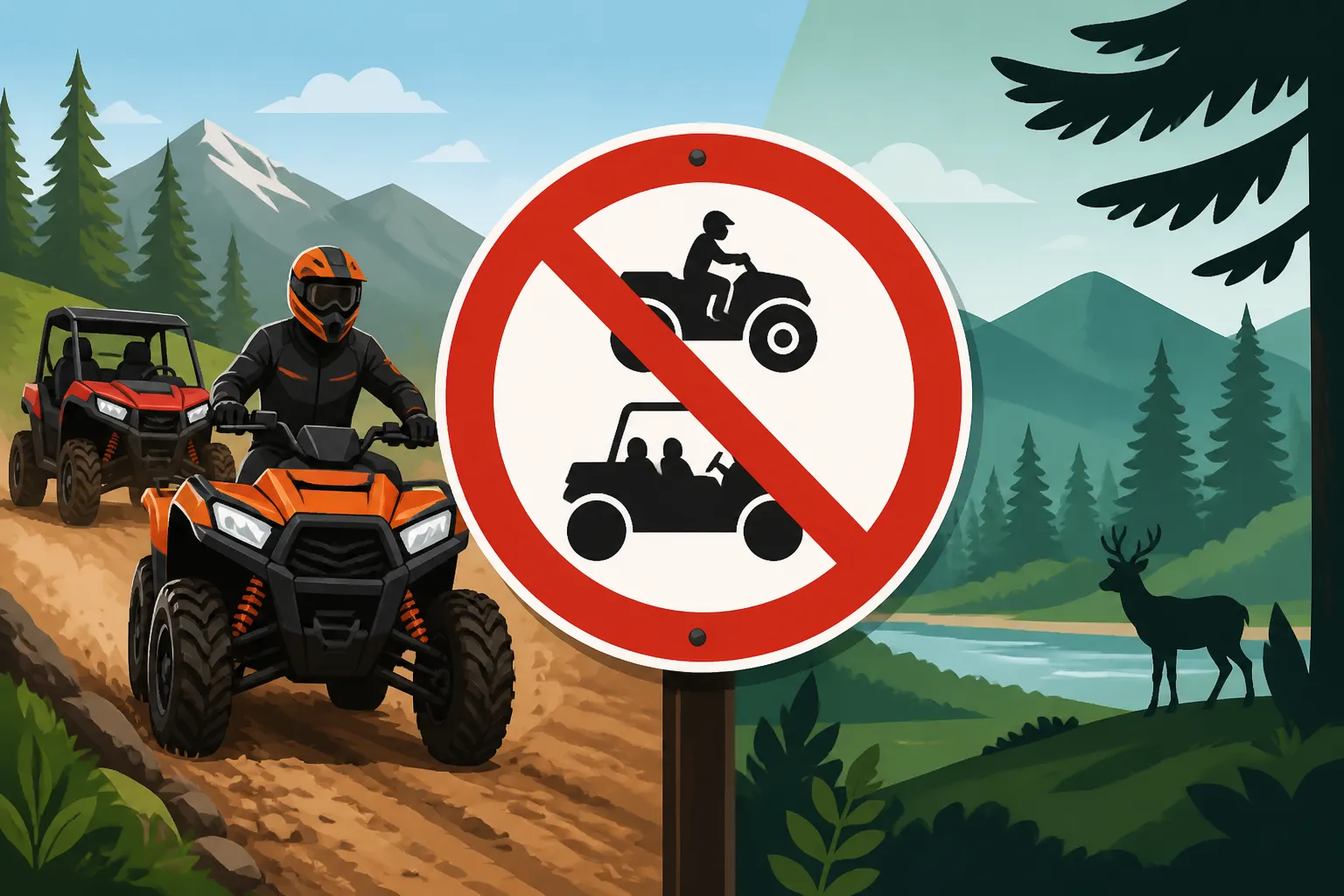
Signs That Restrict ORV Use in BC
A sign on a forest road can turn a familiar ride into a confusing one: does “No Unauthorized Vehicles” include your ATV, and can you continue if a gate is open? This guide explains how to read signs that restrict off-road vehicle use in British Columbia, what to do when wording is unclear, and how to check whether your route is open before you ride.
How to read ORV restriction signs in BC
Start with what the sign actually prohibits
Read the whole sign, not just the largest words. “Road closed,” “No motorized vehicles,” “No unauthorized access,” and “Active logging” can signal different restrictions. A sign may apply to every vehicle, only motorized traffic, or a specific type of access. The sign’s wording, location, and any conditions or dates all matter.
If the sign says “No motorized vehicles,” an ATV or side-by-side is a motorized vehicle. Don’t assume the restriction is meant only for cars. Likewise, “Road closed” is a clear reason not to proceed unless the sign specifically identifies an exception that applies to you.
Other signs may not ban ORV use outright, but they still set conditions. A posted speed limit, a radio channel instruction, or a warning about active industrial traffic is something to follow. On resource roads, that information can matter as much as a direct closure notice. For more on navigating those roads, see [BC Forest Service Road Rules for ORVs].
Identify who the restriction is for
Signs can be placed by different authorities or land managers, and the issuer can help you understand what the notice covers. A road sign may relate to a road authority’s access rules; a trail sign may be set by a recreation-site manager; and a closure notice may apply to a wider area rather than one short stretch of track.
Look for clues such as a named road, a date range, a map reference, a contact number, or wording that identifies a particular activity. A sign at the entrance to a route may apply to the whole road beyond it. A sign beside a short spur may apply only to that spur. When the scope isn’t obvious, don’t guess based on where the sign is mounted.
Some restrictions are temporary, such as a closure during active hauling, fire danger, road work, or a local emergency. Others may be ongoing. A familiar route can change, and an open gate is not proof that public ORV access is allowed. Check the authority or manager responsible for the road or area before treating an unclear sign as permission to continue.
Common BC signs and what to do
Closures, barriers, and limited access
A barrier paired with a closure sign is a strong signal to stop. Don’t ride around a gate, move a barricade, or look for an informal detour through the bush. Even if you see tire tracks beyond it, those tracks don’t establish that access is permitted. They may be from authorized workers, land managers, or riders who shouldn’t have gone through.
“Authorized vehicles only” and “No unauthorized access” require particular care. These notices may allow access for specific people or work activities, not general recreation. Unless you have clear permission or meet an explicitly stated exception, stay out. If the sign names an operator, agency, or road manager, use its contact details to ask whether recreational ORV access is allowed.
Restrictions can cover more than a single sign or gate. A closure may affect nearby spurs, a staging area, or a broader tract of Crown land. Don’t assume you can avoid the restriction by leaving the road and continuing on another track. [BC Motor Vehicle Closures and How to Find Them] explains why it’s important to check closure information for the area, not only the road directly in front of you.
Industrial traffic and road-use instructions
An “Active logging,” “Industrial traffic,” or “Heavy trucks” notice is a warning to slow down, stay alert, and follow any posted road instructions. It doesn’t automatically mean every ORV is prohibited, but it also doesn’t mean you can ride without regard for work traffic. Logging trucks may be wide, heavy, and unable to stop quickly, particularly on blind corners or narrow sections.
On some resource roads, signs direct drivers to use a radio channel or follow a call-in practice. If the sign gives an instruction, don’t treat it as optional trail etiquette. A rider who doesn’t have the required radio or isn’t sure how to use the posted procedure should pause and find out what applies before continuing. The road may be busy with traffic that you can’t see around a bend.
“Use at your own risk” or a similar warning isn’t a substitute for checking whether ORV use is permitted. It may describe road conditions or hazards without granting access. For practical guidance on industrial traffic and communication, see [BC Resource Road Radio Practice] and [BC Riders Meeting a Logging Truck].
| Sign or notice | What it may indicate | Sensible response |
|---|---|---|
| Road closed or no entry | Access is prohibited, subject to any clearly stated exception | Stop and do not ride around a barrier |
| No motorized vehicles | Motorized recreation, including ORVs, is restricted | Turn back unless an applicable exception is explicit |
| Authorized vehicles only | Access is limited to people or vehicles with permission | Don’t assume recreational riding is authorized |
| Active logging or heavy trucks | Industrial traffic may be using the route | Follow road instructions, use extra caution, and confirm access |
| Speed limit or radio instruction | A specific road-use condition applies | Follow the instruction before proceeding |
| Fire or area closure notice | Access may be restricted for a time or across a wider area | Check the named authority’s closure information |
What to check when a sign is unclear
Confirm the road, land, and closure status
A route that looks like a public road may cross land with different access rules. A forest road, a private industrial road, and a trail on Crown land are not interchangeable simply because they appear on a map or connect to one another. The road’s status and the restriction’s source help determine whether you can ride there.
Start by noting the sign’s exact wording, the road or area name, and where the sign is posted. If there’s a contact number or the name of a road manager, use it. If the notice refers to a broader closure, check the relevant authority’s map or public notice before setting out. If you can’t establish that the route is open to ORVs, choose a route with clear access rather than treating uncertainty as permission.
This matters around the province, whether you’re planning a ride near Chilliwack, in the Okanagan, on Vancouver Island, or north of Prince George. Local routes can have different managers, seasonal conditions, and traffic. A friend’s memory of riding there last summer is useful background, but it isn’t confirmation that access remains open today. Related guidance on [BC Crown Land Access Rules] and [BC Resource Roads With Active Hauling] can help you plan with the right questions in mind.
Treat temporary notices as real restrictions
Temporary signs are easy to dismiss when they look newly installed or loosely placed. Don’t. A temporary closure may be there because of active work, a damaged road, an emergency, or conditions that make travel unsafe. Its temporary nature doesn’t make it optional.
Pay attention to dates, hours, arrows, and directions. A restriction may apply only to one road segment or only during particular work periods. If the sign is damaged, turned away, or partly hidden, don’t use the poor condition as a reason to carry on. Stop somewhere safe, check for other notices, and contact the responsible authority if you can identify it.
Also be cautious when a sign seems to conflict with a map or an older trail guide. Maps can lag behind a closure, while signs may refer to a local access condition that isn’t obvious on a general map. If the information disagrees, use the more cautious option until the manager confirms what applies. For a closer look at the role of posted restrictions, see [BC Resource Road Signage] and [BC Motor Vehicle Closed Areas].
How to plan a ride around restrictions
Make access checks part of your pre-ride routine
A quick plan before leaving can prevent a frustrating turnaround miles from your staging point. Note the route you intend to use, identify the relevant road or land manager, and check for closure notices or access conditions. If the route depends on a resource road, check for active industrial traffic and any required communication practices. Make sure everyone in your group understands the plan.
A practical pre-ride checklist:
- Write down the road, trail, and staging-area names you expect to use.
- Check for posted closures, seasonal restrictions, or work notices from the relevant authority.
- Confirm whether recreational ORV access is allowed on each part of the route.
- Review any radio, speed, vehicle, or time-of-day instructions.
- Choose an alternative route in case a gate or new sign blocks your planned way through.
- Tell the group that everyone must stop if a rider spots a restriction the others missed.
On longer rides, build in time to reassess. A route can be open at the staging area but restricted farther along. If the sign you encounter doesn’t match your plan, stop the group before anyone passes it. It’s much easier to turn around together than to sort out a disputed restriction after the group has split up.
Don’t confuse vehicle equipment with permission to use a road
An ATV’s lights, mirrors, windshield, or other accessories don’t cancel out a posted restriction. A modified machine is still subject to the access rules for the road or land. Adding aftermarket equipment—including products from brands such as SuperATV—doesn’t by itself make a route open to ORVs or make an ATV street legal in BC.
That distinction can be easy to miss when a road looks like an ordinary paved or gravel connection. But “looks roadworthy” and “legally permitted to ride here” are different questions. Check the route’s access rules separately from your machine’s equipment and registration requirements. See [BC Has No Street-Legal Path for an ATV] for the road-use distinction, and [BC Rules for Riding a Forest Service Road] for more on riding on that type of road.
Accessories can still be relevant to comfort or visibility in appropriate riding conditions, but they aren’t permission. SuperATV gear, like any aftermarket gear, should be considered as equipment—not as a way around a no-entry sign, road closure, or access rule. The safest decision is the simple one: if a sign bars your vehicle or you can’t confirm that ORV access is allowed, don’t proceed.
What to do when you encounter a restriction mid-ride
Stop before the sign or barrier, in a place where your group and other road users are safe. Read the full notice, including small print and arrows. Tell the rest of the group what it says, and don’t let one rider continue ahead to “check” the road beyond a closure.
If the notice allows a clear alternative, follow it exactly. If it doesn’t, turn around and use your backup route. When the sign is ambiguous, record its wording and location so you can ask the responsible road manager or land authority for clarification later. A photograph can help you remember the details, but don’t step into active traffic or cross a barrier to take one.
If you discover a restriction after riding past a junction, don’t assume the easiest way out is to continue deeper into the closed area. Turn back by a safe, permitted route. If you’re unsure whether a road is a public route or private access, stop and seek guidance rather than testing the boundary. Respecting the sign protects your group and helps keep recreational access from creating avoidable conflict with road users and land managers.
Disclaimer
This article is for general informational purposes only and does not constitute professional advice. Laws, prices and regulations vary by location and change over time. Consult a qualified professional for guidance on your specific situation.