BC Rules for a Visiting Idaho Rider
You've heard whispers of incredible trails just north of the border, sprawling across British Columbia's vast wilderness. Maybe you're from Idaho, accustomed to a certain way of doing things with your quad or side-by-side, and now you're eyeing a trip across the line. But what exactly do you need to know before you load up the trailer and head north? The thought of navigating unfamiliar regulations can be a real headache, and nobody wants their adventure cut short by a misunderstanding of the rules. This guide is here to untangle the web of BC's off-road vehicle (ORV) rules specifically for visiting Idaho riders, ensuring your cross-border adventure is smooth, legal, and unforgettable.
Bringing Your Idaho Machine to British Columbia
The anticipation of hitting new trails is exhilarating, but before you even think about firing up your engine on BC soil, there are a few essential things you need to sort out regarding your machine. The rules around registration and proof of ownership might feel a bit different from what you're used to in Idaho, and understanding them upfront will save you a lot of grief and potential fines.
Non-Resident ORV Registration and Plates
One of the biggest questions Idaho riders have when planning a trip to BC is about registration. You're probably thinking, "My machine is registered in Idaho, do I need to re-register it in BC?" The good news is, generally no! British Columbia's Off-Road Vehicle Act acknowledges that visitors from jurisdictions with their own robust registration systems don't need to get a separate BC registration. Essentially, your valid Idaho ORV registration is recognized as proof that your machine is properly accounted for. [BC Does Not Register Non-Resident Machines].
This recognition is super helpful, but it comes with a critical requirement: you absolutely must carry your valid Idaho ORV registration documents with you at all times when riding in BC. This isn't just a suggestion; it's a legal obligation. Along with your registration, you should also have your personal photo identification. Imagine encountering a conservation officer deep in the Kootenays – having your papers in order makes for a quick and pleasant interaction, letting you get back to your ride. [BC Riders Must Carry the Certificate] and [BC Riders Must Carry Photo ID]. If, for some reason, Idaho didn't have a registration system, then BC's rules would indeed kick in, but that's not the case for you. [BC's Rule Keys on Whether Home Has a Registry].
When it comes to displaying your plate, while your Idaho plate will have specific placement requirements back home, BC's ORV Act has some general guidelines. Your plate needs to be clearly visible and legible, typically mounted on the front, back, or left side of your machine. This ensures that it can be easily seen by law enforcement or other riders. It's a good practice to ensure nothing like cargo or mud is obstructing it. Even though it's an Idaho plate, the visibility expectation remains.
Proof of Ownership and Import Considerations
Beyond just current registration, having solid proof of ownership for your ATV or UTV is always a smart move when traveling internationally, even just across the border. This means bringing your title or a clear bill of sale that demonstrates you are the legal owner of the machine. While not always explicitly requested by an officer on the trail, customs officials might ask for it when you cross the border, and it offers an extra layer of protection against any disputes or misunderstandings.
Another point to keep in mind, even if briefly, is the customs process. When you drive your ORV across the border from Idaho into British Columbia, you're essentially "importing" it temporarily. While you won't be paying duties or taxes for a temporary visit, it's crucial to declare your vehicle properly to Canadian Border Services Agency (CBSA) officers. They might ask for your proof of ownership and registration. Being transparent and having your documents ready makes the border crossing a breeze, setting a positive tone for your entire trip.
Many riders love to customize their machines, often with aftermarket parts from brands like SuperATV, whether it's for improved ground clearance, better protection, or enhanced utility. While BC doesn't have a mandatory safety inspection for ORVs – so you won't need to worry about passing a rigorous mechanical check to get a registration here – it's still crucial to ensure that any modifications you've made don't compromise the safe operation of your vehicle. [BC Has No Safety Inspection for ORVs]. Always make sure your machine is in good working order and that any accessories are securely installed and appropriate for the kind of riding you plan to do on BC's diverse terrain.
Riding Rules and Regulations for Non-Residents in BC
Once you've got your machine legally ready to roll, the next big hurdle is understanding the actual riding rules here in British Columbia. While some aspects might feel familiar to an Idaho rider, there are some significant differences, especially around insurance, that you absolutely need to be aware of. Getting this right is key to enjoying your adventure without any unwelcome surprises or hefty fines.
Driver's Licences and Age Restrictions
Let's start with who can operate the machine. If you hold a valid driver's licence from Idaho, you're good to go! British Columbia recognizes valid driver's licences issued by other jurisdictions, so you don't need to get a special BC licence to operate your ORV here. Just make sure your licence is current and always carry it with you alongside your ORV registration and proof of ownership.
Now, when it comes to age restrictions for riders, BC has specific rules that might differ from Idaho's. For youth riders, the rules are quite clear: if a rider is under 16 years of age, they must be supervised by an adult. [BC Youth Riding Rules Explained]. Specifically, the supervisor needs to be at least 19 years old and maintain visible and immediate direction over the youth. This means staying within sight and close enough to offer guidance or intervention if needed. [BC Supervision Required Under 16]. It's also important to adhere to the manufacturer's age and weight recommendations for the specific machine being operated. These guidelines are there for a reason and help ensure the safety of young riders. [BC Rules for a Child Under 16] and [BC Manufacturer Age and Weight Rules].
Helmets, Seat Belts, and Safety Gear
Safety is paramount, and BC has clear regulations regarding helmets and seat belts. For anyone operating or riding as a passenger on a ride-astride ORV – meaning a traditional quad or ATV where you straddle the seat – wearing an approved helmet is mandatory. This is non-negotiable and strictly enforced. [BC ATV Helmet Law Explained] and [BC Helmets on Ride-Astride Machines]. Look for helmets that meet recognized safety standards such as DOT, ECE, or Snell certifications, ensuring they provide adequate protection.
If you're bringing a side-by-side (UTV) with a roll cage and manufacturer-installed seat belts, the rules are a bit different. In these cases, wearing the seat belt is mandatory for both the operator and all passengers. If the UTV is equipped with a roll cage and seat belts, a helmet is not legally required, though many experienced riders still choose to wear one for added protection. [BC Seat Belts Instead of Helmets]. Always make sure everyone in your UTV is buckled up before you start moving. Beyond the legal requirements, it's always wise to wear additional safety gear like eye protection, gloves, and sturdy, closed-toe boots, regardless of the machine you're riding. These simple precautions can prevent common injuries and make your ride much more comfortable.
Insurance Requirements for Different Riding Areas
This is probably one of the most critical distinctions for Idaho riders visiting BC, as insurance requirements can be significantly different from what you're used to. You absolutely cannot assume your Idaho ORV insurance will cover you adequately, or even legally, in all BC riding scenarios. You need to verify your coverage with your insurance provider before you cross the border. Many US-based off-road policies do not extend to Canada or meet BC's specific minimum requirements, especially for certain types of roads.
Let's break down the BC insurance landscape:
| Riding Area | Insurance Requirement in BC for ORVs |
|---|---|
| General Crown Land | Voluntary. No legal minimum liability, but highly recommended for personal protection. |
| Forest Service Roads (FSRs)/Resource Roads | Mandatory minimum of $200,000 third-party liability insurance. [BC Forest Service Road Insurance] |
| Highway Crossings | Mandatory Basic Autoplan (ICBC) third-party liability insurance for the brief crossing. |
| Private Land (with permission) | Voluntary, but smart. Check with landowner about their requirements. |
As you can see, the requirements change depending on where you're riding. The big one to remember is the $200,000 third-party liability for Forest Service Roads (FSRs). These roads are the lifeblood of BC's backcountry access, and they are often active industrial sites with logging trucks and other heavy equipment. Without this coverage, you could face significant fines and immense personal liability if an incident occurs. [BC Requires $200,000 on a Forest Service Road].
If your Idaho insurance doesn't meet these requirements, especially for FSRs, you will need to purchase temporary coverage. This can often be done through any Autoplan broker in BC. [BC Insurance Bought With Registration]. It's wise to plan this ahead of time, as some brokers might be more familiar with ORV insurance than others. Don't let differing insurance rules lead to a bad day on the trail; clarify your coverage before you leave home. [BC Insurance Price Gaps Riders Talk About].
Navigating Specific BC Riding Environments
British Columbia boasts an incredible diversity of terrain, from vast stretches of open Crown land to industrial Forest Service Roads winding through dense forests. Each environment comes with its own set of rules and etiquette, which can be a bit of a learning curve for visiting riders. Understanding these distinctions is crucial for a safe and legal ride, and ensuring you respect the land and other users.
Crown Land: The Vast Wilderness
When we talk about "Crown land" in BC, we're talking about the vast majority of the province – approximately 94 percent! This is public land managed by the provincial government, and it's where most of the off-road vehicle opportunities exist. [BC Crown Land Triggers the Registration Rule]. Generally, ORV use is permitted on Crown land unless specifically prohibited by signs, regulations, or a designated closure. The key is to look for signs indicating restrictions, as these can include environmental closures, sensitive wildlife areas, or areas under a temporary fire ban.
Riding on Crown land comes with a significant responsibility to protect the environment. This means staying on existing trails, avoiding sensitive areas like wetlands and riparian zones (the areas directly adjacent to streams, rivers, and lakes), and practicing Leave No Trace principles. [BC Riparian Areas to Avoid]. Damaging fragile alpine meadows or creating new trails in sensitive areas is not only harmful to the environment but can lead to fines and further restrictions on riding. [BC Alpine Meadows and Damage]. Always be aware of your surroundings and ride responsibly. It's also important to note that Provincial Parks in BC generally ban motorized recreation, so don't assume you can ride your ATV or UTV through a park unless there's explicit signage indicating otherwise. [BC Provincial Parks That Ban Machines]. During hunting season, certain areas may also have vehicle closures, so checking the hunting synopsis can provide valuable information. [BC Hunting Closed Areas for Vehicles].
Forest Service Roads and Resource Roads
Forest Service Roads (FSRs), also known as Resource Roads, are the backbone of BC's access to the backcountry. These are unpaved roads built and maintained primarily for industrial use, mainly logging. [BC Forest Service Road Rules for ORVs]. While they offer incredible access to remote riding areas, they are not playgrounds and demand a high level of caution from recreational users. One of the biggest differences from many Idaho roads is the constant presence of active industrial traffic, especially huge logging trucks. These trucks are often heavily loaded, move fast, and always have the right of way. [BC Riders Meeting a Logging Truck].
Safe practice on FSRs includes driving defensively, being prepared to pull over entirely to let industrial traffic pass, and using a radio. Many FSRs operate on specific radio channels for calling out kilometre markers and communicating with other industrial users. While not legally mandatory for recreational riders, having a radio and knowing common resource road radio practice is a massive safety advantage and highly recommended. [BC Resource Road Radio Practice]. Always ride with due care and attention, especially around blind corners where a loaded truck could appear at any moment. Be aware that FSRs can also be gated and closed to public access, sometimes seasonally or due to active logging operations. [Active Hauling and Closed Roads]. Always check for local road closures before you head out, as a gate across the road can unexpectedly cut short your planned adventure. [Checking a Road Before You Go].
Highway Crossings and Municipal Access
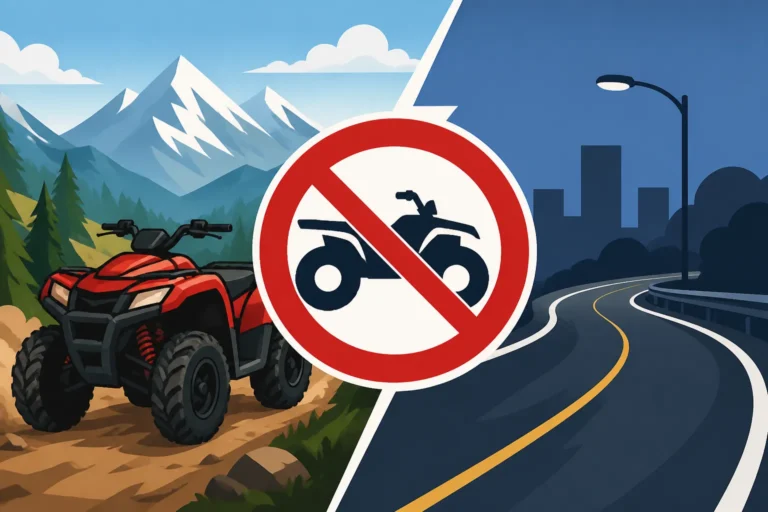
While BC offers incredible off-road opportunities, it's crucial to understand that ORVs are generally not street-legal in British Columbia. [BC Has No Street-Legal Path for an ATV]. This means you cannot simply ride your ATV or UTV down a public highway or road like you might in some other jurisdictions. The rules are very strict about when and how you can interact with highways.
You are permitted to make direct crossings of a highway at intersections or designated crossing points, but only under specific conditions. You must come to a complete stop, yield to all traffic, and cross as directly and safely as possible. This applies whether it's a stop sign [BC Crossings at a Stop Sign] or a traffic light [BC Crossings at a Traffic Light]. You cannot ride along the shoulder of a highway, nor can you use it as a shortcut. Your machine must be trailered to and from your riding area, or to a staging area.
In terms of municipal access, it's highly variable. While some municipalities can create bylaws to allow ORV use on specific roads within their boundaries, this is not widespread and usually requires a special police-issued operation permit. [BC Municipal Authority Over ORV Roads] and [BC Operation Permit Application Steps]. For a visiting Idaho rider, it's safest to assume no municipal road access unless you have verified it for a specific area and obtained the necessary permits. Stick to designated trails and Crown land, and you'll avoid potential issues.
Avoiding Common Pitfalls and Fines
Exploring the vast and beautiful backcountry of British Columbia is an incredible experience, but it comes with the responsibility of understanding and adhering to local regulations. For a visiting Idaho rider, some of these rules might be unfamiliar, and misunderstanding them can quickly turn an epic adventure into a costly headache. Let's look at some common pitfalls and how to steer clear of them.
The Importance of a Spark Arrestor
Wildfire prevention is a huge priority in British Columbia, especially during the dry summer months. One of the most frequently overlooked, yet critical, pieces of equipment for your ORV is a spark arrestor. It is legally required that all ORVs operating in BC's backcountry be equipped with a properly functioning spark arrestor. [BC Spark Arrestor Rules and Fines]. This device is designed to prevent hot carbon particles from escaping your exhaust and potentially igniting dry vegetation.
The fines for not having a spark arrestor, or having one that is not in good working order, are substantial. We're talking hundreds of dollars, and nobody wants to pay a [BC Spark Arrestor Tickets at $460] when they're here to enjoy the trails. Before you head out, take a moment to inspect your machine's exhaust system. Ensure the spark arrestor screen is clean, intact, and not clogged with carbon buildup. Many aftermarket exhaust systems from brands like SuperATV come with integrated spark arrestors, but it's always worth checking to ensure it meets the standard and is in good condition. During extreme wildfire seasons, BC can implement widespread riding bans across entire fire centres, and attempting to ride during such a ban carries even more severe penalties, including massive fines and even potential jail time in extreme cases. [BC Fire Centre Riding Bans] and [BC Wildfire Season and Riding]. Always check for current fire bans before you ride.
Carrying Required Documents and Awareness
We've touched on this before, but it bears repeating: carry your required documents! This includes your valid Idaho ORV registration, your Idaho driver's licence, and proof of any required insurance (especially that $200,000 FSR liability). While a digital copy on your phone might seem convenient, signal can be non-existent in much of BC's backcountry, so a physical copy is always the safest bet. [Carrying Your Certificate of Registration on Every Ride]. This ensures that if you encounter an enforcement officer, you can quickly and easily demonstrate your compliance, preventing delays and potential fines.
Beyond documents, general awareness is your best tool for avoiding issues. "Know before you go" is more than just a catchy phrase in BC. Always check for local trail closures due to weather, environmental concerns, or logging activity. [BC Trail Closures After a Storm]. Respect private property boundaries, don't trespass, and be mindful of wildlife. [Endangering Wildlife or Livestock]. Impaired riding, whether by alcohol or drugs, is treated very seriously and falls under the Criminal Code of Canada, with severe penalties. [BC Impaired Riding and the Criminal Code]. Being prepared, riding responsibly, and showing respect for the environment and other users will ensure your BC ATV or UTV adventure is memorable for all the right reasons. For carrying all your essentials safely and securely, whether it's your documents, emergency kit, or extra gear, consider durable cargo boxes or bags. Aftermarket accessories, like those offered by SuperATV, can provide excellent solutions for organizing and protecting your necessities on rugged BC trails.
Disclaimer
This article is for general informational purposes only and does not constitute professional advice. Laws, prices and regulations vary by location and change over time. Consult a qualified professional for guidance on your specific situation.