BC Motor Vehicle Closed Areas
It's incredibly frustrating to head out for what you expect to be a fantastic day of riding your ATV or side-by-side, only to encounter unexpected signs, gates, or even worse, a conservation officer informing you that you're in a "motor vehicle closed area." These situations can quickly turn a fun outing into a stressful experience, sometimes even leading to fines or machine seizure. This guide is here to demystify what these closed areas are in British Columbia, why they exist, and how you can avoid accidentally trespassing or breaking the rules, ensuring your adventures stay on the right side of the law.
What Exactly Are Motor Vehicle Closed Areas in BC?
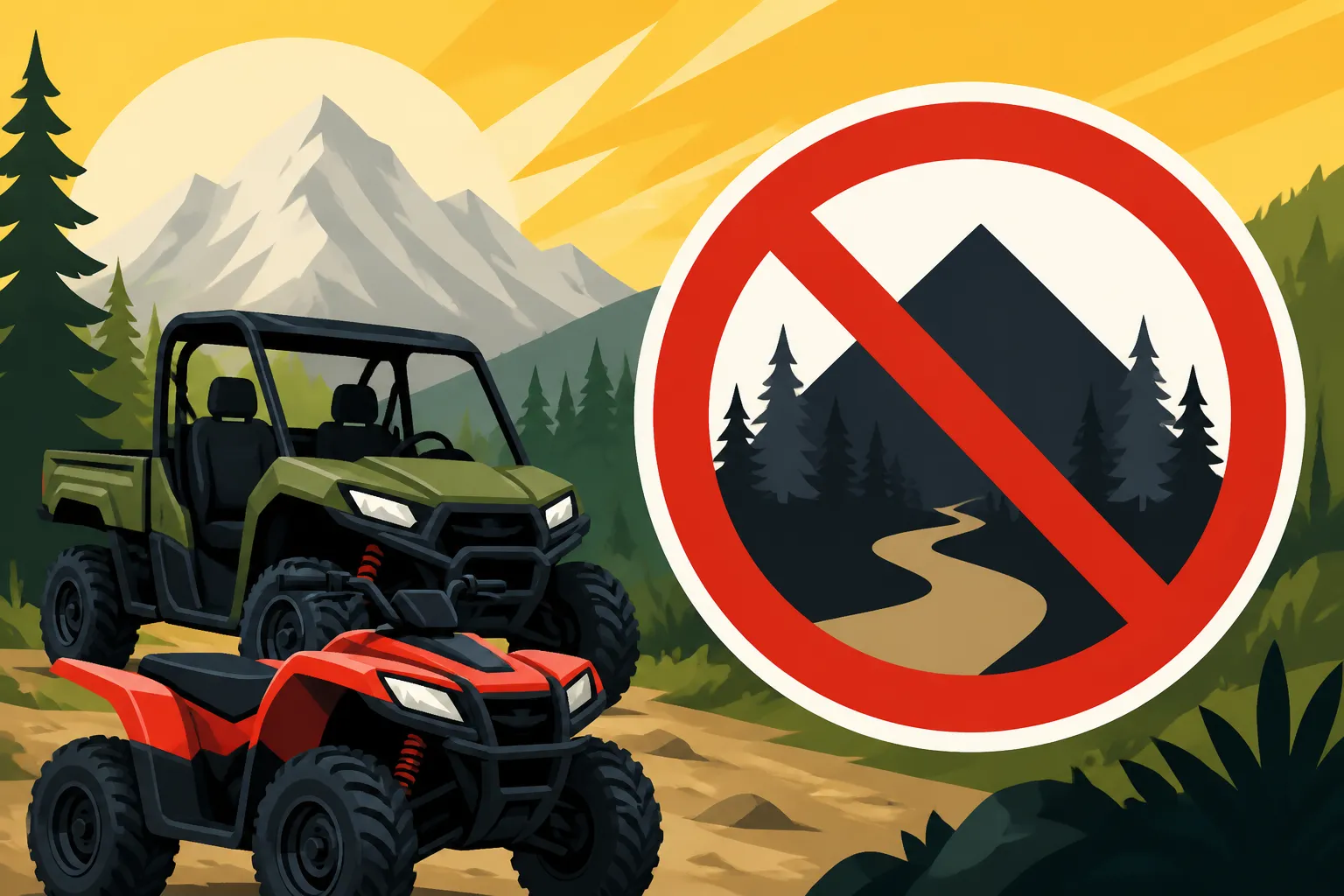
The term "motor vehicle closed area" in British Columbia might sound vague, but it's a critical concept for anyone who rides an Off-Road Vehicle (ORV). Essentially, these are designated regions of land where the operation of motorized vehicles, including ATVs, UTVs, dirt bikes, and sometimes even e-bikes, is restricted or entirely prohibited. The reasons for these closures are varied and always rooted in protecting something vital, whether it's the environment, wildlife, public safety, or specific recreational values.
These designations aren't made lightly; they come from various government ministries and agencies, each with its own mandate. For instance, BC Parks will close areas within provincial parks to motorized vehicles to protect sensitive ecosystems and maintain a tranquil wilderness experience for non-motorized users. The Ministry of Forests, Lands, Natural Resource Operations and Rural Development (FLNRORD) often implements closures on Crown land to safeguard critical wildlife habitat, manage wildfire risk, or facilitate resource extraction activities like logging. Understanding who is responsible for a particular area can sometimes give you a clue as to why it might be closed.
The core intent behind these closures is to strike a balance. British Columbia boasts an incredible amount of Crown land—about 94 percent of the province—and there's a strong desire to allow public access for recreation. However, with that access comes the responsibility to ensure that motorized recreation doesn't negatively impact fragile environments, disturb sensitive wildlife populations, or conflict with other land uses. It's a constant juggling act, and these closed areas are one of the primary tools used to manage that balance.
Who Designates Closed Areas and Why
Several entities in BC have the authority to designate and manage motor vehicle closed areas, each with specific objectives in mind. One of the most common reasons for a closure is wildlife protection. This is especially true during critical periods like calving season for moose and elk, or winter range for deer, where disturbance from vehicles can cause undue stress, deplete energy reserves, or even lead to mortality. Such closures often target specific species or habitats.
Another significant driver for closures involves the protection of sensitive ecosystems. This could include wetlands, alpine meadows, riparian areas along streams and rivers, or specific plant communities that are easily damaged by vehicle traffic. The ground in these areas might be particularly fragile, and even a single pass with an ORV can cause lasting damage, contribute to erosion, or introduce invasive species. Protecting these areas helps preserve biodiversity and ecosystem health across the province.
Public safety also plays a huge role, particularly on [BC Resource Roads With Active Hauling]. Logging operations, mining activities, or other industrial uses on resource roads often lead to temporary or permanent closures to recreational ORVs. This is to prevent accidents between industrial vehicles (which are typically very large and heavy) and recreational riders. It’s a matter of life and death, and these closures are strictly enforced to keep everyone safe. You might also find closures around infrastructure like dams, power lines, or water treatment facilities.
How to Identify and Respect Closed Areas
Navigating the vast landscapes of British Columbia while adhering to all motor vehicle regulations can feel like a labyrinth. The biggest challenge isn't usually a malicious intent to break rules, but rather a lack of clear, readily accessible information about where you can't go. This can lead to innocent mistakes that carry real consequences. The key to staying out of trouble and being a responsible rider lies in proactive research and keen observation.
Before you even load your machine onto the trailer, your smartphone or computer should be your first stop. Government websites, specifically those for FLNRORD, BC Parks, and regional districts, are invaluable. Look for sections related to "motor vehicle prohibitions," "wildlife management areas," or "recreation site closures." Some areas have specific maps you can download, detailing where ORVs are permitted and where they are not. Unfortunately, sometimes these maps are not perfectly up-to-date, which is where local knowledge comes in.
On the ground, signage is your primary indicator. Look for physical signs at trailheads, entry points to Crown land, or along resource roads. These signs can range from official government placards clearly stating "Motor Vehicle Prohibition" with a specific area name, to simple "No Trespassing" signs on private land. Pay attention to any posted maps, even if they look faded. Sometimes, areas are closed by gates or physical barriers, which should always be respected—never go around, under, or over a gate or barrier, even if it seems passable.
Reading a Closure Map and Recognizing Signage
Understanding how to read a closure map is a crucial skill for any ORV enthusiast in BC. These maps, often found online through provincial government portals or sometimes posted physically at staging areas, use various colours, lines, or symbols to denote restricted zones. A legend will usually accompany the map, explaining what each symbol means. Look for shaded areas marked "No Motorized Vehicles," or lines indicating the boundary of a wildlife reserve or park where ORVs are not permitted. It's not always just a blanket ban; sometimes, only certain types of vehicles are restricted, or restrictions apply only during specific seasons, such as [BC Wildfire Season and Riding].
Physical signage on the trail is your last line of defence. Signs might say "Motor Vehicle Act Exemptions Apply" which means the ORV Act rules apply here. Or they might specifically say "Area Closed to Motorized Vehicles." They can also be subtle, like signs indicating a "Wildlife Habitat Area" or a "Sensitive Ecosystem," which, while not explicitly stating a prohibition, strongly imply that motorized vehicle use is discouraged or forbidden without a specific permit. Always assume caution if you see such a sign and can't verify permission to proceed. Ignoring these signs, whether intentionally or through oversight, can lead to serious legal repercussions.
It's also worth noting that some land designations inherently imply motorized restrictions. For instance, most [BC Provincial Parks That Ban Machines] outright, with very few exceptions for specific access roads or permitted uses. Similarly, certain ecologically sensitive zones or areas managed for specific non-motorized recreation might have implicit prohibitions. When in doubt, it's always better to turn around and find an alternative route. Checking in with local ATV clubs or online forums can also provide invaluable real-time information, as local riders are often the first to know about new closures or changes in regulations.
Resources for Checking Before You Ride
In this digital age, there are more resources than ever to help you plan your ride responsibly. The BC government's iMapBC tool can be incredibly powerful, allowing you to overlay different map layers, including Crown land designations, recreation sites, and sometimes even specific motor vehicle prohibitions. While it has a learning curve, it offers a detailed look at the landscape. Similarly, various regional district websites often have maps and bylaws specific to their local jurisdictions, as some municipalities might have [BC Municipal Authority Over ORV Roads] or specific bylaws regarding ORV use within their boundaries.
Beyond official government channels, many local ATV clubs and federations actively track and disseminate information about trail conditions and closures. Groups like the Quad Squad in the South Cariboo or the Okanagan Trail Riders often maintain websites, social media pages, or forums where members share updates. Becoming a member of a local club can be a fantastic way to access this collective knowledge, plus it often comes with benefits like [BC Insurance Discounts Through a Club]. They're often on the ground, advocating for riders while also promoting responsible use.
| Type of Closed Area | Common Reason for Closure | Typical Managing Authority | Key Identifier / How to Find Info |
|---|---|---|---|
| Provincial Parks | Ecosystem protection, non-motorized recreation | BC Parks | Park websites, park signage, management plans |
| Wildlife Management Areas | Critical habitat, sensitive wildlife species (e.g., winter range) | FLNRORD (Fish, Wildlife & Habitat Division) | FLNRORD website, iMapBC, specific signage, hunting synopsis |
| Resource Road / Industrial Operations | Public safety (logging, mining), industrial access | Ministry of Forests / Private Industry | Industrial road signage, local forestry offices, company websites, iMapBC |
| Sensitive Ecosystems / Riparian Zones | Fragile vegetation, wetlands, erosion prevention | FLNRORD / BC Parks / Environmental Ministries | iMapBC, specific signage, environmental regulations, local land use plans |
| Private Land | Landowner rights, property protection | Private Landowner | "No Trespassing" signs, fencing, local knowledge, land title searches |
| Wildfire Prohibitions | High fire risk, public safety | BC Wildfire Service | BC Wildfire Service website, local fire centre updates, news, online maps |
Consequences of Ignoring Closed Area Rules
Riding into a motor vehicle closed area, whether by accident or intent, carries significant risks and consequences in British Columbia. It's not just about potentially getting a slap on the wrist; the penalties can be severe, ranging from hefty fines that dig deep into your wallet to the seizure of your valuable machine. Beyond the legal ramifications, there are broader ethical and environmental responsibilities that every rider should consider, as our actions directly impact the future of access to trails for everyone.
The most immediate consequence is usually a fine. Conservation officers, RCMP, or park rangers have the authority to issue violation tickets. These tickets aren't cheap; depending on the specific regulation broken and the nature of the closed area (e.g., within a Provincial Park versus a wildlife management area), fines can vary widely. Getting caught operating an ORV in a prohibited area can easily cost you hundreds of dollars. For example, [BC Fines for Careless Riding] or operating in a prohibited zone can quickly deplete your adventure budget.
Beyond the fines, enforcement officers have the power to seize your machine. This is a very real possibility, particularly if you are a repeat offender or if your actions have caused significant environmental damage or put wildlife at risk. Imagine having your prized ATV or side-by-side impounded, requiring you to navigate a bureaucratic process, pay storage fees, and potentially face court appearances to get it back—if you get it back at all. [BC Machine Seizures by Police] are a stark reminder that these rules are taken seriously.
Financial Penalties and Machine Seizure
Let's talk about those penalties a bit more. A violation ticket is usually the first step, and the amount can be substantial, often in the range of several hundred dollars for an initial offense related to operating in a prohibited area. These aren't like parking tickets; they're serious administrative penalties. Depending on the specific Act under which the violation occurs (e.g., the Wildlife Act, Park Act, Forest and Range Practices Act, or the Off-Road Vehicle Act), these fines can escalate quickly. Ignoring a fine isn't an option either, as it can lead to further legal complications, including collection actions or even future restrictions on recreational activities.
In more egregious cases, or where environmental damage is apparent, administrative penalties can climb significantly higher, with some regulations allowing for penalties up to $10,000. And if the matter proceeds to court, the fines can become truly astronomical—up to $1,000,000 in some extreme environmental damage cases, or even [BC Jail Terms Up to Three Years] for severe infractions. While these are rare for a simple accidental trespass, they highlight the seriousness with which the province views damage to its natural resources.
The seizure of your machine is a particularly painful consequence. Not only do you lose immediate access to your vehicle, but you also incur towing and storage fees, which can quickly add up. The process to reclaim your ORV can be lengthy and frustrating, requiring you to prove compliance, pay all outstanding fines, and sometimes attend court. It's a massive headache and an expensive lesson that far outweighs the thrill of riding in an unauthorized area. This is why it's so important to be certain of your route before you head out, and why investing in robust navigation tools (and perhaps reliable accessories from a brand like SuperATV to keep your machine running flawlessly on legal trails) can be a wise choice.
Environmental and Ethical Responsibilities
Beyond the legal and financial penalties, there's a broader ethical responsibility that comes with riding ORVs in BC's wilderness. Motor vehicle closed areas are established for valid reasons, and ignoring them can have detrimental effects on the very environment we seek to enjoy. Riding through sensitive ecosystems can compact soil, destroy fragile vegetation, and disrupt delicate hydrological systems, leading to erosion and long-term damage that takes decades, if not centuries, to recover.
Wildlife disturbance is another major concern. Repeated intrusion into critical habitats can stress animals, alter their feeding patterns, or force them to abandon crucial breeding or rearing grounds. This isn't just about large mammals; even smaller creatures, birds, and amphibians can be negatively impacted by the noise and presence of ORVs where they are not meant to be. As riders, we are guests in these wild spaces, and it's our duty to minimize our footprint and ensure we're not inadvertently harming the natural world.
Ultimately, respecting closed areas is about protecting access for all. When a few individuals disregard regulations, it creates a negative perception of the entire ORV community, potentially leading to more widespread closures and restrictions in the future. By riding responsibly, staying on designated trails, and adhering to all posted signs and regulations, we demonstrate that ORV users are responsible stewards of the land, helping to preserve our riding opportunities for generations to come. It’s an investment in the future of the sport.
Navigating Exceptions and Special Considerations
While the general rule is to steer clear of motor vehicle closed areas, there are always nuances and specific situations that can make things a little more complicated. It’s not always a black-and-white prohibition; sometimes, there are specific circumstances under which motorized access might be allowed, or particular land designations that riders often misunderstand. Knowing these exceptions and considerations can help you navigate the landscape more effectively and responsibly, reducing the chances of accidental rule-breaking.
One common exception relates to private land. Even if a large section of Crown land is designated as a motor vehicle closed area, private property within or adjacent to that area might still have legal access for its owners. However, this access is usually very specific and does not grant the right to traverse the closed Crown land to reach it, unless a specific right-of-way or permit has been granted. Always remember that [BC Private Land and the Registration Question] is distinct from Crown land regulations, and you absolutely need permission from the landowner to ride on private property.
Another area of common misunderstanding revolves around "transporting" a machine through a closed area versus "operating" it. Generally, if an area is closed to motor vehicles, it means you cannot operate your ORV there. However, if you are transporting it on a trailer behind a highway-legal vehicle on a designated public road that happens to pass through a closed area, that's usually permissible. The distinction is key: your ORV is cargo, not in operation. Always double-check local regulations, as some areas might have specific rules for even transporting through sensitive zones.
Permits for Access and Specific Uses
Sometimes, certain individuals or groups might be granted permits to access motor vehicle closed areas for specific purposes. These are almost exclusively for work-related activities such as logging, wildlife research, habitat restoration, or emergency services. Recreational permits for closed areas are extremely rare, but they do exist in very limited circumstances for events or specific access needs. Obtaining such a permit is a rigorous process, usually requiring detailed applications, justification for access, and adherence to strict conditions to minimize environmental impact. It's not something a casual rider can typically obtain.
If you are involved in a professional capacity that requires ORV access to a normally closed area, you will need to apply to the relevant government ministry or agency (e.g., FLNRORD, BC Parks) well in advance. These permits will outline specific routes, times of access, and any other restrictions. You'll likely need to carry these permits with you at all times when operating in the restricted zone, along with your [BC Riders Must Carry The Certificate] of registration and [BC Riders Must Carry Photo ID]. Without an explicit, written permit, you should assume all prohibitions apply to you.
It's also worth noting that some land use designations, while not outright "closed areas," come with very specific rules for ORVs. For instance, [BC Forest Service Road Rules for ORVs] dictate requirements like insurance, helmet use, and sometimes even radio protocols due to industrial traffic. While not a closure, failing to meet these requirements can lead to tickets and penalties. Similarly, in areas designated for [BC Hunting Closed Areas for Vehicles], motorized access might be prohibited or restricted to certain times or specific roads during hunting seasons, even if the area is generally open for ORVs outside of those contexts. Always consult the current hunting synopsis for details.
Common Misunderstandings About Closed Areas
One of the most persistent misunderstandings is the belief that if there's no physical gate or prominent sign, an area must be open. This is simply not true. Many closures, especially those related to wildlife habitat or sensitive ecosystems, might be marked only on maps or with less conspicuous signage that can be easily missed. It's crucial to proactively consult those online resources and maps before you head out, rather than relying solely on what you see (or don't see) on the ground.
Another common misconception is that private logging roads are always open to the public. While many are, others are strictly private, closed permanently, or subject to temporary closures for industrial operations or safety. "Resource road" is a broad term, and not all are treated the same. Always respect "No Trespassing" signs, and if you encounter a gate, assume it's there for a reason and don't attempt to bypass it. If you're on a multi-day trip, checking current conditions and closures is vital, as a road that was open last week might be closed today due to new industrial activity or a [BC Fire Centre Riding Bans].
Finally, the rules around [BC Crown Land Riding Explained] can sometimes be confusing. While much of Crown land is indeed open for responsible ORV use, it's not a free-for-all. Crown land includes a vast array of ecological zones, wildlife corridors, and resource management areas, many of which are subject to specific restrictions or closures. Just because it's Crown land doesn't mean it's automatically open for all activities. Always do your homework, consult maps, and err on the side of caution to ensure you're riding legally and responsibly, preserving these incredible natural spaces for everyone to enjoy.
Disclaimer
This article is for general informational purposes only and does not constitute professional advice. Laws, prices and regulations vary by location and change over time. Consult a qualified professional for guidance on your specific situation.