BC Rules for Riding a Gravel Pit
There’s a common fantasy among ATV and UTV riders: stumbling upon that perfect, seemingly abandoned gravel pit, wide open and inviting, just begging for a day of unrestricted throttle and tire-spinning fun. It feels like a natural playground, doesn't it? Raw earth, varied terrain, hills to climb, and puddles to splash. But the reality in British Columbia is a whole lot more complicated than that tempting vision, and riding in a gravel pit without truly understanding the rules can lead to serious legal trouble, heavy fines, and even the seizure of your beloved machine. This guide will walk you through the often-confusing landscape of gravel pit riding in BC, helping you understand where you can and cannot ride, and how to stay on the right side of the law.
The Allure and Ambiguity of Gravel Pits
For many of us who love the roar of an engine and the feel of dirt under our tires, a gravel pit holds a certain irresistible appeal. They just look like they were made for off-road recreation, don't they? But that visual appeal often masks a complex legal reality that can catch even experienced riders off guard.
Why Riders Are Drawn to Gravel Pits
Let's be honest: purpose-built trails and managed recreation sites are fantastic, but sometimes you just want some open space to truly play. Gravel pits offer that sensation of uninhibited freedom. They're often stripped of heavy vegetation, featuring loose surfaces perfect for drifts, varied elevation for climbing and descending, and sometimes even water features from excavation. There's no prescribed trail to follow; you can carve your own path, practice technical skills, or just enjoy the wide-open feeling. It's easy to see why they’re so attractive when you're looking for a spot to really let loose with your quad or side-by-side. The perception is often that they're "wasteland" areas, and therefore fair game.
The Core Legal Question: Who Owns This Land?
This is where the fantasy often collides with reality. That "abandoned" gravel pit isn't actually abandoned in the legal sense. In British Columbia, every single piece of land, including every gravel pit, has an owner. It might be private property, it could be Crown land managed by the province, or it might belong to a municipality or First Nation. The crucial point is that it belongs to someone, and that someone has the ultimate say in whether you're allowed to ride there. Assuming a pit is fair game because it looks unused is a risky gamble. Just like you wouldn't ride on someone's vacant lot in town without permission, you can't assume a gravel pit is open to public motorized recreation. This question of ownership is the absolute bedrock of whether riding in a particular pit is legal or considered trespassing.
Understanding Land Ownership in BC and Gravel Pits
The type of ownership determines the rules, and a misunderstanding here can quickly turn a fun day into a costly one. It’s not always obvious who owns a gravel pit, and sometimes the ownership can even be shared or subject to various permits and leases.
Privately Owned Gravel Pits
This is perhaps the most straightforward, yet most commonly ignored, scenario. Many gravel pits, especially those closer to settled areas or active construction, are privately owned. They might belong to a construction company, a logging company, a farmer, or even a private individual who uses the gravel for their own purposes. If you ride on a privately owned gravel pit without explicit, written permission from the landowner, you are trespassing. It’s that simple.
The consequences of trespassing can range from being asked to leave, to receiving a hefty fine, or even having your machine impounded. Landowners have the right to protect their property, and repeated or egregious trespass can lead to more serious legal action. Imagine the frustration of having your carefully customized machine, perhaps with all those great SuperATV accessories you invested in, seized because you didn't take five minutes to find out who owned the land. Nobody wants that. Always assume a pit is private unless proven otherwise, and if it is, get that permission in writing. Remember, even if a gate is open or a "No Trespassing" sign isn't visible, that doesn't mean you have implied permission. [BC Trespass Rules for Riders] are clear, and ignorance is no excuse.
Crown Land Gravel Pits
Many gravel pits, particularly in more remote or rural areas of BC, are indeed located on Crown land. This might seem like a green light for riding, as much Crown land is accessible for recreational ORV use. However, "Crown land" isn't a blanket term for unrestricted access. Crown land is managed by various provincial ministries, and specific areas can have designations, leases, or permits that restrict or prohibit ORV use.
For example, a gravel pit on Crown land might be leased to a commercial operation, even if it's currently inactive. It could be designated as a wildlife habitat area, a protected watershed, or a cultural heritage site where motorized access is restricted. Or, it could simply be part of a larger area with a motor vehicle prohibition in place, which you can usually find on government mapping portals. Even where ORV use is generally allowed on Crown land, you still need to ensure your machine is properly [BC ORV Registration You Pay Once] and that you carry your [BC Riders Must Carry the Certificate] and [BC Riders Must Carry Photo ID]. Never assume that just because it's Crown land, you're free to ride anywhere and everywhere. Always check for specific closures or restrictions for the area you plan to visit.
Commercial Gravel Operations and Their Risks
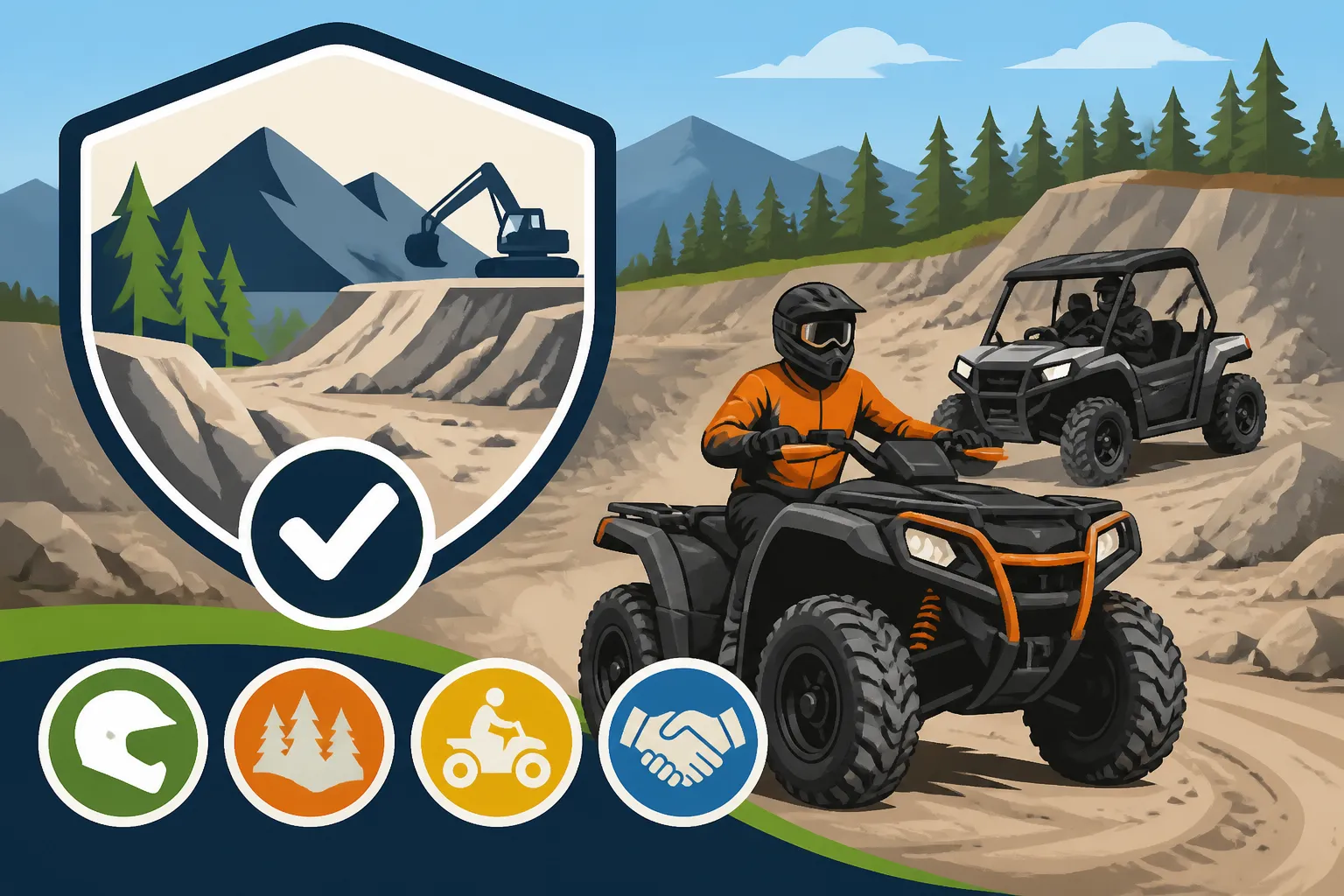
Riding in or near an active or recently active commercial gravel pit operation is incredibly dangerous and almost universally prohibited. These sites are busy with heavy machinery like excavators, loaders, and dump trucks, which have massive blind spots and operate on unpredictable schedules. The terrain itself can be highly unstable, with steep banks, sudden drop-offs, deep excavations, and hidden hazards like rebar or discarded equipment.
Even if a pit looks quiet, workers could be present, or blasting operations could be scheduled. The risk of severe injury or even death is extremely high. No amount of fun is worth putting yourself or others in such peril. Always avoid active commercial sites. If you’re unsure, err on the side of caution and find a different, designated riding area. These aren't playgrounds; they're industrial zones.
Key Regulations That Apply to Any Gravel Pit Riding
Even if you've done your homework and secured permission to ride in a specific gravel pit, you're not entirely off the hook. The BC Off-Road Vehicle Act and its regulations still apply. This means you need to ensure your machine and your riding practices meet provincial standards, just as you would on any other accessible Crown land or managed trail.
ORV Registration and Plates Are Non-Negotiable
This is one of the most fundamental rules for any ORV use in BC, regardless of where you're riding, as long as it's not exclusively on your own private land where you live. Even if you have permission to ride on a private gravel pit, or if the pit is on Crown land, your machine must be registered with ICBC. [BC Registration Became Mandatory in 2015] for a reason: to ensure accountability and track ownership.
This means having a valid [BC's Certificate of Registration Explained] and displaying your [BC ORV Number Plates and Decals] correctly. For example, if you've installed a cargo box or a SuperATV winch bumper, make sure it doesn't obstruct your plate. Failing to register your machine and display your plate can result in significant fines if encountered by law enforcement or Conservation Officers. [BC Tickets for an Unregistered Machine] are not just an inconvenience; they're a clear message that the rules are being enforced.
Insurance Requirements for Public and Private Land
Insurance is another critical piece of the puzzle. If you are riding on any Crown land, including Crown land gravel pits, you are generally required to carry a minimum of $200,000 in third-party liability insurance. This is mandatory if you're on a [BC Forest Service Road Requirements], and highly recommended for any other Crown land access. This coverage protects you in case you cause damage to property or injury to another person while riding.
For private gravel pits, even with permission, personal liability insurance is still a very good idea. While the ORV Act's mandatory insurance provisions primarily focus on Crown land, if you cause damage to the private landowner's property or injure someone else on their land, you could be personally liable for those costs. Basic Autoplan does not typically cover ORV use off-highway, so you’ll need specific ORV liability coverage. This can often be purchased through your ICBC Autoplan broker when you register your machine.
Safety Gear and Operating Rules
The rules around safety gear and operation apply universally wherever you ride an ORV in BC, with very few exceptions.
- Helmets: If you're on a ride-astride machine (like an ATV or dirt bike), you must wear an approved helmet. [BC ATV Helmet Law Explained] covers this explicitly. For side-by-sides with roll cages and seatbelts, helmets are generally not mandatory, but seatbelts are. Always prioritize safety.
- Youth Riders: There are strict [BC Youth Riding Rules and Supervision] in place. Children under 16 have limitations on engine size, and those under 19 require supervision by an adult (19 or older) who can provide immediate direction. A gravel pit, with its open space, might seem safe for a young rider, but the rules are still in full effect.
- Spark Arrestors: During fire season, especially, machines must be equipped with a spark arrestor that meets specific standards. [BC Spark Arrestor Rules and Fines] can be substantial if your machine isn't compliant, particularly in dry conditions.
- Impaired Riding: Just like driving a car, operating an ORV while impaired by alcohol or drugs is illegal and carries severe penalties under the Criminal Code. [BC Impaired Riding and the Criminal Code] applies no matter if you are on Crown land, private land, or in a gravel pit.
Environmental Impact and Responsible Riding
Even though a gravel pit might look like a barren landscape, it’s still an environment that can be damaged. Rutting up sensitive areas, driving through creeks (which is generally illegal), or leaving garbage behind can have long-term negative impacts. We all share a responsibility to keep BC beautiful. Stick to existing tracks if possible, avoid sensitive riparian areas, and always pack out whatever you pack in. The mantra "tread lightly" applies everywhere you ride, even where the terrain seems robust.
Finding Legal and Safe Places to Ride
Given the complexities of gravel pit access, it's often far easier and safer to stick to designated, legal riding areas. British Columbia has some incredible spots, and supporting these managed areas helps ensure we have places to ride for years to come.
Official OHV Recreation Sites and Managed Trails
British Columbia boasts a growing network of official Off-Highway Vehicle (OHV) recreation sites and managed trail systems. These are purpose-built or designated areas where ORV use is explicitly permitted, often with mapped trails, amenities, and clear rules.
Places like [Bear Creek OHV: BC's Largest Recreation Site] near Kelowna, or various spots in the [Chilliwack Area Riding in BC] offer hundreds of kilometers of trails designed for a variety of skill levels. The [BC Okanagan Riding Areas] and [BC Kootenay Riding Areas] also have numerous designated sites. These areas provide a legal, safe, and often more enjoyable riding experience without the constant worry of trespassing or encountering unexpected hazards. Many are maintained by passionate local clubs, ensuring a good experience.
Exploring Opportunities with Local Clubs
Joining a local ATV or UTV club is one of the best ways to find legal places to ride. Clubs often have established relationships with private landowners, manage permitted Crown land trails, or advocate for new riding areas. They're a wealth of knowledge about local conditions, rules, and upcoming rides.
For example, clubs like the Okanagan Trail Riders (who help manage Bear Creek OHV) or the Prince George ATV Club ([What the Prince George ATV Club Offers Riders]) work tirelessly to maintain and expand riding opportunities. [BC ATV Clubs Worth Joining] often host events, group rides, and even provide insurance discounts or access to training courses. They can guide you to areas where you can ride legally and responsibly, including pits that might be part of an approved trail system or under a specific permit.
Seeking Explicit Written Permission
If you absolutely have your heart set on riding a specific gravel pit that appears to be on private land, your only legal recourse is to contact the landowner directly and obtain explicit, written permission. A verbal "yeah, sure" isn't enough; things can be easily misunderstood or forgotten, and if a different representative of the owner or law enforcement shows up, you need documented proof.
Be prepared to provide details about your insurance, your plans, and demonstrate a commitment to responsible riding. Some landowners may be open to it, especially if you offer to help with maintenance or cleanup, but many will simply say no due to liability concerns. Remember, even a [BC Farm Quads Are Not Exempt] from registration rules just because they're on private land, which underscores the province's comprehensive approach to ORV regulation. Respect their decision either way.
Here’s a quick overview of what to consider:
| Gravel Pit Type | Typical Ownership | Legal Access Requirement | Key Risks | Recommended Action |
|---|---|---|---|---|
| Active Commercial Pit | Private Company | Strictly Prohibited without explicit commercial permit | Heavy machinery, unstable ground, blasting, severe injury/death | Avoid entirely. |
| Inactive Private Pit | Private Individual/Company | Explicit, written permission from owner | Trespassing fines, machine seizure, liability for damage | Seek written permission; otherwise, avoid. |
| Crown Land Pit | Provincial Government | ORV Act compliance (registration, insurance, etc.) | Motor vehicle prohibitions, environmental restrictions, leases | Check for local closures/restrictions on Crown land maps. |
| Designated OHV Pit | Provincial/Club Managed | ORV Act compliance, potential site pass | Following posted rules, avoiding sensitive areas | Follow all site-specific rules, enjoy! |
Ultimately, while the allure of an open gravel pit is undeniable, the smart rider in British Columbia understands that "open" doesn't necessarily mean "legal." Do your homework, respect land ownership, and prioritize safety and legality. You'll not only protect yourself and your machine, but you'll also help ensure the future of responsible off-road riding in our beautiful province.
Disclaimer
This article is for general informational purposes only and does not constitute professional advice. Laws, prices and regulations vary by location and change over time. Consult a qualified professional for guidance on your specific situation.