Basic Autoplan on a Quad
The world of ATV and UTV riding in British Columbia offers incredible freedom and stunning landscapes, but let's be real: navigating the rules, especially around insurance, can feel like slogging through deep mud. Many riders are confused about whether their quad needs "Basic Autoplan" like a car, and what exactly that means for off-road adventures or those quick dashes across a paved road. This guide is here to untangle the complexities of ATV and UTV insurance in BC, helping you understand when and where different coverages apply, so you can ride with confidence and compliance.
Understanding BC's Autoplan System for Off-Road Vehicles
When we talk about vehicle insurance in British Columbia, most people immediately think of ICBC's Autoplan. It's the mandatory, public insurance system for vehicles that travel on highways. For cars, trucks, and motorcycles, it's a straightforward process: you get your Basic Autoplan, and then you can add optional coverage. However, off-road vehicles (ORVs) like ATVs and UTVs don't quite fit into this neat highway-centric box, which leads to a lot of head-scratching and frustration for riders just trying to do the right thing. The distinction between highway use and off-road use is absolutely critical when it comes to understanding your insurance needs.
The Core Difference: Highway vs. Off-Road Coverage
The fundamental difference lies in where your machine is legally permitted to operate. Basic Autoplan, at its heart, is designed to cover vehicles that are driven on public roads and highways. It provides minimum third-party liability coverage, accident benefits, and uninsured motorist protection for incidents that occur on this network. For most of an ATV or UTV's life, however, it's not on a highway; it's tearing up trails, crossing streams, or navigating resource roads. This is where the standard Autoplan framework often falls short, creating a gap in understanding for many riders. Your quad is primarily an off-highway vehicle, and its insurance needs reflect that specialized use.
When you're out on Crown land, enjoying the vast expanses of BC's wilderness, the risks and liabilities are different from those you'd encounter commuting on the Trans-Canada Highway. The provincial government recognized this distinction, which is why a separate set of rules and insurance requirements exist specifically for ORVs, particularly concerning their use on Crown land and resource roads. It’s not about making things difficult; it’s about aligning the coverage with the actual risks and environments where these machines operate, protecting riders and the public from the unique challenges of off-road recreation.
When Basic Autoplan Might Apply to Your Quad
Despite their off-road nature, there are very specific, limited scenarios where your ATV or UTV might indeed need Basic Autoplan. These situations are almost exclusively tied to interaction with the formal highway system. It’s not for riding on the highway for extended periods – BC has [BC Has No Street-Legal Path for an ATV] – but for transient moments or very specific permitted uses. For instance, if you obtain an operation permit from a local police detachment to cross a municipal road or highway section, that permit will almost certainly stipulate that you must carry Basic Autoplan liability coverage for the duration of that crossing.
These moments are typically brief: a quick transit from one trail section to another, or moving from a staging area to an access point that requires crossing a paved road. It's not about cruising down main street, but about necessary, short-duration interactions with the highway network. Understanding these narrow circumstances is key to avoiding penalties. The fines for being caught on a highway without the proper registration and insurance can be significant, so it's always better to be prepared. Consult with your local Autoplan broker or police detachment for exact requirements in your area. [BC Autoplan Brokers Handle ORV Registration] is a great resource.
Why the Standard Autoplan Doesn't Fully Cover Your ORV Life
The biggest misconception is that if you have Basic Autoplan for your quad, you're fully covered for all your riding adventures. This simply isn't true for the majority of off-road riding in BC. Basic Autoplan provides coverage for highway use, but it doesn't extend to the vast majority of your time spent on trails, in the backcountry, or on Forest Service Roads (FSRs) unless explicitly stated otherwise, which is rare. Your typical Basic Autoplan policy for a car wouldn't cover you if you drove it into the wilderness and had an accident, and the same principle largely applies to an ORV used off-highway.
For most off-road scenarios, particularly on Crown land, you'll need separate, specialized ORV insurance. The risks associated with off-road riding—remote locations, higher chance of rollovers, potential for environmental damage—are different from those encountered on paved roads. This means that while [BC Requires Basic Autoplan on a Highway] for specific moments, it's only one piece of the puzzle. Relying solely on Basic Autoplan for your comprehensive off-road protection would leave you incredibly exposed to financial risk if an incident occurred away from the highway.
When Your Quad Needs Basic Autoplan in BC
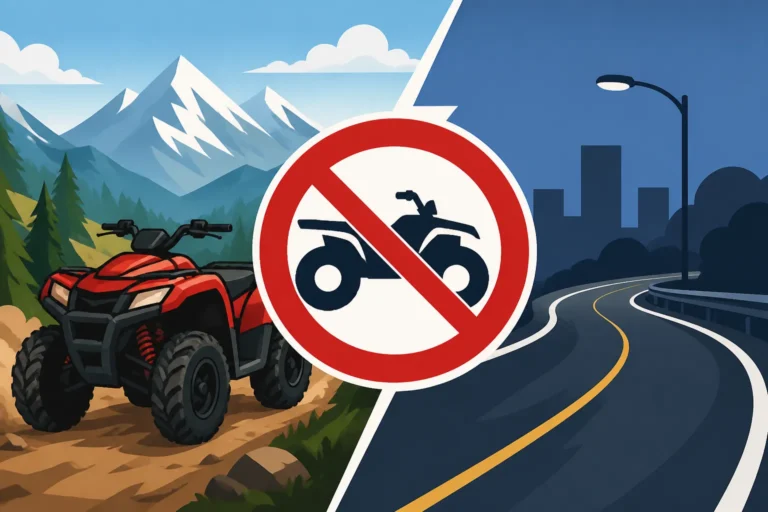
It can feel like a contradiction: an off-road vehicle needing road insurance. But in British Columbia, the law carves out very specific instances where your ATV or UTV must have Basic Autoplan coverage. These moments are brief, highly regulated, and generally involve your machine touching the paved public road system. It’s not about transforming your quad into a street-legal vehicle – that’s generally not possible in BC – but about providing a safety net for those quick, unavoidable interactions with highway traffic. Being aware of these triggers is paramount for any responsible rider.
Crossing a Highway: The Brief But Critical Requirement
Perhaps the most common scenario where your ATV or UTV requires Basic Autoplan is when you need to cross a highway or public road. This isn't about riding along a highway, but directly perpendicular to it, to get from one section of Crown land or trail to another. Imagine you're riding a fantastic trail system that happens to be bisected by a provincial highway. To legally continue your journey, you'll need to stop, ensure it's safe, and then cross directly. During this short period, your machine is interacting with highway traffic, and therefore, it must have Basic Autoplan liability coverage.
This requirement for highway crossings is strictly enforced because the potential for an incident involving a highway vehicle, even during a brief crossing, is high. The moment your wheels touch the pavement of a gazetted highway, you are subject to the Motor Vehicle Act, and that includes the insurance provisions. Riders often mistakenly believe that because they're "just crossing," the rules don't apply, but that's a dangerous assumption. Always ensure you have the necessary documentation, including proof of your Basic Autoplan, should you be stopped during such a transit. [BC Rules for Crossing a Highway] lays out the specifics you need to know.
Operation Permits and Autoplan Conditions
Beyond simple crossings, local police detachments in BC can issue Operation Permits for ORVs to use specific municipal roads or small sections of highway under very limited circumstances. These permits are typically for accessing remote trailheads, moving between properties in rural areas, or for certain utility work. When a police detachment issues such a permit, it almost universally comes with the condition that the ORV must carry valid Basic Autoplan liability insurance for the duration of the permitted operation.
These permits are not a free pass to ride your quad wherever you want on public roads; they are highly restrictive in terms of routes, times, and duration. However, they provide a legal avenue for necessary road use, provided you meet all conditions, including the insurance requirement. Think of them as a temporary, highly specific exception to the general rule that ORVs aren't street legal. Always check the specific conditions on your permit, as failure to comply with the insurance stipulation could lead to significant fines and penalties. Remember, [BC Requires a Driver's Licence on a Highway] as well when operating under such a permit.
The Driver's Licence Connection to Highway Use
It’s worth noting that if you are operating your ATV or UTV in a situation that requires Basic Autoplan (like a highway crossing or under an operation permit), you will also need to possess a valid driver's licence. Basic Autoplan is tied to the operation of a motor vehicle on a highway, and operating any motor vehicle on a highway, even briefly, demands that the driver holds the appropriate licence. This means that young riders, or those without a valid driver's licence, cannot legally operate an ORV in these specific highway-related scenarios, even if the machine itself has Basic Autoplan.
This rule is often overlooked, particularly by new riders or those who primarily ride on private land where a licence isn't typically required. However, the moment you transition onto a public highway, even for a crossing, the full weight of the Motor Vehicle Act applies. It's another layer of compliance that many riders find surprising but is crucial for safety and legality. Always ensure that both the operator and the machine meet all legal requirements before venturing onto any public road or highway, no matter how brief the interaction.
Beyond Basic Autoplan: Mandatory ORV Insurance on Resource Roads
Okay, so we've established that Basic Autoplan is for those rare, specific moments when your quad hits the pavement. But what about the vast majority of riding that happens off-road? This is where a separate, equally critical insurance requirement comes into play, one that many riders, especially those new to BC, often overlook. If you plan on exploring BC's extensive network of Forest Service Roads (FSRs) or other designated resource roads, there's a specific type of liability insurance that becomes mandatory. This isn't your Basic Autoplan; it's tailored for the unique risks of industrial roads and backcountry travel.
The $200,000 Liability Rule for FSRs
The Off-Road Vehicle Act in British Columbia mandates that any ORV operating on a Forest Service Road or other industrial or resource road must carry a minimum of $200,000 in third-party liability insurance. This is a non-negotiable requirement. Forest Service Roads are often active industrial zones, with heavy logging trucks, construction vehicles, and other resource-sector traffic sharing the road. The potential for a serious incident, and the associated liability, is significant. The $200,000 minimum is there to protect you financially in case you're found at fault in an accident that causes injury or property damage to another party on these roads.
Many riders, especially those coming from other provinces or who've only ever ridden on private property, are genuinely surprised by this. They often assume their regular vehicle insurance might cover it, or that if it's not a "highway," no insurance is needed. This is a dangerous misunderstanding. [BC Resource Roads Count as Crown Land], and with that access comes responsibility. Without this mandatory liability coverage, you're not just risking a ticket; you're risking financial ruin if a serious accident occurs. Imagine colliding with a loaded logging truck – the damages could easily exceed $200,000, leaving you personally liable for the difference.
Where to Get This Specific ORV Coverage
So, where do you get this specialized $200,000 liability coverage for FSRs? You can purchase it through an Autoplan broker, the same place you'd go for your car insurance. While it's not "Basic Autoplan" in the traditional sense, ICBC is typically the provider for this mandatory ORV liability for FSRs. When you go to register your off-road vehicle in BC, the broker will guide you through the process, which includes selecting this mandatory coverage if you intend to ride on FSRs. It's often offered as part of the overall ORV registration and insurance package.
It’s essential to be clear with your broker about your riding intentions. Tell them you plan to ride on Forest Service Roads and other Crown land, and you need to ensure you meet the $200,000 liability requirement. They can help you understand the options, which may also include additional voluntary coverage for your machine itself (collision, comprehensive) if you choose. Just like with a car, you'll receive a document proving you have this coverage, and [BC Riders Must Carry the Certificate] of registration, which includes proof of your insurance, whenever you're riding.
Consequences of Riding an FSR Without Proper Insurance
Riding on an FSR without the mandatory $200,000 liability insurance is a serious offence with significant consequences. Enforcement of the Off-Road Vehicle Act is carried out by various authorities, including the RCMP, Conservation Officers, and Forest Service officials. If you're caught, you could face hefty fines. These fines aren't just a slap on the wrist; they can be substantial and accumulate quickly. Beyond the immediate financial penalty, you're also exposed to immense personal liability should you be involved in an accident.
Imagine causing an accident on an FSR where someone is injured, or a piece of valuable industrial equipment is damaged. Without that $200,000 in liability coverage, you would be personally responsible for all damages, potentially leading to lawsuits that could strip you of your assets. This is why the requirement is in place: to protect everyone. Don't take the risk. Always ensure you have the correct and current insurance coverage before venturing onto any Forest Service Road. Your peace of mind, and your bank account, will thank you for it. For more details on what's required, see [BC ATV Insurance Requirements].
Voluntary Insurance Options for Your Quad
While certain liability coverages are mandatory for specific riding environments in BC, most riders want more protection for their valuable machines and for their own peace of mind. This is where voluntary insurance options come into play. Just like with cars, you can choose to purchase additional coverage beyond the basic legal requirements. These options can protect your ATV or UTV from damage, theft, and provide extended liability coverage for those unforeseen incidents that can happen far from pavement. It’s about tailoring your insurance to your specific riding habits and the value of your machine.
Protecting Your Machine: Collision and Comprehensive
The mandatory liability coverage for FSRs, or the Basic Autoplan for highway crossings, only protects other people and their property in an accident where you are at fault. It doesn't pay a dime to fix or replace your own damaged ATV or UTV. For that, you need to add voluntary collision and comprehensive coverage.
- Collision coverage will pay for damages to your own machine if you're involved in an accident with another vehicle, or if you hit an object (like a tree, a rock, or even roll over while navigating a difficult trail). Given the adventurous nature of off-road riding, collision coverage is often considered essential by many riders. Accidents happen, even to the most experienced, and repairs can be surprisingly expensive. Protecting your investment makes a lot of sense, especially with the cost of parts and labour these days.
- Comprehensive coverage protects your machine from damages that aren't collision-related. This includes things like theft, vandalism, fire, certain natural disasters (like floods or wind damage), and even hitting an animal on the trail. If your quad is stored in a shed and a tree falls on it, or if it's stolen from your property, comprehensive coverage would kick in. These coverages are available through ICBC or private insurance companies, and it's worth comparing what each offers in terms of deductibles, limits, and specific exclusions. Many riders invest in robust aftermarket protection, like heavy-duty skid plates, A-arm guards, and bumpers, from companies like SuperATV, not just to enhance performance but also to proactively reduce the risk of damage that might otherwise trigger a collision claim.
Enhanced Liability for Peace of Mind Off-Road
Beyond the minimum $200,000 liability required for FSRs, many riders choose to purchase higher limits of third-party liability coverage. While $200,000 sounds like a lot, in a serious accident involving multiple parties, significant injuries, or extensive property damage, it can be exhausted surprisingly quickly. Imagine an incident where you're at fault, and it leads to someone's long-term disability or major environmental clean-up. The costs could easily run into the millions.
Purchasing additional liability coverage, often up to $1 million or even $2 million, provides a far greater layer of financial protection. This enhanced coverage extends to all your off-road riding, not just on FSRs. Whether you're on Crown land trails, private property (with permission!), or even in an organized riding event, having higher liability limits means you're better protected against potential lawsuits. It’s an investment in your financial future and offers significant peace of mind knowing that you’re well-covered if the unthinkable happens. This type of coverage is usually available through the same brokers who handle your other ORV insurance.
Benefits of Club Membership for Insurance Discounts
Did you know that being a member of an organized ATV or UTV club in British Columbia can sometimes lead to discounts on your voluntary ORV insurance? Many clubs are affiliated with larger provincial or national organizations that negotiate group rates or provide exclusive benefits to their members, including preferred insurance premiums. These clubs often promote safe riding practices, offer rider training courses, and contribute to trail maintenance, all factors that insurance companies appreciate.
Beyond potential discounts, club membership offers a host of other benefits, from organized group rides and events to access to local trail knowledge and advocacy for rider rights. It's also a great way to connect with like-minded individuals and contribute to the vibrant riding community in BC. When you're talking to your insurance broker about [BC ATV Insurance Cost Per Year], be sure to mention if you are a member of a recognized ORV club. It could save you some money and connect you with a supportive community that further enhances your riding experience.
Navigating the Insurance Broker: What to Ask
Walking into an Autoplan broker's office to insure your ATV or UTV can feel a bit daunting, especially with all the different rules for highways, resource roads, and general off-road use. It’s not like insuring a car, where the process is largely standardized. You'll likely encounter brokers who are incredibly knowledgeable about ORV insurance, and others who might need a bit more guidance from you on your specific needs. The key is to be prepared with the right questions and to be very clear about how and where you intend to ride your machine. Don't be afraid to ask for clarity until you completely understand your coverage.
Important Questions to Ask Your Broker
To ensure you get the right coverage for your off-road vehicle, here are some crucial questions to ask your insurance broker:
- "What insurance do I need to ride on Forest Service Roads and other resource roads in BC?" This directly addresses the mandatory $200,000 liability. Make sure they clearly explain this specific coverage.
- "When and where does my machine require Basic Autoplan?" Confirm the specific scenarios (like highway crossings or under a police permit) where this applies and ensure you have it for those moments.
- "What are my options for collision and comprehensive coverage for my quad/UTV?" Discuss deductibles, actual cash value vs. replacement value, and any exclusions for extreme use. You might ask if certain aftermarket protection, perhaps heavy-duty bumpers or rock sliders from a brand like SuperATV, could influence your premium or reduce potential claims.
- "Can I get additional third-party liability coverage beyond the minimum required for FSRs?" Inquire about increasing your liability limits to $1 million or $2 million for enhanced protection.
- "Are there any discounts available for ORV club members, safety course completion, or if I have other policies with you?" Explore all potential savings.
- "What is the process for making a claim if I have an accident or my machine is stolen?" Understand the steps involved and what documentation you'll need.
- "What exactly is covered if I'm riding on private property with permission?" Clarify if your liability and machine damage coverage extends to these situations.
Be specific about your machine type (ATV, UTV, dirt bike, snowmobile) and its primary use (recreational, farm work, hunting access). The more information you provide, the better your broker can tailor your policy.
Understanding Policy Limitations and Exclusions
Every insurance policy has limitations and exclusions, and ORV insurance is no different. It's absolutely vital that you read and understand these, rather than just signing on the dotted line. For example, some policies might have exclusions for certain types of competitive racing, or for modifications that significantly alter the vehicle's safety characteristics. If you've heavily modified your UTV with a lift kit and oversized tires, or high-performance parts, it's worth discussing this with your broker. While quality parts from SuperATV might enhance your machine, you need to ensure they don't inadvertently void a portion of your coverage if not declared.
Pay close attention to geographic limitations – does your policy only cover you in BC, or does it extend to other provinces or states if you plan on a trip? What about age restrictions for operators? If a younger family member rides your machine, ensure they are covered under your policy, or understand the conditions under which they are not. Asking about common scenarios and potential pitfalls will help you avoid unwelcome surprises if you ever need to make a claim.
Keeping Your Insurance Proof Handy on the Trail
Once you've secured all your necessary and voluntary insurance coverages, the final, crucial step is to always carry proof of that insurance with you when you ride. Whether it's the Certificate of Registration that shows your liability coverage for FSRs, or a separate insurance card for your optional coverages, you need to have it accessible. Enforcement officers – be they RCMP, Conservation Officers, or Forest Service staff – can ask for proof of your registration and insurance at any time.
Having your physical documents, or at least clear digital copies on your phone, can save you a lot of hassle and potential fines. There's nothing worse than being pulled over and having to prove your compliance when you know you've done everything right. A small, waterproof pouch attached to your machine or carried in your riding gear is a smart investment. Always be prepared to show that you are a responsible and legal rider. [BC Riders Must Carry Photo ID] with their Certificate of Registration as well.
Insurance at a Glance for BC ORV Riders
| Insurance Type | Where It Applies (Primary Use) | Mandatory/Voluntary | Covers My Machine? (Collision/Comp) | Covers Others? (Liability) | What to Ask Your Broker For |
|---|---|---|---|---|---|
| Basic Autoplan | Highway crossings, permitted short road use | Mandatory* | No | Yes (Minimum Third-Party Liability) | Specific needs for highway crossings/permits |
| FSR/Resource Road Liability | Forest Service Roads, Industrial Roads, Crown Land with active industrial use | Mandatory | No | Yes (Minimum $200,000 Third-Party Liability) | Ensure you meet the $200K FSR requirement |
| Voluntary Collision | Damage to your ORV from an accident (e.g., rollover, hitting a tree) | Voluntary | Yes | No | Deductibles, actual cash value, exclusions, aftermarket parts |
| Voluntary Comprehensive | Damage/loss to your ORV from non-collision events (e.g., theft, fire, vandalism, animal strike) | Voluntary | Yes | No | Deductibles, actual cash value, storage details |
| Enhanced Liability | All off-road riding (Crown Land, private property, FSRs) | Voluntary | No | Yes (Increased Third-Party Liability, e.g., $1M or $2M) | Higher liability limits, club discounts |
*Mandatory for specific highway-related interactions; not for general off-road use.
Disclaimer
This article is for general informational purposes only and does not constitute professional advice. Laws, prices and regulations vary by location and change over time. Consult a qualified professional for guidance on your specific situation.