Buying a Quad With a Handwritten Receipt
It's a familiar scenario for many off-road enthusiasts in British Columbia: you've found a fantastic deal on a used quad, maybe through a local ad or a friend of a friend, and the seller hands you a simple handwritten receipt. While it feels like a handshake agreement and a way to make the deal official, you quickly realize that when it comes time to register that machine for legal riding on Crown land, a scribbled note might not cut it. This guide is here to walk you through the often-confusing process of successfully registering your quad with just a handwritten receipt, validating your concerns and offering practical, step-by-step solutions to navigate the BC registration system.
The Frustration of Unofficial Paperwork in BC
There's a certain charm to a private sale, isn't there? You're dealing directly with another rider, perhaps someone who has loved and cared for their machine, and the whole transaction feels less formal than buying from a dealership. In many cases, a quick handwritten receipt is all that's exchanged, serving as proof of payment and a basic record of the transaction. But when you go to register your new-to-you off-road vehicle (ORV) in BC, you quickly discover that the informal nature of these receipts can lead to real headaches. It’s not that the sale itself isn’t legitimate; it’s that the provincial system, designed for clarity and a clear audit trail, often needs more than just a quick note to satisfy its requirements. You're left feeling like you've done everything right, but the paperwork just isn't "enough."
Why a Handwritten Receipt Feels Problematic
The core issue with a handwritten receipt, from the perspective of BC's ORV registration system, is usually a lack of comprehensive, verifiable detail. While it might confirm that you paid money to someone for a quad on a certain date, it often lacks the robust information needed to establish a clear and uninterrupted chain of ownership. Think about it: a hastily scribbled note might omit the seller's full legal name and address, their contact information, or even a precise description of the quad beyond its make and model. Crucially, it might not include the Vehicle Identification Number (VIN) or other serial numbers, or explicitly state that the seller is indeed the legal owner with the right to transfer title. This ambiguity can throw a wrench into the registration process, making you feel like your perfectly legitimate purchase is suddenly under a cloud of suspicion.
When you're dealing with an older machine, say a quad that's been passed through a few hands over the decades, the problem compounds. Each transfer of ownership, even informal ones, needs to be documented for BC registration. A simple handwritten note from the most recent seller doesn't account for what happened two, three, or even four owners ago. This is where the system gets tricky, as it demands a complete narrative of who has owned that quad since it left the manufacturer's hands or first entered BC. For many long-time quad owners, especially those who bought their machines before mandatory registration in 2015, the idea of having a meticulously documented history seems almost absurd, yet it's what the province now asks for.
What ICBC (Or Rather, an Autoplan Broker) Looks For
When it comes to registering an ORV in BC, you'll be dealing with an Autoplan broker, essentially an agent for ICBC (Insurance Corporation of British Columbia). While ICBC oversees the provincial vehicle registration and insurance system, the actual legwork for ORVs is done through these brokers. They are the gatekeepers, tasked with ensuring that all documentation meets the requirements of the Off-Road Vehicle Act and its regulations before they can issue a Certificate of Registration and an ORV plate.
What these brokers are really looking for is undeniable proof of ownership and a clear, unbroken [BC Ownership Chains Going Back Decades]. They need to be confident that the person selling you the machine had the legal right to do so and that there's no question about its provenance. A formal bill of sale typically includes all the necessary identifying details for both buyer and seller, the ORV's VIN, the purchase price, and a declaration that the seller is the legal owner. A handwritten receipt, even if it's got some of this information, often falls short on the "formal declaration" part or might miss key contact details that the broker needs for verification purposes.
The broker's goal isn't to make your life difficult, but to adhere to the provincial rules designed to prevent the registration of stolen machines and ensure proper ownership transfers. If your handwritten receipt is vague or missing critical pieces of information, the broker's hands are tied. They can't just take your word for it. They need a verifiable paper trail. This is why many people get turned away, not because their sale isn't real, but because the documentation doesn't meet the specific legal criteria for registering an asset like an ORV. It's at this point that you'll realize a simple handwritten receipt, while useful for your personal records, rarely satisfies the stringent requirements of the provincial registration authority on its own.
Navigating the Registration Process with a Handwritten Receipt
So, you’ve got this handwritten receipt, and you’re wondering if it's worth the paper it's written on when it comes to BC ORV registration. The good news is, a handwritten receipt isn't necessarily a dead end. It can be part of your ownership proof, but it often needs some significant reinforcement to satisfy the requirements of an Autoplan broker. The key is understanding what information is absolutely non-negotiable and how to provide it in a format the system will accept.
When a Handwritten Receipt Might Be Enough (and When It's Not)
In rare cases, a handwritten receipt might be sufficient if it is remarkably detailed and reads almost like a formal bill of sale. For it to even stand a chance, it would need to include:
- Full Legal Names and Addresses: Of both the buyer and the seller. Not just a first name and a phone number, but proper legal identification.
- Complete Contact Information: Phone numbers and email addresses for verification.
- Detailed Machine Description: Make, model, year, colour, and most importantly, the full Vehicle Identification Number (VIN) or other serial numbers.
- Date of Sale and Purchase Price: Clearly stated.
- Clear Statement of Ownership Transfer: A line indicating that the seller transfers all rights and ownership of the ORV to the buyer.
- Signatures: Both buyer and seller, preferably witnessed.
However, most handwritten receipts for private sales, especially older ones, fall far short of this ideal. They often omit full addresses, precise VINs, or a clear declaration of ownership. More commonly, they just state "Sold quad to [Buyer Name] for $X on [Date]" with a signature. This is where it becomes insufficient because it doesn't provide the concrete, verifiable details required by the Autoplan broker to complete the registration. You can review the [BC Registration Paperwork Checklist] to see exactly what details are expected in a complete application. If your receipt is missing even a few of these critical pieces, you’ll likely need to take additional steps.
The crucial element that's almost always missing from a casual handwritten note is a legal attestation of facts. It’s not just about what information is present, but how it’s presented and its legal weight. A handwritten note, while reflecting an agreement, doesn’t carry the same legal weight as a sworn statement or a formal contract signed with witnesses. This lack of legal formality is generally where handwritten receipts falter and where additional documentation becomes absolutely necessary.
The Importance of a Statutory Declaration
This is where the [BC Statutory Declaration for an ORV] steps in as your best friend. A Statutory Declaration is a formal, written statement of facts that you swear or affirm to be true before a commissioner for taking affidavits, a notary public, or certain other authorized officials. Essentially, you are putting your personal integrity and legal liability behind the information you provide, stating under oath how you came to own the quad. This document carries significant legal weight and is often the bridge between an informal handwritten receipt and the formal requirements of the BC ORV registration system.
You'll need a Statutory Declaration when your handwritten receipt is incomplete, missing crucial information, or if you've lost previous bills of sale, or even if the seller is now unreachable. It allows you to present a comprehensive narrative of the quad's ownership history as you understand it, covering any gaps in the paper trail. For example, if you bought a quad from someone who only had a handwritten note from their purchase, your Statutory Declaration can explain that situation, identifying the previous seller as best you can, and stating that you believe the machine was legitimately owned.
Creating a Statutory Declaration might seem intimidating, but it's a straightforward process. You can obtain a blank form from Service BC or use online legal document services like LawDepot to help you draft one. LawDepot provides templates and guidance to ensure you include all the necessary information, making the process much clearer. Once drafted, you'll need to sign it in front of a qualified individual (like a notary public, a lawyer, or a commissioner of oaths, often found at Service BC offices). They will then witness your signature and affix their seal, validating that you have sworn to the truth of the contents. This sworn statement is exactly what the Autoplan broker needs to move forward when other documents are lacking. It addresses the "missing link" in the chain of ownership and provides the legal assurance that the handwritten receipt could not on its own. [Declaring Ownership Under Oath] is a critical step for many, and it puts the onus on you to provide a truthful account.
Building Your Ownership Story
Even with a handwritten receipt, or especially when it's incomplete, your goal is to present a continuous, believable narrative of how your quad came into your possession. The handwritten receipt is just one piece of this puzzle. Think of yourself as a detective, gathering all available clues to establish your legitimate claim to the machine. Any scrap of relevant information can help.
For instance, if the handwritten receipt is from a friend, perhaps you have text messages, emails, or even social media messages discussing the sale, the price, or arranging the pickup. These digital communications, while not formal documents, can serve as supplementary evidence that corroborates the handwritten note and your Statutory Declaration. The more pieces of evidence you can provide that align with your sworn statement, the stronger your case for ownership. This might include old insurance slips (even if they're not in your name, they show a previous owner), photos of the machine with the seller, or even maintenance records.
The critical thing to remember is that the Autoplan broker needs to feel confident that the machine isn't stolen and that you are its rightful owner. Every bit of information you can provide helps build that picture. For machines that have been around for a while, the concept of [Why Every Past Sale Has to Be Documented] can feel overwhelming. But by combining your handwritten receipt with a robust Statutory Declaration and any other corroborating evidence, you create a compelling "story" of ownership that addresses the system's need for a clear paper trail, even when traditional documents are sparse. Your aim is to leave no room for doubt about the legitimacy of your acquisition.
Step-by-Step: Registering Your Quad with a Handwritten Receipt
Dealing with "unofficial" paperwork can make the registration process feel daunting, but it doesn't have to be. By following a clear, methodical approach, you can successfully register your quad in British Columbia, even if your primary proof of purchase is a handwritten receipt. It's all about being prepared and understanding what the Autoplan broker truly needs from you.
Gathering Your Information and Documentation
Before you even think about heading to an Autoplan broker, you need to consolidate all the information and documents you do have. This preparation phase is crucial and will save you time and potential frustration. Start by making a physical checklist and gathering the following:
- Your Personal Identification: You'll need at least two pieces of valid, government-issued identification. This usually includes your BC driver's licence, BC Services Card, or passport.
- The Handwritten Receipt: Dig it out! Make sure it’s legible. Even if it's incomplete, it's a starting point.
- Vehicle Identification Number (VIN): This is non-negotiable. You absolutely must have the full VIN of your quad. Locate it on the machine itself (it's often stamped on the frame, usually near the steering head or on a cross-member). Take a clear photo of it. The broker will need this to run checks and confirm the machine's identity. If you're struggling to find it, research common VIN locations for your specific make and model. [Serial Numbers and Where They Hide] can offer some guidance.
- Seller's Information (as much as you have): Even if the receipt is handwritten, try to collect the seller's full name, address, and any contact information you have (phone, email). This helps add credibility to your transaction.
- Purchase Date and Price: Clearly noted. This information is needed for calculating PST (Provincial Sales Tax) and for the registration forms.
- Any Other Supporting Documentation: This could be anything from old registration papers (even if not in your name), past insurance documents, previous transfer of ownership forms, text messages, emails, or even photos of the quad with the seller. These items, though not formal bills of sale, help to build a narrative of legitimate acquisition.
The more thoroughly you gather this initial information, the smoother the subsequent steps will be. Missing a VIN or critical seller details will inevitably lead to delays and potentially require you to go back and get more information.
Preparing Your Statutory Declaration (If Needed)
If, after reviewing your handwritten receipt and other documents, you realize you have gaps in your ownership chain or insufficient proof, a Statutory Declaration will be your primary solution. This document essentially allows you to declare, under oath, the full circumstances of your quad's acquisition and ownership history.
Here's how to prepare one:
- Obtain a Form: You can usually pick up a blank Statutory Declaration form from any Service BC office. Alternatively, online legal document services like LawDepot can provide you with a template and guide you through the process of filling it out correctly. Using a service like LawDepot can be beneficial as it prompts you for all the necessary details, ensuring your declaration is comprehensive and legally sound.
- Draft the Contents: This is where you tell your quad's story. Clearly state:
- Your full legal name and address.
- A declaration that you are the lawful owner of the ORV.
- How you acquired the machine (e.g., "purchased from John Smith on [Date] for [Price] via a handwritten receipt").
- All identifying details of the ORV, including make, model, year, and the all-important VIN.
- If there are gaps in the ownership chain (e.g., "John Smith informed me he purchased the quad from an unknown individual years ago and did not have a bill of sale for that transaction"), explain this clearly and to the best of your knowledge.
- State that you are unaware of any liens, encumbrances, or other claims against the ORV.
- Declare that you believe the ORV is not stolen.
- Swear or Affirm the Declaration: Once drafted, you must sign this document in front of a commissioner for taking affidavits, a notary public, or a lawyer. These officials will verify your identity, witness your signature, and then sign and seal the document themselves, confirming that you have sworn to the truth of its contents. Many Service BC offices have commissioners available, or you can find a notary public in your community. There will be a small fee for this service, typically a nominal amount. [When a Declaration Replaces a Missing Bill of Sale], this document becomes your primary evidence.
This Statutory Declaration is your robust, legally recognized statement of ownership. It transforms your informal handwritten receipt into a formal component of your registration application.
Visiting Your Autoplan Broker
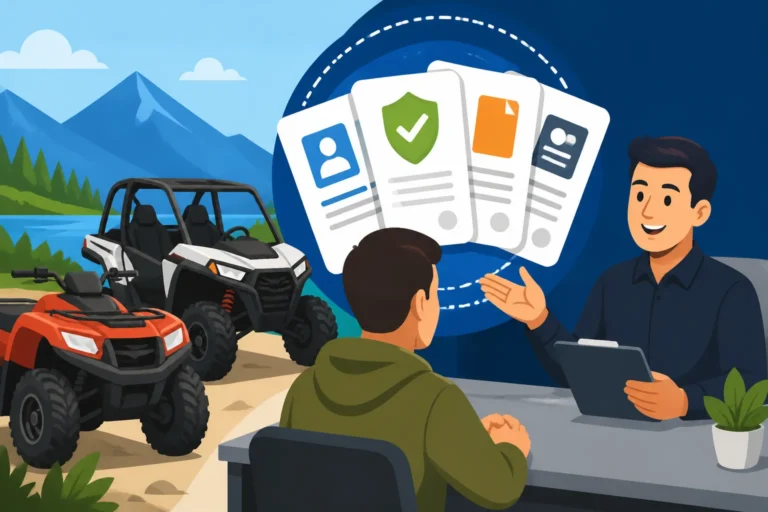
With your ID, handwritten receipt, Statutory Declaration (if needed), and any other supporting documents in hand, you're ready to visit an Autoplan broker. Remember, [BC Autoplan Brokers Handle ORV Registration] and they are the only ones who can process this for you. Don't go to a general ICBC office; seek out an Autoplan broker.
Here’s what to expect and what to bring:
- All Your Documents: Present your complete package to the broker. This includes your government-issued ID, the original handwritten receipt, your original Statutory Declaration (if you prepared one), and any other corroborating evidence you've gathered.
- Be Prepared to Explain: The broker will review your documents. Be ready to clearly and concisely explain how you acquired the quad, especially if you’re relying on a Statutory Declaration to fill in gaps.
- VIN Verification: The broker will use the VIN to perform a stolen vehicle check and verify the machine's details. They might also check for any outstanding liens.
- PST Calculation: They will calculate the Provincial Sales Tax based on the purchase price you declared or the machine's depreciated value, whichever is higher. Be prepared to pay this.
- Registration Fee: You will pay the initial registration fee, which is a one-time charge for as long as you own the machine.
- Insurance (Optional but Recommended): While not mandatory for riding all Crown land, you will need minimum liability insurance to ride on [BC Forest Service Road Requirements]. Your broker can help you arrange this at the same time.
The broker will guide you through the necessary forms. They'll submit your paperwork for processing. If everything is in order, they will issue you a temporary Certificate of Registration and your ORV license plate on the spot. Your permanent Certificate of Registration will arrive in the mail later. [Papers a Broker Needs to Transfer a Quad] vary based on the situation, but your thorough preparation will make it much easier for them to help you.
Common Pitfalls and Important Considerations
Even with the right approach, navigating ORV registration with a handwritten receipt can still present challenges. Understanding these potential pitfalls beforehand can help you avoid delays and protect yourself.
Dealing with a Disappeared or Uncooperative Seller
This is perhaps the biggest headache when relying on informal paperwork. You buy a quad, get a simple handwritten note, and then later discover you need more information for registration. You try to contact the seller, only to find their phone number disconnected, emails bounce back, or they simply refuse to provide further details or a more formal bill of sale.
When the seller is unreachable or uncooperative, your Statutory Declaration becomes even more critical. It needs to be extremely detailed, laying out all the facts as you know them, including any attempts you made to contact the seller. The broker will rely heavily on your sworn statement to verify the legitimacy of your ownership. This situation underscores the importance of due diligence before you hand over cash. Always try to get as much verifiable information from the seller as possible at the time of purchase, including copies of their ID if they're comfortable providing it. Ask for a photo of their licence plate on their truck when you pick up the quad. If you have any doubts, pause the sale. [Running a Stolen Vehicle Check Before You Hand Over Cash] is another crucial step you should take before the transaction is finalized, regardless of the paperwork.
Potential for Stolen Machines
Handwritten receipts, especially those lacking detailed seller information, can unfortunately be a red flag for stolen vehicles. Thieves are less likely to provide formal documentation, making a quick, informal sale attractive. If you acquire a stolen machine, even unknowingly, you risk losing your quad without compensation, and you could face legal troubles yourself.
This is why the Autoplan broker's VIN check is so important. They will cross-reference the VIN with national stolen vehicle databases. While this helps protect you, it's always best to perform your own checks beforehand. If the deal seems too good to be true, or the seller is overly eager to rush the sale without proper paperwork, exercise extreme caution. Ask questions, document everything, and prioritize getting a clear VIN that you can verify. If the VIN appears tampered with, unreadable, or missing, walk away immediately. It's simply not worth the risk.
The "Old Machine, No Papers" Scenario
What if your quad is decades old, and the previous owner (or owners) genuinely never had any formal papers? This is a common situation for machines bought before ORV registration became mandatory in BC in 2015. In these cases, a handwritten receipt from a recent seller, even if complete, might still leave significant gaps in the historical ownership chain.
For an "old machine, no papers" scenario, your Statutory Declaration becomes the central piece of evidence. If you've owned the quad for many years yourself, your declaration would state how you acquired it (e.g., "purchased from a neighbour in 2005 for cash, no bill of sale exchanged") and declare that you have been the sole owner since then. If you bought it recently from someone who also had no papers, your declaration would need to outline their lack of papers and your belief in their legitimate ownership. This is often where a broker might ask for additional details or even suggest that the previous owner (if reachable) also complete a Statutory Declaration if their ownership period is critical to establishing the chain. In some extreme cases, particularly with very old machines where no paper trail exists at all, you might even be asked to provide more unique details about the machine's history that only a long-term owner would know. This situation highlights the complexities addressed by topics like [Registering a Quad Bought for Cash Decades Ago], where the solution almost always revolves around a thorough and truthful Statutory Declaration.
Comparing Documentation for ORV Registration
To help clarify the differences between various forms of ownership proof, here's a comparison table. This can guide you in understanding why a handwritten receipt needs to be bolstered by a Statutory Declaration to meet BC's registration requirements.
| Feature / Document Type | Handwritten Receipt | Formal Bill of Sale | Statutory Declaration |
|---|---|---|---|
| Typical Content | Buyer/seller names, date, price, basic description | All details from handwritten, plus full addresses, VIN, warranty info (if any), explicit transfer statement | Sworn statement of facts, how ORV acquired, VIN, purchase details, explanation of missing papers |
| Legal Authority | Basic informal agreement | Formal legal contract, strong proof of transaction | Sworn statement under oath, high legal weight (perjury risk if false) |
| Acceptance by Broker | Often insufficient on its own, especially if incomplete or lacking VIN | Generally preferred and sufficient as primary proof | Essential for supplementing missing or insufficient primary documents |
| Chain of Ownership | May only cover the most recent transaction | Covers current transaction, may refer to previous owner details | Explains entire known ownership history, bridges gaps |
| Required for Missing Papers | No, it is the "missing paper" problem | No, it is the ideal paper | Yes, explicitly designed to address missing/insufficient documents |
| Ease of Obtaining | Very easy to create (informal) | Requires more detail, can be generated by templates (e.g., LawDepot) | Requires drafting, signing before a commissioner/notary |
Disclaimer
This article is for general informational purposes only and does not constitute professional advice. Laws, prices and regulations vary by location and change over time. Consult a qualified professional for guidance on your specific situation.