Machines Already Registered for Highway Use
It's a common assumption when you own an ATV, UTV, or even a dirt bike that's already got a license plate for highway use: surely, that plate covers you for everything, right? You've gone through the trouble of getting it registered with ICBC, you've got your insurance, so it should be good to go. But in British Columbia, the rules for off-road vehicles (ORVs) are distinct from those for highway-legal machines, and this guide is here to untangle that confusion and ensure you're riding legally, no matter the terrain.
The Core Distinction: Highway vs. Off-Road
The misunderstanding often stems from how we think about "registration." For cars and trucks, one registration covers everything. For ORVs that can also be highway-registered, it's a bit more nuanced. It’s about understanding that different laws apply to different environments.
Understanding BC's Off-Road Vehicle Act
Back in 2015, British Columbia introduced the Off-Road Vehicle Act, which fundamentally changed how ATVs, UTVs, dirt bikes, and snowmobiles are regulated. Before this Act came into force, there was a lot of ambiguity, and frankly, a bit of a free-for-all when it came to riding on Crown land or Forest Service Roads (FSRs). The provincial government saw a need for better accountability, public safety, and environmental protection, leading to the creation of a specific registration system for these machines.
This Act established clear requirements for ORV registration, visible identification (plates and decals), and carrying proof of ownership and insurance when riding off-highway. Its primary focus is on regulating these vehicles when they are not on public roads governed by the Motor Vehicle Act. So, if you're exploring the vast backcountry, hitting a trail network, or even just traversing an FSR to get to your favourite fishing spot, the ORV Act is the set of rules you need to be mindful of. It created a framework where every ORV, regardless of its age or how it was acquired, needs to be registered if it's going to touch Crown land. [BC Registration Became Mandatory in 2015] was a significant shift, and it applies even to machines that might also see pavement.
When a Machine is "Already Registered for Highway Use"
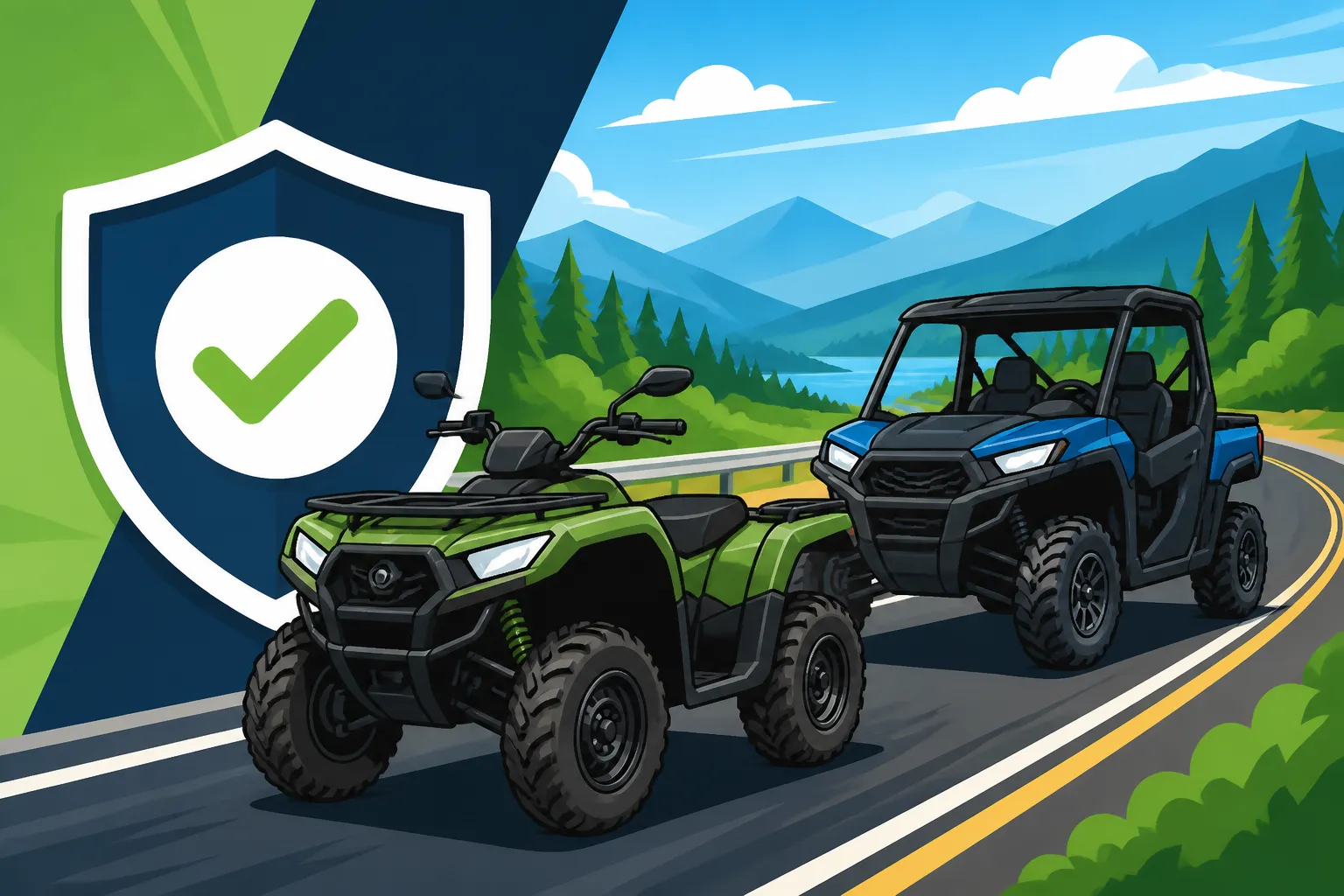
So, what exactly does it mean for a machine to be "already registered for highway use" in BC? Typically, this refers to vehicles that have gone through the full registration process with ICBC under the Motor Vehicle Act (MVA) and have been issued a standard, yellow-on-blue BC license plate. Think of dual-sport motorcycles that can hit the pavement, or in some very specific, often modified cases, a side-by-side that has been made compliant with MVA standards (though full MVA compliance for side-by-sides is extremely rare and often impossible without significant, costly modifications). You might even be thinking of an old farm tractor that's licensed to drive on local roads between fields.
These machines meet stringent requirements for roadworthiness, including proper lighting, signals, mirrors, and often emissions standards. They are insured with basic Autoplan liability coverage that specifically applies when they are operating on public highways. The critical point here is that their registration and insurance are tied to their use on roads and highways – the very places where the ORV Act generally doesn't apply. The fact that it has a standard plate means it's been recognized for a certain type of travel, but that recognition has geographical and legal limits.
No Automatic Exemption from ORV Rules
This is where the biggest misconception usually lies. Riders often assume that because their machine has a highway license plate, it's somehow "above" or exempt from the separate ORV registration requirements. Unfortunately, that's not how the system works in British Columbia.
Why the Highway Registration Doesn't Cover Crown Land
The legal frameworks governing vehicles in British Columbia are distinct based on the type of land or road. The Motor Vehicle Act is the law of the land for public highways and roads. It dictates everything from vehicle safety standards to driver licensing and insurance for paved and maintained public thoroughfares. However, the moment your wheels leave that paved road and venture onto Crown land, a Forest Service Road, or any other area designated for off-road vehicle use, you transition into the domain of the Off-Road Vehicle Act.
Think of it like this: your boat has a registration for operating on the lake, but that doesn't mean it's registered to drive on the highway, even if you put wheels on it. Two different environments, two different sets of rules and registrations. In BC, [BC Crown Land Triggers the Registration Rule] for ORVs. This includes vast expanses of wilderness, managed recreation sites, and critically, [BC Resource Roads Count as Crown Land] for the purposes of the ORV Act. So, even if your dual-sport bike is perfectly legal to ride on the highway to get to an FSR, the moment you turn onto that FSR, it becomes an ORV in the eyes of the law, and it needs to comply with the ORV Act's specific registration and plate requirements.
The Double-Duty Dilemma for Riders
For those of us who love the versatility of a machine that can handle both highway commuting and rugged trail adventures, this "double-duty" situation can feel like a bureaucratic headache. You've already got one set of papers, one plate – why do you need another? The answer lies in the distinct purposes of the two Acts. The MVA focuses on highway safety and infrastructure, while the ORV Act focuses on the responsible use and management of off-road areas.
Practically, this means your machine might need both a standard highway license plate and an ORV plate. It's not an either/or situation; it's a both/and situation, depending on where you choose to ride. For example, if you own a UTV that you've somehow managed to make street legal (again, a rare feat in BC) and you want to drive it on the highway and take it on logging roads, you'll need both registrations. You’ll also need to ensure your insurance covers both scenarios. This duality means that a quick glance at your machine's standard highway plate isn't enough to confirm compliance if you're planning an off-road excursion. The authorities enforcing the ORV Act will be looking for that specific ORV plate and decal.
What This Means for You: Practical Steps
So, you've got a machine with a highway plate, and you want to ensure you're fully legal for both worlds. What are the actual steps you need to take? It's usually simpler than you might think, as the system is designed to accommodate this exact scenario.
Registering Your Dual-Purpose Machine as an ORV
The good news is that you don't typically have to "de-register" your machine from highway use to register it as an ORV. You simply add the ORV registration. The process is handled by any authorized Autoplan broker in British Columbia. These are the same offices where you would register your car or truck, or get your annual insurance.
When you go to the broker, you'll need to bring your proof of ownership for the machine – typically your existing highway registration documents and perhaps a bill of sale, especially if you've recently acquired it. The broker will help you complete the ORV registration application. They'll verify your ownership and assign your machine a unique ORV number, which will be printed on a small Certificate of Registration. You'll also be issued a distinct ORV plate and decal. This ORV plate is smaller than a standard highway plate and needs to be mounted clearly visible on your machine. [BC ORV Number Plates and Decals] explains where to put it.
The process for this dual-registered machine is very similar to [How to Register an ATV in BC] that has never seen a highway. The key is to make it clear to your broker that this machine already has highway registration. They will ensure the system correctly links your existing Motor Vehicle Act registration with your new Off-Road Vehicle Act registration. Many [BC Autoplan Brokers Handle ORV Registration] regularly, so they're well-versed in the nuances.
Ensuring Proper Insurance Coverage
This is another crucial aspect for dual-purpose machines. While your basic Autoplan covers your liability and accident benefits for highway driving, it's generally not sufficient for off-road use, especially on Forest Service Roads. The Off-Road Vehicle Act mandates a minimum of $200,000 third-party liability insurance for any ORV operating on a Forest Service Road. For other Crown land, while not legally mandated, having liability insurance is highly advisable to protect yourself from potentially ruinous costs if you cause an accident.
When you're at the Autoplan broker registering your machine as an ORV, this is the perfect time to discuss your insurance needs. You can often purchase the necessary off-road liability coverage right then and there. It's an additional policy that works in conjunction with your highway Autoplan. Don't assume your highway coverage extends to off-road scenarios; it's a common and potentially very costly mistake. [BC Insurance Bought With Registration] is typically liability coverage, and it's what you'll need to secure for FSRs. Specifically, you'll want to ensure you have that [BC Resource Road Insurance of $200,000] if you plan on riding on logging roads or other industrial roads. Talk openly with your broker about where and how you intend to use your machine to ensure you're adequately covered for all eventualities.
Common Misconceptions and Clarifications
Even with the ORV Act having been in place for years, confusion persists. It's easy to get caught up in old habits or rely on hearsay, but knowing the precise rules can save you a lot of hassle and potential fines.
"It Has a License Plate, So It's Fine Everywhere"
This is perhaps the most prevalent misconception. Many riders, especially those who come from jurisdictions with different rules, believe that a standard highway license plate makes their machine universally legal. As we've discussed, this is simply not the case in BC. A highway plate signifies compliance with the Motor Vehicle Act, which governs highways. It doesn't magically confer rights or compliance under the Off-Road Vehicle Act.
If you ride a machine with only a highway plate onto Crown land or an FSR without also having the ORV registration and plate, you are technically operating an unregistered ORV. This can lead to significant penalties. Conservation Officers, RCMP, and other enforcement personnel specifically look for the ORV plate and decal when patrolling off-road areas. If you're caught, you could face [BC Tickets for an Unregistered Machine], which can be costly and put a damper on your adventure. It's far better to spend a little time at the broker and ensure you're compliant than to risk a fine or, worse, a seizure of your machine.
Farm Quads and Industrial Equipment
Another area of frequent confusion involves machines used primarily for work, such as farm quads, utility vehicles, or specialized industrial equipment. People often think that because these machines have a specific work-related function, or because they might occasionally operate on public roads with a farm vehicle plate, they are exempt from ORV registration when used on Crown land. This is another misconception.
The Off-Road Vehicle Act generally applies to all off-road vehicles when they are operated on Crown land. While there are some very specific exclusions for heavy industrial equipment like certain types of tractors or loaders that are designed primarily for excavation or heavy construction, most "farm quads" still fall under the ORV Act's definition of an ORV. For example, if a farmer uses their ATV to check fences on their own private property, ORV registration isn't required. However, if that same farmer takes their quad onto adjacent Crown land or a Forest Service Road to access a remote pasture or move livestock, that machine needs to be ORV registered and plated.
The law differentiates between the type of machine and its use location. [BC Excludes Tractors and Loaders From the ORV Rules] under very specific circumstances, usually related to their design and primary purpose. But for most ATVs, UTVs, and similar machines, even if they're used for farm work, they are still considered ORVs when on Crown land. This means [BC Farm Quads Are Not Exempt] from ORV registration simply because of their agricultural purpose. Always check with an Autoplan broker if you're unsure about your specific equipment and intended use.
Here's a quick comparison to help clarify the different requirements:
| Feature | Highway-Registered Machine (Motor Vehicle Act) | ORV-Registered Machine (Off-Road Vehicle Act) | Dual-Purpose Machine (Both) |
|---|---|---|---|
| Primary Use Area | Public roads, highways, municipal streets | Crown land, Forest Service Roads, trails | Both highway and off-road |
| Registration Body | ICBC (via Autoplan broker) | ICBC (via Autoplan broker) | ICBC (via Autoplan broker) |
| Plate Type | Standard yellow-on-blue vehicle plate | Smaller ORV plate (white-on-green) | Both standard and ORV plates |
| Decal Required? | No | Yes (small, year-specific) | Yes, for ORV plate |
| Insurance | Basic Autoplan liability (highway only) | Optional liability (Crown land), $200K liability (FSRs) | Basic Autoplan (highway), plus ORV liability |
| Required Documents | Vehicle registration, driver's license | ORV Certificate of Registration, photo ID | Both sets of documents |
| Cost | Varies by machine, location (registration + insurance premiums) | Nominal registration fee (one-time) + optional insurance premiums | Combination of both |
| Annual Renewal | Yes (for insurance, though registration is continuous) | No (registration is continuous) | Yes (for highway insurance), no (for ORV registration) |
As you can see, owning a dual-purpose machine means you’re navigating two different worlds. It's about ensuring that your documentation, plates, and insurance are appropriate for the environment you're riding in at any given moment. Don't let the convenience of a highway plate lull you into a false sense of security when you hit the trails. Get registered, get insured, and enjoy all the incredible terrain BC has to offer, knowing you're fully compliant.
Disclaimer
This article is for general informational purposes only and does not constitute professional advice. Laws, prices and regulations vary by location and change over time. Consult a qualified professional for guidance on your specific situation.