BC Insurance Proof on the Trail
Alright, fellow riders and outdoor enthusiasts! There's nothing quite like hitting a BC trail, feeling the rumble of your machine, and breathing in that crisp, clean air. But let's be real, that peace of mind can quickly vanish if you're ever stopped by a conservation officer or RCMP and realize you're missing a critical piece of paperwork: proof of insurance. It's a common oversight, often leading to unnecessary stress and potentially hefty fines. This guide is here to cut through the confusion and make sure you know exactly what insurance proof you need to carry when you're out exploring British Columbia's incredible backcountry.
Why Carrying Proof of Insurance is Non-Negotiable in BC
It’s easy to get caught up in the excitement of a ride and overlook the less glamorous, but equally vital, aspects of owning and operating an off-road vehicle (ORV) in British Columbia. Think of carrying proof of insurance not as a bureaucratic burden, but as a small act of preparedness that can save you a world of trouble. Just like you wouldn't head out without checking your fuel or tire pressure, you shouldn't hit the trail without confirming your insurance documentation is secure and accessible.
The Legal Mandate: Where BC's ORV Act Comes In
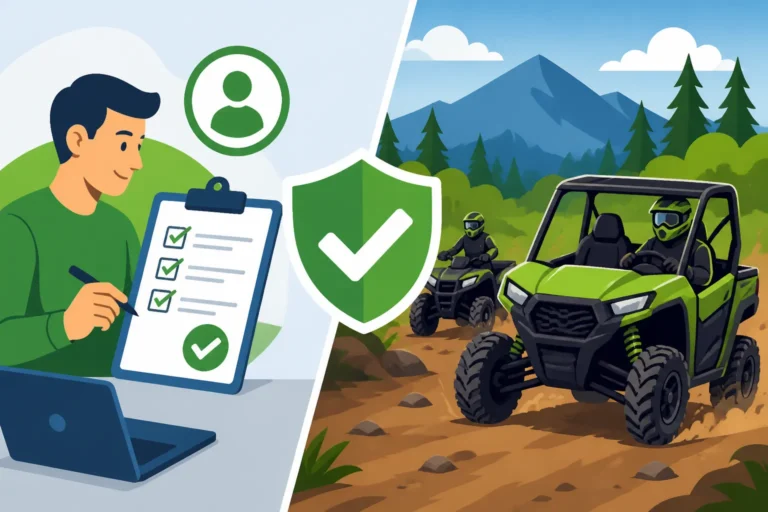
When you register your ATV or UTV in BC, you're taking a big step towards legal compliance. But registration isn't the whole story; insurance is another distinct layer of legal requirement under the province's Off-Road Vehicle Act. This isn't just a friendly suggestion; it's a rule designed to protect everyone on the trail. Imagine you're out on a beautiful summer day, riding a well-maintained Forest Service Road (FSR), and you're flagged down by an officer. They'll likely ask for your certificate of registration, your driver's licence, and, you guessed it, proof of insurance. If you can't produce it, you're immediately in a tricky spot.
The "why" behind this rule is pretty straightforward: it's about responsibility and protection. Off-road vehicles can cause damage or injury, and having insurance ensures that if something goes wrong, there's a financial safety net. This protects you from potentially crippling personal liability and also protects other trail users and the environment. While the [BC ORV Act Does Not Reach Highways] in terms of its direct jurisdiction, its rules govern your machine on all the resource roads and Crown land where you actually want to ride.
Understanding Different Insurance Requirements on BC Trails
Now, this is where it can get a little nuanced, and it’s crucial to understand the distinctions because not all trails are created equal in the eyes of the law (or your insurance policy!). British Columbia has vast expanses of Crown land, but different designations come with different rules.
The most critical distinction is for Forest Service Roads, or FSRs. These are often active industrial roads, shared with logging trucks, utility vehicles, and other resource users. Because of the inherent risks and shared access, BC mandates that any ORV operating on an FSR must carry a minimum of $200,000 in third-party liability insurance. This isn't an option; it's a firm requirement. If you're planning to ride an FSR, which includes many of the most popular access points to backcountry recreation, you absolutely must have this coverage. Many riders are surprised by this, thinking their basic registration is enough, but it's not. For a deeper dive into these requirements, check out [BC Forest Service Road Requirements].
For general Crown land — think open fields, designated trails within provincial recreation areas (that aren't FSRs), or just wide-open spaces away from developed roads — basic liability insurance is technically "voluntary." However, and this is a huge "however," it is highly, highly recommended. Voluntary doesn't mean unnecessary. An accident can happen anywhere, and if you cause damage to property (say, a fence line on adjacent private land) or injure another rider, you're personally on the hook if you don't have coverage. Imagine the legal and financial headache of an incident without that safety net. Even if you're the most careful rider, unforeseen circumstances can arise. Understanding these nuances is a big part of knowing [BC ATV Insurance Requirements] overall.
Some managed ORV riding sites might also have their own specific requirements, which could include proof of insurance beyond the provincial minimums, or even proof of a day pass or club membership. Always check with the site operator before you head out. And if you're ever riding on private land, you'll want to confirm that you have permission from the landowner and understand if your existing home insurance policy extends any coverage to ORV use on private property – often, it doesn't. You'll likely need specific ORV coverage.
What Counts as Valid Insurance Proof in BC
Okay, so you understand why you need it. Now, let's get down to the practicalities of what you need to carry and what's considered valid when you're asked for it on the trail. Having the right document in the right format is key to a smooth interaction with authorities.
The Official Documentation You Need to Carry
For most ORV owners in BC, your primary insurance will be purchased through ICBC Autoplan, usually at the same time you register your machine. When you complete this transaction, your Autoplan broker will provide you with a printed document. This document, often part of your [BC Insurance Bought With Registration], serves as your official proof of insurance. It will clearly state the type of coverage you have (e.g., third-party liability), the coverage limits (like the $200,000 for FSRs), and the effective dates of your policy. This is the gold standard for proof.
What if you've opted for coverage through a private insurer? Some riders choose to buy additional or primary ORV insurance from private companies, especially if they want higher liability limits, specific off-road coverage, or perceive better rates. In this case, your proof will be the policy declaration page or a specific insurance card issued by that private company. It needs to clearly show your machine's details (VIN), your name, the coverage type, and the policy dates.
The big question many riders have is: "Can I just show it on my phone?" While many services are moving to digital documents, physical proof is often preferred and sometimes implicitly expected in the backcountry. Imagine this: you're deep in a canyon, far from cell service, and your phone battery dies. Suddenly, your "digital" proof is useless. While some officers might accept a clear digital copy on a working phone, it's always safest to have a physical backup. The general rule is, if an officer can't verify it on the spot, you could still be in trouble.
Practical Tips for Storing and Protecting Your Proof
Now that you know what to carry, let's talk about how to carry it. The backcountry is tough on paper. Mud, rain, sweat, and jostling can quickly render a document illegible or even destroy it.
My absolute top recommendation is to make a high-quality, legible photocopy of your insurance document and laminate it. This waterproofs it and makes it incredibly durable. You can also slip it into a clear, heavy-duty Ziploc bag or a dedicated waterproof document pouch. These aren't expensive items, but they are invaluable for protecting critical paperwork.
Where to keep it? Don't just stuff it into a backpack that might be tossed around or get separated from your machine. Consider a secure, waterproof compartment on your ATV or UTV – maybe a glove box, a small storage box under the seat, or a dedicated document tube. The key is that it's easily accessible but also well-protected from the elements and secure enough not to fall out during a bumpy ride.
It's also a good idea to have multiple copies. Keep one laminated copy on your machine, another in your truck (if you're hauling), and maybe even a clear digital photo on your phone (fully charged, of course) as a last resort. What happens if your single paper proof gets lost or damaged mid-ride? You'd be left vulnerable. Thinking ahead can save you from that headache. And remember, you also need to carry your [Carrying Your Certificate of Registration on Every Ride] as well as photo ID!
The Consequences of Not Having Proof When Asked
Let's not sugarcoat it: riding without the required insurance or, more commonly, without immediate proof of that insurance, can lead to some significant headaches. It's not just about a minor inconvenience; it can impact your wallet, your machine, and your peace of mind.
Facing a Conservation Officer or RCMP on the Trail
Picture this scenario: You're enjoying a beautiful day on a remote FSR near Harrison Lake. Suddenly, flashing lights in your rearview mirror. A Conservation Officer pulls you over for a routine check. They're friendly, professional, but firm. After asking for your driver's licence and [BC Registration Lasts as Long as You Own It], they then ask for your proof of insurance. You fumble through your pockets, check your small storage box, but… nothing. You thought you put it in there, but it's gone. Or maybe you simply forgot to renew it.
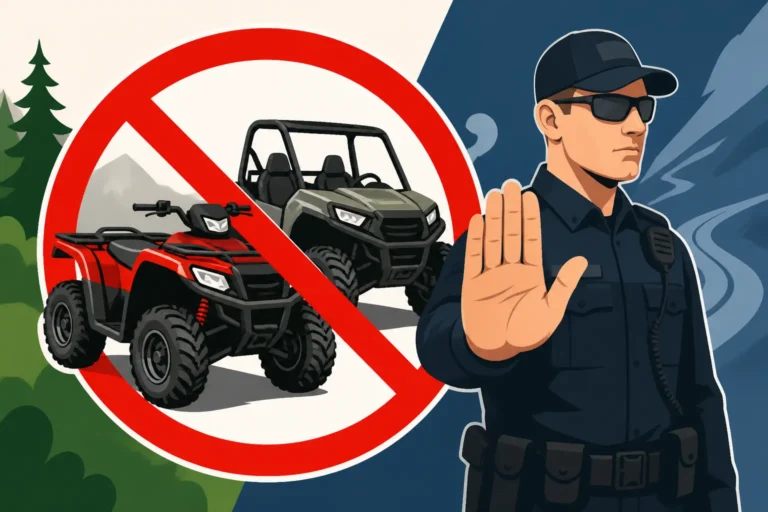
In this situation, you're likely looking at a violation ticket. Not having proof of insurance is a ticketable offense under the ORV Act. While I can't give you specific fine amounts, let's just say they're significant enough to ruin your day and make you wish you'd taken five minutes to double-check your documents. An officer has the authority to issue a ticket on the spot. If you can't produce the documents later, the fine stands. In more severe cases, or if you're found to be riding without any insurance at all, the situation can escalate rapidly.
The interaction can quickly become less pleasant if you're unprepared. An officer's primary concern is ensuring public safety and compliance with the law. If you're missing required documents, it casts a shadow of doubt on your general adherence to rules. You might even face more serious repercussions. For example, [BC Machine Seizures by Police] can occur for various infractions, including severe registration or insurance violations, leaving you stranded in the backcountry and facing a costly recovery process for your machine. It’s far better to be prepared and simply hand over the requested documents with a smile. It's also worth noting that this is distinct from [BC Penalties for Riding Unregistered], though similar in gravity; this is specifically about having proof of what you're required to have.
Beyond the Ticket: What Happens in an Accident Without Proof?
This is the nightmare scenario that every rider hopes to avoid. You're riding on a logging road, come around a blind corner, and unfortunately, collide with another ORV or vehicle. Or perhaps you lose control and damage a piece of private property adjacent to Crown land, like a fence or gate.
If you are involved in an accident and cannot produce proof of valid third-party liability insurance, the financial implications can be devastating. Your insurance policy is designed to cover damages you might be legally responsible for if you injure someone else or damage their property. Without that proof, and therefore potentially without that coverage, you could be personally liable for tens of thousands, or even hundreds of thousands, of dollars in medical bills, property repair costs, or legal fees. Imagine facing a lawsuit for someone else's injuries because your machine was uninsured and you were deemed at fault.
The stress of an accident is already immense. Adding the burden of proving you had insurance, or worse, admitting you didn't, will only compound the situation. This is why paying for and carrying the correct insurance isn't just about avoiding a ticket; it's about safeguarding your financial future and ensuring that if the worst happens, you and others involved are protected. This is especially relevant on [BC Crown Land Triggers the Registration Rule] where you're mixing with various users.
Keeping Your Insurance Current and Easily Accessible
Being a responsible ORV owner means more than just knowing what to carry; it means actively managing your insurance to ensure it's always current and ready for inspection. This proactive approach ensures continuous peace of mind and compliance.
Regular Checks and Updates for Your Policy
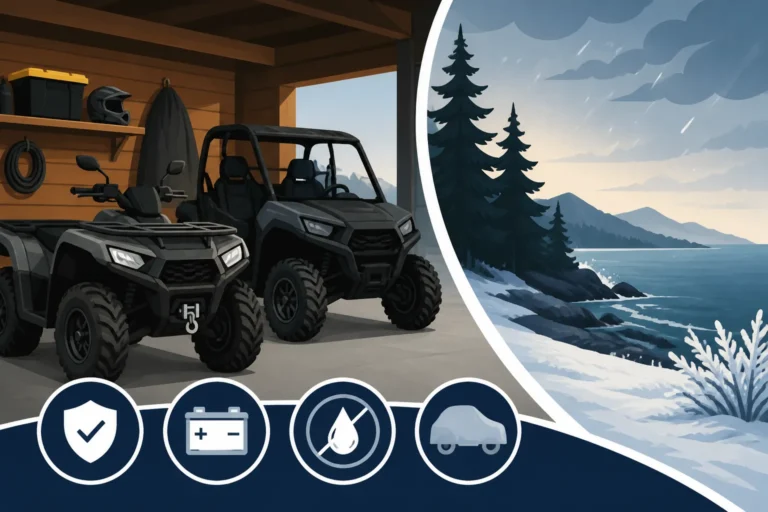
Life changes, and so do your riding habits and your machines. It's incredibly important to review your ORV insurance policy at least once a year, ideally when it's up for renewal. Don't just blindly pay the premium; take a few minutes to read through the policy details.
Ask yourself:
- Are my coverage limits still adequate? If you've started riding more challenging terrain or on busier FSRs, you might consider increasing your liability coverage beyond the minimum $200,000.
- Does my policy cover all my machines? If you've recently bought another quad or a side-by-side, ensure it's added to your policy.
- Are there any new exclusions I should be aware of? Sometimes policies are updated, and what was covered last year might have new limitations this year.
- Have I explored all available discounts? Are you a member of a local ATV club? Sometimes these memberships offer [BC Insurance Discounts Through a Club].
Understanding the specifics of your coverage, including what's covered and what's not, is vital. You don't want to find out after an incident that you had a gap in your coverage. While I can't give you actual numbers, riders often ask about [BC ATV Insurance Cost Per Year], and reviewing your policy annually is a great way to ensure you're getting the best value for your coverage.
Leveraging Resources and Staying Informed
You don't have to navigate the complexities of ORV insurance alone. There are plenty of resources available to help you stay compliant and informed.
Local ATV clubs are fantastic hubs of knowledge. Members often share tips on the best insurance providers, discuss common issues, and can even offer advice on navigating specific regulations. Many clubs also actively advocate for rider rights and responsible land use, providing a collective voice. Joining a club is a great way to stay connected and informed about all things ORV in BC.
Your local Autoplan broker is another invaluable resource. These are the same professionals who handle your car insurance, and many are well-versed in ORV registration and insurance requirements. Don't hesitate to sit down with them and ask specific questions about your coverage. They can clarify the differences between FSR requirements and general Crown land recommendations, and help you tailor a policy that fits your riding style and machine. After all, [BC Autoplan Brokers Handle ORV Registration] for a reason – they're the experts.
Lastly, for general legal documentation, particularly if you're dealing with private sales, inherited machines, or situations where official paperwork might be missing, services like LawDepot can be helpful. For example, if you need to draft a legally sound bill of sale for a private purchase, or even a [BC Statutory Declaration for an ORV] if you're trying to register an older machine with no previous ownership papers, these platforms provide templates that can guide you. While LawDepot won't directly get you insurance, correctly documenting ownership is a prerequisite for registration, which then allows you to get your insurance in order. Always ensure any document you use aligns with BC's specific legal requirements.
Staying informed about [BC Rules for Riding Crown Land] and generally being aware of your responsibilities as a rider will always pay off. Being prepared means you can focus on the thrill of the ride, not the worry of a roadside check.
Disclaimer
This article is for general informational purposes only and does not constitute professional advice. Laws, prices and regulations vary by location and change over time. Consult a qualified professional for guidance on your specific situation.