Checking a Fire Ban Before You Ride in BC
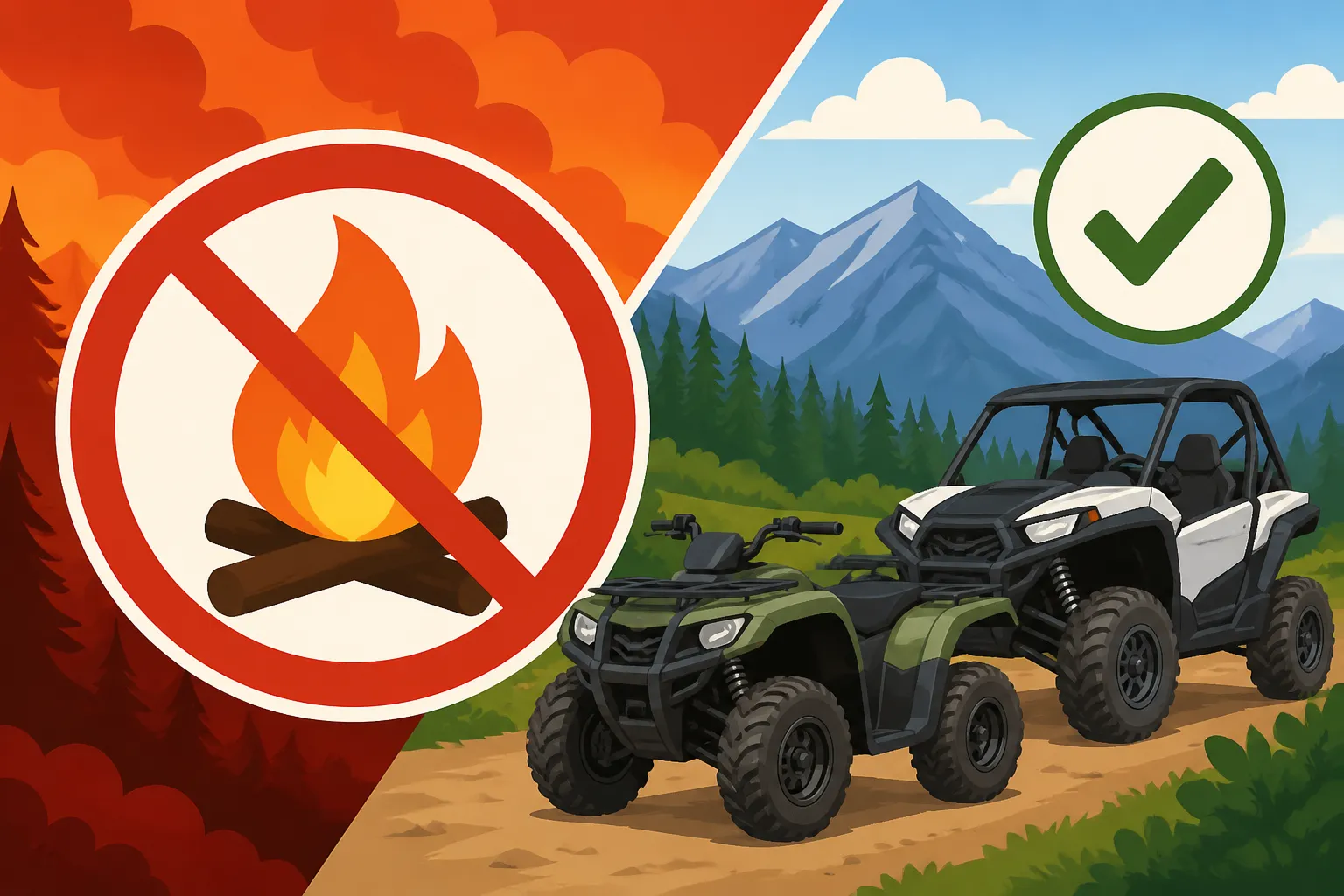
A sunny forecast doesn’t mean an ATV or UTV route is open during wildfire season. Restrictions can apply to particular areas, activities or machines, and a campfire ban is not the same thing as a riding prohibition. Before you leave, check the current official notices, the route’s access status and any equipment conditions that apply.
Understand what kind of restriction applies
“Fire ban” is often used as a catch-all, but different orders can restrict different activities. One notice may prohibit open fires, while another may limit equipment use or motorized recreation in a defined area. A fire danger rating, meanwhile, describes conditions; it does not by itself tell you whether your planned ride is prohibited.
For riders, the practical question is not simply “Is there a fire ban?” It is: Does a current restriction cover this place, this activity and this machine at the time I plan to ride?
A restriction might name ATVs or off-road vehicles directly, prohibit certain equipment, or set conditions that affect whether a ride can proceed. Read the order itself, including its map, dates, exceptions and definitions. Do not assume that a restriction applies everywhere in BC, or that it applies only to campfires.
| What you find | What it tells you | What to check next |
|---|---|---|
| Fire danger rating | The level of fire risk in an area | Whether an actual prohibition or closure has been issued |
| Campfire prohibition | Open fires are restricted in the stated area | Whether separate rules restrict riding, equipment or access |
| Equipment or activity restriction | Certain uses or machinery may be limited | Whether your ATV or UTV and planned route are included |
| Trail or recreation-site closure | Access may be closed or limited at a specific site | The closure boundary, dates and alternate access |
| Road restriction or closure | The road may be unavailable, even if nearby trails are open | Who manages the road and whether your whole route depends on it |
A spark arrestor is important where required, but having one does not automatically make a ride permissible during a restriction. Likewise, a trail that is normally open may close temporarily because of fire danger, active wildfire operations or an access order. Check BC Fire Centre riding bans and BC Fire Centre Closures for ORVs for more on the kinds of restrictions that can affect a ride.
Check the official notices for your route
Start with the current notices from BC Wildfire Service. Look for the fire prohibitions and restrictions covering the area you plan to visit, and check the relevant map as well as the written notice. A map can help you identify whether a route falls inside a boundary; the written conditions explain what is restricted and when.
Then check the people or agency responsible for the trail, recreation site, park or road. A wildfire-related order is only one part of the access picture. A separate closure may apply to a trail, staging area or road even if the fire notice you found does not prohibit riding there. BC Trails Closed in Fire Season explains why it is worth checking site and trail notices separately.
Use this sequence before heading out:
- Choose the exact route. Write down the trailhead, staging area, roads and trails you expect to use. A broad destination such as “the Okanagan” is not precise enough to compare against a mapped restriction.
- Check BC Wildfire Service notices and maps. Look for current fire prohibitions, equipment restrictions and closures in the area. Read the details, not just a headline or a social media summary.
- Check the site or trail manager. Review current notices for recreation sites, trails, parks and any managed riding area on your route. A site may have its own restrictions or access conditions.
- Check road access. Confirm that any forest service or resource road you need is open and usable. A closed road can make a trail unreachable even when the trail itself has no separate closure. See BC Forest Service Road Requirements for the distinct rules that can apply on those roads.
- Check again on the day of the ride. Restrictions can be added, expanded, changed or lifted. A notice you checked earlier in the week may not reflect current conditions.
- Save the information for offline use. Download or capture the relevant map and notice before entering an area with limited service. Keep track of the notice date and any conditions, rather than relying on a screenshot with no context.
Check dates and times carefully. An order may be effective for a defined period, apply only during certain conditions, or be amended as the fire situation changes. If the map and written notice appear to conflict, do not guess. Contact the issuing authority or land manager for clarification before riding.
For a broader look at how riding restrictions relate to the season, see BC Wildfire Season and Riding. Conditions can shift quickly, but that does not mean every area has the same rules. Local boundaries and the wording of the current order matter.
Read the map and the wording together
A map is useful for locating your route, but it cannot always answer every question. Boundaries may follow roads, landmarks, water features or administrative lines that are hard to identify from a general-purpose map. Some notices also use terms that are narrower or broader than casual phrases such as “fire ban.”
Compare the notice boundary with your actual route, not just your final destination. If you drive to a staging area outside a restricted zone and then ride into the zone, the riding portion may still be covered. The same is true if the outbound route is clear but your planned return crosses a closed area.
Before deciding that a route is outside a restriction, check:
- The full boundary: Trace the route from the staging area to the riding area and back. Consider access roads, connectors and spurs, not only the main trail.
- The activity named: Check whether the notice addresses open burning, equipment use, motorized vehicles or access generally. Similar-sounding notices may have different effects.
- The effective period: Confirm the start, expiry or review conditions. Do not infer that an old notice is still active—or that it has ended—without checking the latest update.
- Any exceptions or conditions: If an order lists exceptions, make sure they actually apply to your situation. Do not treat a technical exception as general permission to ride.
- Other closures: Check for wildfire response activity, road restrictions, park rules and site-specific notices. A route may be unavailable for a reason separate from a fire prohibition.
If you cannot tell whether the restriction covers your route or machine, pause and ask the issuing authority or land manager. Give them a clear location, the route you intend to use and the type of vehicle. “Can I ride near this town?” may be too vague for a useful answer; a trailhead name or route map is more helpful.
The access rules also depend on the land and road you are using. For example, many riders check BC Crown Land Access Rules alongside current fire notices, because a restriction does not replace the need to confirm that access is otherwise allowed. If your route includes private or leased land, check permission and any local conditions as well.
Make a ride decision you can defend
Use a simple go-or-no-go test: Can you confirm that the route is accessible, the planned riding is allowed, and your machine meets the applicable conditions? If one part is unclear, choose another route or wait for confirmation. A route being open last weekend, showing up on a familiar map or appearing in a riding group’s post is not proof that it is open today.
Keep the route flexible during high fire danger. Have an alternative that does not depend on crossing the restricted area or reaching a closed trailhead. Tell your group where the plan changes if conditions do, and agree that anyone can call off the ride when an order or closure makes access uncertain.
Also keep separate requirements in view. A fire-related order may not cover every equipment rule that applies to your machine or managed riding area. Review BC Spark Arrestor Requirements and any site-specific conditions, but don’t confuse meeting an equipment requirement with permission to ride during a closure.
On the day, make one final check before unloading. If there is no service at the staging area, prepare in advance with saved notices, maps and contact information. If conditions change while you are out, follow posted instructions, avoid entering restricted areas and leave by a route that remains open. Do not rely on an unofficial report to overrule a current order.
A few practical habits make checking easier:
- Save the official notice and map with the date you checked them.
- Keep a note of the trailhead and road names you verified.
- Check again if your group changes the route or adds a new trail.
- Treat unclear boundaries as a reason to confirm, not as permission.
- Respect posted signs and directions from authorized personnel, even if an online map appears to show access.
A careful check takes less time than reaching a closed trailhead or having to turn around after entering a restricted area. Most importantly, it helps keep riders away from places where activity could increase risk or interfere with wildfire response. For more on how fire restrictions can affect off-road access, see BC Fire Centre riding bans and BC Fire Centre Closures for ORVs.
Disclaimer
This article is for general informational purposes only and does not constitute professional advice. Laws, prices and regulations vary by location and change over time. Consult a qualified professional for guidance on your specific situation.