BC Fire Centre Closures for ORVs
A ride can be legal and accessible one day, then off-limits when wildfire conditions change. In BC, a fire-centre restriction may apply to off-road vehicles in a defined area, but it does not automatically close every trail or road in the region. Here’s how to check what a closure covers, plan around it and avoid treating a registration or permit as permission to ride.
What a BC fire-centre closure means for ORV riders
BC Wildfire Service may restrict activities in a particular area when wildfire risk is high. Some restrictions concern open fires; others can limit the operation of vehicles or equipment that may create sparks or start a fire. An off-road vehicle (ORV), including an ATV or UTV, may be affected when the order specifically restricts that activity in the area where you plan to ride.
A fire centre is a regional wildfire management area, not a single trail system. A notice associated with a fire centre does not necessarily mean all riding across that entire region is prohibited. The restriction may cover a smaller mapped area, certain types of land or specific activities. The terms of the current order matter more than a broad description such as “fire-centre ban.”
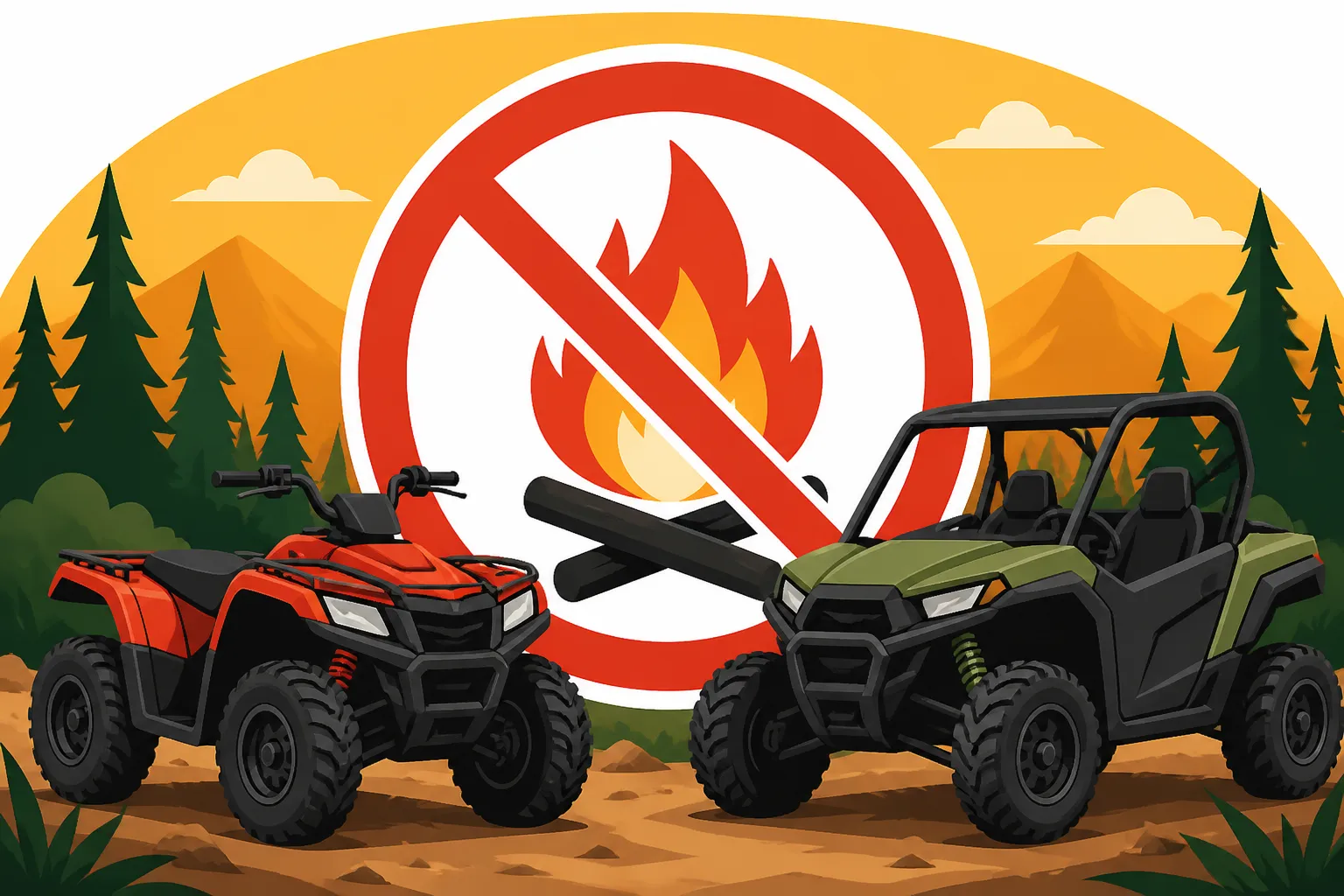
That distinction is important because people often use “fire ban” to mean several different things. A campfire prohibition, a restriction on certain industrial work and a closure to ORV use are not interchangeable. A campfire ban does not automatically close every route to vehicles, and an ORV restriction does not necessarily mean every activity named in a fire notice is prohibited. Read the notice for the specific activity, boundary and dates.
| What you see | What it may mean for your ride | What to check |
|---|---|---|
| A campfire or open-burning prohibition | It may regulate fires without banning ORV travel | Whether a separate vehicle or area restriction is in effect |
| A vehicle or equipment restriction | Some or all vehicle use may be prohibited in the stated area | The order’s exact wording, map and exceptions |
| A local trail or recreation-site closure | Access may be restricted by the land manager, even if a broad fire notice does not show a vehicle ban | The site or trail operator’s current notice |
| A fire-centre boundary on a map | It identifies a region; it is not, by itself, proof that every part is closed | The actual restriction area and activity covered |
A closure may change while you are preparing for a ride or already travelling. Conditions, fire behaviour and response needs can develop quickly, so an old screenshot, a group chat or a notice from a previous weekend is not enough to confirm that a route is open. Check the current official information shortly before leaving and again if conditions or travel plans change.
For a broader look at this topic, BC Fire Centre Riding Bans explains why restrictions may be regional or limited to particular areas. Checking a Fire Ban Before You Ride in BC is also useful when you need to separate fire restrictions from other trail and land-access rules.
A fire-centre closure is not the same thing as an ORV registration or operation permit. Registration documents the machine; it does not grant access to a closed area. A permit for a specific type of road use does not override a wildfire restriction either. Riders from outside BC are subject to the same current area restrictions as local riders. Home registration or ownership papers may help establish your machine’s status, but they do not make a closed route open.
How to check whether your route is closed
Start with the current official BC Wildfire Service information, rather than relying on a trail post or a search result that may be out of date. Look for the current restriction notice and its map, then compare the described boundary with your whole planned route. The route may pass through more than one land type or management area, and a restriction may not follow the road or trail you expect it to follow.
Use this process before each ride:
- Identify the exact route and staging area. Write down the road, trail, recreation site or access point you intend to use. “Riding near town” is too broad to compare against a closure map.
- Check current wildfire restrictions. Find out whether the notice concerns open fires, ORV use, other vehicle or equipment activity, or some combination. Read the effective dates and conditions.
- Compare the map boundary with your route. Check the start, destination and connecting segments. A route that begins outside a closed area may enter it farther along.
- Check for other closures. A trail manager, land manager or road operator may have its own access notice. Fire restrictions are only one part of the access picture.
- Confirm again before departure. If the notice has changed, your route crosses a boundary, or you cannot tell whether a segment is included, do not assume it is open. Contact the relevant authority or choose a clearly open alternative.
Be precise about location. A fire-centre name alone does not establish whether your particular trail is included. Equally, seeing that one staging area is open does not prove that every route leading from it is open. Maps can be hard to read on a small screen, especially when you are comparing a narrow trail with a shaded closure boundary. If the boundary is unclear, choose a route outside the uncertain area or get clarification before riding.
Check the land manager’s information as well. A public road, a resource road, a managed recreation site and an informal trail can have different access conditions. A wildfire-related restriction can exist alongside a separate motor-vehicle closure, road restriction or site-specific rule. BC Motor Vehicle Prohibitions Explained covers another type of restriction riders may need to check, while BC Crown Land Riding Explained gives context on access across Crown land.
Avoid assuming that a posted gate tells the whole story. Gates can be closed for logging, fire response, road work, private access or other reasons; an open gate is not proof that riding is authorized. Likewise, an old sign may not reflect a new order. Check the current notice and respect signs or instructions at the location.
Keep a usable record of what you checked, especially on a longer trip. A saved map or screenshot can help you remember the boundary and communicate your plan to other riders, but it does not replace checking for updates. If your phone loses service, the last saved image may be useful for navigation while still being stale as a status report. Check before you leave a connected area and do not rely on receiving a notification once you are in the backcountry.
The same care applies to seasonal information. Fire season dates can help with general planning, but dates alone do not confirm whether a specific ORV closure is active. Restrictions depend on current notices and conditions. For that reason, BC Fire Season Dates is background information, not a substitute for checking the current order.
Planning a ride during wildfire season
The safest plan is one that can change without pushing riders into an uncertain or restricted area. Choose a main route and an alternative that you have also checked. If a closure blocks the main route, do not improvise a shortcut through an unmapped trail, private land or a closed road. Turn around, use a verified legal alternative or postpone the ride.
Before setting out, agree on a few practical details with your group:
- Name the person who will check official notices and share any updates.
- Make sure every rider understands the route and where it may meet a closure boundary.
- Identify a turnaround point before reaching a restricted area.
- Decide what the group will do if the route changes or communications fail.
- Tell someone who is not riding where you plan to go and when you expect to return.
Bring navigation that works without a live connection, but treat offline maps as route tools rather than current closure information. A paper map, downloaded map or GPS track can help with orientation; none confirms that access remains open. A quick pre-ride check is still necessary, and riders should turn back if new signs, barriers or official instructions conflict with the planned route.
Spark-arrestor rules and wildfire restrictions are related to fire prevention, but they are not the same requirement. Having an appropriate spark arrestor does not automatically exempt a machine from an ORV closure. Conversely, a vehicle restriction should not be read as permission to ignore equipment rules in areas where riding remains allowed. Check both the applicable access notice and the equipment requirements. BC Spark Arrestor Requirements explains the separate equipment issue.
It is also sensible to keep the machine in good condition and carry basic recovery and communication gear. These measures can help with an ordinary backcountry problem, but they do not justify entering a closed area. If a fire is visible, smoke is changing quickly, or emergency personnel are directing traffic, follow their instructions and move away from the hazard. Do not stop where you block response vehicles or attempt to approach a fire to get a better view.
Do not count on an exemption unless the applicable notice clearly provides one and you meet its conditions. A work purpose, local address, club membership, trail pass or out-of-province registration does not, by itself, establish permission to travel through a restricted area. Where an order has specific exceptions or authorization requirements, confirm them with the authority responsible before travelling.
Riders visiting from another jurisdiction should plan with the same approach as BC residents: check the local restrictions, follow posted access conditions and have the documents required for their machine and route. BC Rules for a Visiting Alberta Rider and BC Rules for a Visiting Washington Rider cover visitor considerations, but neither home registration nor familiarity with rules elsewhere changes a BC wildfire closure.
If a restriction starts during your trip
A restriction can be issued or updated after you have left home. If you receive a reliable notice while riding, stop somewhere safe and check the order. Do not continue deeper into a potentially closed area while trying to sort out the details on the trail.
If you are already inside an area that has become restricted, follow the notice and any direction from officials. Leave by a route that is open and safe, if permitted, and do not cross a barrier or continue because your vehicle entered before the restriction took effect. If you cannot tell which way out is allowed, contact the relevant authority when possible and follow any instructions from emergency personnel.
A practical response looks like this:
- Stop before entering the disputed area.
- Check the current notice and map using a reliable connection if available.
- Ask the group to remain together and avoid blocking a road or response route.
- Use a confirmed open exit or turn around where safe.
- Do not create a new route around a barrier or closure.
- Update the person expecting you if your return time or route changes.
If a closure affects your staging area, do not leave a trailer or vehicle where it obstructs emergency access. If you need to change locations, confirm the alternative site is open and suitable for your machine and trailer. For resource roads, check the separate road conditions and operating expectations too; access to a road does not necessarily mean the adjacent riding area is open. BC Forest Service Road Rules for ORVs explains why road travel has its own considerations.
A restriction being lifted also does not automatically reopen every route. Road damage, fire activity, response operations or a separate land-manager closure may still affect access. Check the current notice before returning, and look for any remaining restrictions on the trail, road or staging area.
The core rule is straightforward: follow the exact current restriction, not the broadest rumour or the most reassuring interpretation. Check the activity, area and dates; confirm the route with the relevant land manager; and be prepared to turn back. That approach helps protect people and property while keeping a wildfire-related closure from becoming an avoidable enforcement or safety problem.
Disclaimer
This article is for general informational purposes only and does not constitute professional advice. Laws, prices and regulations vary by location and change over time. Consult a qualified professional for guidance on your specific situation.