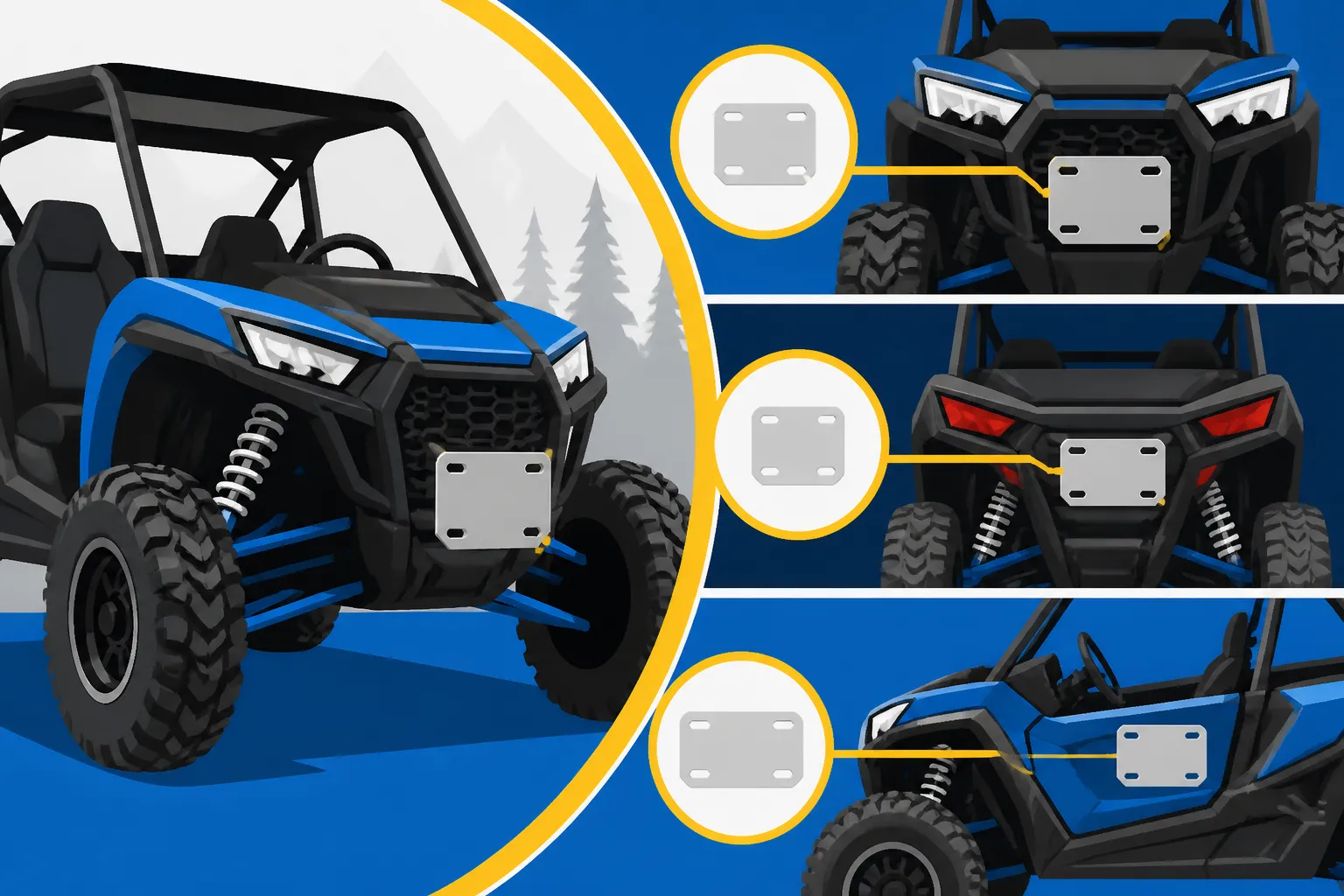
Mounting a Plate on the Front, Back or Left
It can feel like a small thing, but figuring out exactly where to put that new number plate on your off-road vehicle in British Columbia often brings more questions than answers. You’ve got your machine registered, you’ve got your plate, and now you’re standing there, drill in hand, wondering if you’re about to break some obscure rule. This guide is here to walk you through the specific requirements for mounting your ORV plate in BC, helping you avoid unnecessary fines and ensuring you stay compliant with the law.
Why Proper Plate Placement is More Important Than You Think
When you first get your ORV plate, it might seem like just another piece of metal to bolt onto your quad, side-by-side, or dirt bike. But in British Columbia, the placement of that plate isn't just a suggestion; it's a legal requirement designed for safety and enforcement. Ignoring these rules can turn a fun day on the trails into a costly hassle, and nobody wants that.
Visibility is Key to Compliance
Imagine you're out riding a beautiful [BC Okanagan Riding Areas] trail, enjoying the fresh air and the challenge of the terrain. A conservation officer or RCMP member needs to identify your machine quickly and clearly, whether you're moving or stopped. If your plate is hidden by mud, a bulky cooler, or a spare tire, it defeats the purpose of having it. The law prioritizes visibility above all else, ensuring that your unique identifier is easily seen from a reasonable distance. This helps enforcement officials verify that your ORV is properly registered and that you're following the rules of the road or trail. Without clear visibility, they might assume your machine isn't registered, leading to further inspection and potential issues.
Consider a scenario where you're passing a conservation officer on a [BC Forest Service Road Requirements]. They need to be able to glance at your machine and confirm your plate is visible. If they have to crane their neck, get out of their vehicle, or ask you to move cargo just to see your plate, you've already created a reason for them to stop you. Proper placement means quick identification, allowing both you and the officer to continue on your way without delay.
Avoiding Unnecessary Fines and Hassles
The Off-Road Vehicle Act in BC is pretty clear about the requirements for your machine, and that includes your plate. An improperly mounted or obscured plate can lead to a ticket, and who wants to deal with that when you’re just trying to enjoy a ride? The goal is to make it as easy as possible for enforcement officers to confirm your compliance, so they don't have to stop you in the first place. You’ve gone through the effort to get your [BC ORV Number Plates and Decals] and [BC's Certificate of Registration Explained]; don't let a simple mounting mistake undo that effort.
It's not just about avoiding tickets, either. It’s about minimizing friction during any interaction with law enforcement. If your plate is clearly visible and correctly mounted, it shows that you’re a responsible rider who understands and respects the regulations. This can make a significant difference in how an encounter proceeds. Remember, officers are out there to ensure everyone's safety and protect our natural resources, and visible plates are a crucial part of that mission.
The Specific BC Rules for ORV Plate Mounting
When it comes to attaching your ORV plate, BC has some fairly straightforward rules, but the nuances can sometimes be tricky. The key is understanding these rules and how they apply to the varied types of off-road vehicles and their common uses. These regulations are designed to ensure consistency and ease of identification across all registered ORVs in the province.
The "Front, Back, or Left" Rule
Here’s the core of it: your ORV plate must be securely attached to the front, back, or left side of your off-road vehicle. This specific wording is important because it gives riders a bit of flexibility depending on their machine type and how they use it, while still ensuring the plate is in a generally predictable location.
For many ATVs and side-by-sides, the most common and often easiest spots are the front or the back. On a quad, you might find a flat area on the front rack or bumper, or a suitable spot on the rear fender or cargo rack. For a side-by-side, the front bumper or grill area, or the rear frame near the hitch, are often good candidates. However, if those locations aren't practical due to design or accessories, the "left side" option becomes incredibly useful, especially for dirt bikes. On a dirt bike, often the best place is the left side of the rear fender or a dedicated plate bracket that extends from the rear. What's absolutely critical is that no matter which of these three locations you choose, the plate must be affixed horizontally. It can't be angled up, down, or sideways – it needs to be perfectly level.
Ensuring Legibility and Clarity
Beyond just the location, the law stresses that your plate must be legible and clearly visible. What does this actually mean in practice? It means your plate should be free from obstructions like mud, snow, dirt, or anything else that might prevent the numbers and letters from being easily read. It also means it shouldn't be covered by cargo, a backpack, or any part of your machine. Think about it from the perspective of someone trying to read it from a distance – if they have to strain or move to see it, it's probably not clear enough.
This also extends to the condition of the plate itself. A heavily bent, scratched, or faded plate might technically be "there," but if the characters are unreadable, it’s just as problematic as having no plate at all. Regular cleaning is a must, especially if you ride in muddy or dusty conditions. After a good, dirty ride, taking a few moments to wipe down your plate can save you a lot of grief. Remember that [Keeping Your ORV Plate Clean Enough to Read] is a year-round responsibility, not just something you worry about before a big trip.
What About Trailers?
This is a common point of confusion. While your ORV needs its own plate, any trailer you might be towing behind your ORV, if it’s designed for highway use or specific types of hauling, will likely require its own separate registration and plate under the Motor Vehicle Act. The ORV plate is specifically for the off-road vehicle itself. A small utility trailer used solely on private land or within a specific recreation site that doesn't touch public roads might have different requirements, but if you're hauling anything on a resource road or across a highway, assume it needs its own legal identity. Always double-check the specific requirements for trailers you intend to use with your ORV, as the rules can differ significantly from those for the ORV itself.
Common Challenges and Practical Solutions for Plate Mounting
Even with clear rules, real-world riding often presents challenges. The design of your specific ORV, the type of accessories you use, and the terrain you ride can all conspire to make plate mounting a bit of a puzzle. But don't worry, there are plenty of practical solutions to ensure your plate stays visible and secure.
Obstructions from Cargo or Accessories
This is perhaps the most common issue riders face. You've loaded up your quad or side-by-side for a weekend trip, and suddenly that trusty cooler or the extra fuel jug is directly in front of or behind your plate. Or perhaps you've installed a new winch, light bar, or fender flares that partially obscure the view. It’s a common scenario – you need your gear, but you also need your plate to be seen.
Solutions:
- Reposition Cargo: The simplest fix is often to adjust how you load your cargo. Can you shift that cooler slightly to the left or right? Can you stack items differently to leave the plate area clear? Sometimes just a few inches can make all the difference. Many riders use bungee cords, nets, or specialized cargo boxes that allow for strategic placement around the plate.
- Relocate the Plate: If your primary mounting spot is consistently getting blocked, consider using one of the other legal options. If your plate is usually on the back and gets covered by a gear bag, can you move it to the front bumper? Or, for a side-by-side, if the rear is always packed, is there a clear spot on the left side, perhaps mounted to the roll cage or a fender?
- Specialized Brackets: Aftermarket accessory manufacturers understand these dilemmas. Many offer specialized plate brackets that extend, offset, or raise your plate to clear common obstructions. These can be particularly useful for dirt bikes or machines with unique rear fender designs. You might even find custom mounts that attach to your existing hitch receiver, providing a clear, elevated spot for the plate when towing.
Protecting Your Plate on Rough Terrain
BC's trails are notoriously rugged and beautiful, but they can also be hard on your equipment. Riding through thick brush, over rocky terrain, or through deep mud can easily bend, scratch, or even rip off your plate. Not only is losing your plate a nuisance, but riding without it or with a damaged, illegible one can land you a ticket.
Solutions:
- Sturdy Mounting Points: Avoid flimsy plastic fenders for mounting if possible. Opt for a solid metal bumper, frame, or a robust aftermarket bracket. Use good quality nuts, bolts, and washers, possibly with lock washers or thread-locker, to prevent loosening from vibration.
- Reinforce Mounting: If you must mount to plastic, consider using a backing plate made of thin metal or thick plastic on the inside of the fender. This distributes the stress over a wider area, making it less likely for the plate to tear through the plastic or for the fender to crack.
- Plate Protectors/Guards: Just like you put skid plates on the underside of your machine, you can get plate protectors. These are often made of durable plastic or thin aluminum and act as a shield, deflecting brush and minor impacts. They also add a bit of rigidity, preventing the plate from bending as easily.
- Strategic Placement: Sometimes, placing the plate slightly inboard (closer to the center of the machine) rather than right on the edge of a fender can protect it from glancing blows with trees or rocks. For a side-by-side, a recessed area in a bumper or even a mount within the roll cage structure can offer more protection than an exposed position.
Securing Your Plate Properly (Preventing Loss)
Losing your ORV plate out on the trail is frustrating. Not only do you have to replace it (which means a trip to an Autoplan broker and a small fee), but you're riding illegally until you do. Vibration, impacts, and even theft can all lead to a lost plate.
Solutions:
- Use Proper Hardware: Don't just use zip ties or thin sheet metal screws. Use bolts with locking nuts, or self-tapping screws designed for secure attachment. Many riders use stainless steel hardware for better corrosion resistance, especially in BC's damp climate.
- Check Regularly: Make it a habit to check your plate's mounting hardware before and after each ride, especially if you’ve been on particularly rough terrain. A loose bolt is much easier to tighten than a lost plate is to replace.
- Anti-Theft Hardware: If you're concerned about theft, consider using specialized anti-theft screws that require a unique tool to remove. While not foolproof, they can deter casual thieves.
- Consider a Flexible Mount: For dirt bikes or very active quads, some riders opt for a flexible rubber or plastic backing for the plate, which allows it to bend and flex slightly on impact rather than snapping or tearing off. This can be especially useful for those who frequently ride in conditions where the plate might hit obstacles.
By being proactive about these common challenges, you can ensure your ORV plate remains securely attached, visible, and legally compliant throughout your riding adventures in British Columbia.
Consequences of Improper Plate Mounting
It might seem like a minor infraction – just a piece of metal after all, right? But in British Columbia, the authorities take ORV regulations seriously, and an improperly mounted plate is not just an inconvenience; it can lead to real legal trouble. The [BC ORV Act Does Not Reach Highways], but it definitely governs your conduct on Crown land and resource roads, where most of us ride.
Tickets, Fines, and Warnings
The most immediate consequence of an improperly mounted or obscured plate is a violation ticket. Conservation officers and RCMP members are trained to spot these issues, and if they deem your plate to be non-compliant, you could be facing a fine. While the exact amount can vary, it's never a pleasant surprise. This ticket can be issued under the Off-Road Vehicle Act or its associated regulations, specifically targeting conditions related to the display of your plate.
Beyond the immediate financial hit, receiving a ticket can create a record. While it might not affect your driving record in the same way a speeding ticket in your car would, it still indicates a failure to comply with ORV regulations. Repeated infractions could lead to more scrutiny in the future. Sometimes, if you're lucky and it's a very minor issue, an officer might give you a warning and ask you to fix it on the spot or within a certain timeframe. However, this is at their discretion and shouldn't be relied upon. It's far better to ensure compliance before you ever hit the trail. For example, if you're stopped on a busy [BC Resource Roads Count as Crown Land] with an obscured plate, an officer might have less patience than if you're in a remote, rarely patrolled area.
Encountering Enforcement Officers
An improperly mounted plate can also be a magnet for enforcement officers. Even if you've done everything else right – you have your [BC Riders Must Carry the Certificate], you're riding sober, and you're sticking to designated trails – a hidden or unreadable plate gives them a reason to pull you over. What might have been a quick wave and a nod can turn into a full stop, requiring you to show your identification and registration papers.
During such an interaction, the officer might ask you to move your cargo or demonstrate how your plate is mounted. If it's clear you've made an effort but an unavoidable circumstance caused the obstruction (e.g., a sudden mud splatter), they might be more understanding. However, if your plate is intentionally obscured, bent to be unreadable, or missing due to negligence, you're likely going to face a ticket. These encounters can be stressful and time-consuming, pulling you away from your ride and potentially souring your whole day. They can also escalate if other issues are found, like a lack of [BC ATV Insurance Requirements] on a resource road. Ensure you are prepared with all necessary documentation, perhaps utilizing templates for bills of sale or other ownership documents from resources like LawDepot if you're dealing with older machines.
Here's a quick comparison of proper vs. improper plate mounting:
| Aspect | Proper Mounting | Improper Mounting |
|---|---|---|
| Location | Front, back, or left side; horizontally aligned | Obscured, angled, or mounted incorrectly (e.g., top) |
| Visibility | Clear, unobstructed, readable from a distance | Covered by cargo, mud, accessories; difficult to read |
| Security | Securely fastened with appropriate hardware | Loose, flimsy, held by zip ties, prone to falling off |
| Condition | Clean, legible characters, not bent or damaged | Dirty, faded, scratched, severely bent, illegible |
| Legal Status | Compliant with ORV Act, reduces risk of fines | Non-compliant, high risk of violation tickets |
| Officer Interaction | Smooth, quick identification, less chance of stop | Increased likelihood of being stopped, extended interaction |
Safety and Responsibility Implications
While not a direct legal penalty, an improperly mounted plate also touches on the broader themes of safety and responsible recreation. The regulations are in place to ensure that all ORV users are identifiable and accountable. If your plate is constantly falling off or getting obscured, it raises questions about the overall maintenance of your machine and your attention to detail as a rider.
Furthermore, in the event of an accident or an emergency, a clearly visible plate can aid in identification and communication with emergency services. If your machine is involved in an incident and your plate is unreadable, it could delay efforts to contact you or identify the vehicle. Being a responsible rider means more than just safe operation; it means adhering to all regulations that contribute to a well-managed and safe recreational environment for everyone. Think of it as part of your overall [BC ATV Safety Training Options] – being prepared and compliant helps keep the trails open and enjoyable for all. When handling transactions for an ORV, having clear documents, possibly drafted with the help of platforms like LawDepot, is just as crucial as physical compliance.
Registering Your Machine: A Foundation for Compliance
Before you even think about where to mount your plate, you need to ensure your off-road vehicle is properly registered in British Columbia. This is the foundational step for legal ORV operation in the province, especially since [BC Registration Became Mandatory in 2015]. Without proper registration, any discussion about plate mounting is moot, as you wouldn't have a plate to begin with!
Why Registration Matters
The registration process provides your ORV with its unique identity – that specific number plate and the corresponding Certificate of Registration. This identity allows authorities to track ownership, enforce regulations, and ensure accountability on [BC Crown Land Triggers the Registration Rule] and other designated riding areas. It's a system designed to manage the growing popularity of off-road recreation responsibly. Whether you're riding a brand new side-by-side or a vintage quad you’ve spent years restoring, every machine that hits public land needs to be registered. Even if you bought your machine decades ago with no paperwork, there are pathways to get it registered, often involving statutory declarations which you can prepare using legal form resources like LawDepot.
The Registration Process and Your Autoplan Broker
Registering an ORV in BC is handled through [BC Autoplan Brokers Handle ORV Registration], the same places where you get your car insurance. You'll need to provide proof of ownership (like a bill of sale), identification, and details about your machine. They'll process the paperwork, collect any applicable PST, and issue your Certificate of Registration along with your shiny new ORV plate and decal. The whole process is generally straightforward, but it does require having all your ducks in a row. For instance, if you're trying to register a quad bought for cash years ago and the seller is long gone, a statutory declaration confirming ownership will be needed. Resources like LawDepot can often provide templates for these kinds of legal documents.
Once your machine is registered, you’ll be given a permanent plate. Unlike highway vehicles, [BC Has No Annual Renewal Sticker] for ORVs. That registration lasts as long as you own the machine, which is a nice perk for riders. This also means that the initial mounting of that plate is a one-time critical task that will serve you for years to come.
What Happens if You Don't Register?
If you choose to ride an unregistered ORV on Crown land or resource roads in BC, you're not just risking a minor ticket; you're operating outside the law. [BC Tickets for an Unregistered Machine] can be significant, and repeated offenses or more serious infractions can lead to your machine being impounded. Enforcement officers have the authority to [BC Machine Seizures by Police] for various violations, including operating an unregistered vehicle.
It’s a simple fact: if you want to enjoy the incredible riding opportunities British Columbia has to offer, proper registration and visible plate mounting are non-negotiable. Take the time to understand the rules, set up your plate correctly, and carry your documentation. This ensures your adventures stay fun, safe, and legal.
Disclaimer
This article is for general informational purposes only and does not constitute professional advice. Laws, prices and regulations vary by location and change over time. Consult a qualified professional for guidance on your specific situation.