Fuel Range Between Communities
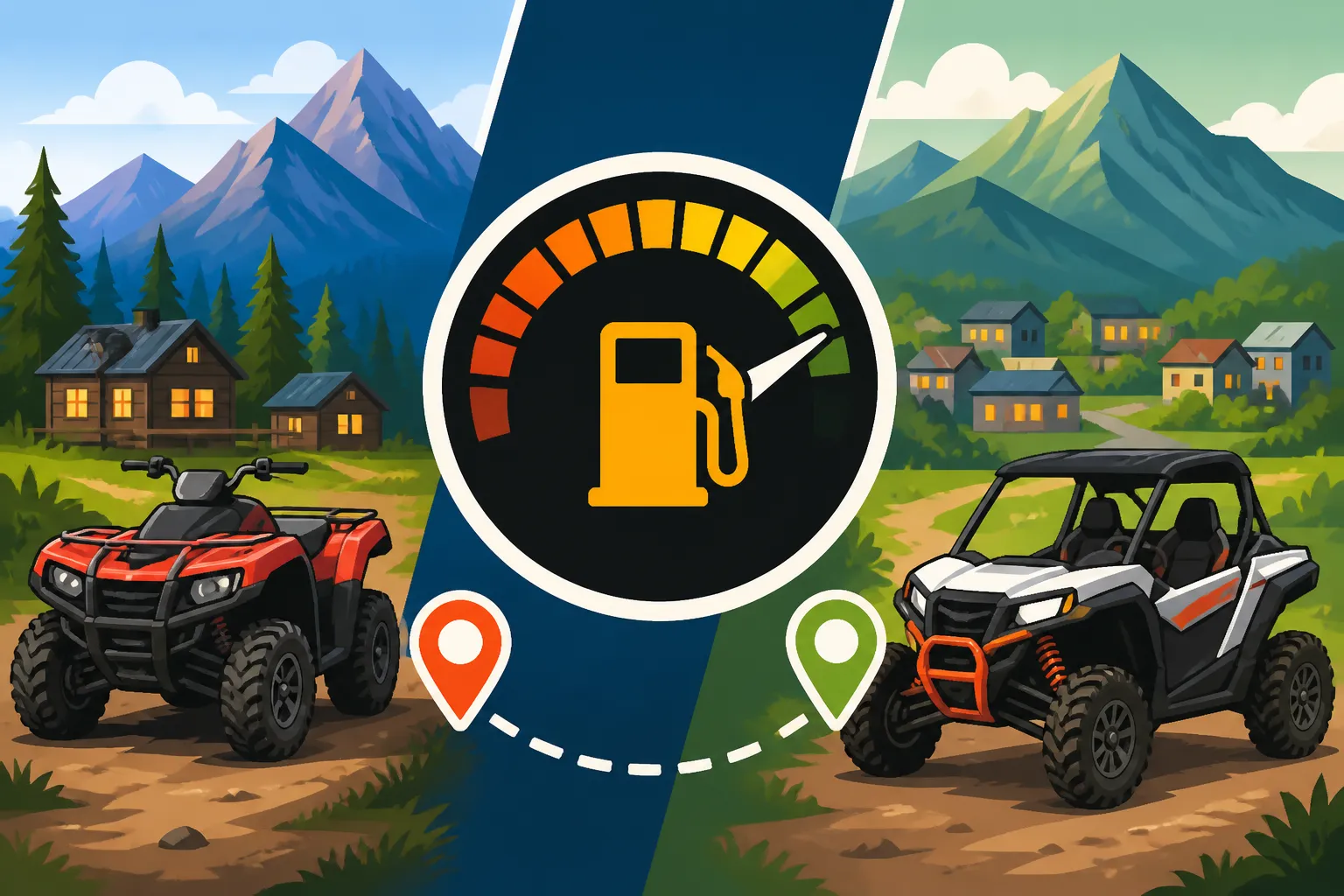
A fuel stop that looks close on a map can be a long way from the trail, and remote riding areas in BC may have no fuel at the staging area at all. This guide explains how to estimate your ATV or UTV’s practical range, plan for detours and rough terrain, and decide how much fuel to carry between communities.
Why fuel range is harder to predict in BC
A map distance is not a fuel plan
The distance between two communities tells you very little about how much fuel a ride will use. A machine may travel along a resource road, climb a steep trail, double back around a closure, or spend hours moving slowly through mud. Each of those can use fuel differently from steady riding on a smooth road.
It also helps to separate the distance to a fuel station from the distance to a riding area. A community may be your last reliable opportunity to fill up, even if the trailhead is only a short drive away. Fuel availability at a staging area, recreation site, or small settlement should be confirmed rather than assumed.
When planning a ride near places such as Prince George, Wells, Campbell River, or Nelson, treat the community as a planning reference, not a guarantee that fuel will be available exactly where you need it. Check where the machines can actually be refuelled, whether the route reaches that location, and whether your timing gives you a practical chance to stop.
Terrain and riding style change consumption
A machine’s advertised or remembered range is only a starting point. A steep climb, soft ground, deep mud, frequent stops, heavy throttle, or low-speed technical riding can all reduce the distance you get from a tank. A long UTV ride with passengers and gear may also use fuel differently from a lightly loaded ATV on a familiar route.
Conditions can change partway through the day. A route that seems easy in dry weather may become slow and demanding after rain. Detours around a gate, active work, or a trail closure can add distance when you have already used more fuel than expected.
That is why it is risky to plan around the best range you have ever achieved. Use experience from similar riding, but build in room for conditions to be worse than expected. On a remote loop, a conservative estimate is much more useful than a perfect-weather estimate.
Fuel stops may be limited or inconvenient
In some BC riding areas, the nearest community is not necessarily on your route. A service station may be open only at certain times, or may be far enough from the staging area to require extra riding or towing logistics. Small communities can be especially important to plan around, so confirm the fuel option, its location, and its opening information before leaving.
For broader trip planning, look at BC Riding Areas With Fuel Nearby and BC Riding Areas Reachable in a Day. These topics can help you compare the general logistics of an area, but still verify your specific route and fuel options before setting out.
How to estimate your machine’s usable range
Start with a real-world consumption figure
Your own riding notes are usually more helpful than a single manufacturer range figure. If you know how much fuel you used on a similar ride, under similar conditions, use that as your baseline. Record the route, riding pace, load, terrain, weather, and the amount of fuel added afterward.
If you do not yet have reliable consumption records, begin with a conservative estimate and test it on a ride close to services. Fill the tank before departure, note the distance and riding conditions, then refill and record how much fuel the machine took. Repeat this over more than one type of ride if possible; a smooth resource road and a slow, technical trail may produce very different results.
Do not wait until a remote trip to find out how far your machine can go. A short local ride can reveal whether your usual estimate is optimistic, especially when you ride with passengers, carry a full load, or spend a lot of time climbing.
Plan around usable fuel, not just tank capacity
A full tank does not mean every litre should be treated as available for reaching the next stop. Keep a reserve for unexpected detours, slower conditions, getting turned around, or reaching a fuel source that is unavailable. Your reserve should be part of the plan from the beginning, not something you hope will remain after the main ride.
One simple way to organize the estimate is to ask:
- How much fuel does my machine typically use on this kind of ride?
- How much route distance am I planning, including the return trip?
- What extra distance might result from a detour or route mistake?
- What reserve do I want to keep untouched for unexpected changes?
- Can I carry extra fuel safely if the plan depends on it?
A useful estimate is deliberately less generous than the machine’s best-case range. If a ride only works when everything goes smoothly, it is probably too tight for a remote day out.
Use a map to identify constraints, not promise a precise range
A trail map can help you see the broad shape of a ride, possible access roads, and where a route may connect with another area. It cannot tell you exactly how much fuel your machine will consume, whether a road is passable today, or whether a route is open to motorized use.
Tools such as onX Offroad can help you review route options and understand the geography before you go. Use that planning view alongside local information, posted signs, and current access checks rather than treating a mapped line as a guaranteed, fuel-efficient route. Save the information you need before entering areas where phone service may be unreliable.
For more mapping preparation, see BC ATV Trail Map Downloads. If your route uses resource roads, review BC Resource Roads With Active Hauling as well. Work activity, posted restrictions, and road conditions can change the route you are able to ride.
| Planning factor | Why it matters | Practical approach |
|---|---|---|
| Typical fuel use | Your machine and riding style determine consumption | Record fuel used on comparable rides |
| Return distance | A one-way estimate can leave you short on the way back | Calculate the full outing, including the return |
| Terrain | Hills, mud, and slow technical sections can increase use | Estimate conservatively for the hardest sections |
| Detours | Closures and wrong turns can add unplanned distance | Allow extra fuel and identify alternatives |
| Reserve | Unexpected changes can use fuel you did not budget | Keep a planned reserve rather than relying on an empty tank |
| Fuel access | A community or staging area may not have an open pump | Confirm the location and availability before departure |
Carrying extra fuel and planning the route
Decide whether extra fuel is the right answer
Carrying extra fuel can make a longer ride practical, but it is not a substitute for knowing your route and estimating consumption. Before adding fuel, consider whether a shorter loop, a nearer staging area, or an overnight stop closer to the riding area would be a safer and simpler choice.
If you do carry fuel, use a suitable, secure container designed for that purpose. Keep it fastened so it cannot shift, fall, or interfere with steering, passengers, or access to controls. Follow the container and machine manufacturers’ guidance, and avoid placing fuel where it could be damaged by heat, impact, or trail debris.
Plan how you will handle the extra fuel before you leave. A container that is awkward to reach, difficult to secure, or exposed to a likely impact can create a problem rather than solving one. For a group ride, agree on whether each machine is self-sufficient or whether any shared fuel plan has been tested and is genuinely practical.
Build the route around a reliable turnaround point
Choose a clear point where you will turn around if conditions, fuel use, or timing are worse than expected. That point might be a junction, a known staging location, or a place where the group can safely pause and reassess. A turnaround plan removes the pressure to continue just because the group has already invested time getting there.
Do not base the decision only on the fuel gauge. Gauges may be imprecise, and fuel use can rise quickly when the route becomes slower or more demanding. Combine the gauge with distance, riding time, observed fuel use, and the amount of reserve you planned to keep.
If you are riding with a group, consider the machine with the shortest practical range. A group plan should work for that rider too, not only for the machine with the largest tank or most efficient consumption. Keep the pace and stops coordinated so one person is not pushed into continuing past a sensible fuel limit.
Prepare for limited communications
Remote riding can make it difficult to check a map, call for help, or tell someone that your plan has changed. Download or otherwise prepare the information you need before losing service, and leave a trusted person a basic trip plan with your intended riding area and expected return.
onX Offroad may be useful for reviewing and preparing route information, but do not rely on a phone app as your only navigation or communication plan. Battery life, device damage, and dead zones can turn a convenient tool into an unavailable one. Consider what backup method is appropriate for the remoteness and length of your ride.
Before leaving, review Cell Dead Zones in the Interior and Carrying a Satellite Messenger. If a remote loop is part of your plan, First Aid on a Remote Interior Loop is also worth considering. These preparations do not replace fuel planning, but they matter when a small delay becomes a longer day.
A practical pre-ride fuel checklist
Before leaving the community
Confirm where you can refuel and whether the location fits your route and schedule. Fill up before heading toward the riding area when practical, and avoid assuming that a small community, campground, or staging area will have fuel available. Check the route, possible restrictions, and any known work or access issues that could require a detour.
Estimate fuel for the whole outing rather than only the outward leg. Include riding around the area, returning to the staging location, and any distance needed to reach a reliable fuel stop afterward. If your estimate leaves little room for a change of plan, shorten the route or choose a different riding area.
For trips that include remote roads, consider how conditions could affect progress as well as fuel use. BC Weekend Riding Itineraries can help with the broader question of how to structure a trip, while BC Resource Roads With Active Hauling is relevant when industrial traffic may affect access or timing.
At the staging area
Before unloading, confirm the group understands the planned route, turnaround point, and fuel reserve. Make sure each rider knows what to do if the group separates or a machine begins using fuel faster than expected. A quick conversation in the parking area can prevent a stressful argument later when the group is far from the trailer.
Check that any extra fuel is properly secured and that the load does not block visibility, controls, or access to equipment. If the trailhead is remote, make sure the person staying behind or the contact at home knows when to expect the group. If the plan changes, update them when you have a reliable way to do so.
During the ride
Pay attention to fuel use early in the ride, not only when the tank is getting low. If the group has covered less ground than expected while using more fuel, reassess before continuing deeper into the route. Turning back earlier is a good decision, not a failure to complete the ride.
Stop and review the plan if you encounter a closure, unexpected road work, difficult conditions, or a navigation uncertainty. Do not assume that the next junction will lead to an easy shortcut or a fuel source. A small detour can have an outsized effect when the initial plan had little reserve.
The best fuel plan is one that still works when the ride does not go exactly as expected. Know your machine’s real-world consumption, identify dependable fuel access, account for the return journey, and give yourself enough reserve to make a conservative choice on the trail.
Disclaimer
This article is for general informational purposes only and does not constitute professional advice. Laws, prices and regulations vary by location and change over time. Consult a qualified professional for guidance on your specific situation.