BC Registration for a Youth Quad
Getting a youth quad can be an incredibly exciting time for families in British Columbia, promising years of outdoor adventures and skill-building. But along with the excitement often comes a flurry of questions about legality and paperwork. One of the biggest puzzles for many parents is how to properly register a quad meant for a younger rider. This guide will walk you through the ins and outs of registering a youth quad in BC, covering everything from necessary documents to important safety considerations, ensuring your family can hit the trails legally and safely.
Understanding Youth Quads and BC Registration Rules
It's easy to assume that a smaller machine for a child might fall under different rules, but when it comes to registration in British Columbia, the province largely treats youth quads the same as their full-sized counterparts. Understanding this fundamental principle is key to navigating the process correctly.
What Qualifies as a "Youth Quad" in BC's Eyes?
The Off-Road Vehicle (ORV) Act in British Columbia doesn't specifically define a "youth quad" or separate it into its own category for registration purposes. Instead, the focus is on whether the machine fits the general definition of an ORV: a vehicle designed for off-highway use, weighing less than 4,500 kg, and not intended for use on public highways. This broad definition includes everything from a 50cc mini-quad to a powerful 1000cc side-by-side.
What distinguishes a youth quad in practical terms usually comes down to its engine size, physical dimensions, and the manufacturer's recommended age and weight limits for riders. These recommendations are crucial for safety and responsible operation, but they don't change the machine's status as an ORV that may require registration. Regardless of its size or intended user, if it's an off-road vehicle, it falls under the same provincial registration framework.
Why Your Child's Quad Needs to Be Registered
This is where many parents get tripped up. The simple truth is, if that youth quad is ever going to touch Crown land in British Columbia, it absolutely needs to be registered. This includes vast areas like provincial parks (where allowed), recreation sites, and critically, all Forest Service Roads (FSRs) and resource roads. The [BC Registration Became Mandatory in 2015], meaning that almost every ORV operated on Crown land must have a unique number plate and a Certificate of Registration.
The reason behind this mandatory registration is about accountability and land management. It allows authorities to track machines, address environmental concerns, and ensure that riders are identifiable. Skipping registration, even for a child's quad, can lead to serious consequences. Imagine your child out riding on an FSR with you, and a conservation officer stops you. An unregistered machine could result in [BC Tickets for an Unregistered Machine], spoiling a fun day out and creating unnecessary stress. It's not just about avoiding fines; it's about being a responsible off-road enthusiast and setting a good example for the next generation of riders.
Who Needs to Own and Register a Youth Quad?
Here's an important legal distinction: while the quad might be "for" your child, British Columbia's registration process typically requires an adult (19 years or older) to be the legal registered owner. Minors generally cannot legally own or register vehicles in their own name because they cannot enter into binding contracts.
Therefore, when you're registering a youth quad, you, as the parent or legal guardian, will likely be listed as the registered owner. This means you'll be responsible for signing all the necessary paperwork, just as you would for your own ATV. This arrangement isn't just a formality; it places the legal responsibility for the machine's use and compliance with the ORV Act squarely on the adult owner. It ensures there's an accountable individual who can handle any official communications, transfers, or other legal aspects related to the quad throughout its lifetime.
The Registration Process for a Youth Quad
Registering a youth quad in BC follows essentially the same steps as registering any other off-road vehicle. The key is to be prepared with the right documentation and to know where to go. It’s a one-time process, meaning once it's done, you don't have to renew it annually, which is a common point of confusion for new owners.
Gathering the Necessary Paperwork
The smooth registration of your child's quad hinges on having all your ducks in a row when it comes to paperwork. This is often the part that causes the most headaches for new owners, especially if the machine is older or was bought privately without pristine records.
Firstly, you'll need proof of ownership. For a brand-new quad purchased from a dealer, this will typically be a sales agreement or bill of sale that clearly identifies the machine and the purchaser (you, the adult). If you're buying a used youth quad, you'll need a bill of sale from the previous owner. What many people don't realize is that BC law requires a complete chain of ownership. This means you need [BC Bills of Sale for Every Prior Owner] linking back to the original purchase, if possible, or at least a clear lineage of how the machine came into your seller's possession. This can be particularly challenging for older machines that have changed hands many times.
If the youth quad was a gift, especially from a family member, a formal [BC Gift Letters Between Family] is essential. This letter should clearly state the donor and recipient, the machine's details (make, model, VIN), and confirm it's a gift. Along with proof of ownership, you'll need your own government-issued photo identification (like a driver's license) and proof of your BC residential address. The machine's Vehicle Identification Number (VIN) or serial number is also critical; make sure you have it written down accurately, and know where it's located on the machine in case the broker needs to verify it.
What happens if a bill of sale is missing from a prior owner in the chain? This is a common scenario, especially with older, smaller quads that might not have seemed important to document years ago. In such cases, you might need to complete a [BC Statutory Declaration for an ORV]. This is a legal document where you declare under oath that you are the rightful owner of the machine and explain how you acquired it, often with supporting details. These declarations usually involve a small fee to have them witnessed by a commissioner for taking affidavits. Resources like LawDepot can provide useful templates and guidance for drafting a statutory declaration, making sure it contains all the necessary legal language.
Where to Go to Register the Machine
Once you have all your documents ready, the next step is straightforward: visit an Autoplan broker. In British Columbia, [BC Autoplan Brokers Handle ORV Registration], just as they handle vehicle insurance and registration for cars and trucks. You don't go to a government office; you go to your local insurance broker.
It's worth noting that while all Autoplan brokers can register ORVs, some are far more experienced than others. If you live in a more rural area where ORV use is common, chances are your local brokers are very familiar with the process. In urban centers, you might want to call ahead and confirm that the broker you plan to visit is well-versed in ORV registrations to ensure a smooth transaction. When you arrive, the broker will review your paperwork, enter the machine's details into the provincial system, and process the registration. They will verify your identity and proof of address, so make sure to bring those items along with all your ownership documents.
Understanding the Costs and What You Get
Registering a youth quad in BC involves a one-time fee. While I cannot provide specific current pricing, it's a fixed cost that covers the administration of the registration. This is not an annual fee; it's paid once and covers the machine for as long as you own it. You won't receive an annual renewal sticker or bill.
Beyond the registration fee itself, you might also be subject to Provincial Sales Tax (PST) if you've recently purchased the machine. [BC PST on an ATV Purchase] applies to both new and used ORV sales, unless specific exemptions apply (like certain gift transfers between family members). The broker will calculate and collect this tax during the registration process.
Once the registration is complete, the broker will provide you with two key items: an ORV number plate and a [BC's Certificate of Registration Explained]. The number plate is typically a durable plastic plate that you must affix securely and visibly to your youth quad. It contains a unique alphanumeric identifier specific to your machine. The Certificate of Registration is a paper document that serves as your proof of ownership and registration. It's crucial to keep this document safe, as you'll need to carry it with you whenever the quad is operated on Crown land.
Important Considerations for Youth Quad Ownership
Registering your child's quad is just the first step in ensuring safe and legal off-road adventures. As a parent, there are several other critical aspects you need to consider to fully comply with BC's ORV regulations and promote responsible riding.
Legal Ownership vs. Practical Use
Even though you, as the adult, will be the legal registered owner of the youth quad, the reality is that the machine is intended for your child's practical use. This distinction is important because it means your responsibilities extend beyond just the paperwork. You are effectively supervising the use of a vehicle you legally own.
British Columbia has specific [BC Youth Riding Rules and Supervision] that govern how and where children can operate ORVs. For example, children under 16 have particular restrictions on engine size and require direct adult supervision. A supervisor must be at least 19 years old and be able to give immediate direction. This isn't just a recommendation; it's a legal requirement designed to keep young riders safe. It's your responsibility as the registered owner to ensure these rules are followed every time the quad is ridden, even if you're not the one directly supervising at that moment. You need to make sure anyone supervising your child is aware of and adheres to these guidelines.
Insurance for a Youth Quad
This is a frequently misunderstood area. The one-time registration fee covers the administrative aspect of tracking your ORV, but it does not include liability insurance for off-road use. This is a critical gap that every ORV owner, especially those with youth quads, needs to address.
While optional for some types of Crown land, liability insurance becomes mandatory if your youth quad will be ridden on [BC Forest Service Road Requirements]. On FSRs, you are legally required to carry a minimum of $200,000 in third-party liability coverage. This coverage protects you financially if your child causes an accident that injures another person or damages property. Even if you don't plan to ride on FSRs, carrying voluntary liability insurance for other Crown land use is a very smart move. Accidents happen, and the cost of an incident without insurance can be catastrophic.
[BC ATV Insurance Requirements] vary by provider, but many offer specific ORV policies. You can often purchase this additional insurance through the same Autoplan broker who registered your quad, or through private insurance companies. It's crucial to understand what your policy covers and what it doesn't. Don't assume your existing home or auto insurance will cover ORV incidents; typically, they do not. Taking the time to secure adequate liability coverage is an essential part of responsible youth quad ownership.
Safety and Compliance Beyond Registration
Beyond the registration plate and insurance, there are other critical safety and compliance rules for youth quads in BC. These are designed to protect your child and others on the trail.
First and foremost is the [BC ATV Helmet Law Explained]. Every rider on a ride-astride ORV, regardless of age, must wear an approved helmet. This is not optional. Ensuring your child has a properly fitted, certified helmet is non-negotiable for their safety. Beyond helmets, consider other protective gear like goggles, gloves, sturdy boots, and appropriate riding apparel.
Another vital compliance point is the spark arrestor. British Columbia has strict regulations regarding fire prevention, and this includes [BC Spark Arrestor Rules and Fines] for ORVs. All ORVs operating on Crown land must be equipped with an approved, serviceable spark arrestor to prevent embers from escaping the exhaust and starting a wildfire. Regularly check that your child's quad has one and that it's in good working order.
Finally, familiarize yourself with other aspects of [BC Youth Riding Rules and Supervision], such as restrictions on carrying passengers. Generally, child operators cannot carry passengers, and all passengers must adhere to manufacturer guidelines regarding age and weight. LawDepot can also be a helpful resource if you need to create any specific permission forms or waivers, for example, if your child will be supervised by another family member or adult who isn't you, the registered owner. While not legally required for direct supervision, having clear documentation can be a good practice.
What Happens After Registration?
Congratulations! Your youth quad is registered, and you've taken the necessary steps to ensure safe and legal riding. But the journey doesn't quite end there. There are a few ongoing responsibilities and considerations that come with registered ORV ownership.
Carrying Your Documents on the Trail
The Certificate of Registration isn't just a document to file away at home. British Columbia law is clear: [BC Riders Must Carry the Certificate] whenever the ORV is operated on Crown land. This means you, as the registered owner (or the adult supervising your child), must have that physical document or a legible copy with you. You must also carry [BC Riders Must Carry Photo ID] that matches the name on the certificate.
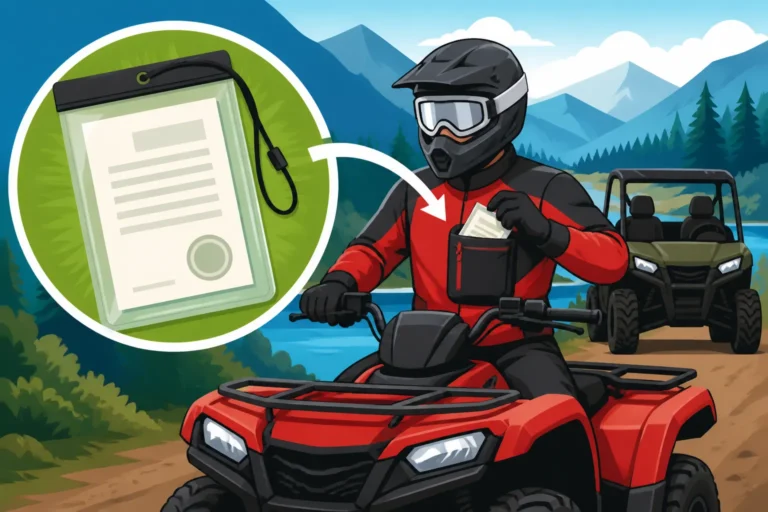
In the event you are stopped by a conservation officer, RCMP, or other authorized official, they will ask to see these documents. Being able to readily present them demonstrates your compliance and can prevent unnecessary delays or fines. Make sure the certificate is protected from the elements; many riders keep it in a waterproof bag or a sealed compartment on the quad.
Equally important is the proper display of the ORV number plate. The plate must be securely attached to your youth quad and clearly visible. The regulation allows for [BC Plate Placement on Front, Back or Left] of the machine, but it must be mounted horizontally and not obstructed by cargo or accessories. Keeping the plate clean and legible is also essential. A mud-caked plate that can't be read is effectively no plate at all in the eyes of the law.
Selling or Gifting a Youth Quad in the Future
The beauty of BC's ORV registration system is its simplicity once you're in it. Unlike vehicles registered under the Motor Vehicle Act, there's no annual renewal. [BC Registration Lasts As Long As You Own It]. This means once you've registered your child's quad, you don't need to worry about yearly fees or stickers.
However, if and when your child outgrows the quad, or you decide to sell or gift it, you will need to facilitate a [BC Transfer of Ownership Explained]. Just as you provided a bill of sale or gift letter when you registered, you'll need to provide similar documentation to the next owner. This ensures that the continuity of ownership is maintained in the provincial system. A clear, properly executed bill of sale (for a sale) or gift letter (for a gift) is essential for the next owner to successfully transfer the registration into their name. Remember, this document will need to contain the machine's details, the seller's and buyer's information, and the date of the transaction. You can find reliable templates for these types of legal documents through services like LawDepot, ensuring all the necessary fields are covered for a smooth transfer. By doing so, you're not only fulfilling your legal obligations but also making the process much easier for the next family looking to enjoy the world of youth quad riding.
Here’s a quick summary of the key documents you’ll typically need for youth quad registration:
| Document Type | Description | Why It's Needed |
|---|---|---|
| Proof of Ownership | Original Bill of Sale (from dealer or previous owner), or Gift Letter (if received as a gift). Must show a clear chain of ownership back to the original sale if possible. | Establishes your legal right to register the machine. |
| Statutory Declaration | (Optional) A sworn statement declaring ownership if key bills of sale are missing. Templates can be found on LawDepot. | Fills gaps in the ownership chain, allowing registration when standard proof is unavailable. |
| Registered Owner's Photo ID | Valid government-issued photo identification (e.g., BC Driver's Licence, Passport). | Confirms your identity as the legal owner. |
| Registered Owner's Proof of Address | Documents like a utility bill, driver's licence with current address, or property tax assessment. | Verifies your residential address in BC. |
| ORV's Serial Number/VIN | The unique Vehicle Identification Number (VIN) or serial number for the specific quad. | Identifies the machine being registered in the provincial database. |
| PST Payment (if applicable) | Provincial Sales Tax may be collected at the time of registration for newly purchased or privately sold machines, unless exempt. | Required by the province for most vehicle purchases. |
| Payment for Registration Fee | The one-time fee for registering the off-road vehicle. | Covers the administrative costs of processing the registration. |
Disclaimer
This article is for general informational purposes only and does not constitute professional advice. Laws, prices and regulations vary by location and change over time. Consult a qualified professional for guidance on your specific situation.