BC Gift Letters Between Family
Passing down an off-road vehicle (ORV) within the family can feel like a simple, heartfelt gesture, but when you hit the Service BC counter or an Autoplan broker, the paperwork can quickly turn a warm moment into a confusing headache. Many folks assume a simple handshake or a quick note is enough for that quad or side-by-side they're gifting to a son, daughter, or spouse. This guide will walk you through exactly what a gift letter is, why it's so important in British Columbia, and how to create one that sails through the registration process without a hitch.
Why a Gift Letter is Essential for Family Transfers
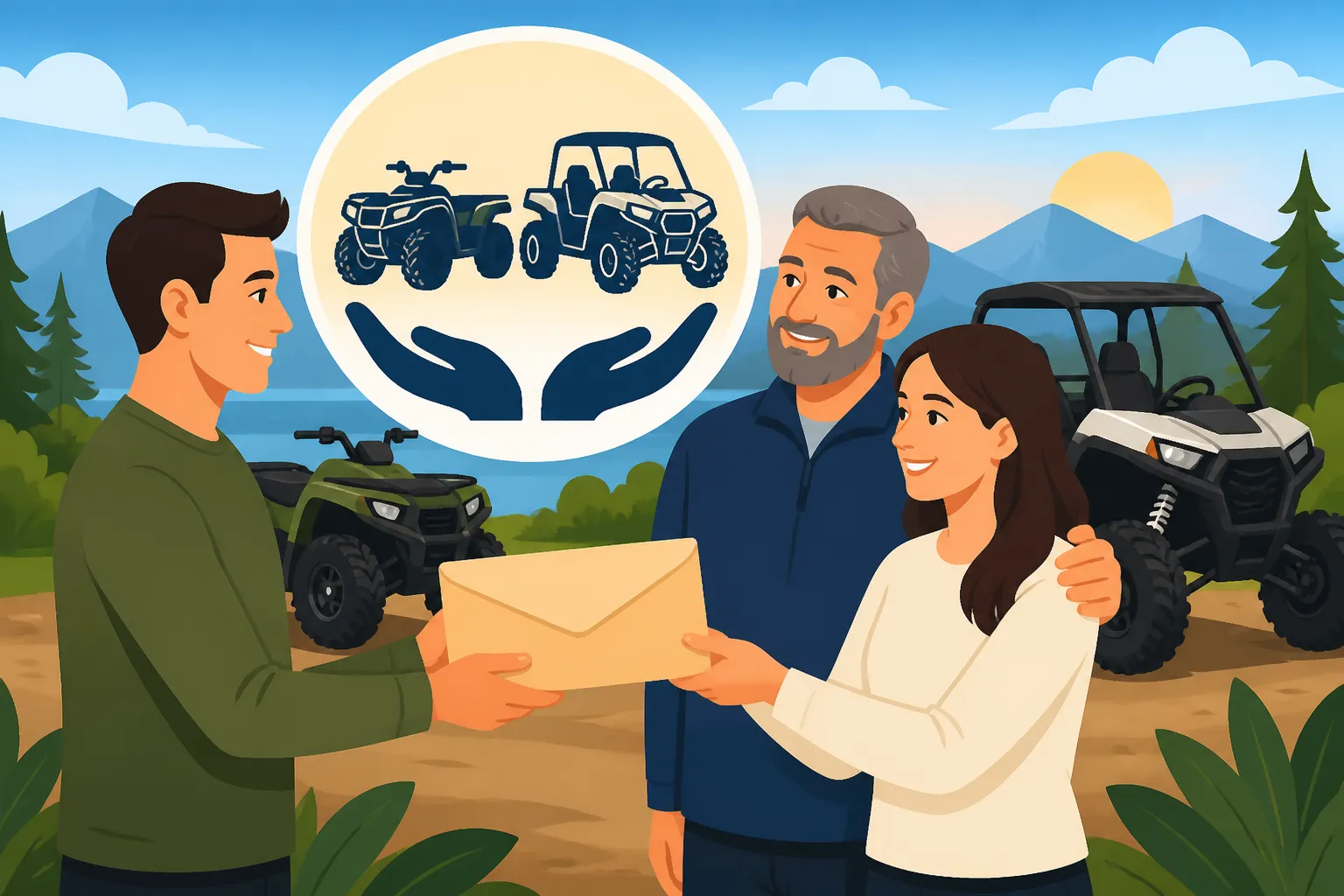
It’s truly a wonderful thing to pass on a beloved quad or side-by-side to a family member. Maybe it's a son graduating, a daughter showing a new passion for the trails, or a spouse ready to join you on more adventures. While the emotional value is clear, the legal and financial implications in BC for these kinds of transfers need a specific document: a gift letter. Without it, you could be facing unnecessary taxes and administrative roadblocks, turning a generous act into a hassle. This letter acts as a crucial piece of the puzzle for official recognition of the transfer.
Avoiding PST on Family Gifts
One of the biggest reasons to get a proper gift letter in order is to avoid paying Provincial Sales Tax (PST) again on a machine that's staying within the immediate family. In BC, when an ORV is transferred, PST is generally applied based on the purchase price or the estimated market value. This can be a significant amount, especially for newer, more expensive machines. However, the provincial tax rules often have specific exemptions for gifts between "qualifying relatives," which typically include spouses, parents, and children. A well-written gift letter explicitly stating that the ORV is a gift and not a sale can save your family a substantial sum. It's not about dodging taxes but ensuring you're not taxed on a transaction that isn't a commercial sale. The gift letter provides the formal declaration required by the province to confirm that no money changed hands for the ORV itself.
This exemption is a massive relief for families trying to make an ORV more accessible for a loved one. Imagine handing over a side-by-side valued at $20,000, only for the recipient to face a tax bill on that amount. That completely undermines the spirit of the gift! The gift letter is your shield against this. It clearly communicates to the provincial authorities that this is a non-commercial transfer. Without it, even if you tell the broker it was a gift, they might be obligated to treat it as a taxable transfer unless proper documentation is provided. This is why getting it right upfront prevents frustrating surprises later when you are trying to finalize the [BC Transfer of Ownership Explained].
Establishing a Clear Ownership Chain
Beyond saving on taxes, a gift letter is absolutely vital for maintaining a clear and unbroken chain of ownership for your off-road vehicle. Unlike highway vehicles, ORVs in BC don't have a traditional "title" document that gets transferred. Instead, their ownership is recorded through a system of bills of sale, statutory declarations, and registration certificates. Every time an ORV changes hands, there needs to be a document to prove who owned it previously and who owns it now. A gift letter serves as that crucial link when a cash transaction isn't involved. It formally documents the transfer from the donor to the recipient, ensuring there are no gaps in the record.
Think about it like this: if you gifted a quad to your son, and years later he decides to sell it, the person he sells it to will need to see documentation proving his ownership. If there's no bill of sale because it was a gift, and no formal gift letter, there's a missing link in the [BC Ownership Chains Going Back Decades]. This can cause major headaches for future buyers or even for your son if he needs to prove ownership for insurance claims or other legal matters. A clear ownership chain is fundamental for the integrity of the ORV registration system in BC. Without it, a machine can become virtually untransferable or unsellable down the line, trapping it in a kind of ownership limbo.
What Makes a Valid BC Gift Letter?
So, you understand why you need one, but what exactly does a BC gift letter need to look like to be effective? It's not just a casual note scribbled on a napkin. To be legally sound and accepted by an Autoplan broker for ORV registration, it needs to contain specific information and be prepared with care. Accuracy and completeness are key here, as missing details can easily lead to delays or rejection of your registration application. You want this process to be as smooth as possible, and that starts with a robust gift letter.
Key Information to Include
A valid gift letter for an ORV transfer in British Columbia should be comprehensive and leave no room for ambiguity. At a minimum, it must include the full legal names and current residential addresses of both the donor (the person giving the gift) and the recipient (the person receiving it). Clarity on who is giving and who is receiving is paramount. Next, you need a detailed description of the off-road vehicle itself. This means providing the make, model, year, and crucially, the Vehicle Identification Number (VIN). The VIN is the unique identifier for the machine, much like a fingerprint, and it must match exactly what's on the ORV and any previous documentation.
Beyond the identities and the machine's details, the letter must unequivocally state that the ORV is being transferred as a genuine gift, with no money or other consideration changing hands. This declaration is essential for the PST exemption. The date of the gift is also a critical piece of information. Finally, while not strictly required for every gift letter, it's a good practice to include a statement acknowledging that the donor is the legal owner of the ORV and has the right to gift it. This helps reinforce the legitimacy of the transfer. Missing any of these key pieces of information can cause a red flag during the registration process, requiring you to go back and get it corrected, which is a frustrating waste of time for everyone involved.
The Role of Signatures and Witnesses
Once you've got all the crucial information laid out, the gift letter needs to be properly executed with signatures. Both the donor and the recipient must sign and date the letter. Their signatures confirm their agreement to the terms of the gift – that one is giving, and the other is accepting, without payment. This simple act of signing formalizes the intent and acknowledgment of the transfer. It's a fundamental requirement for any legal document, and a gift letter is no exception. Without both signatures, the document is incomplete and won't be accepted as proof of ownership transfer for registration purposes.
To add an extra layer of legitimacy and to protect against future disputes, it's highly recommended, and often expected by brokers, that the signatures be witnessed. An independent third party, not directly involved in the gift or related to either party, should sign and print their name as a witness. This witness attests to the fact that they saw the donor and recipient sign the document on the specified date. While not always a legal requirement for every type of gift, for ORV transfers involving registration and potential tax exemptions, having a witness (or even two) can significantly strengthen the validity of your gift letter. It makes the document much harder to challenge if questions about its authenticity arise later, providing peace of mind for both parties involved in the transfer.
Navigating the BC Registration Process with a Gift Letter
So, you've drafted and signed your perfect gift letter, complete with all the necessary details and witnesses. You might think the hardest part is over, but bringing that document to an Autoplan broker requires a bit more preparation. The broker needs to see a complete picture, not just one piece of paper. Knowing what to expect and what else to bring will make your visit to the broker a breeze, allowing you to quickly get that ORV officially registered to its new owner.
Steps at the Autoplan Broker
When you're ready to register a gifted ORV, your first stop will be an Autoplan broker. These are the same folks who handle your car insurance and vehicle registration, and they are authorized to process ORV registrations as well. You'll need to bring your completed and signed gift letter. But don't stop there! The broker will also require other documents to fully process the registration. This usually includes proof of identity for the new owner (the recipient), such as a valid driver's licence or other government-issued photo ID. You'll also need to bring in any existing registration documents for the ORV, such as the [BC's Certificate of Registration Explained] if the machine was previously registered in BC.
The broker will carefully review all the documentation, including your gift letter, to ensure that the chain of ownership is clear and that all information aligns. They will check the VIN on the documents against the ORV's physical VIN (you may need to provide a photo of this, or bring the machine in for verification depending on the broker's process). If the machine has never been registered in BC, or if there are gaps in its history, they might ask for additional documents to prove prior ownership, even for a gift. The broker's job is to ensure legal compliance and accuracy. They will then input the details into the provincial system. There will be a nominal fee for processing the transfer itself, which is separate from PST if your gift qualifies for exemption. Once approved, the new owner will receive their own Certificate of Registration and will be issued [BC ORV Number Plates and Decals] if the machine is not already plated.
When a Gift Letter Isn't Enough (and What Is)
While a gift letter is incredibly powerful for family transfers, there are situations where it might not be the sole document needed, or where its effectiveness is limited. The biggest challenge arises when the donor of the gift cannot conclusively prove their own ownership. For instance, if you're gifting an older machine that has been in the family for decades, and there are no original bills of sale or previous registration documents, the gift letter alone won't magically establish your ownership. The Autoplan broker needs to see a clear path from the original owner (or a previous registered owner) to you, the donor, before they can transfer it to the recipient.
In scenarios where the ownership history is murky or missing documents, even with a heartfelt gift letter, the broker may require a [BC Statutory Declaration for an ORV]. This is a formal statement made under oath, declaring the details of how you, the donor, came to own the machine, and that you have the legal right to gift it. It’s a more involved process than a simple gift letter, sometimes requiring a visit to a notary public or commissioner of oaths. This is particularly common for [BC Machines With No Paperwork] or if there's a significant gap in the historical documentation. The gift letter is fantastic for the current transfer, but it can't fix historical documentation problems. Always aim to have as much of the ORV's paperwork as possible when approaching the broker, even for a family gift, to ensure a smooth process.
| Document Type | Purpose | When It's Needed | Cost Implications |
|---|---|---|---|
| Gift Letter | Proof of non-commercial transfer between family members. | Family gifts of ORVs (e.g., parent to child, spouse to spouse). | Avoids PST if conditions met. |
| Bill of Sale | Proof of purchase and transfer for a monetary transaction. | Any purchase of an ORV, new or used. | Establishes value for PST calculation. |
| Statutory Declaration | Formal declaration of ownership under oath when other documents are missing. | Missing bills of sale, gaps in ownership history. | Fee for commissioner of oaths. |
| Certificate of Registration | Official record of current ORV owner in BC. | Required for all registered ORVs; transferred to new owner. | Part of the transfer fee. |
Common Family Gift Scenarios and Solutions
Family dynamics are wonderfully varied, and so are the ways in which ORVs are passed around. Understanding how your specific family gift scenario fits into the BC registration requirements can save a lot of guesswork and potential frustration. Whether it’s passing on a youth quad, transferring between spouses, or dealing with an inherited machine, each situation has its nuances when it comes to formalizing the transfer with a gift letter.
Gifting to a Child or Youth
Gifting an ORV to a child or youth in British Columbia brings up a few extra considerations. While a parent can certainly gift a quad or side-by-side to their minor child, the legal ownership for registration purposes often defaults to the supervising adult, especially if the child is under 16. For registration purposes, the ORV will usually be registered in the parent or guardian's name, or potentially co-registered, until the youth reaches a certain age or maturity. This isn't just about legalities; it's also about responsibility. The adult who holds the registration is ultimately responsible for ensuring the machine is operated safely and legally, which aligns with [BC Youth Riding Rules Explained]. The gift letter in this scenario would document the transfer from, say, Grandma to her grandson, but the grandson's parent would typically be the one registering the machine in their name for the time being.
When writing the gift letter for a youth recipient, it's wise to clearly state the youth's name as the intended recipient of the gift, but also acknowledge that for registration purposes, the machine may be placed in a parent or guardian's name. This manages expectations and clarifies the situation for the broker. It ensures that the spirit of the gift is recorded, even if the formal registration reflects an adult's name for legal and practical reasons. As the youth matures and gains more independence, the ownership can be formally transferred to them later, often requiring another transfer process and a new gift letter or bill of sale at that time.
Gifting Between Spouses or Common-Law Partners
Transfers between spouses or common-law partners are a fairly common occurrence. Perhaps one partner is more into riding and wants to pass on a second machine to the other, or they simply want to put a shared machine clearly in one person's name for insurance or other administrative reasons. In BC, these transfers also benefit significantly from a clear gift letter. The same principles apply: a gift letter between spouses ensures that the transfer is recognized as a non-commercial gift, potentially exempting it from PST. The letter should clearly identify both partners as donor and recipient, detail the ORV, and state that it's a gift.
The process at the Autoplan broker for spouses or common-law partners is usually straightforward if the gift letter is well-prepared. Both individuals will need to be present, or at least have their identities confirmed, and bring their identification. It's a testament to the fact that even within the closest relationships, formal documentation is required when dealing with provincial registries. This also ensures that if the relationship changes in the future, there is a clear record of who legally owns the machine, avoiding any potential disputes down the line. A gift letter provides that solid, unequivocal proof of the transfer of ownership, protecting both parties and streamlining the registration process.
Inheriting an ORV: Estate Sales vs. Gifts
Receiving an ORV from a deceased family member can be an emotional time, and dealing with the paperwork might feel overwhelming. It's important to distinguish between inheriting an ORV as part of an estate and receiving it as a direct gift. If the ORV is explicitly bequeathed in a will, or if it's distributed as part of the estate by an executor, the transfer process involves specific estate documentation. This typically includes a copy of the will, letters probate (if applicable), and a letter from the executor authorizing the transfer. This is different from a simple gift letter, as the transfer is happening from the estate, not directly from the deceased individual.
However, if the family decides that an ORV, not specifically mentioned in a will or distributed as part of a formal estate process, should go to a particular family member, a gift letter can still play a role. In this scenario, the executor or the legal representative of the estate would act as the donor, gifting the machine from the estate to the chosen family member. This is a subtle but important distinction. The gift letter would then be between the estate (represented by the executor) and the recipient. The key is to ensure that whoever signs as the donor has the legal authority to transfer the ORV from the deceased's assets. For complexities like this, it's often advisable to bring all available [BC Registration After the Owner Dies] paperwork to the Autoplan broker for the most accurate guidance.
Crafting Your Gift Letter: Templates and Best Practices
Now that you know the ins and outs, it's time to actually put pen to paper (or fingers to keyboard!). Crafting a gift letter doesn't have to be daunting. In fact, there are resources available to help you create a professional, legally sound document that will be accepted without question during the registration process. Avoiding common mistakes and utilizing reliable tools will ensure your gift letter serves its purpose effectively.
Utilizing Online Resources (LawDepot)
In today's digital age, you don't have to start from scratch when creating legal documents like a gift letter. Online legal document services offer fantastic templates and guided processes that ensure you include all the necessary information and follow proper formatting. One such resource that many find helpful is LawDepot. Platforms like LawDepot provide customizable templates for various legal documents, including bills of sale and gift letters, which can be adapted for ORV transfers. Using a service like this can give you peace of mind, knowing that the structure and essential clauses of your letter are legally sound.
When you use an online template from a reputable source like LawDepot, you're guided through a series of questions that populate the document with your specific details. This significantly reduces the chance of forgetting crucial information such as VINs, addresses, or the explicit declaration of a gift. While these services typically charge a fee for their premium templates, the investment can be well worth it to ensure your document is correct the first time, preventing delays and frustration at the Autoplan broker. Plus, these templates often include sections for witnesses, ensuring your letter meets all the best practices for validity. Remember to double-check all details against your actual ORV and personal identification before finalizing and printing the document.
What to Avoid When Writing Your Own
While the idea of simply writing your own gift letter on a piece of paper might seem appealing for its simplicity, there are several pitfalls to avoid if you choose this route. The biggest mistake is being too informal or vague. A casual note that says, "I gave John my quad," is simply not sufficient. It lacks the legal specifics required for official registration. Avoid ambiguous language, especially regarding the intent of the transfer. It must clearly state "gift" and explicitly deny any exchange of money or services. Any hint of payment could trigger PST, even if it wasn't the intention.
Another common error is omitting key details. Forgetting the full VIN, using an outdated address, or failing to include a clear date of transfer can all cause problems. Make sure all names are full legal names, not nicknames. Also, neglecting to include a space for witnesses, or simply having family members witness the document who might not be considered independent, can weaken the letter's credibility. If you're going to write it yourself, ensure it's typed, formal in tone, and includes every single piece of information discussed earlier. While LawDepot or similar services provide a safety net, if you're writing it manually, meticulous attention to detail is your best defense against having to redo the paperwork.
Beyond the Gift Letter: Other Considerations for Family ORVs
Even with a perfectly crafted gift letter and a successful registration transfer, the journey of your family ORV doesn't end there. There are other important considerations that come into play once the machine is officially in the new owner's name. Thinking about these aspects upfront can prevent future complications and ensure that your family can enjoy their off-road adventures with full peace of mind.
Insurance Implications
Once the ORV is officially registered in the new owner's name through the gift letter process, the insurance requirements immediately fall to them. In British Columbia, all off-road vehicles that operate on Crown land, which includes most trails and [BC Forest Service Road Requirements], must carry a minimum of third-party liability insurance. This isn't just a recommendation; it's a legal requirement. When you're at the Autoplan broker registering the gifted machine, you'll also need to arrange for this liability coverage. It's often bundled with the registration process.
It's crucial to understand that simply having the ORV registered doesn't automatically mean it's insured. The new owner will need to specifically purchase [BC ATV Insurance Requirements]. While the basic liability coverage is mandatory, many riders opt for additional coverage like collision, comprehensive, or extended liability, especially for newer or more valuable machines. Discuss these options with your Autoplan broker. The cost of insurance can vary, and factors like the rider's experience, the type of ORV, and where it will be ridden will all play a role. Don't let the excitement of a new machine overshadow the importance of proper insurance coverage; it's essential for protecting both the rider and other trail users.
Future Transfers and Documentation
The smooth transfer of an ORV via a gift letter sets an excellent precedent for the machine's documentation moving forward. However, it's vital to instill in the new owner the importance of maintaining meticulous records. Just as a gift letter facilitated this transfer, future transfers—whether through sale or another gift—will require equally clear documentation. The Certificate of Registration is a critical document that [BC Riders Must Carry the Certificate] on every ride on Crown land. This certificate, along with the gift letter, forms part of the machine's official history.
Encourage the new owner to keep their gift letter, their Certificate of Registration, and any insurance documents in a safe, accessible place. If they ever decide to sell the ORV, having all these papers in order will make the process much smoother for them and the prospective buyer. It continues the clear [BC Transfer of Ownership Explained] chain, avoiding the headaches that can arise from missing paperwork. Every document associated with the ORV's ownership and transfer history is a valuable asset, and diligent record-keeping is a best practice that benefits everyone involved in the lifespan of the machine.
Disclaimer
This article is for general informational purposes only and does not constitute professional advice. Laws, prices and regulations vary by location and change over time. Consult a qualified professional for guidance on your specific situation.