BC Crown Land Triggers the Registration Rule
It can be incredibly confusing trying to figure out the rules for riding your ATV or UTV in British Columbia, especially when it comes to registration. Many riders assume that if they own their machine outright, or if they only ride occasionally, they might not need to bother with registration. However, a major misconception arises around where you can actually ride without proper documentation. This guide will clarify the crucial role that BC's vast Crown land plays in triggering the mandatory registration rule, helping you avoid unexpected fines and keep your adventures legal and worry-free.
Understanding BC's ORV Act and Crown Land
Navigating the rules and regulations for off-road vehicles (ORVs) in British Columbia can feel like driving through dense fog at times. One of the biggest areas of confusion, and frankly, frustration, for many riders revolves around when and why their beloved quad or side-by-side needs to be registered. It’s not simply about owning the machine; it's about where you choose to ride it. The provincial government put specific legislation in place to manage ORV use, and understanding this framework, particularly the definition and impact of Crown land, is absolutely essential for every BC rider.
The Mandatory Registration Requirement
Before 2015, the rules were a lot fuzzier, leading to a patchwork of understanding across the province. But that changed significantly. The provincial Off-Road Vehicle Act, which came into effect in November 2015, made it mandatory for most ORVs to be registered if they are operated on Crown land. This wasn't just a suggestion; it was a hard and fast rule designed to bring more accountability and safety to the trails and resource roads that crisscross our beautiful province. For many long-time riders, this felt like an abrupt shift, suddenly demanding paperwork for machines they'd owned and ridden for years without a second thought.
The key takeaway here is that the registration isn't about the purchase of your machine as much as it is about its operation. If your quad or side-by-side never leaves private property that you own or have explicit permission to use, then the provincial registration requirements typically don't apply. However, the moment you venture off that private parcel and onto publicly accessible land, you fall under the Act. This distinction is critical because, as we'll explore, the vast majority of desirable riding areas in BC are, in fact, Crown land. You can learn more about the specifics of this legislation by checking out [What the Off-Road Vehicle Act Covers in BC].
What Exactly is Crown Land?
So, what exactly is Crown land in British Columbia? In simple terms, Crown land is publicly owned land, managed by the provincial government. It's not private property, and it's not federally owned land like a national park or military base. Think of the sprawling forests, mountains, lakeshores, and wilderness areas that make up the breathtaking landscape of BC – a huge portion of it is Crown land. In fact, over 90% of British Columbia is considered Crown land, making it virtually impossible for most ORV enthusiasts to avoid it if they want to enjoy a proper ride.
This encompasses a wide array of areas that are popular with riders: Forest Service Roads (FSRs), which are often the arteries of our backcountry access; vast networks of unmarked trails; open fields and clearings in non-private areas; and even many gravel pits that aren't privately owned or leased. When you head out for a day of exploration, whether it’s a leisurely cruise along a scenic route or a challenging climb up a mountain track, there’s a very high probability you are on Crown land. Understanding this geographical reality is the first step to truly grasping why registration is so important.
The definition also includes areas like provincial parks, though it's crucial to remember that while provincial parks are Crown land, many of them have specific bylaws that prohibit ORV use entirely. It's not enough to know it's Crown land; you also need to know if ORVs are permitted in that specific Crown land area. The sheer amount of accessible terrain means that if you're planning any kind of off-roading adventure beyond your own backyard, you'll almost certainly be entering territory where the ORV Act, and thus the registration rule, comes into play. If you're keen to understand more about specific areas, you might find [BC Crown Land Riding Explained] helpful.
Why Crown Land Triggers the Rule
The reason Crown land triggers the registration rule boils down to a few key principles: accountability, safety, and environmental stewardship. When ORVs operate on public land, there's a need for the province to be able to identify who is operating them, especially in cases of accidents, environmental damage, or illegal activity. Without a registration system, tracking down individuals responsible for careless operation, trespass, or damage would be nearly impossible. The number plate issued upon registration serves as a visible identifier, much like a license plate on a car, allowing conservation officers, RCMP, and other authorities to enforce the rules effectively.
Furthermore, the provincial government has a responsibility to manage Crown land for the benefit of all citizens, which includes protecting sensitive ecosystems, wildlife habitats, and water sources. Unregulated ORV use can lead to erosion, habitat destruction, and conflict with other land users like hikers, hunters, and industrial operators. Registration helps to create a framework for responsible use, providing a baseline level of control and encouraging riders to be mindful of their impact. It’s part of a larger effort to ensure that these shared resources remain healthy and accessible for generations to come.
Ultimately, the registration rule on Crown land is about bringing order and responsibility to what was once a largely unregulated activity. It means that when you’re out enjoying the incredible backcountry, you’re doing so as a recognized operator, making it easier for authorities to maintain safety and protect our natural environment. While it might feel like an extra bureaucratic step, it's designed to contribute to a more sustainable and enjoyable riding experience for everyone in BC. The requirement for registration became official in [BC Registration Became Mandatory in 2015].
The Practicalities of Registering for Crown Land Access
So, you've realized that your riding plans will almost certainly take you onto BC's vast Crown land, meaning your off-road vehicle absolutely needs to be registered. Now comes the practical part: actually getting it done. This process can sometimes feel a bit daunting, especially if your machine is an older model or if its paperwork has seen better days. But don't fret; it's a manageable process, and knowing what to expect can save you a lot of headaches and potential frustration.
The Registration Process
When it comes to registering your ATV or UTV in British Columbia, the process is handled through authorized Autoplan brokers, just like registering a car. You can't just send a form in the mail or do it online; you'll need to visit a broker in person. This ensures all the necessary documentation is reviewed properly and helps prevent errors that could lead to issues down the line. Most communities have at least one Autoplan broker, so finding one near you shouldn't be too difficult. This also means you'll deal with real people who can answer your specific questions. A good place to start for general guidance is [How to Register an ATV in BC].
When you go to the broker, you'll need to bring a collection of documents. The most crucial piece of paper is proof of ownership, which usually means a bill of sale. If you're buying a brand-new machine from a dealership, they'll typically handle much of this paperwork for you, making the process relatively smooth. However, if you're purchasing from a private seller, you'll need a robust bill of sale clearly identifying both you and the seller, the machine's details (make, model, VIN), and the sale price. Beyond that, you'll need government-issued photo identification, proof of your BC address, and payment for the registration fee and any applicable provincial sales tax (PST). Keep in mind that brokers play a key role in this, and you can find more information about their involvement in [BC Autoplan Brokers Handle ORV Registration].
One of the biggest hurdles that many riders encounter, especially with older machines, is establishing what the province calls "continuity of ownership." This means you need to show a clear paper trail from the original owner (or as far back as reasonably possible) all the way to you. If there are gaps in this chain—for example, if a previous owner sold it to someone who then sold it to another person without proper bills of sale—it can complicate things. The broker needs to be satisfied that you are the rightful owner and that no previous ownership is outstanding. This can be a real sticking point for machines that have changed hands many times over the years. We delve deeper into this challenge in [BC's Continuity of Ownership Problem].
Dealing with Missing Paperwork
Let's be realistic: a lot of off-road machines in BC have been passed down through families, bought from a buddy for cash, or acquired decades ago when formal paperwork wasn't as strictly emphasized. It's a common scenario to find yourself with a fantastic quad but absolutely no bill of sale, or perhaps only a handwritten note from a seller who has long since vanished. This can feel like a dead end when you're trying to meet the continuity of ownership requirements, and it's a frustration many riders share. You know the machine is yours, but proving it on paper is another matter entirely.
In these situations, the provincial government offers a lifeline in the form of a statutory declaration. This is a formal legal document where you declare under oath that you are the rightful owner of the machine, explaining how you came into possession of it and why you don't have the standard proof of ownership. You essentially attest to the facts, and it carries the same legal weight as if you were giving testimony in court. While it's not a substitute for a bill of sale, it can bridge those critical gaps in the ownership chain, allowing the broker to proceed with your registration. You can find more detail on this in [BC Statutory Declaration for an ORV].
Preparing a statutory declaration properly is important. It needs to contain specific information, be clearly worded, and be sworn before a commissioner for taking affidavits (which many notaries public, lawyers, and even some government officials can do). Services like LawDepot can be incredibly helpful here, as they provide user-friendly templates and guidance for creating various legal documents, including statutory declarations. While you should always review such documents carefully and consider professional advice, a well-prepared declaration can make all the difference in getting your beloved machine registered when traditional paperwork is missing. This kind of form helps formalize your claim and allows the province to process your application, getting you one step closer to legal Crown land access. You can find a more extensive list of requirements in [BC Registration Paperwork Checklist].
What You Get After Registering
Once you've successfully navigated the paperwork, paid the fees, and satisfied the Autoplan broker that you are the rightful owner, congratulations! You'll walk out with a few key items that signify your machine is officially registered for use on Crown land. The most important document you'll receive is the Certificate of Registration. This isn't a "title" in the way cars have titles; it's a certificate proving that your machine is registered under the BC Off-Road Vehicle Act. It contains vital information about your ORV, including its Vehicle Identification Number (VIN), make, model, and your name as the registered owner. Think of it as your ORV's passport for the backcountry.
In addition to the certificate, you'll be issued a number plate and a decal. The plate is a standard-sized, durable piece of metal that needs to be affixed to your ORV in a clearly visible location. The law is quite specific about where this plate can go—front, back, or left side—and it must be horizontally mounted and visible. The decal, a smaller sticker, usually goes near the plate or on another prominent part of the machine. Both the plate and the decal signify that your ORV is registered and compliant with provincial regulations. These are the physical markers that police, conservation officers, and other enforcement personnel will look for when you're out riding.
It is absolutely crucial that you carry your Certificate of Registration with you every time you operate your ORV on Crown land. This isn't just a suggestion; it's a legal requirement. In the event you are stopped by an enforcement officer, they will ask to see this document along with your photo identification. Failure to produce them can lead to fines. It's a good practice to keep your certificate in a waterproof bag or container, perhaps under your seat or in a storage compartment, to protect it from the elements while you're out on the trails. This ensures it's always legible and available when needed. [BC's Certificate of Registration Explained] and [BC ORV Number Plates and Decals] provide more detail on these items, and you can also read [BC Riders Must Carry the Certificate] for specific requirements about having it with you.
Common Scenarios and Misconceptions About Crown Land Riding
Even after understanding that Crown land triggers the registration rule, there are still quite a few nuanced situations and common misconceptions that trip up BC riders. It’s not always a clear-cut case, and sometimes the rules feel like they have more twists and turns than your favourite winding trail. Let’s tackle some of these specific scenarios to ensure you’re fully equipped with the knowledge to ride legally and confidently.
Forest Service Roads (FSRs) and Resource Roads
One of the most frequent areas of confusion centers around Forest Service Roads (FSRs) and other resource roads. These gravel arteries are the lifeblood of BC's backcountry, providing access to incredible riding areas, fishing spots, and remote camping. Many riders, however, mistakenly believe that because these roads are unpaved and often remote, they might operate under a different set of rules than, say, a provincial park. This isn't the case at all. FSRs and other resource roads are unequivocally considered Crown land. Therefore, if you're riding your ATV or UTV on any of these roads, your machine absolutely must be registered.
Operating on FSRs also comes with additional layers of responsibility and regulation beyond just registration. These are not private playgrounds; they are active industrial roadways. This means you're sharing them with logging trucks, heavy equipment, and other industrial traffic, which always have the right of way. Beyond registration, BC also has specific insurance requirements for operating an ORV on a Forest Service Road. You're typically required to carry a minimum amount of third-party liability insurance, often $200,000, which is more than what might be necessary for other types of Crown land. This is a crucial safety net given the potential for serious accidents on these busy, industrial routes. You can delve into this further by reading [BC Resource Roads Count as Crown Land] and [BC Forest Service Road Insurance].
The rationale here is clear: the province needs to manage access, ensure safety for all users, and hold individuals accountable for their actions on these vital transportation routes. Whether you're using an FSR to get to a remote trailhead or simply riding along it for pleasure, you're interacting with a public asset that requires oversight. Thinking that an FSR is "different" from other Crown land could lead to significant fines and puts you and others at risk.
Private Property Versus Crown Land
The distinction between private property and Crown land is fundamental to understanding ORV registration requirements. Generally speaking, if you operate your ATV or UTV exclusively on private property that you own, or on land where you have explicit, written permission from the owner to ride, you are typically exempt from the provincial ORV registration rule. This is a common scenario for many rural residents who primarily use their machines for chores around their own acreage or who have dedicated trails on their personal land. For them, the complexities of provincial registration might genuinely not apply.
However, the line can get blurry very quickly, creating what we affectionately call "grey areas." Imagine your property borders a patch of provincial forest, or your favourite riding spot involves crossing a small, seemingly insignificant strip of Crown land to get from one private parcel to another. In these instances, the moment your tires touch that public land—even for a brief crossing—the provincial registration requirement is triggered. It doesn't matter if it's "just a few feet" or if "no one will ever know." Legally, you've moved from an exempt zone to a regulated one.
This is a point of frequent misunderstanding and frustration for riders whose properties might be intermingled with Crown land or who have grown accustomed to riding "around the back" of their property, which inadvertently leads them onto public land. The province's stance is unequivocal: if you're on Crown land, you need to be registered. There's no partial exemption or "almost private" category. Therefore, it's always best to err on the side of caution. If there's any doubt whether your riding area might include public land, getting your machine registered is the safest and most legally sound option. More information on this specific topic can be found in [BC Private Land and the Registration Question].
Farm Quads and Industrial Use
Another common misconception is that certain types of ORVs, particularly those used for agricultural or industrial purposes, are exempt from registration when operating on Crown land. It’s easy to see why this belief persists; farming and forestry operations often use quads and side-by-sides as tools, not just for recreation. Many people assume that a "work machine" would fall under different regulations, possibly under agricultural exemptions or industrial safety rules, rather than the general ORV Act. However, this is largely incorrect when it comes to Crown land use in British Columbia.
If a farm quad, a machine used by a guide, or an ORV employed for any commercial or industrial purpose operates on Crown land, it falls under the exact same registration requirements as a recreational machine. The key determinant is where the machine is being operated, not what it's being used for. Whether you're checking fences on Crown range land, scouting timber areas, or leading a guided tour on an FSR, if your machine is on public land, it needs to be registered with the province. There are very few, highly specific exemptions under the Act, and general "farm use" on Crown land is typically not one of them.
This means that even if your side-by-side spends 99% of its life tending to chores on your own private farm, the moment you drive it across a small strip of Crown land to reach another part of your property, or if you use it to access Crown range for livestock, it must be registered. The Act is broad in its application to ensure comprehensive coverage and enforcement on public lands. So, if you're relying on your ORV for work and your work takes you onto any part of BC's public domain, plan on getting it registered. To clarify further on this, you can look into [BC Farm Quads Are Not Exempt] and [BC Registration Covers Work and Recreation].
Consequences of Non-Compliance and Staying Legal
Ignoring the registration rules for your ATV or UTV in British Columbia, especially when riding on Crown land, isn't just a minor oversight—it can lead to some significant and unwelcome consequences. While the process of getting your machine registered might seem like a bit of a hassle, it pales in comparison to the stress and expense of dealing with enforcement actions. Staying legal is not only about avoiding penalties but also about ensuring a safer and more responsible riding environment for everyone.
Penalties for Unregistered Operation
If you're caught operating an unregistered off-road vehicle on Crown land in BC, you could face substantial fines. Enforcement officers, including RCMP and Conservation Officers, regularly patrol popular riding areas, FSRs, and backcountry trails, and they are well-versed in the ORV Act. A violation ticket for operating an unregistered ORV can be quite costly, and it's certainly more expensive than the initial registration fee itself. These fines are designed to be a deterrent, making it clear that compliance is expected. It's a tough pill to swallow when you're out trying to enjoy nature, only to have your day abruptly ended by a ticket.
Beyond financial penalties, there are more severe consequences to consider. In some situations, particularly if there are other offenses involved (like careless operation, environmental damage, or repeated non-compliance), your unregistered ORV could even be seized by enforcement authorities. Having your machine impounded means not only dealing with fines but also the hassle and cost of retrieving it, which can involve impound fees, storage costs, and additional administrative charges. It’s an outcome no rider wants, and it highlights the seriousness with which the province views the registration requirement on public lands. You can find more specific information on this in [BC Tickets for an Unregistered Machine] and [BC Machine Seizures by Police].
It's important to remember that these penalties aren't arbitrary; they're part of the provincial government's efforts to ensure safety, traceability, and environmental protection on Crown land. An unregistered machine is essentially an unknown quantity on public land, making it harder to manage and regulate. The penalties serve as a powerful incentive to get your paperwork in order before you hit the trails.
Proving Ownership and Registration
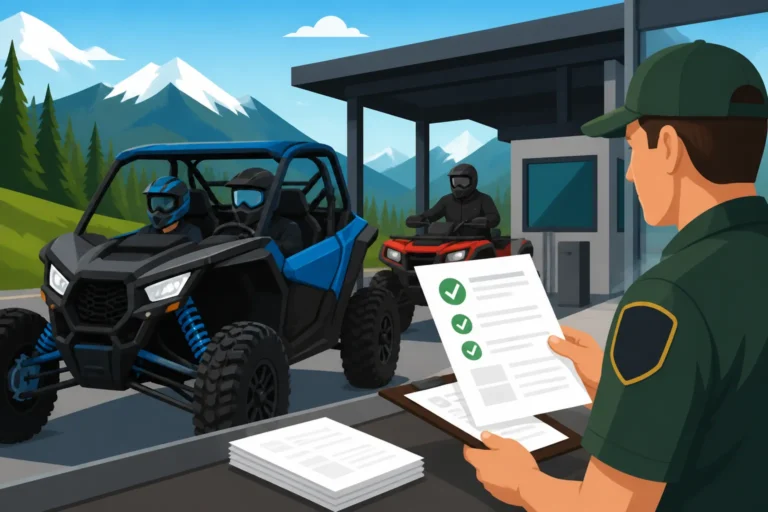
When you're out riding on Crown land, whether it's a bustling FSR or a quiet backcountry trail, there's always a chance you might encounter an enforcement officer. When they approach you, one of the first things they'll ask for is proof of your ORV's registration and your identification. This is why it's legally mandated to carry your Certificate of Registration and valid photo ID with you at all times when operating on Crown land. Simply stating that your machine "is registered" isn't enough; you need to be able to physically produce the document on demand.
In addition to carrying the certificate, your ORV's number plate must be clearly visible and legible. This means mounting it horizontally in one of the approved locations (front, back, or left side) and ensuring it's not obscured by mud, snow, gear, or modifications. An officer needs to be able to read the plate easily to verify its status. A plate covered in grime or hidden behind a jerry can can still lead to a ticket, even if your machine is technically registered. It’s all about immediate identifiability and adherence to the visible display rules. For tips on maintaining visibility, check out [Keeping Your ORV Plate Clean Enough to Read].
A practical tip for riders is to invest in a durable, waterproof pouch or small Pelican-style case for your Certificate of Registration and ID. Keep it securely stored on your machine, perhaps under the seat, in a storage box, or even in a zipped pocket on your jacket. This protects your documents from the elements and ensures they're always accessible when an officer asks to see them. Being prepared makes any interaction with enforcement much smoother and prevents unnecessary delays or fines.
Ensuring Your Documentation is Solid
Getting your ORV registered is just the first step; maintaining solid documentation throughout your ownership is equally important. This isn't just about avoiding tickets today, but about preventing future headaches when you eventually decide to sell your machine or if you need to deal with an insurance claim. A complete and accurate chain of ownership, supported by proper bills of sale, is invaluable. It ensures clarity and reduces the risk of disputes or difficulties proving the machine's history.
As we discussed earlier, if you originally registered your machine using a statutory declaration because you lacked a conventional bill of sale, it's a good idea to keep a copy of that declaration safely filed. This document is part of your machine's official history and provides a clear record of how you established ownership. Should you sell the machine in the future, providing a copy of this declaration to the new owner, along with a new bill of sale from you, will help them immensely in maintaining the continuity of ownership when they go to register it themselves.
Again, for those situations where original bills of sale are lost or never existed, utilizing resources like LawDepot for a robust statutory declaration template can be a smart move. Having a professionally formatted document, even if self-prepared, lends credibility and provides the necessary legal structure for your declaration. It helps to ensure that your claim of ownership is as strong as possible, not just for provincial registration but for any future transactions involving your machine. Investing a little time upfront to ensure your documentation is solid can save you a significant amount of stress and potential expense down the road. This diligence is key to truly trouble-free ownership. For more on this, check out [BC Ownership Chains Going Back Decades].
Riding Location vs. Registration Requirement
Here’s a quick overview of how different riding locations in BC typically affect your ORV registration requirements:
| Riding Location | Registration Required? | Key Consideration |
|---|---|---|
| Private Property | No | You must own the land or have explicit written permission. |
| Crown Land (General) | Yes | Mandatory for all ORV operation since Nov 2015. |
| Forest Service Roads | Yes | Count as Crown land; industrial traffic, liability insurance often required. |
| Provincial Parks | Varies/No | Generally prohibited for ORVs, even if Crown land; check specific park bylaws. |
| Crossing a Highway | Yes | Must be registered, insured, and adhere to strict crossing rules. |
| Designated ORV Trails | Yes | These are typically on Crown land and require registration. |
Disclaimer
This article is for general informational purposes only and does not constitute professional advice. Laws, prices and regulations vary by location and change over time. Consult a qualified professional for guidance on your specific situation.