What the Prince George ATV Club Offers Riders
Prince George riders often want more than a place to unload a quad: they need local trail knowledge, reliable information about conditions, and a way to help keep riding areas in good shape. The Prince George ATV Club can connect riders with that local community, particularly around Tabor Mountain, while helping newcomers understand what to check before heading out.
What the Prince George ATV Club Offers
Local knowledge of riding areas
A local ATV club can make it easier to understand where riding is practical, what terrain to expect, and what details to check before leaving home. Around Prince George, Tabor Mountain is a major point of reference for off-road riders. People new to the area may hear about a route or trailhead without knowing whether it suits a beginner, a side-by-side, or a group with mixed experience. Local knowledge helps turn a vague destination into a more realistic ride plan.
The club is also a useful starting point for learning how conditions can vary across the area. A route that feels manageable in dry weather may be slick, rutted, or difficult after rain or snowmelt. Rather than assuming every trail is suitable for every machine, ask about surface conditions, steep sections, creek crossings, and whether a route is appropriate for the least experienced rider in your group. For more background on the local area, see [Prince George Riding on Tabor Mountain] and [Riding 150 Kilometres at Tabor].
Local advice is especially valuable when you are visiting from outside Prince George. A GPS route shared by a friend may not tell you whether a road has changed, whether industrial traffic is active, or whether a trail is currently closed. Treat club information as one part of your planning, then check any posted restrictions and current land-manager notices before riding.
A connection to the riding community
Joining or contacting a club gives riders a way to meet people who know the local area and care about its future. That can be helpful if you have recently moved to Prince George, bought your first ATV, or simply do not have a regular riding group. Conversations with experienced local riders can answer practical questions that are hard to resolve from a map alone, such as where people typically stage, what kind of machine is a good fit for a route, and which areas are best for a relaxed first ride.
A club can also help riders find opportunities to participate in organized activities. Those may include group rides, club meetings, volunteer work, or other community events, depending on the club’s current plans. Do not assume that every activity happens on a fixed schedule or is open to every rider without registration. Check the club’s own communications for details about eligibility, meeting points, equipment expectations, and whether guests are welcome.
The community side matters for more than companionship. Riding with people who understand the area can make it easier to share navigation, communicate about changing conditions, and respond calmly if a machine has a problem. If you are considering joining, [BC ATV Clubs Worth Joining] offers useful context on the kinds of benefits and responsibilities that can come with club involvement.
Tabor Mountain and Trail Stewardship
Supporting the riding area
A riding area does not stay usable by accident. Trails can need clearing, drainage attention, signage, or other maintenance after weather and regular use. Clubs often help connect riders with stewardship efforts, and the Prince George ATV Club’s relationship with the local riding community makes it a sensible place to ask how riders can contribute around Tabor Mountain. The precise projects and volunteer opportunities can change, so check what is planned before making a trip specifically to help.
Volunteer work may be hands-on, but contribution does not always mean operating equipment or doing strenuous trail work. Depending on a project, help might involve attending a work day, reporting a damaged sign, following a designated route to avoid widening a muddy section, or sharing accurate information about a closure. Ask organizers what tasks are needed, what tools or protective gear to bring, and whether volunteers need to register in advance.
Responsible riding is part of stewardship too. Staying on established routes, avoiding soft ground, and not creating bypasses around obstacles can reduce damage and keep trails more enjoyable for others. For ideas about getting involved, read [BC Trail Volunteer Days]. If you notice a hazard or a damaged section, report it through the appropriate local channel rather than trying to repair infrastructure without permission.
Understanding access, passes, and closures
One common source of frustration is assuming that club membership automatically provides access to every riding area or covers every site requirement. Membership and site access are not necessarily the same thing. A managed recreation area may have its own rules, pass requirements, operating conditions, or restrictions. Before riding, find out whether the location you plan to use has a separate access process and whether it applies to your machine and group.
Closures also need careful attention. A route that appears on an older map may be restricted because of weather damage, wildfire risk, active work, or another temporary concern. Check posted signs at the trailhead and look for current notices from the organization or land manager responsible for the area. If you are uncertain about a route, do not treat the absence of a gate as proof that riding is permitted.
Planning around closures is easier when you have more than one option. Ask whether there are alternative routes suitable for your machine and group, and be ready to shorten or change the ride if conditions are unsafe. [BC Trail Closures After a Storm] explains why recent weather can affect access, while [BC Passes Exist Only at Managed Sites] helps clarify why access requirements can differ from one riding area to another.
Planning a Ride With the Club or Local Riders
Choosing a route that fits your group
A good group ride is not simply the longest route everyone can manage. It is a route that fits the least experienced rider, the machines being used, the weather, and the time available. Before setting out, talk through the expected distance, elevation changes, surface conditions, and likely turnaround points. A group with youth riders or first-time participants may need a shorter route and more frequent breaks than a group of experienced adults.
The machine matters as much as the rider. A narrow quad and a wider side-by-side may not handle every trail the same way, and cargo, passengers, tires, and ground clearance can all affect what is sensible. Ask whether the route has narrow sections, tight turns, steep grades, or obstacles that could be awkward for a larger vehicle. When the group has a mix of machines, agree on a route that does not leave one rider struggling to keep up.
Before you commit to a destination, compare route difficulty with the group’s actual experience rather than its confidence. Trail labels and local descriptions can help, but conditions change. [BC Trail Difficulty Ratings] offers a framework for thinking about trail suitability, and [BC Group Ride Planning] can help you organize communication, spacing, and regrouping points.
Maps, navigation, and backup plans
Digital mapping can be useful for understanding the layout of an area, saving a route, and keeping your bearings when trails branch. Some riders use onX Offroad as one navigation aid, but any map app should be treated as a planning tool rather than proof that a road is open or legal to ride. Check the map’s coverage and details before relying on it, and compare what you see on your screen with signs and conditions on the ground.
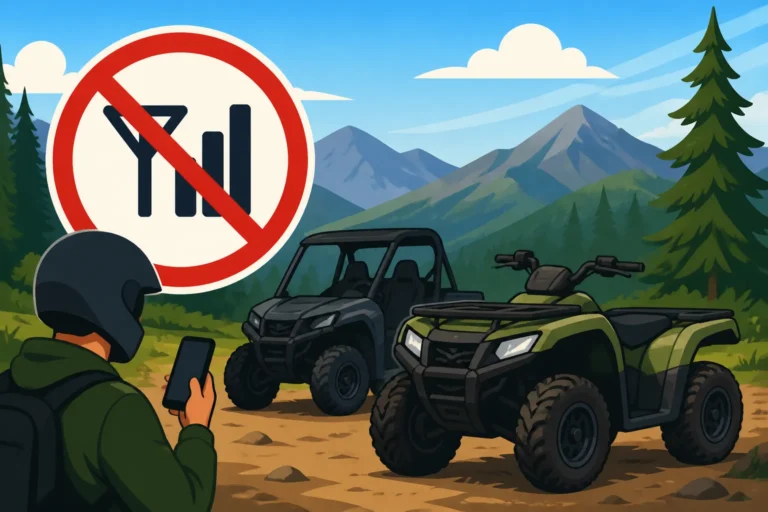
Do not make the phone your only navigation plan. Batteries lose charge, devices can be damaged, and service may be limited in the backcountry. Download or save the information you need before leaving an area with reliable connectivity, bring a charging option if appropriate, and make sure someone in the group can navigate if the lead rider’s device fails. A paper map or a second device can provide useful backup.
onX Offroad may help riders organize routes and view map information, but it cannot replace local knowledge about a closure, current trail condition, or a change that has not appeared on a map. Ask local riders what they recommend checking, and agree on a simple plan if the group becomes separated. For additional resources, see [BC ATV Trail Map Downloads]. Keep a note of your intended route and expected return time with someone who is not on the ride.
| Planning need | What to ask or check | Why it matters |
|---|---|---|
| Route suitability | Difficulty, distance, surface, and major obstacles | Helps match the ride to the group and machines |
| Current access | Closures, signs, and area-specific rules | A mapped route may not be open or permitted |
| Group readiness | Experience, passengers, fuel, and equipment | Reduces the chance of leaving someone unprepared |
| Navigation | Saved maps, backup device, and regrouping points | Helps when coverage or batteries become a problem |
| Club activity | Registration, meeting location, and guest rules | Prevents confusion on the day of a ride or work event |
What New and Visiting Riders Should Know
Getting useful information before your first ride
If you are new to Prince George, start by asking specific questions rather than asking only, “Where should I ride?” Explain what you ride, how much experience you have, whether you are bringing passengers, and how long you want to be out. A question such as “Is there a shorter route suitable for a new rider on a quad?” is more likely to produce useful guidance than a broad request for the best trail.
Ask about the practical details that can affect your day: where riders stage, whether a pass or other access requirement applies, what vehicle combinations are suitable, and what conditions are common for the season. Confirm that the advice relates to the area you actually plan to visit. A recommendation for a route near Prince George may not apply to a different trailhead or a route on another land-management area.
If you are looking to become involved, ask how to hear about meetings, rides, and work parties. You can also compare nearby organizations through [Finding a Club Near Your Town]. Keep expectations flexible: club activities can depend on volunteer availability, weather, access, and the work required at the time.
Preparing the machine and the people
A club connection does not remove the need to prepare your machine. Before riding, check the basics: tires, brakes, controls, lights where needed, fuel, and any loose cargo. Carry tools and supplies suited to the route, and make sure you know how to use them. A minor issue at home is usually an inconvenience; the same issue on a remote trail can turn into a long day for the whole group.
Bring clothing for changing conditions. The weather near Prince George can feel different from the forecast in town, especially when a route climbs, crosses exposed terrain, or passes through wet forest. Pack water, food, a first-aid kit, and a layer that still helps if you stop moving. Let the group know about medical concerns or limitations that might affect pace, and agree that riders can ask for a break without being pressured to continue.
Check that the legal and access basics are in order for your trip. Registration, insurance, equipment, and land-use requirements can depend on where you ride and what kind of machine you operate. For Forest Service Road travel, review [BC Forest Service Road Requirements] rather than assuming that ordinary trail rules apply. Confirm details with the relevant authority or a knowledgeable local contact if the route includes a road or access point you have not used before.
Getting the Most From Club Involvement
Membership as participation, not just access
For many riders, the greatest value of a club is the chance to take part in the local riding community. Membership can give you a clearer path to finding events, meeting riders, learning about volunteer opportunities, and supporting work that benefits the area. The exact benefits depend on the club’s current structure, so ask what membership includes, what it does not include, and how dues or volunteer contributions are used.
It is worth thinking about what you want from the club before you join. A new rider may prioritize local advice and a welcoming first group ride. A long-time rider may be more interested in trail stewardship or helping coordinate community activities. Someone who rides only occasionally might still value local updates, but should check whether membership makes sense for their own use rather than assuming it is a substitute for a day pass or other site requirement.
Good club participation also means respecting the needs of other users and the work already done on the trails. Follow ride-leader instructions, give other riders room, and keep noise and speed appropriate for the setting. When volunteering, follow the project lead’s directions and do not take on work that requires permission, training, or equipment you do not have.
Questions to ask the club
A short conversation can prevent a disappointing first visit. Ask where the club shares announcements, whether it has upcoming public activities, and whether a non-member can attend or join a ride. If you are interested in helping, ask what projects need volunteers and what the expected commitment involves. These questions are practical, not pushy; organizers generally need to know who is coming and what support they can count on.
For a planned Tabor Mountain ride, ask about the trailhead and staging arrangements, route options for your machine, current access notices, and any separate site rules. Verify the information close to the ride date, since conditions and access can change. If you are travelling a long distance, have a backup plan in case the preferred route is closed or unsuitable.
Finally, be clear about what you are bringing and what you are not prepared to do. If your side-by-side is wide, your quad is new, or your group includes children or inexperienced riders, say so before the ride begins. That gives the club or ride organizer a chance to recommend a more suitable plan. The best first experience is one where the route, group, and expectations are aligned—not one where everyone discovers a mismatch halfway up the trail.
Disclaimer
This article is for general informational purposes only and does not constitute professional advice. Laws, prices and regulations vary by location and change over time. Consult a qualified professional for guidance on your specific situation.