BC Helmets on Ride-Astride Machines
Navigating the rules and regulations for off-road vehicles in British Columbia can feel like traversing a particularly challenging trail – full of twists, turns, and sometimes, unexpected obstacles. One area that often causes confusion, and frankly, some frustration, is the requirement for helmets, especially for those of us who love the thrill of a ride-astride machine. This guide is here to untangle the specifics of BC's helmet laws for ATVs and dirt bikes, ensuring you understand exactly when, where, and why you need to wear that essential piece of safety gear.
The Core Rule: Why Helmets Are Mandatory for Ride-Astride Machines in BC
It’s not just a suggestion; it’s a non-negotiable legal requirement in British Columbia. The province's Off-Road Vehicle Act makes it abundantly clear that if you're operating or riding as a passenger on an off-road vehicle where you straddle the seat, a helmet is not optional. This rule was put into place for one reason, and one reason only: your safety. While some might view it as an infringement on personal freedom, anyone who has seen the aftermath of an off-road accident, even a minor one, understands the critical role a helmet plays in preventing catastrophic injury. It’s about protecting your most vital asset, your brain, from the unpredictable nature of the trail.
This isn't just a random policy. It's a fundamental pillar of responsible riding, enshrined in law to mitigate the severe risks inherent in off-road activities. The terrain we love to explore – the gravel, the dirt, the roots, the rocks, the trees – can turn an exhilarating ride into a life-altering incident in a split second. A helmet acts as your last line of defense, absorbing impact forces that would otherwise be directly transmitted to your skull. It’s a simple piece of gear that carries immense protective power, and the law reflects this understanding.
Understanding the Off-Road Vehicle Act's Mandate
When the Off-Road Vehicle Act came into force in 2015, it brought a new level of clarity and enforceability to off-road riding in BC. Among its many provisions, the mandate for helmet use on ride-astride machines was unequivocal. The Act defines "ride-astride" quite simply: if you sit on it like a horse, straddling a seat, then you need a helmet. This includes the vast majority of ATVs, dirt bikes, and some specialty machines. It doesn't matter if you're a seasoned veteran with decades of experience or a newbie just getting the hang of things; the rule applies to everyone.
The legislation extends this requirement not only to the operator but also to any passenger on such a machine. So, if you're taking your child for a supervised ride, or a friend is hopping on the back of your two-up ATV, everyone needs to be wearing an approved helmet. The responsibility ultimately falls on the operator to ensure all occupants are compliant. Failing to do so isn't just a gamble with safety; it's a direct contravention of provincial law that can lead to fines and other penalties. It’s crucial to understand that this isn’t about generating revenue from tickets; it’s about establishing a baseline standard for safety on our trails and resource roads. You can learn more about this general rule by reading [BC Helmet Law Covers Every Rider].
The "Ride-Astride" Distinction Versus Side-by-Sides
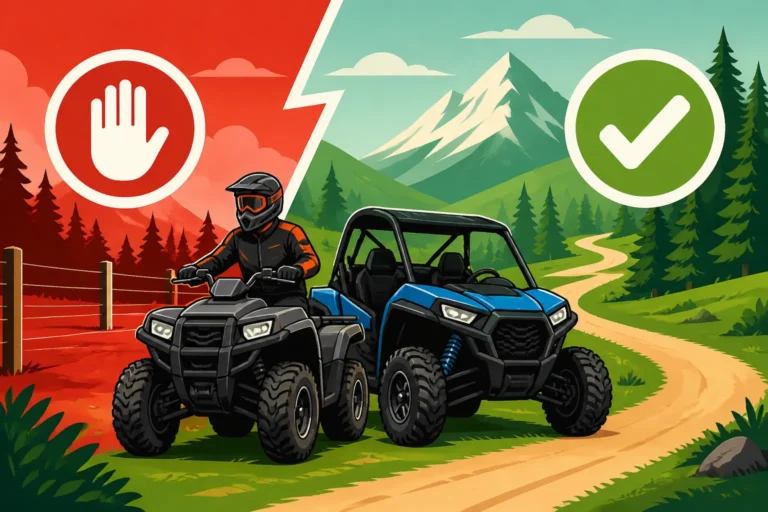
Here's where some of the common confusion pops up. The "ride-astride" definition is key because it differentiates traditional ATVs and dirt bikes from side-by-side (SxS) vehicles, also known as UTVs. Side-by-sides typically feature bucket or bench seats, a roll cage, and often seat belts, much like a small car. Because of these structural differences, which offer a different form of occupant protection, the helmet requirement for side-by-sides is generally different.
For most side-by-sides equipped with manufacturer-installed seat belts and roll-over protection, operators and passengers are required to wear seat belts, not necessarily helmets, while the vehicle is in motion. This doesn't mean helmets are forbidden in UTVs – many riders still choose to wear them for added protection, especially in challenging terrain or during competitive events. However, under the Off-Road Vehicle Act, the primary restraint for a UTV is the seatbelt system. This distinction is critical for riders to understand; mistaking the rules for one type of machine for another can lead to unnecessary risks or even fines. Always check the specific regulations pertaining to your vehicle type and remember that manufacturers like Polaris or Can-Am design their UTVs with specific safety features in mind, which include seatbelts as the primary occupant restraint. For details on related safety gear, check out [BC Lighting and Seat Belt Requirements].
What Makes a Helmet Legal in British Columbia?
It's not enough to just put any helmet on your head. BC's regulations, like those in many other jurisdictions, stipulate that the helmet must meet specific safety standards. This isn't about brand loyalty or how cool it looks; it's about objective performance metrics designed to ensure the helmet can actually protect you in an impact. A poorly constructed or uncertified helmet, or one that’s been compromised, might offer a false sense of security, which is arguably more dangerous than wearing no helmet at all because it changes your risk perception without providing real protection.
Think of it this way: your helmet is a sophisticated piece of engineering designed to manage extreme forces. It has layers of specialized materials, an energy-absorbing liner, and a tough outer shell. These components work together to dissipate impact energy away from your head. Without proper certification, there's no guarantee that the helmet you're wearing has undergone the rigorous testing required to perform this crucial function effectively. Skimping on helmet quality is truly an area where the potential cost far outweighs any savings.
Decoding Helmet Certification Standards (DOT, Snell, ECE)
When you're shopping for an ATV or dirt bike helmet, you'll see various acronyms like DOT, Snell, and ECE. These aren't just decorative labels; they represent internationally recognized safety certifications, each with its own set of testing protocols and performance requirements. In British Columbia, the law generally requires helmets to meet one of these recognized standards.
Here’s a quick breakdown:
- DOT (Department of Transportation): This is a mandatory standard for helmets sold for use on public roads in the United States. It's a minimum standard, meaning any helmet with a DOT sticker has passed a series of impact, penetration, and retention tests. It ensures a basic level of protection, and helmets meeting DOT standards are generally accepted for off-road use in BC.
- Snell (Snell Memorial Foundation): Snell is a non-profit organization dedicated to helmet safety. Their standards are often considered more rigorous than DOT, especially for racing applications. Snell certification involves more advanced and varied impact tests, including multiple impacts in the same spot. While not strictly required by law in BC, a Snell-certified helmet offers a higher level of protection and is certainly accepted.
- ECE (Economic Commission for Europe): This standard is widely recognized in over 50 countries, primarily in Europe. ECE 22.05 (or the newer 22.06) is a comprehensive standard that tests for impact absorption, abrasion resistance, and retention, among other things. Helmets with ECE certification are also fully accepted for use in British Columbia.
When you're looking at a helmet, make sure you can clearly see the certification sticker, usually on the back or inside. No sticker, no proof of compliance. It’s also worth noting that some helmet designs might feature removable liners, adjustable visors, or even integrated communication systems. While these features can enhance comfort and convenience, they should never compromise the helmet’s core protective qualities. For more information on what to look for, see [BC Helmet Standards in the Regulation].
Here's a comparison of common helmet certifications:
| Certification | Authority | Focus | Rigor Level | Common Use | Acceptance in BC |
|---|---|---|---|---|---|
| DOT | US Department of Transport | Minimum road safety | Basic | Street and Off-Road | Yes |
| Snell | Snell Memorial Foundation | High-performance safety | Advanced (often for racing) | Racing, demanding off-road | Yes |
| ECE | UN Economic Commission for Europe | Comprehensive safety | Advanced | Europe, international export | Yes |
The Importance of a Proper Fit and Condition
Even the most certified, high-tech helmet is useless if it doesn't fit correctly or if it's compromised. A helmet that's too loose can shift during an impact, exposing vulnerable areas of your head. One that's too tight can be uncomfortable and distracting, which is a safety hazard in itself. When you try on a helmet, it should feel snug all around your head, with no pressure points. Your cheeks should feel a bit squeezed, and if you try to move the helmet from side to side or up and down, your skin should move with it, not just the helmet sliding around.
Furthermore, a helmet's condition is paramount. Helmets are designed for a single major impact. If your helmet has been in a crash, even if it looks fine on the outside, the internal energy-absorbing foam may have compressed or cracked, rendering it ineffective for future protection. It’s a common misconception that a helmet is only "used up" if you see visible damage. Often, the internal damage is invisible from the exterior. Similarly, helmets have a lifespan; the materials degrade over time, typically after about five years of regular use, even if never crashed. UV exposure, sweat, and general wear and tear take their toll. Always replace a crashed helmet and consider replacing an old one, regardless of its appearance. Your brain is worth it.
Where and When You Must Wear a Helmet in BC
The helmet rule for ride-astride machines isn't confined to a specific type of trail or a particular time of day. It's a broad requirement that applies whenever you are operating or riding as a passenger on an ATV or dirt bike on Crown land or other areas regulated by the Off-Road Vehicle Act. This means pretty much anywhere you'd want to ride for recreation or work purposes outside of exclusively private property. There's no escaping the rule by simply choosing a less-traveled path; the law follows you into the backcountry.
Understanding the geographical scope of this requirement is crucial to avoiding accidental non-compliance. It's not just about avoiding a ticket; it's about maintaining a consistent standard of safety wherever your adventures take you. Whether you're hauling firewood, scouting hunting spots, or just enjoying a weekend ride with friends, the helmet rule remains constant. Ignorance of the law is never a valid defense, especially when it pertains to such a fundamental safety measure.
Crown Land, Forest Service Roads, and Managed Trails
British Columbia is blessed with an immense amount of Crown land, including a vast network of Forest Service Roads (FSRs) and designated recreation sites and trails. If you're riding your ATV or dirt bike on any of these public lands, a helmet is legally required for all ride-astride operators and passengers. This includes:
- Crown Land: The vast majority of BC is Crown land. Whether it's open wilderness, designated recreational areas, or undeveloped backcountry, if it's public land and not specifically restricted, you need your helmet. [BC Crown Land Riding Explained] offers more insights into accessing these areas.
- Forest Service Roads (FSRs): These roads, often used for industrial access, are also popular routes for off-road recreation. They fall under the scope of the Off-Road Vehicle Act, and therefore, helmets are mandatory. This is critically important, as FSRs can often have active industrial traffic (logging trucks, heavy machinery), increasing the risk of incidents. Your helmet is especially vital here. You can read more about requirements for FSRs in [BC Forest Service Road Requirements].
- Managed Trails and Recreation Sites: Areas like Bear Creek OHV in the Okanagan or various trails managed by local clubs often have specific rules, but the provincial helmet requirement still applies. These sites are typically well-maintained and marked, but accidents can still happen, making helmets non-negotiable for anyone on a ride-astride machine.
The key takeaway is that if you’re riding on land that isn’t privately owned and exclusively controlled by you, assume the helmet rule applies. This covers virtually all the exciting and scenic places you’d want to ride in BC. It’s part of the trade-off for having access to such incredible natural resources.
Brief Highway Crossings and Specific Exceptions
While ATVs and dirt bikes are generally not street-legal in British Columbia, the Off-Road Vehicle Act does allow for brief, direct crossings of highways in specific circumstances, such as moving from one section of Crown land to another. Even during these short crossings, if you're on a ride-astride machine, your helmet is absolutely required. The rules don't suddenly disappear because you're transitioning from dirt to pavement for a few seconds. The risk of an impact, however brief, remains, and your head protection should too.
The only "exception" to the helmet rule for an ORV user that doesn't involve actually being on a ride-astride machine is the case of enclosed side-by-sides with seatbelts, as discussed earlier. However, for traditional ATVs and dirt bikes, there are essentially no legal exceptions for adult riders to forgo a helmet when operating on regulated lands. There aren't special permits for experienced riders or low-speed zones where the rule is relaxed. The expectation is constant helmet use for these machine types.
Rules for Passengers and Youth Riders
The helmet law in BC isn't just for the driver; it extends to anyone riding as a passenger on a ride-astride machine. This is particularly important for those who enjoy two-up ATVs or who take children along for rides. If your ATV is designed to carry a passenger, both the operator and the passenger must wear an approved helmet. The same certification standards apply to passenger helmets as they do to operator helmets.
For youth riders, the rules are even stricter and reinforce the helmet requirement. Children and youth operating off-road vehicles have additional supervision requirements, and the helmet rule is non-negotiable. A child under 16 years of age operating an ORV on Crown land must be supervised by an adult (19 years or older) who can provide immediate direction, and both the child and supervisor must adhere to all safety regulations, including helmet use. For specific details on young riders, check [BC Rules for a 14-Year-Old Rider]. You can also find out more about passenger rules in [BC Rules for Passengers on a Quad]. The goal is to instill safe riding habits from a young age and protect vulnerable riders, who may have less experience and reaction time. No parent wants to face the consequences of a preventable injury.
Safety First: Beyond Just Legal Compliance
While legal compliance is a must, thinking about helmets purely in terms of avoiding a ticket misses the bigger picture. Your helmet is a life-saving device, and its primary purpose is to protect you in an accident. Embracing helmet use as a fundamental part of your riding safety culture goes far beyond merely ticking a box on a checklist. It's about personal responsibility, rider well-being, and setting a good example for others, especially younger riders.
A good helmet is an investment in your health and your ability to continue enjoying the trails. It's comparable to investing in good tires, reliable brakes, or a powerful engine – essential components that contribute to the overall performance and safety of your machine. When you prioritize safety, you enhance your entire riding experience, allowing you to focus on the trail and the adventure, rather than worrying about potential risks you haven't mitigated.
Choosing the Right Helmet for Your Riding Style and Terrain
Not all helmets are created equal, even if they all meet certification standards. The "right" helmet for you will depend on your specific riding style, the type of terrain you typically encounter, and even the weather conditions you ride in.
Consider these factors when choosing:
- Full-Face vs. Open-Face: Most off-road riders opt for a full-face helmet. These offer comprehensive protection for your entire head, including your chin and jaw, which are highly vulnerable in a face-first impact. The extended chin bar also helps deflect roost from other riders. Open-face helmets are generally less suitable for aggressive off-road riding due to their lack of facial protection, though they might be used in very specific, low-speed utility applications.
- Ventilation: Off-road riding is physically demanding, and you can generate a lot of heat. Good ventilation is crucial to keep you cool and prevent fogging of your goggles or visor. Look for helmets with multiple intake and exhaust vents.
- Weight: A lighter helmet can reduce neck fatigue, especially on long rides. However, don't sacrifice protection for weight; the materials used contribute significantly to safety.
- Goggle Compatibility: Most off-road helmets are designed to be worn with goggles, which provide better dust and debris protection than a typical street helmet visor. Ensure the eyeport is large enough for your preferred goggles.
- Peak/Visor: The peak on an off-road helmet helps shield your eyes from sun glare and can deflect branches or roost. Ensure it's adjustable and robust.
- Comfort and Liner: A comfortable helmet with a removable, washable liner will make your rides much more enjoyable. Some brands, like those that cater to the off-road market and carry a wide range of gear, might offer specific features designed for extreme conditions or comfort. While SuperATV doesn't make helmets, they sell many accessories that enhance the comfort and safety of your ride, such as protective gear storage or windshields for UTVs that complement helmet use in an open-air machine.
Taking the time to research and try on different helmets is well worth the effort. Think about where you ride most often – is it dusty, muddy, hot, or cold? Your helmet choice should reflect these conditions.
Maintaining Your Helmet for Maximum Protection
Once you've invested in a quality helmet, taking care of it is essential to ensure it continues to offer maximum protection. A neglected helmet can quickly lose its effectiveness.
Here are some maintenance tips:
- Clean Regularly: Sweat, dust, and grime can build up, affecting comfort and hygiene. Remove and wash liners and cheek pads according to the manufacturer's instructions. Wipe down the exterior shell with a mild soap and water solution – avoid harsh chemicals or solvents that can degrade the helmet's materials.
- Store Properly: Store your helmet in a cool, dry place, away from direct sunlight or extreme temperatures. Don't leave it hanging on your handlebars or on the ground where it can be accidentally kicked or dropped. Many helmets come with a helmet bag for this purpose.
- Inspect Before Each Ride: Quickly check for any cracks, dents, or signs of wear and tear. Ensure the chin strap and buckle are in good working order and that the D-rings (if applicable) are not bent or damaged.
- Replace After an Impact: This is arguably the most important rule. If your helmet takes a significant hit, even if you can't see visible damage, the internal EPS (Expanded Polystyrene) liner has likely done its job by crushing to absorb impact. Once crushed, it cannot provide the same level of protection again. Retire the helmet and get a new one. It's a small price to pay for preventing serious injury.
- Respect its Lifespan: Even without an impact, helmets have a finite lifespan, typically around five years from the date of manufacture (not purchase). The glues, resins, and comfort padding can degrade over time, reducing its protective capabilities. Check the manufacturing date, often found under the comfort liner or on a sticker inside the shell.
Treat your helmet as your most critical piece of riding gear. It's the one thing that stands between you and potentially life-altering injury.
The Real-World Consequences of Skipping Your Helmet
Deciding to ride without a helmet on a ride-astride machine in British Columbia carries a dual burden of risk and penalty. On one hand, you're exposing yourself to severe injury, and on the other, you're facing legal repercussions that can include significant fines. It's a gamble that very few experienced riders would ever advocate, as the downsides far outweigh any perceived convenience or comfort of riding without one.
Ignoring the helmet rule isn't just a minor infraction; it's a statement that you're willing to accept an elevated level of risk, both for yourself and potentially for those around you if you were to be involved in an accident and require emergency services. Understanding the full scope of these consequences is essential for any responsible off-road enthusiast in BC.
Fines, Tickets, and Administrative Penalties
When a conservation officer, RCMP officer, or other authorized official spots you riding a ride-astride ORV without an approved helmet on Crown land or an FSR, you're looking at a violation ticket. These tickets come with a specified fine, which can be a significant dent in your wallet. The exact amount can vary, but generally, tickets for safety infractions like this are not trivial.
Beyond the immediate fine, repeated infractions could lead to more severe administrative penalties, though these are less common for a single helmet offense. However, the legal system takes off-road safety seriously, and fines are just one tool to ensure compliance. More importantly, getting a ticket can sometimes lead to additional scrutiny, especially if you're involved in another incident. It's a clear warning that you're operating outside of the legal framework established for everyone's safety. While we don't discuss specific dollar amounts, know that such fines are designed to act as a deterrent.
The Unthinkable Cost of Head Injuries
Far more significant than any fine is the devastating personal cost of a head injury. Helmets are designed to prevent or mitigate traumatic brain injuries (TBIs), which can have profound, long-lasting effects on a person's physical, cognitive, and emotional well-being. A TBI can change everything: your ability to work, your relationships, your memory, your personality, and your independence.
Consider a simple fall off an ATV at a relatively low speed. Without a helmet, hitting your head on a rock or hard-packed dirt can result in a concussion, skull fracture, or worse – internal bleeding or swelling of the brain. The medical costs associated with treating a severe head injury can be astronomical, potentially running into hundreds of thousands of dollars over a lifetime for rehabilitation, specialized care, and loss of income. Beyond the financial burden, there's the emotional toll on you, your family, and your loved ones. The brief discomfort or perceived inconvenience of wearing a helmet pales in comparison to the lifelong struggles that can arise from a preventable head injury. This is the ultimate "why" behind the BC helmet law, and it's a sobering reminder that our safety gear isn't just about rules, but about preserving our lives and quality of life.
Disclaimer
This article is for general informational purposes only and does not constitute professional advice. Laws, prices and regulations vary by location and change over time. Consult a qualified professional for guidance on your specific situation.