BC Forest Service Road Rules for ORVs
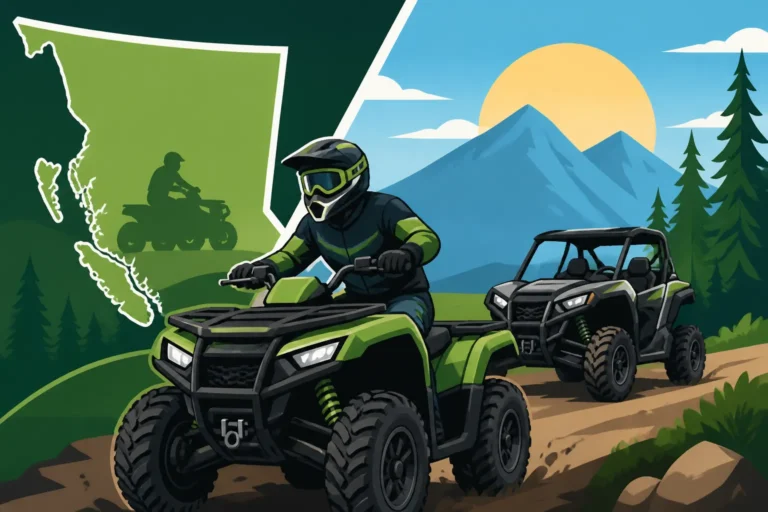
There’s nothing quite like the freedom of exploring British Columbia’s vast backcountry on your ATV or UTV, but the moment your tires hit a Forest Service Road (FSR), a whole new set of rules comes into play. It can feel like navigating a legal minefield, leaving many riders confused and worried about fines. This comprehensive guide is here to demystify those crucial BC Forest Service Road rules, ensuring you can ride safely, legally, and with peace of mind.
Understanding Forest Service Roads and Their Importance
For many of us who love the outdoors in BC, Forest Service Roads are the gateways to adventure. They crisscross our incredible landscapes, providing access to remote camping spots, fishing lakes, hunting areas, and, of course, countless trails for off-road vehicles. But it's easy to forget that these aren't just dirt tracks; they are active industrial roads with specific regulations designed to keep everyone safe and protect our natural resources.
What Exactly is a Forest Service Road?
Think of an FSR as a working highway in the wilderness. These roads are primarily built and maintained to facilitate resource extraction, like logging, mining, and hydroelectric projects. While they serve commercial purposes, they also provide public access to vast tracts of Crown land. This dual nature means that while they offer incredible recreational opportunities, they also carry the serious responsibilities of an active industrial site. The rules governing their use by off-road vehicles (ORVs) reflect this reality, balancing public access with industrial safety and environmental protection. It's not just about getting from point A to point B; it's about respecting the land and the other users.
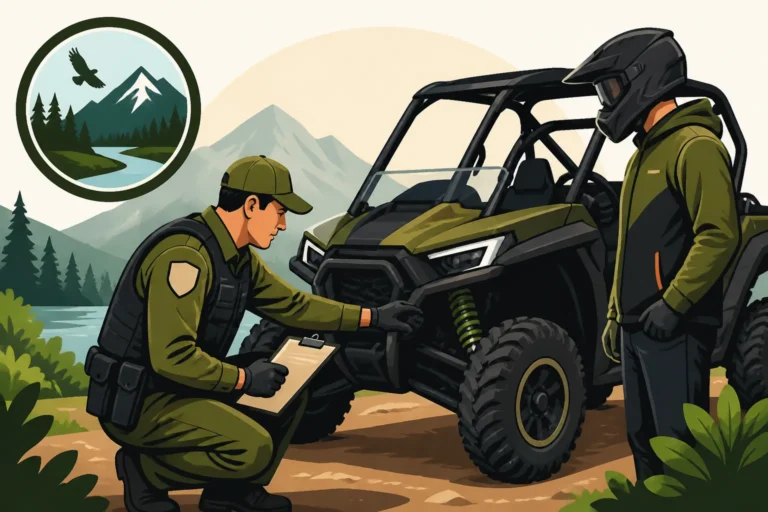
Many riders mistakenly assume that because an FSR is unpaved and remote, it operates under different, more relaxed rules than a paved highway. This simply isn't true. While the type of rules might differ, the enforcement is very real. Conservation Officers, RCMP, and even forestry officials have the authority to pull over ORV riders and issue tickets for non-compliance. Understanding that an FSR is an active, regulated road is the first step toward responsible riding.
Why FSRs Are Different from Other Roads
The key difference between an FSR and a regular highway, beyond the obvious pavement, lies in their primary function and the regulatory framework. Highways are governed by the Motor Vehicle Act, largely focused on public passenger and commercial transport, with clear rules for speed, licensing, and vehicle standards. FSRs, on the other hand, fall under the Forest and Range Practices Act and the Off-Road Vehicle Act, which account for their industrial nature and the specific risks associated with off-road recreation.
This means you'll encounter hazards on an FSR that you wouldn't typically see on a public highway: active logging trucks, heavy machinery, narrow sections, steep grades, and often, limited or no cell service. The rules around FSRs are designed to mitigate these risks. For instance, the requirement for specific liability insurance on FSRs, which we'll delve into, is a direct response to the higher potential for serious accidents and property damage in these environments. It's about recognizing that you're in a shared space with heavy industry, and your machine needs to be ready for it, and so do you.
FSRs and Crown Land Access
It's important to understand the relationship between FSRs and Crown land. In British Columbia, a significant portion of the province is Crown land, managed by the provincial government. [BC Resource Roads Count as Crown Land], meaning that if you're riding on an FSR, you're essentially on Crown land. This is a crucial distinction because the Off-Road Vehicle Act applies explicitly to ORVs operating on Crown land. This Act mandates registration, plating, and carrying specific documents, among other things, whenever you're off-roading outside of private property.
Many of us head to FSRs precisely to access these expansive Crown land areas for recreation. Whether you're planning a multi-day trip or just a day ride to a scenic viewpoint, your journey will likely involve FSRs. Therefore, knowing the rules for FSRs is synonymous with knowing the rules for accessing and riding on a vast amount of BC's incredible outdoor spaces. It’s not just about the road itself, but what that road allows you to experience.
Mandatory Registration and Plates for FSR Riding
Before you even think about hitting a Forest Service Road in BC, your off-road vehicle absolutely must be registered and plated. This isn't an optional step; it's a legal requirement that became mandatory years ago and is strictly enforced. Riding an unregistered or unplated ORV on an FSR (or any Crown land) can lead to significant fines and even impoundment of your machine.
The ORV Registration Requirement
Since November 2015, all off-road vehicles operating on Crown land in British Columbia, which includes FSRs, must be registered with the provincial government. This means your quad, side-by-side, dirt bike, or snowmobile needs a unique registration number and a corresponding plate. This isn't a complex process, but it is non-negotiable. You can complete this registration through any authorized Autoplan broker, the same places you'd register your car or truck. [BC Autoplan Brokers Handle ORV Registration] and they are well-versed in the paperwork.
The registration process involves proving ownership, providing your identification, and ensuring the machine's Vehicle Identification Number (VIN) is legible. Once registered, you'll receive a [BC's Certificate of Registration Explained], which is your official proof that your machine is legally recognized. This certificate, along with your plate, signifies that you're ready to explore BC's backcountry responsibly. Don't skip this step, no matter how remote your riding plans are.
Displaying Your ORV Number Plate
Getting your plate is only half the battle; you also need to display it correctly on your ORV. The rules are clear: the plate must be securely attached and clearly visible. For most ATVs and UTVs, this means mounting it either on the front, the back, or the left side of the machine. It needs to be horizontal and unobstructed. It sounds simple, but you'd be surprised how often riders get ticketed for improper plate display. A plate covered in mud, obscured by a cooler on your rack, or tucked away where it can't be easily seen by an enforcement officer is considered non-compliant.
Think about it from an enforcement perspective: they need to quickly and easily identify your machine. If your plate is dangling by a zip tie or hidden behind a tire, it defeats the purpose. Ensure your [BC ORV Number Plates and Decals] are always clean and visible, especially when riding on FSRs where you might encounter conservation officers or RCMP patrols. If you've got a busy weekend planned, a quick pre-ride check of your plate's visibility is a must.
Carrying Proof of Registration and ID
Having your ORV registered and plated isn't enough; you also need to carry the physical proof of registration and your photo identification with you whenever you're operating your machine on Crown land, including FSRs. [BC Riders Must Carry the Certificate] of registration and [BC Riders Must Carry Photo ID] at all times. This is another area where riders often get caught out. Forgetting your wallet or leaving the registration papers in your truck can lead to a ticket, even if your machine is fully compliant.
Think of it like driving your car: you wouldn't leave home without your driver's license and vehicle registration. The same principle applies here. These documents confirm your identity and that your machine is legally allowed to be there. An officer will ask to see them during a stop, and if you can't produce them, you're breaking the rules. Keeping these documents in a waterproof bag or container that's easily accessible on your ORV is a smart practice.
Insurance Requirements for FSRs
This is perhaps one of the most critical, and often misunderstood, aspects of riding on BC Forest Service Roads. Unlike riding on purely private land, operating an ORV on an FSR requires specific insurance coverage. This isn't just about protecting your machine; it's about protecting you from significant financial liability if an accident occurs.
Mandatory Liability Coverage for FSRs
The provincial government requires that any ORV operating on a Forest Service Road must carry a minimum of $200,000 in third-party liability insurance. This is non-negotiable. [BC Requires $200,000 on a Forest Service Road] is a direct response to the risks involved in sharing these industrial roads with heavy equipment and other users. This insurance protects you financially if you're found responsible for an accident that causes injury to another person or damage to property – whether it's another ORV, a logging truck, or FSR infrastructure.
Without this mandatory liability coverage, you are not legally permitted to operate your ORV on an FSR. While basic registration is handled through ICBC, this specific liability coverage for FSRs is typically obtained through private insurance providers. You'll need to contact an insurance broker who deals with off-road vehicle policies to ensure you have the correct coverage. Don't assume your existing homeowner's policy or auto insurance covers this; most do not. Always check with your insurance provider to confirm you're adequately covered before heading out.
The Difference Between Public and Private Insurance
When it comes to ORV insurance in BC, it's important to understand the roles of both the public insurer (ICBC) and private insurance companies. While your ORV registration is processed through ICBC's Autoplan network, the specific liability coverage required for FSRs often comes from private insurers. ICBC offers a basic "Off-Road Vehicle Liability Insurance" that provides the minimum $200,000 coverage, but many riders opt for more comprehensive policies from private companies.
Private insurers often offer policies with higher liability limits (e.g., $1 million or $2 million), which can provide greater peace of mind, especially given the high costs associated with serious accidents. These policies can also include coverage for damage to your own machine (collision, comprehensive), theft, and other perils, which ICBC's basic offering may not. It's a good idea to shop around and compare options to find a policy that best suits your needs and the risks you're comfortable taking. Remember, while the minimum is $200,000, that amount can be quickly exceeded in a severe incident.
What Happens Without FSR Insurance?
Riding on a Forest Service Road without the mandatory $200,000 liability insurance is a serious offense in British Columbia. If you're caught, you can face substantial fines. Beyond the immediate financial penalty, the real danger lies in the potential for an uninsured accident. If you're involved in a crash and found liable for damages or injuries, you could be personally responsible for hundreds of thousands, or even millions, of dollars in costs.
Imagine hitting a piece of heavy machinery, or causing a collision with another recreational user. The medical bills, repair costs, and legal fees could be catastrophic to your personal finances. This isn't just a bureaucratic rule; it's a critical safety net. Always ensure your insurance is up-to-date and covers you for FSR use before you embark on any backcountry adventure. It's one of those expenses you hope you never have to use, but you'll be incredibly grateful for if you do.
Operator and Passenger Requirements on FSRs
Operating an ORV on a Forest Service Road in British Columbia comes with specific requirements for both the driver and any passengers. These rules are in place to ensure everyone's safety, from minimum age requirements to mandatory protective gear. Ignoring these can lead to fines and, more importantly, put lives at risk.
Licensing and Age Restrictions
While you don't need a specific "ORV license" to operate a machine on Crown land (including FSRs) in BC, the rules around age and supervision are strict. Generally, anyone operating an ORV should be old enough and competent enough to do so safely. For riders aged 14 and 15, written permission from a parent or guardian is required, and they must be supervised by an adult aged 19 or older who can provide immediate direction and is clearly visible. Children under 14 have even stricter supervision requirements.
Once a rider turns 16, these direct supervision requirements ease, but it's still about capability. While no driver's license is required to operate an ORV on an FSR itself, if you need to cross a public highway to access an FSR, then a valid driver's license is required for that brief highway crossing. These rules are designed to prevent inexperienced or underage operators from being in situations beyond their skill level, especially on active industrial roads. Always check the specific regulations for youth riders, as they are detailed and critical for compliance.
Mandatory Helmets and Seatbelts
This is a big one: safety gear is not optional on FSRs. [BC Helmet Law Covers Every Rider] of a ride-astride ORV (like a quad or dirt bike) whenever they are operating on Crown land, including FSRs. The helmet must be certified to a recognized safety standard (like DOT, Snell, or ECE). It’s not just about wearing a helmet, but wearing a properly certified helmet that fits correctly. If you're riding a side-by-side (UTV) that has a rollover protective structure (ROPS) and seatbelts, then occupants are required to wear the seatbelts. In this case, helmets are not mandatory for UTV occupants if the seatbelts are being worn.
However, many experienced UTV riders still choose to wear helmets for additional protection against impacts from loose rocks, branches, or rollovers. When considering your gear, think about quality accessories that enhance safety. For instance, a durable windshield from a brand like SuperATV can protect UTV occupants from debris, but it's not a substitute for proper eye protection or a helmet when required. Always prioritize safety gear, as FSRs can be unpredictable, and even a low-speed incident can cause serious injury if you're unprotected.
Carrying Passengers Safely
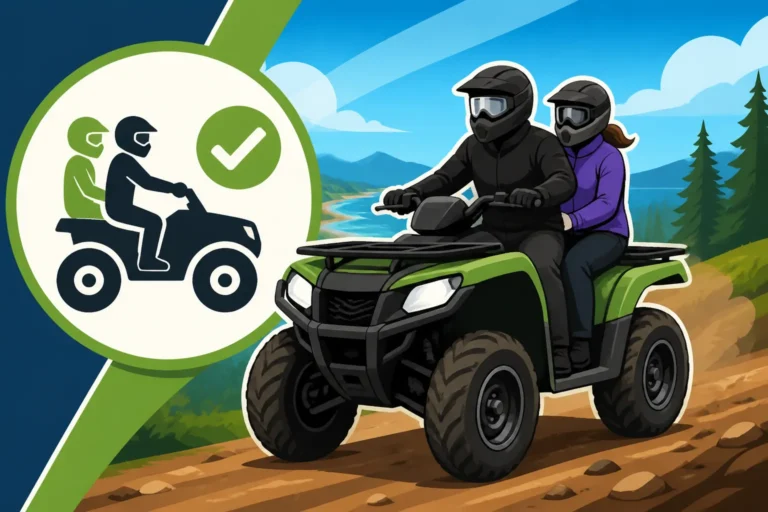
Carrying passengers on your ORV requires careful attention to safety and manufacturer guidelines. If your ORV is designed by the manufacturer to carry a passenger, then you can do so, provided all other safety requirements (like helmets or seatbelts) are met. Many quads, for example, are single-rider machines and are not designed to safely carry a passenger. Adding a passenger to a machine not designed for it can severely impact stability, handling, and braking, making it extremely dangerous, especially on the uneven and unpredictable terrain of an FSR.
For UTVs, which are specifically designed for multiple occupants, ensuring every passenger is wearing their seatbelt and meets any manufacturer-specified age or size requirements is crucial. Never exceed the manufacturer's maximum seating capacity. Children, in particular, must meet specific criteria regarding their ability to reach footrests and handholds, and generally, a child cannot operate an ORV if they are carrying a passenger. Always consult your ORV's owner's manual for specific passenger guidelines, as these are critical for safe operation and liability.
Operating Rules and Safety on FSRs
Riding on a Forest Service Road isn't just about technical rules; it's also about practicing safe and responsible riding habits. These roads are shared spaces, and respecting other users and the environment is paramount. A momentary lapse in judgment can have serious consequences.
Yielding to Industrial Traffic
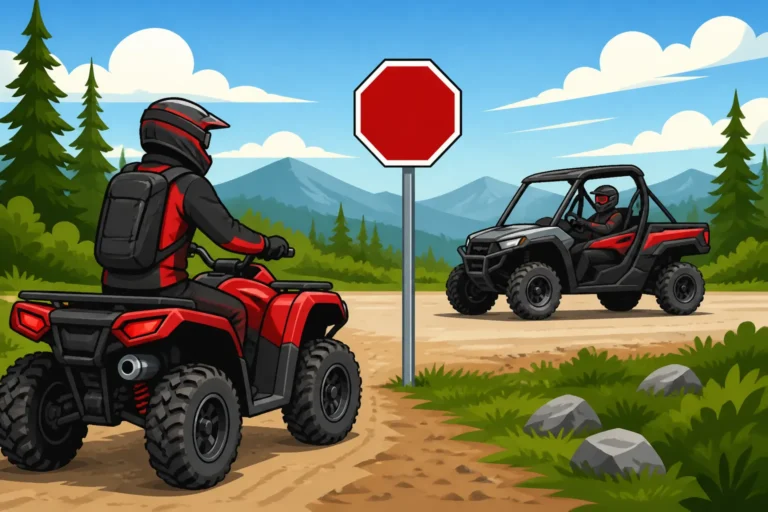
This is arguably the most important safety rule on FSRs: you must yield to all industrial traffic. This includes logging trucks, heavy equipment, and other commercial vehicles. These vehicles are large, heavy, and often travelling at speed, especially when empty. They have the right-of-way, and you, as a recreational user, are expected to give them ample space. Logging trucks often travel in convoys, and if you see one, assume there are more behind it.
Many FSRs use radio call-in systems, where drivers communicate their location and direction on specific channels (e.g., "calling kilometres"). While ORV riders are not legally required to have a radio, it is highly recommended if you're riding on active hauling roads. A two-way radio can be a lifesaver, allowing you to hear approaching industrial traffic and signal your presence. If you don't have a radio, drive defensively, be alert, and pull over safely to the side of the road, giving logging trucks a wide berth, particularly on blind corners. Your life could depend on it. [BC Resource Road Radio Practice] is a crucial skill.
Speed Limits and Road Conditions
While FSRs don't always have explicitly posted speed limits like highways do, the expectation is that you will operate your ORV at a speed that is reasonable and prudent for the conditions. This often means much slower than you might think. FSRs can be incredibly varied: smooth gravel in one section, deeply rutted and rocky in the next, or slick with mud after rain. Dust can also be a significant hazard, reducing visibility for you and others.
Always adjust your speed to the road conditions, visibility, and your skill level. Blind corners, steep grades, and washouts are common. Driving too fast not only increases your risk of an accident but can also throw gravel and dust, creating a hazard for others. Remember, [BC Has No Safety Inspection for ORVs], so it’s entirely up to you to ensure your machine is in good working order and that you are operating it responsibly. Careless operation can lead to fines and serious injury.
Environmental Responsibility and Wildlife
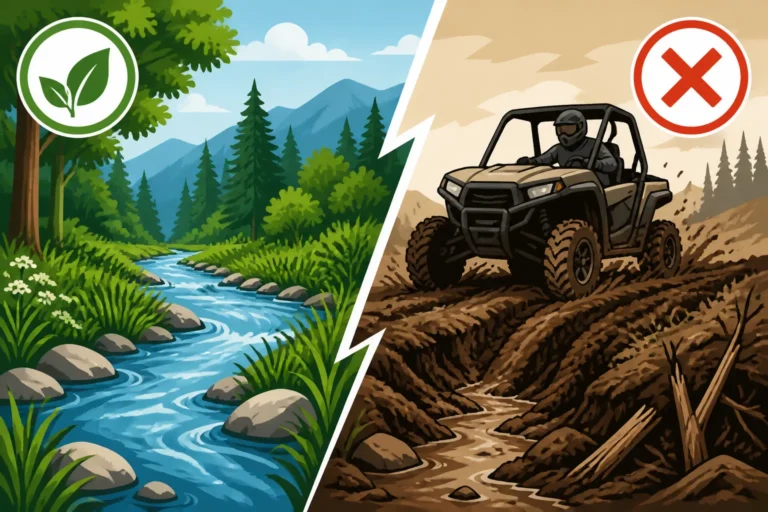
Riding on FSRs means you're in the heart of BC's natural environment, and with that comes a responsibility to protect it. Stay on designated roads and trails. Off-roading through sensitive areas like wetlands, riparian zones (areas near streams and rivers), or fragile alpine meadows can cause irreparable damage to ecosystems and is illegal. Respect signage indicating closed areas, wildlife closures, or environmental protection zones.
Wildlife encounters are common on FSRs. Drive slowly and be aware of your surroundings, especially at dawn and dusk. Give animals plenty of space and never harass them. Carry bear spray and know how to use it, especially if you're planning to stop for a break or explore off your machine. Proper waste disposal is also critical: pack out everything you pack in. Leaving trash in the backcountry not only spoils the experience for others but can attract wildlife, creating dangerous situations. We're privileged to ride in these areas, and it's our duty to keep them pristine.
Equipment Requirements for FSRs
Beyond registration and insurance, your ORV itself needs to meet certain equipment standards to be legally and safely operated on BC Forest Service Roads. These aren't just suggestions; they are requirements designed to ensure your machine is visible, safe, and doesn't pose an environmental risk.
Lighting Requirements
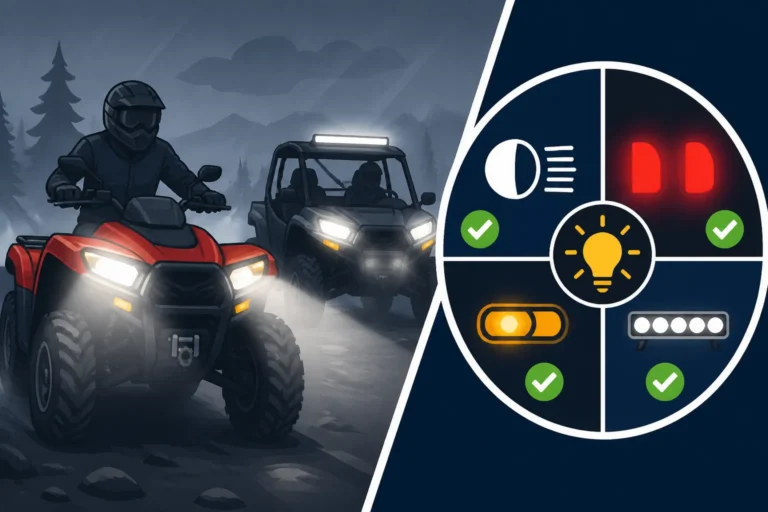
If you plan to ride your ORV on an FSR at any time between 30 minutes before sunset and 30 minutes after sunrise, or at any other time when visibility is poor (like in fog or heavy rain), your machine must have proper lighting. This means at least one white or amber headlamp visible from 150 meters, and at least one red taillamp visible from 50 meters. [BC Lighting and Seat Belt Requirements] are in place for a reason – to ensure you can see and be seen by other road users, especially industrial traffic.
Many newer ORVs come equipped with adequate lighting from the factory, but it's always good to double-check their functionality before each ride. If your machine is older or has minimal lighting, you might need to add aftermarket lights. Companies like SuperATV offer a range of robust LED light bars and auxiliary lighting solutions that can significantly improve your visibility and ability to navigate in low-light conditions, making your FSR experience much safer. Just ensure they meet the legal requirements.
Spark Arrestors and Fire Prevention
Given BC's challenging wildfire seasons, the requirement for a spark arrestor on your ORV's exhaust system is incredibly important and strictly enforced, especially when riding on FSRs. A spark arrestor is a screen or device within your muffler designed to prevent hot carbon particles (sparks) from escaping the exhaust and potentially igniting dry vegetation. [BC Spark Arrestor Rules and Fines] are in place to prevent accidental wildfires caused by ORVs.
Your machine must have an approved spark arrestor that is in good working condition. Check your muffler for a stamp or label indicating it's a U.S. Forest Service approved spark arrestor, or consult your owner's manual. Damaged or modified exhaust systems that bypass the spark arrestor are illegal and can result in significant fines. During periods of high fire danger, restrictions on ORV use, or even complete closures of FSRs and Crown land, are common. Always check the BC Wildfire Service website for current fire bans and restrictions before you head out. [BC Wildfire Season and Riding] is a critical consideration for all riders.
General Machine Condition and Preparedness
While [BC Has No Safety Inspection for ORVs], you are still responsible for ensuring your machine is in safe operating condition. This includes properly inflated tires, functional brakes, secure steering, and no fluid leaks. A pre-ride inspection is always a good idea. Beyond the basics, consider carrying essential tools and recovery gear, especially on longer FSR trips.
A spare tire, tire repair kit, basic tool kit, and a small air compressor can get you out of a bind. For UTVs and larger ATVs, a winch can be invaluable for self-recovery if you get stuck in mud or a ditch, or for clearing fallen trees from the road. SuperATV offers robust winches and other utility accessories that are perfect for the demands of BC's FSRs. Also, ensure you have sufficient fuel for your planned route, as gas stations are few and far between in the backcountry. Always be prepared for the unexpected when venturing into remote areas.
Navigating FSR Access and Closures
One of the biggest frustrations for ORV riders in BC is the uncertainty around FSR access. Roads can be open one day and closed the next due to industrial activity, fire bans, or environmental concerns. Knowing how to check for closures and respecting restricted areas is essential for legal and safe riding.
Checking for Active Hauling and Road Restrictions
Many FSRs are active industrial roads, meaning they are regularly used by logging trucks and other heavy equipment. These roads can have temporary closures or restrictions due to active hauling, road construction, or maintenance. It's crucial to check for these before you go. Sources for this information can include local forestry offices, logging company websites, or local community information boards. Some regions also have online maps or apps that show active hauling routes.
Ignoring "Active Hauling" or "Road Closed" signs is not only incredibly dangerous but also illegal. These signs are there for your safety and the safety of industrial workers. If you encounter a gate across an FSR, it's typically there for a reason – respect it and do not attempt to bypass or damage it. Planning your route and checking for up-to-date information on road conditions and closures is a vital part of responsible FSR riding in BC.
Understanding Fire Bans and Seasonal Closures
British Columbia experiences significant wildfire seasons, and during these times, fire bans and area restrictions are common and strictly enforced. These bans can prohibit ORV use on FSRs and Crown land in specific regions or across entire Fire Centres. Operating an ORV during a fire ban can result in massive fines and even jail time if your machine is deemed responsible for starting a wildfire.
Beyond fire bans, FSRs can also have seasonal closures due to spring melt (to prevent road damage), environmental protection (e.g., during critical wildlife breeding seasons), or winter conditions. Always check the BC Wildfire Service website for current fire bans and the Recreation Sites and Trails BC website for any specific area closures or restrictions before you head out. This information changes frequently, so what was open last week might be closed today. Be flexible with your plans and always prioritize compliance with these vital regulations.
Crown Land Leases and Private Property
While FSRs are primarily on Crown land, you might encounter sections of private property or Crown land under lease (e.g., ranching leases) adjacent to or intersected by FSRs. In these cases, you must have permission from the landowner or leaseholder to ride on their property. Trespassing, even accidentally, is illegal and can lead to fines and legal action.
Be aware of property boundaries and "No Trespassing" signs. It's easy to accidentally stray off an FSR onto private land, especially in remote areas where signage might be sparse. If you're unsure, it's best to err on the side of caution and stick to clearly marked FSRs. Local clubs and riding groups often have good knowledge of local access and potential private land issues, so connecting with them can be a great resource for planning your rides.
Understanding Penalties and Enforcement on FSRs
The rules governing ORV use on BC Forest Service Roads are not just suggestions; they are laws with real consequences if violated. Enforcement is carried out by a range of authorities, including the RCMP, Conservation Officers, and Forest Officers, who regularly patrol FSRs.
Common Violations and Associated Fines
Failure to comply with FSR rules can result in significant financial penalties. Here are some of the common violations ORV riders face:
- Unregistered ORV: Operating an ORV on Crown land (including FSRs) without proper registration. [BC Penalties for Riding Unregistered] can be substantial.
- No Number Plate: Failure to properly display a valid ORV plate.
- No Insurance: Operating on an FSR without the mandatory $200,000 third-party liability insurance. This is a severe offense.
- No Documents: Failure to carry your Certificate of Registration and photo ID.
- No Helmet/Seatbelt: Operating a ride-astride ORV without a certified helmet, or failing to wear a seatbelt in a UTV.
- Improper Passenger: Carrying passengers on a machine not designed for it, or an underage passenger without proper supervision.
- Careless Operation: Driving recklessly, at excessive speeds for conditions, or without due regard for safety. [BC Fines for Careless Operation] can be costly.
- Spark Arrestor Violation: Operating without an approved and functional spark arrestor.
- Environmental Damage/Trespassing: Riding off designated trails, damaging sensitive ecosystems, or entering private property without permission.
- Ignoring Closures/Bans: Riding in areas closed due to fire bans, industrial activity, or other restrictions.
These fines can range from a few hundred dollars for minor infractions to thousands for more serious offenses, with the potential for court fines reaching much higher for environmental damage or fire-related offenses.
Machine Seizure and Other Consequences
Beyond fines, there are other serious consequences for violating FSR rules. In some cases, enforcement officers have the authority to seize your off-road vehicle. [BC Machine Seizures by Police] can occur for serious or repeat offenses, such as riding an unregistered ORV, operating without insurance, or impaired riding. Getting your machine back can be a lengthy, expensive, and frustrating process, often involving impoundment fees, storage costs, and further penalties.
Additionally, reckless or illegal operation of an ORV on an FSR can result in damage to your reputation, loss of access to riding areas, and even criminal charges for impaired driving or serious environmental damage. These are not trivial matters. The goal of enforcement is to ensure everyone can enjoy BC's backcountry safely and responsibly, and those who fail to adhere to the rules undermine that goal for everyone.
Preparing for Your FSR Adventure
Venturing onto BC's Forest Service Roads requires more than just knowing the rules; it demands proper preparation and a respect for the environment and other users. A little planning can make the difference between an epic ride and a frustrating or dangerous experience.
Planning Your Route and Sharing Your Plans
Before you leave, carefully plan your route. Use reliable maps (digital and paper), and be aware of potential hazards, fuel stops, and areas with limited or no cell service. Always inform someone of your planned route, your estimated time of return, and who you're riding with. This "trip plan" is crucial for your safety, especially in remote FSR areas where help can be hours away. Consider carrying a satellite messenger device for emergencies, as cell service is often non-existent.
Having a physical map and compass, and knowing how to use them, is also a smart backup to GPS systems that can fail or lose signal. Being aware of the local weather forecast is also critical. Mountain weather can change rapidly, and heavy rain or snow can quickly turn a fun ride into a survival situation. Pack accordingly with extra layers, rain gear, and emergency supplies.
Essential Gear for FSR Riding
Beyond your mandatory safety gear, there are several items you should always carry when riding on FSRs:
- First Aid Kit: A comprehensive kit capable of handling common injuries.
- Emergency Kit: Items like a space blanket, whistle, fire starter, knife, and flashlight.
- Water and Food: More than you think you'll need, especially for longer rides.
- Tools: Basic repair tools for your ORV, tire repair kit, and a small air pump.
- Winch/Recovery Gear: Especially for UTVs or if riding alone. Many riders opt for quality winches from companies like SuperATV.
- Navigation: Maps, compass, and a GPS device (and know how to use them).
- Communication: Cell phone (for areas with service), and a satellite messenger for remote areas. A two-way radio for industrial roads.
- Bear Spray: Know how to access and use it safely.
- Fuel: Extra fuel if your range is limited or you're unsure about fuel availability.
- Warm Clothes/Rain Gear: Even on sunny days, mountain weather can change quickly.
Being well-prepared not only makes your ride safer but also more enjoyable. It means you can tackle unexpected challenges with confidence, rather than panic.
Respecting Others and the Environment
Finally, remember that FSRs are shared spaces. You will encounter other ORV riders, hunters, hikers, campers, and industrial workers. Be courteous, slow down when passing, and minimize dust and noise. Respect private property and leased lands, and always pack out what you pack in. Leaving no trace is the golden rule of backcountry recreation.
By following the rules, preparing thoroughly, and practicing responsible riding, you're helping to ensure that BC's incredible Forest Service Roads remain open and accessible for all to enjoy for years to come. Ride safe, ride smart, and enjoy the beauty of British Columbia!
Summary of Key FSR Rules for ORVs in BC
To help keep all these rules straight, here’s a quick overview of the essential requirements for operating your ORV on a BC Forest Service Road:
| Requirement | Detail | Notes |
|---|---|---|
| Registration | Mandatory for all ORVs on Crown land (includes FSRs). | Obtain through an Autoplan broker. |
| Number Plate | Must be displayed visibly (front, back, or left side), horizontal. | Keep clean and unobstructed. |
| Documents | Carry your Certificate of Registration and photo ID. | Keep in a waterproof, accessible location. |
| Insurance | Minimum $200,000 third-party liability required for FSRs. | Usually obtained from a private insurer. |
| Operator Age/Licence | No specific ORV license, but age/supervision rules apply (under 16). | Driver's license needed for highway crossings. |
| Helmets | Mandatory for ride-astride ORVs (ATVs, dirt bikes). | Must be certified (DOT, Snell, ECE). |
| Seatbelts | Mandatory for UTVs with ROPS and seatbelts. | Helmets still recommended for UTVs by many riders for additional protection. |
| Passengers | Only on machines designed for them, follow manufacturer guidelines. | Children have specific rules; never overload. |
| Industrial Traffic | MUST yield to all industrial vehicles (logging trucks, etc.). | Consider carrying a two-way radio. |
| Speed/Conditions | Operate at a reasonable and prudent speed for road conditions. | Be aware of dust, blind corners, and washouts. |
| Environmental | Stay on designated roads/trails, respect closures, pack out waste. | Protect riparian areas and wildlife. |
| Lighting | Required for low-light conditions (dawn, dusk, fog, night). | At least one white/amber front, one red rear lamp. |
| Spark Arrestor | Mandatory, approved, and functional. | Check for U.S. Forest Service approval stamp; crucial for fire prevention. |
| Closures/Bans | Check for active hauling, fire bans, and seasonal restrictions. | Consult BC Wildfire Service & Recreation Sites and Trails BC websites. |
| Penalties | Fines, machine seizure, and potential criminal charges for violations. | Be aware of the consequences; ride responsibly. |
Disclaimer
This article is for general informational purposes only and does not constitute professional advice. Laws, prices and regulations vary by location and change over time. Consult a qualified professional for guidance on your specific situation.