Moving Provinces With a Machine
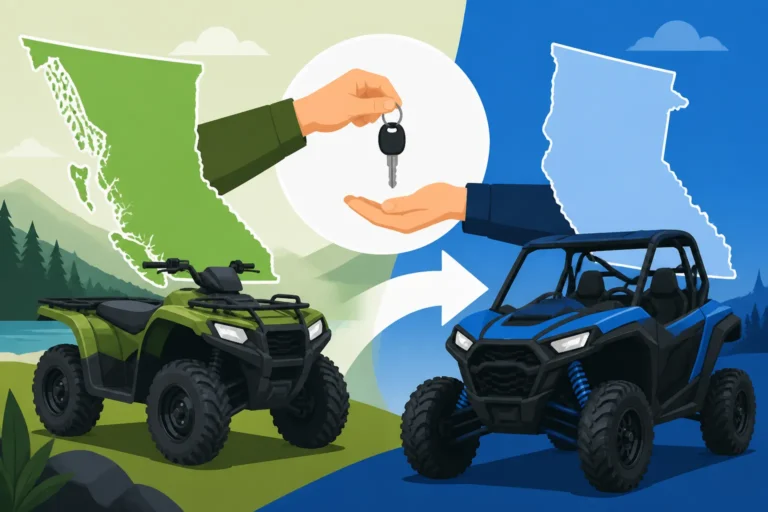
Moving your beloved ATV or UTV across provincial lines, whether you're heading into the beautiful landscapes of British Columbia or waving goodbye to them, can feel like navigating a legal minefield. It's not just about packing your machine; it's about understanding a whole new set of rules for registration, insurance, and even how you prove you own it. This guide is here to untangle that knot for you, offering a clear path through the paperwork and processes so your off-road adventures can continue seamlessly in your new home.
Bringing Your Machine to British Columbia From Another Canadian Province
Welcome to BC! We're thrilled to have you and your off-road machine join our trails. But before you hit the dirt, there are a few important steps to take. Unlike some provinces, BC has a very specific system for off-road vehicles (ORVs), and it’s important to get it right from the start to avoid any headaches or fines down the road.
Understanding BC's Unique ORV Registration System
One of the first things you'll notice when you arrive in BC is that our system for ATVs and UTVs is quite different from what you might be used to elsewhere in Canada. In British Columbia, we don't issue "titles" for off-road vehicles in the same way that many other jurisdictions do for cars or even some ORVs. Instead, your machine will receive a [BC's Certificate of Registration Explained]. This certificate acts as your official proof that the machine is registered with the province.
This registration became mandatory in 2015, and it’s a one-time process. Once your machine is registered, you’re good to go – there’s [BC Has No Annual Renewal Sticker] to worry about. This is a big relief for many riders, as it simplifies things considerably after the initial setup. You pay once, get your plate, and as long as you own the machine, you don't typically need to renew that registration itself. [BC ORV Registration You Pay Once] is truly a set-it-and-forget-it kind of deal once you've gone through the initial steps. The key difference here is that BC prioritizes a chain of ownership documentation rather than a single, transferable title document. This often confuses people coming from provinces that have a more traditional titling system, but rest assured, it’s a robust system designed to track ownership and ensure accountability.
Paperwork You'll Need for an Out-of-Province Machine
This is often where new residents get a bit stuck, so let's walk through it. When you're bringing an ORV into BC from another province, the provincial government wants to see a clear, unbroken chain of ownership. This means you need to provide documentation for every sale, all the way back to the manufacturer, if possible. I know, it sounds like a lot, especially for older machines, but it's crucial.
The most important documents you’ll need are the [BC Bills of Sale for Every Prior Owner] in your machine’s history. If you bought your machine new, you’ll have the original bill of sale from the dealer. If you bought it used, you'll need your bill of sale, and the bill of sale from the person who sold it to you, and so on. If you happen to be missing a bill of sale or two in that chain, don't panic entirely. Sometimes a Statutory Declaration can bridge these gaps, but it's always best to have as much official documentation as possible. This is particularly relevant if your home province didn't have a formal registration or titling system for ORVs, as you might need to lean more heavily on private sales receipts. When preparing these documents, consider using a reliable source like LawDepot for professional-looking templates for bills of sale or affidavits, especially if you need to create one to confirm your purchase details or if you're gifting a machine to a family member. These templates can help ensure all necessary information is included, which makes the process smoother when you visit the broker.
The Registration Process at an Autoplan Broker
Once you have all your ducks in a row with the paperwork, the actual [BC Registration for a New Resident] process is handled by any [BC Autoplan Brokers Handle ORV Registration]. These are the same places where you would go to register your car or truck, and there are hundreds of them across the province. When you visit a broker, they will verify your identification, review your ownership documents, and help you fill out the necessary forms.
You’ll need to bring your driver’s license or another form of photo identification, as well as all your proof of ownership documents. The broker will cross-reference the VIN (Vehicle Identification Number) on your machine with the documents you provide to ensure everything matches up. They will then process your one-time registration, and you'll be issued a [BC ORV Number Plates and Decals]. Make sure you mount this plate clearly on your machine before you head out on Crown land or resource roads. The broker is also the place where you can purchase any optional insurance coverage for your ORV, such as liability insurance for riding on Forest Service Roads or comprehensive coverage for damage. They are experts in the process of [Registering an ATV With ICBC in BC] and can guide you through any specific questions related to your situation, including [BC Registration for an Imported Machine] from another province.
Taking Your Machine From British Columbia to Another Canadian Province
Saying goodbye to BC and its incredible riding might be tough, but moving your ORV to a new province means preparing for a new set of rules. The key here is understanding how BC’s registration system interacts with what your new province will expect.
What Happens to Your BC Registration?
Since [BC Registration Lasts as Long as You Own It] and there's no annual renewal, when you move out of BC, your machine's registration in British Columbia essentially becomes inactive for riding within BC, because the registered owner is no longer a resident. However, the ownership record remains in the provincial database. You won't typically need to "deregister" it in BC. What you do with the physical plate is a common question. You can usually remove the [BC ORV Number Plates and Decals] from your machine and keep it for your records, or you can return it to an Autoplan broker, though it's not strictly mandatory to return it in the way a vehicle plate might be.
The important thing is that the financial transaction associated with your initial registration payment is complete. [What Happens to a $48 BC Registration When You Sell] (or move) is that the registration fee itself doesn't transfer or get refunded; it was a one-time administrative cost. The main thing you need to focus on is documenting your ownership clearly for your new home province. This means holding onto your [BC's Certificate of Registration Explained] as it is critical proof of your ownership, even if your new province has a different system.
Preparing for Your New Province's Rules
Every province in Canada has its own specific regulations for ORVs, and they can vary quite a bit. What’s perfectly acceptable in BC might not be in Alberta, Saskatchewan, or Ontario. Your new province might have a different approach to registration, requiring annual renewals, or even a full "title" document that BC doesn't provide for ORVs.
It's absolutely vital to research the ORV laws of your new province before you arrive. Check their provincial ministry responsible for vehicles or natural resources. You’ll want to know:
- Do they issue a title, or is it a registration certificate like BC's?
- Is registration annual, or one-time?
- What are the insurance requirements? Many provinces have mandatory liability insurance, even on private land, which can be different from BC's voluntary approach for most Crown land.
- Are there specific safety equipment requirements (e.g., helmets, lights, spark arrestors) that differ from BC's?
- What are the rules for youth riders, passengers, or specific types of terrain?
When you present your BC Certificate of Registration in a new province that requires a title, you might need to explain BC's system. They will typically accept the Certificate, along with your original bill of sale, as proof of ownership to issue their own provincial title or registration. Sometimes, they might ask for an affidavit of ownership if the chain of previous documents isn't perfectly clear to them. A service like LawDepot can be a useful resource if you need to quickly generate a legally sound affidavit or bill of sale to present to your new province's registry office, ensuring you have robust documentation.
Documentation to Carry When You Leave
As you pack up and head east or west, make sure you have a physical or digital copy of your [BC's Certificate of Registration Explained] with you. This is your primary proof of legal ownership and that the machine was registered in BC. Keep it with your other important moving documents. You should also retain all original bills of sale you used when you registered the machine in BC. These collectively form the ownership history that your new province’s registry will likely want to review.
Even though you won't be riding in BC anymore, having these documents readily accessible will streamline your transition into the new provincial system. Remember, while the BC registration isn’t an annual sticker, it is tied to the owner and their residency in BC for active riding. The plate itself doesn't hold monetary value, so focus on the ownership paper trail. When dealing with registry offices that might be unfamiliar with BC's unique ORV registration, being well-prepared with all your paperwork will be your best asset.
Key Differences in Provincial ORV Rules to Anticipate
Moving between provinces highlights just how diverse ORV regulations can be across Canada. It's not just a minor tweak here and there; sometimes, the fundamental approaches are quite different. Expecting these differences can help you prepare better and avoid surprises.
Registration, Licensing, and Insurance Variations
As we've already touched on, the most immediate difference you'll encounter is often around registration. In BC, it's a [BC ORV Registration You Pay Once] and it's tied to the owner. Other provinces might have annual renewals, different plate requirements, or even a more robust titling system for off-road vehicles. For instance, [BC Registration Compared to Alberta] shows significant differences; Alberta has a simpler, permit-based registration that requires annual renewal, and the permit is tied to the machine itself, rather than a more comprehensive chain of ownership.
Insurance is another big one. In BC, liability insurance is mandatory only when riding on Forest Service Roads (requiring a minimum of $200,000 third-party liability), but it's otherwise voluntary for most Crown land. Many other provinces, however, mandate a basic level of third-party liability insurance for all ORV operation, regardless of where you're riding. You might also find variations in licensing requirements. While BC requires a valid driver's licence to operate an ORV on a highway crossing, and generally recommends training, other provinces might have specific ORV operator licenses or mandatory training courses that BC does not. Always check with your new province's transportation or motor vehicle branch to understand their specific requirements.
Safety Gear and Operating Restrictions
Beyond the paperwork, the actual rules of the trail can differ significantly. Helmet laws, while widely adopted across Canada for ride-astride machines, can have different specifics regarding approved standards or exceptions for UTVs with roll cages and seatbelts. For example, some provinces might have stricter age restrictions for youth riders, or require a higher level of supervision than BC.
You might also encounter varying rules for:
- Spark Arrestors: While essential in BC for wildfire prevention, some provinces might have more stringent inspection requirements or different decibel limits for exhaust systems.
- Passenger Rules: Some provinces might be more restrictive on who can carry a passenger, especially on ATVs not designed for it, or have specific age requirements for passengers.
- Time of Day Restrictions: Riding after dark or during specific hours might be more regulated in your new province.
- Trail Access: Regulations on riding on private land, municipal roads, or even certain types of Crown land can vary wildly. What's open in BC might be closed elsewhere.
These operational details are crucial for safe and legal riding, so don't assume that what you did in BC will fly in your new locale.
The Importance of Local Research
I really can't stress this enough: do your homework! Before you even hitch up the trailer, dedicate time to thoroughly research the specific ORV laws of your destination province. Here's a quick checklist of things to investigate:
- Provincial Government Websites: Look for the Ministry of Transportation, Natural Resources, or Parks. Many provinces have dedicated sections on their websites outlining ORV regulations.
- Local ORV Clubs: These clubs are often fantastic resources. They know the local trails, the nuances of the laws, and can offer practical advice.
- Registry Offices: Contacting a local registry agent in your new province can provide direct answers on registration and insurance.
- Legal Document Services: If you anticipate needing affidavits of ownership, specific bills of sale for a private purchase in your new province, or any other legal forms, a service like LawDepot can be a helpful tool for drafting compliant documents that meet provincial standards. This is especially true if you find yourself needing to create a new ownership document that aligns with your new province's expectations for a machine previously registered under BC's certificate system.
By being proactive and thoroughly understanding the rules, you can ensure that your off-road adventures continue smoothly and legally in your new home, wherever that might be across Canada.
Here's a quick overview of some common differences you might encounter:
| Feature | British Columbia (General) | Other Canadian Provinces (General Variations) |
|---|---|---|
| Registration System | Certificate of Registration, one-time fee, ownership chain focused | Often a formal "Title" document, or annual permit/registration |
| Annual Renewal | No annual renewal for registration (pay once) | Common to have annual registration renewals |
| Primary Proof of Ownership | Certificate of Registration + Bills of Sale | Provincial Title (if issued) or Registration certificate |
| Insurance Requirements | $200k liability mandatory for FSRs; voluntary elsewhere | Often mandatory basic liability for all ORV operation |
| Licensing | Valid driver's licence for highway crossings; training advised | Some may require specific ORV operator's licence or mandatory training |
| Plate Placement | [BC ORV Number Plates and Decals] required, specific placement | Placement rules vary; some may have smaller decals instead of plates |
Disclaimer
This article is for general informational purposes only and does not constitute professional advice. Laws, prices and regulations vary by location and change over time. Consult a qualified professional for guidance on your specific situation.