Does Riding on Your Own Land Need BC Registration?
It’s a common question that pops up in conversations around campfires and on social media forums: "If I'm just riding my quad on my own property, do I really need to bother with BC registration?" It's a valid query, especially when you think about the time and effort involved in getting all your paperwork in order. This guide is going to walk you through the specific rules in British Columbia, clear up common misunderstandings, and help you understand when you absolutely need that registration and when you might be able to leave it at home.
The Foundational Rule: Crown Land vs. Private Property
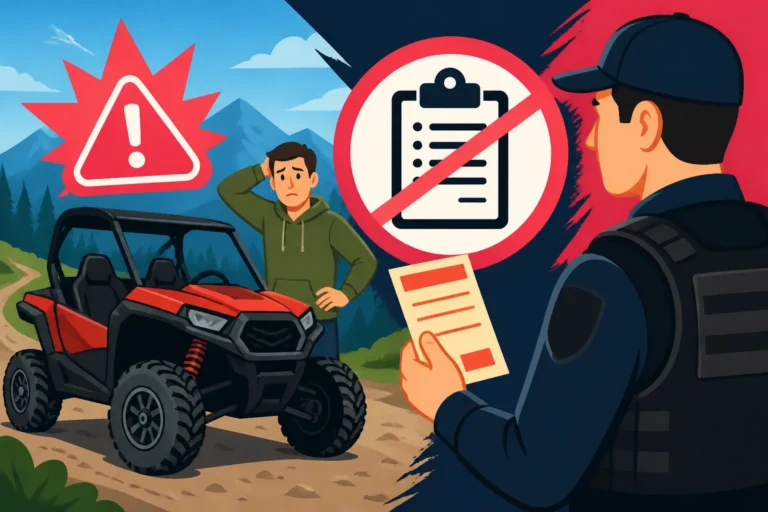
Let's cut right to the chase because this is where a lot of confusion begins. In British Columbia, the requirement to register your Off-Road Vehicle (ORV) – whether it’s an ATV, UTV, dirt bike, or snowmobile – is directly tied to where you operate it. The Off-Road Vehicle Act of British Columbia specifies that registration becomes mandatory the moment you operate your machine on Crown land. This is the critical distinction, and it's often overlooked or misunderstood by riders.
Imagine you've got a beautiful parcel of land in the Cariboo, maybe near Horsefly or Likely, acres of sprawling fields and treed areas. It feels entirely yours, and you've always ridden your ATV there without a second thought. You might think, "This is my property, my rules!" And for many things, you'd be absolutely right. However, the provincial government has very specific definitions and regulations, and your machine's registration status hinges on whether the ground under your tires is legally classified as "Crown land" or truly "private land." It's not about how it feels; it's about how the law sees it.
The Specific Language of the BC Off-Road Vehicle Act
The Off-Road Vehicle Act came into full effect in 2015, and it significantly changed the landscape for ORV owners in British Columbia. Before then, registration was a bit more patchwork, but November 1, 2015, was a game-changer. Since that date, anyone operating an ORV on Crown land is legally required to have it registered. This means it needs a registration plate and decals, and you, as the operator, need to carry the Certificate of Registration and your photo identification. It's a pretty clear line in the sand, but understanding where that line falls on a map is the tricky part.
The Act defines "off-road vehicle" broadly and "operate" as driving, managing, or having charge of the machine. The key phrase, as mentioned, is "on Crown land." What does that really mean for the average rider? It means if you're on a provincial forest service road, a public trail, or even just crossing a section of unclaimed wilderness, your machine needs to be registered. There are no exemptions in the Act for recreational use on Crown land, even if you are just passing through briefly. It's a system designed for accountability, safety, and to help identify machines in case of an accident or theft. This fundamental rule is often the first thing brokers explain when you go in to register your machine, and it's a direct answer to the question of [BC Crown Land Triggers the Registration Rule].
Defining "Private Land" in British Columbia
So, if Crown land triggers registration, what exactly counts as "private land" in BC, and how does it relate to your ATV? Private land is generally property that is owned by individuals, corporations, or Indigenous communities through specific land titles or reserves. This includes your backyard, your acreage, a private farm, a commercially owned gravel pit, or a resort property. The critical point is that these lands are not under the direct administration of the provincial or federal government as Crown land.
If your ATV or UTV never leaves your clearly defined, privately owned property – let's say a large farm in the Fraser Valley, or a remote cabin property in the Okanagan that isn't bordering any Crown land or public access points – then, strictly speaking, the Off-Road Vehicle Act's registration requirement does not apply to your machine. This is one of the [BC Registration Exemptions Explained] in practice. You could ride that machine all day, every day, without needing to register it with ICBC, as long as it truly never touches a centimeter of Crown land, including resource roads, public trails, or even the shoulder of a public road used for access.
This scenario is less common than you might think, though. Many properties, especially in rural BC, are bordered by or have easements that pass through Crown land, or they rely on resource roads – which are almost always on Crown land – for access. It’s vital to be absolutely certain of your property lines and access routes before assuming you're exempt from registration.
How Crown Land Influences ORV Registration
The sheer amount of Crown land in British Columbia is immense, covering approximately 94% of the province. This vast expanse includes everything from remote wilderness areas and provincial parks (though many ban ORVs) to managed forests and all those forest service roads we love to explore. If your intention is to ride anywhere off your immediate private acreage, even if it's just to get to a different section of your own private land via a shared access road, the likelihood is high that you'll cross Crown land.
Let's consider a common situation: you own a cabin accessed by a long, unpaved road. You assume this road is "private" because it only leads to a few cabins. However, unless that entire road is within a private strata or land development and demonstrably on titled private property, it's highly probable that some portion of it is a forest service road or other Crown land access. If you ride your unregistered ATV down that road, even just to get to your cabin, you are technically in violation of the Act. This is why most experienced BC riders understand that, for practical purposes, if you plan to ride an ORV in BC, getting it registered is almost always the safest and most compliant option. It avoids the headaches and potential fines that come with being caught in a "grey area" situation. The law on [What the Off-Road Vehicle Act Covers in BC] is quite clear on this trigger.
Verifying Your Property's Status and Your Machine's Papers
Understanding the law is one thing, but how do you apply it to your specific situation? It's not always as simple as glancing at a map. And even if you're riding exclusively on truly private land, there are still important steps you should take regarding your ORV's ownership documentation.
Checking Your Land Title and Property Boundaries
To be absolutely sure your riding is confined to private land, you need to know your property boundaries inside and out. Don't rely on assumptions or old fences. If you're unsure, you can consult your property's legal survey or title documents. These documents will clearly delineate where your property ends and where public or Crown land might begin. You can usually obtain these from the Land Title and Survey Authority of British Columbia (LTSA) or through a lawyer or land surveyor. It's an investment, but it can save you a lot of grief and potential fines if you mistakenly believe you're on private property when you're actually on Crown land.
Sometimes, what appears to be private land is actually a leasehold interest on Crown land, especially for cabins or recreational properties. In these cases, even though you have exclusive use of the land, it's still legally Crown land, and thus, ORV registration rules would apply. Always verify your specific land tenure to avoid surprises.
Documenting Your ORV's Ownership, Even If Not Registered
Even if your machine never leaves your private property and therefore doesn't require provincial registration, it is absolutely, unequivocally crucial to have solid proof of ownership for the machine itself. Why? Because accidents happen, machines get stolen, and eventually, you'll likely want to sell it. If you don't have proper documentation, proving the machine is yours can become a monumental headache.
Think about it: without registration, there's no provincial record linking you to that specific VIN. If it's stolen, how do the police prove it belongs to you without a robust paper trail? A strong bill of sale is your best friend here. It should include:
- The full names and addresses of both buyer and seller.
- The date of sale.
- A clear description of the ORV, including make, model, year, and crucially, the Vehicle Identification Number (VIN).
- The purchase price.
- Signatures of both parties.
If you received the machine as a gift, a [BC Gift Letters Between Family] can serve a similar purpose, detailing the transfer of ownership. Even if you've owned the machine for decades and the original paperwork is long gone, you might need to use a statutory declaration to assert ownership if you ever want to sell it or register it in the future. Websites like LawDepot can be a helpful resource for drafting official-looking [BC Bills of Sale for Every Prior Owner] or gift letters, providing templates that ensure you include all the necessary information. Having these documents on hand, even if tucked away in a safe drawer, is just good practice and can save you a world of trouble down the line. It's much easier to gather these papers when you first acquire the machine than trying to reconstruct an ownership chain years later. This is especially true if you ever decide to sell it, as the new owner will need proof for [BC Transfer of Ownership Explained].
Formalizing Permissions for Others to Ride on Your Land
Another angle to consider, even when you’re riding on your own land, is if you have friends or family who come to ride with you. While your unregistered machine might be fine on your private property, what about their machines? If their ORVs are not registered and they ride them onto what you believe is your private land, the same rules apply to them. They too would be exempt from registration as long as their machines never touch Crown land.
However, it's good practice to have a clear understanding or even a simple written agreement if you're regularly allowing others to use your property for riding. This isn't legally required for ORV registration purposes, but it can protect you in case of an accident or property damage. For instance, if a guest injures themselves on your land, a general liability waiver could be useful. Again, resources like LawDepot offer templates for various legal documents, including permission letters or waivers, which might give you peace of mind if you're hosting group rides on your property. This also helps clarify expectations and responsibilities, which is always a good idea when combining motorized recreation with private property.
Beyond Registration: Practical Considerations for Private Land Riders
Even if you've confidently determined that your specific riding activities on your private land don't require provincial registration, there are still several critical factors you should weigh. Ignoring these can lead to different kinds of headaches, from financial woes to strained neighborly relations.
The Importance of Insurance on Your Private Property
This is a big one. Just because you don't need registration doesn't mean you shouldn't have insurance. In BC, basic third-party liability insurance is mandatory for ORVs when operating on Crown land (including resource roads where you need at least $200,000 in third-party liability). But what about your private property? While the Off-Road Vehicle Act doesn't mandate insurance for private land use, it would be extremely unwise to go without it.
Imagine a scenario: you're riding on your acreage, and you accidentally hit a visitor, or cause significant damage to a structure, or even spark a fire. Without liability insurance, you could be personally on the hook for hundreds of thousands, if not millions, of dollars in damages or medical bills. Your homeowner's insurance might offer some limited coverage for recreational vehicles on your property, but it's often minimal and might have exclusions for certain types of incidents or machines.
Many riders choose to purchase voluntary off-road liability insurance specifically for their ATVs and UTVs, even if they ride exclusively on private land. This gives them peace of mind, knowing they're protected against unforeseen circumstances. This insurance can often be purchased through private insurers or even through ICBC (though their primary ORV product is tied to registration for Crown land use). It's a small annual cost compared to the financial ruin a single accident could bring. Don't let the lack of a registration requirement lull you into a false sense of security regarding financial risk. Think of it as protecting your assets, not just your ORV. Understanding [BC ATV Insurance Requirements] is crucial for all riders.
Neighbourly Concerns and Local Bylaws
While the provincial Off-Road Vehicle Act might not apply to your private land, your local municipality or regional district might have bylaws that do. These bylaws often address issues like noise, hours of operation, and nuisance. Even if you're on your own land, if your loud exhaust system is disturbing neighbors, they have every right to complain, and local authorities could step in.
Let's say you live in a semi-rural area where lots are still quite large, but you do have neighbours. If you're running your machines late into the evening, kicking up a lot of dust, or creating excessive noise, you could quickly find yourself at odds with the people next door. Good neighbourly relations are often worth more than the freedom to ride exactly when and how you please. It's always a good idea to be mindful of those living around you.
Furthermore, some local governments may have bylaws regarding the operation of motorized vehicles on private property, especially concerning environmental protection (e.g., riding near riparian areas or sensitive habitats) or public safety. Before you open up your private property as a full-fledged ORV park, do a quick check with your local municipal or regional district office to ensure you're not inadvertently breaking any local rules.
Safety and Responsibility on Unregistered Machines
Regardless of where you ride, safety should always be your top priority. An unregistered ORV on private land is still a powerful machine that can cause serious injury or death. All the standard safety rules still apply:
- Wear a helmet: Always, no exceptions, even on your own property. Head injuries are devastating.
- Don't drink and ride: Impaired operation laws apply everywhere, not just on public land.
- Ride within your limits: Don't take unnecessary risks.
- Supervise youth riders: Ensure young riders are on age-appropriate machines and are properly supervised.
- Maintain your machine: Keep it in good working order to prevent mechanical failures.
Because these machines aren't registered, they aren't subject to any provincial safety inspections (though BC doesn't have safety inspections for ORVs anyway, registered or not). This means the onus is entirely on you to ensure your machine is safe to operate. If you ever found yourself in a situation where an accident occurred and your machine was found to be in an unsafe condition, it could compound any liability issues you might face.
While the question of Does Riding on Your Own Land Need BC Registration? can technically be "no" under very specific circumstances, the reality for most BC riders is that registration is a necessary part of responsible ORV ownership and operation. It paves the way for legal riding across the vast majority of our beautiful province and helps ensure you're covered should you accidentally venture onto Crown land. If you decide not to register, make sure your property lines are crystal clear, your ownership documents are ironclad, and your insurance coverage is robust. Otherwise, you could be facing [BC Penalties for Riding Unregistered] if you mistakenly cross onto Crown land.
| Aspect | Required for Private Land (BC ORV Act) | Recommended for Private Land (Best Practice) |
|---|---|---|
| Provincial Registration | No (if truly private) | Yes (if any chance of touching Crown land) |
| ORV Plate & Decals | No | Yes (for Crown land access) |
| Certificate of Registration | No | Yes (for Crown land access) |
| Proof of Ownership (Bill of Sale) | No (but crucial for future sale/theft) | Absolutely Yes |
| Third-Party Liability Insurance | No | Absolutely Yes |
| Helmet Use | No | Absolutely Yes |
| Respecting Neighbors | No (but impacts community relations) | Absolutely Yes |
| Driver's Licence (for ORV) | No | No (only for highway crossings or police permits) |
Disclaimer
This article is for general informational purposes only and does not constitute professional advice. Laws, prices and regulations vary by location and change over time. Consult a qualified professional for guidance on your specific situation.