What Riding During a Fire Ban Costs You
A fire ban in BC does not always mean every ATV or UTV ride is prohibited. The cost depends on what the order actually restricts, where you ride and what happens if you ignore it. The safest way to avoid a ticket, a costly incident or a cancelled trip is to check the current restriction for your riding area before unloading.
First find out what the fire ban prohibits
“Fire ban” is often used as shorthand for several different restrictions. An order may prohibit campfires, restrict certain equipment, or prohibit off-road vehicle use in a specified area. Those are not interchangeable. A campfire ban by itself does not necessarily mean that riding a quad or side-by-side is banned too.
The exact wording and boundaries matter. Restrictions can apply to a defined part of a fire centre, a particular recreation area or another mapped location. They may change as conditions change. A route that was open last weekend—or a trailhead with no sign posted—does not prove that riding is allowed today.
Before leaving, check the current notice for the area you plan to visit and look specifically for restrictions on off-road vehicles or power-driven equipment. The overview in BC Fire Centre Riding Bans can help explain what to look for, while Checking a Fire Ban Before You Ride in BC focuses on checking the current status. If the notice refers to a map, use the map: a restriction might cover one portion of a route but not another.
Also distinguish a wildfire restriction from a general road or land closure. A trail or road can be closed for reasons unrelated to fire danger, and a fire prohibition can apply even when the route itself looks open. BC Motor Vehicle Closures and How to Find Them explains why checking access restrictions is a separate step.
| What you find | What it means for your ride |
|---|---|
| A campfire restriction only | Do not assume it prohibits ATV or UTV travel. Read the full notice for separate equipment or vehicle restrictions. |
| A restriction naming off-road vehicles or power-driven equipment | Treat the named activity as prohibited within the stated area and dates unless the order provides an applicable exception. |
| A road, trail or recreation-site closure | Do not use the closed route, even if the fire notice does not name your machine. |
| No restriction found for the planned area | Check the boundary, date and route again before riding; notices can change, and other access rules still apply. |
A useful check is to compare the notice with your actual route, not just the community or staging area. A ride may cross different land or management areas, and the restriction can change along the way. On Crown land, you still need to follow applicable access restrictions, not simply the rules at your starting point. BC Crown Land Riding Explained covers that broader access question.
If you are riding a forest service road, remember that road access has its own operating and safety requirements. A road that remains open to industrial traffic is not automatically open to recreational riders. Review BC Forest Service Road Rules for ORVs as well as any wildfire notice that applies.
What riding during a restriction can cost
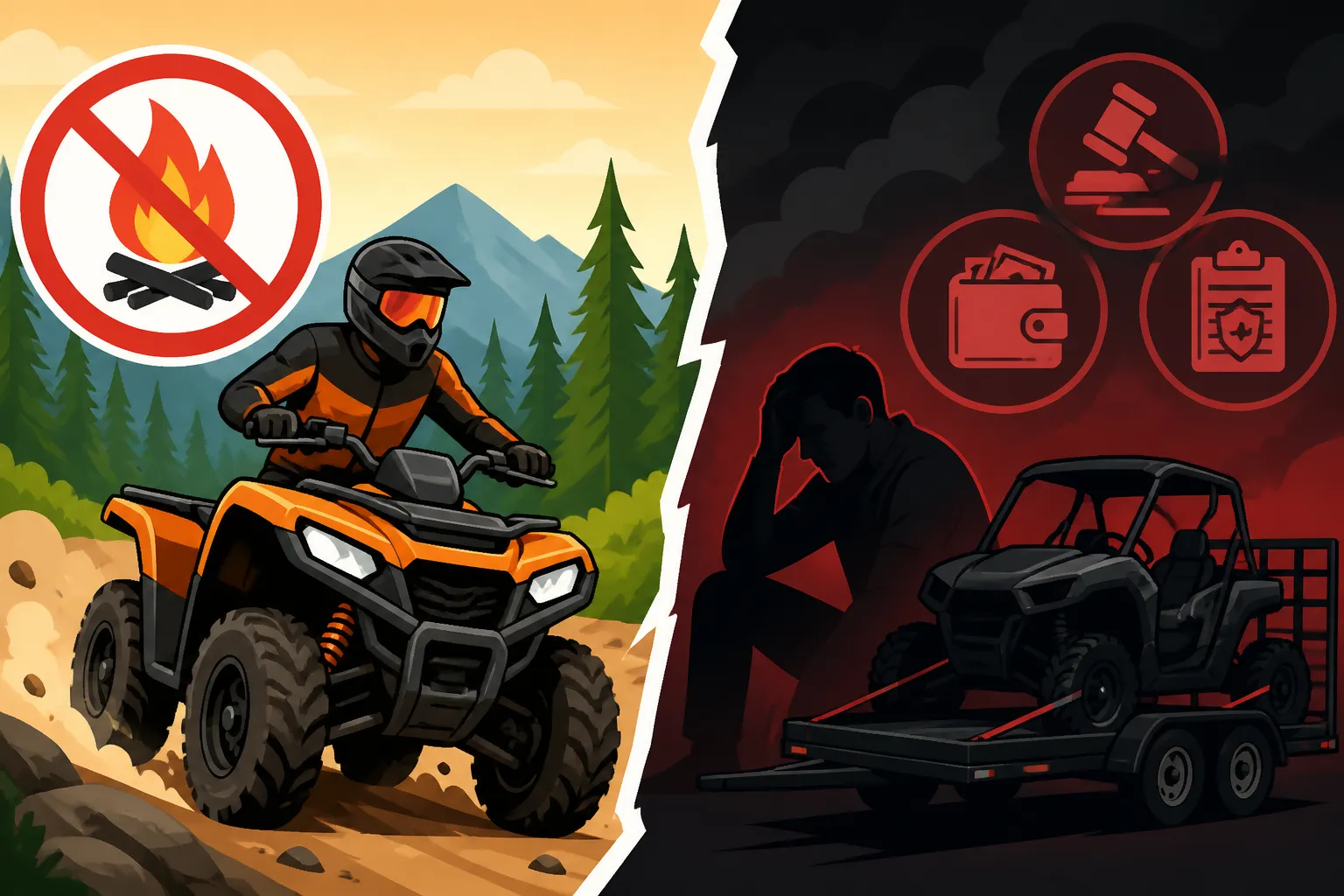
There is no single fixed bill for “riding during a fire ban.” The financial consequences depend on the specific rule, the circumstances and how the matter is handled. A violation may lead to a ticket or another enforcement process, and more serious circumstances can result in larger penalties. The current amount and process should be confirmed with the official notice or enforcement authority rather than guessed from an old post or a number associated with a different offence.
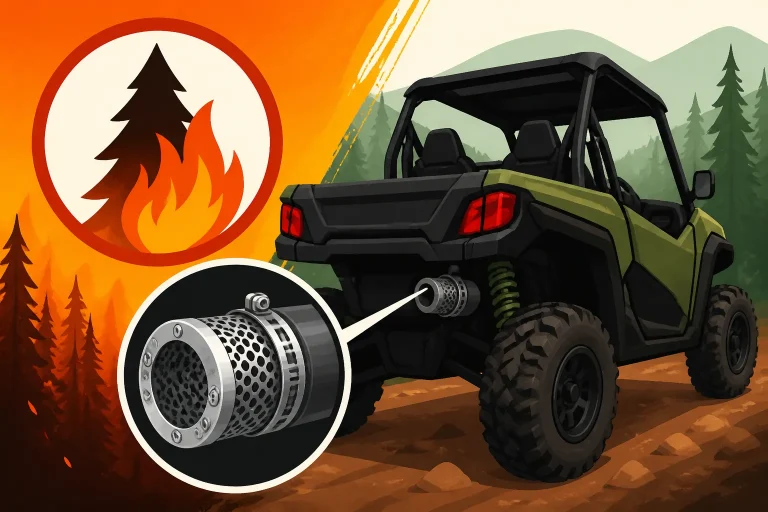
That distinction matters because wildfire-related offences are not all the same. Riding in an area where an order prohibits off-road vehicles is different from failing to meet an equipment requirement, such as having the required spark-arresting equipment. A spark-arrestor offence can have its own consequences; it is not automatically the penalty for riding during a vehicle prohibition. See BC Wildfire Penalties for Riders for an overview of the possible enforcement consequences and BC Spark Arrestor Requirements for the separate equipment question.
The amount of a ticket is only one possible cost. You may also have to deal with the time and expense of responding to a ticket, arranging to retrieve or move a machine, changing travel plans, or losing the use of a route. If a machine or equipment is involved in starting a wildfire, the consequences can be much more serious than a routine access violation. Depending on the facts and the applicable law, there may be additional enforcement or financial consequences. Do not assume that a ticket is the full extent of what could follow an incident.
A wildfire response can also affect other people and property. If your actions cause a fire or damage, you could face claims or other proceedings related to the loss. Whether you are legally responsible, and what costs may be recoverable, depends on the circumstances. It is not possible to calculate that exposure simply by looking at the fine for a separate riding or equipment offence.
Insurance should not be treated as a substitute for following an order. Coverage depends on the policy and the facts of a claim; an insurer may ask how the loss occurred and whether the machine was being used lawfully. If an incident happens, document what occurred and contact your insurer promptly. Do not assume that a policy will pay every cost connected to a prohibited ride or a fire.
The practical comparison is simple: checking the restriction before setting out takes a few minutes, while dealing with enforcement or a fire-related incident can become expensive and time-consuming. If the notice is unclear, do not try to interpret uncertainty in favour of riding. Contact the agency or site manager responsible for the area and get clarification before you enter it.
How to avoid a costly mistake before unloading
A quick pre-ride routine helps prevent the most common mistake: relying on an old report, a familiar trail or the absence of a gate as proof that riding is allowed.
- Identify the full route. Note the staging area, trails, roads and any planned turnarounds. Check the areas you will cross, not only where you park.
- Read the current wildfire notice. Look for the restriction’s activity, location, dates and any stated exceptions. A campfire rule and an ORV prohibition are different things.
- Check access closures separately. Review road, trail and site notices too. A wildfire order is not the only reason an area may be closed.
- Confirm equipment requirements. If you are riding where required, make sure your machine has the appropriate exhaust screen or spark-arresting equipment. What Exhaust Screen the Wildfire Rules Require explains what to look for.
- Recheck on the day of the ride. Conditions and orders can change. Check again before travelling to the staging area, especially during periods of elevated fire danger.
- Keep proof of what you checked. Save or photograph the relevant notice and map. This does not give permission to ride if an order changes, but it helps you keep the route and restrictions straight.
- Turn around if the status is uncertain. Do not cross a posted closure or rely on another rider’s assumption. Choose a confirmed-open area instead.
Equipment preparation matters, but it does not override a vehicle restriction. A clean machine and compliant exhaust equipment do not make a prohibited ride legal. Conversely, a campfire prohibition does not automatically establish that every kind of vehicle use is prohibited. Check both the activity named in the order and the equipment rules that apply to your machine.
For a visiting rider, the same caution applies. Your home registration or out-of-province status does not exempt you from a BC wildfire restriction. Check the current local order and any separate access rules before riding. Reciprocity can affect whether a machine’s registration is recognized, but it does not grant access to a closed area or cancel a local prohibition.
If you discover the restriction after you arrive
If you learn that your planned route is restricted, do not ride in and hope the order does not apply. Leave the machine unloaded or choose a route clearly outside the restricted boundary. If you are already on the route when you discover a closure, stop in a safe place, avoid continuing deeper into the affected area and follow the posted direction for leaving. Do not cross a barrier or enter a closed trail to reach a preferred turnaround.
If you have a genuine question about the boundary or wording, contact the responsible authority before riding. Be ready to give the area name, road or trail, planned route and the wording of the notice you are looking at. A general question such as “Is riding allowed around here?” may not be enough to resolve a boundary issue.
If an officer or enforcement official asks about your ride, stay calm and provide accurate information. Do not alter or hide equipment, argue that other riders were doing the same thing, or assume that a notice you saw earlier remains current. If you receive a ticket, read the instructions and deadlines on it and use the stated process if you want to dispute it. BC Fire Centre Prohibition Tickets offers more context on the ticket side of wildfire restrictions.
If a fire starts, prioritize safety. Move away from immediate danger, alert emergency services or the appropriate fire authority as soon as it is safe, and give the location and information you have. Do not put yourself or others at risk trying to fight a fire beyond your ability or equipment. Cooperate with responders and preserve relevant details about the ride and machine.
The cost of riding during a fire restriction can range from an avoidable ticket and disrupted trip to serious consequences if the ride contributes to a fire. The key is not to guess from the phrase “fire ban.” Read the current order, confirm that it covers your exact route and activity, and stay out of any area where riding is prohibited.
Disclaimer
This article is for general informational purposes only and does not constitute professional advice. Laws, prices and regulations vary by location and change over time. Consult a qualified professional for guidance on your specific situation.