BC Leased Crown Land and Permission
A Crown land lease can make an ATV route look public on a map while the ground is used by a rancher, lodge or other tenure holder. The important question is not simply who owns the land, but what access the tenure allows. Here’s how to check permission, avoid conflicts and understand what a lease does—and does not—mean for your ride.
Why leased Crown land needs a closer look
Crown land is land held by the provincial government, but that does not mean every part is open for every activity. The province can grant a lease, licence or other form of tenure that allows a person or organization to use a defined area for a particular purpose. Examples can include ranching, recreation, tourism or industrial use.
The tenure holder’s rights depend on the agreement and the activity. A grazing lease, for instance, may involve livestock, fences, water sources and seasonal use. A recreation or tourism tenure may involve facilities, visitors or managed routes. The holder may have obligations to manage the land as well as rights to use it. Those details matter when deciding whether an ATV or side-by-side can cross or travel within the area.
Two assumptions can cause trouble:
- “It is Crown land, so I can ride wherever I want.” Public access is not unlimited. A tenure, posted restriction, closure, safety concern or other rule may affect access.
- “It is leased, so the holder can close every route.” A tenure does not automatically tell you the status of every road or trail crossing the land. Road access and the leaseholder’s rights need to be assessed separately.
The practical answer is to check the specific land and proposed route, then ask the person or organization responsible for the tenure when permission is uncertain. See BC Crown Land Access Rules and BC Crown Land Riding Explained for the wider access picture.
A lease boundary may not be visible from the trail. Fences, gates and signs can help identify a managed area, but they may not show the full boundary or explain whether a route is open. Online maps can also show Crown land without clearly explaining the terms attached to a particular parcel. Treat a map as a starting point, not as permission to ride.
| Situation | What to check before riding |
|---|---|
| Route crosses leased grazing land | Whether the tenure holder permits access, and whether livestock, gates or seasonal conditions affect the route |
| Trail appears to follow a road | Whether the road is public, restricted or subject to separate access rules |
| Gate or sign is posted | What the notice says, who posted it and whether a current closure applies |
| Route crosses a recreation or tourism tenure | Whether the operator allows public riding and which routes, if any, are available |
| Map shows Crown land but no lease details | The current land status, tenure information and any applicable access restrictions |
Permission from a tenure holder is only one part of ride planning. It does not replace ORV registration requirements, local restrictions, fire-related prohibitions or rules for a resource road. For example, check BC Registration Before Riding Crown Land and BC Rules for Riding Crown Land before heading out.
How to find out who controls access
Start by identifying the exact area you plan to enter. A broad description such as “the Crown land above town” is not enough: tenure boundaries can be irregular, and a route may cross several parcels or managed areas. Mark the intended trail, access road, parking or staging location, and any planned stops.
Then work through these steps:
- Check current land and access information. Use reliable land-status and recreation information to identify the tenure area and any posted restrictions or closures. Check the route itself, not just the destination.
- Identify the tenure holder or land manager. If the map or signage names an organization, contact it directly. If the responsible party is unclear, ask the relevant land manager or a local recreation contact how to verify the tenure and access status.
- Describe your trip clearly. Give the route or parcel location, dates, group size, machine type, and whether you plan to camp, hunt, cross a gate or bring a trailer. A request for a specific route is easier to answer than a general question about riding on the lease.
- Ask what conditions apply. Confirm whether riding is allowed, where it is allowed, and whether there are limits on dates, group size, speed, noise, parking, camping or route direction.
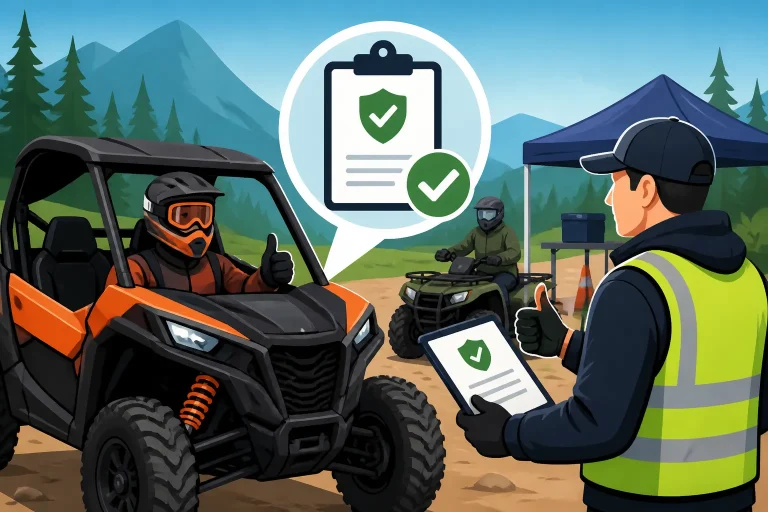
- Keep the response and follow the conditions. A dated email or written message can help clarify what was agreed. It does not override a later closure, a sign or another applicable rule, so check again before the ride.
A useful permission request can be brief: “We are planning to ride this marked route on these dates with this many machines. Does the route cross your tenure, and is access permitted? Are there gates, livestock, seasonal restrictions or other conditions we should know about?”
Do not assume that silence means approval. If you cannot identify the tenure holder or get a clear answer, choose a route with confirmed access rather than treating uncertainty as consent. This is especially important where a route passes through working land or near a residence, livestock, water system, timber operation or public facility.
Permission may apply only to a particular activity or route. Approval to cross a lease on an established road, for example, may not include permission to leave the road, explore side trails, camp or retrieve game. Ask specifically about the action you intend to take. For more on private parcels along a route, see BC Private Land Permission. Crown tenure and private ownership are different arrangements, but riders should not treat either one as automatic permission.
Roads, gates, closures and other rules
A road crossing leased Crown land may have a different access status from the surrounding land. Forest Service roads and other resource roads can cross land used under a tenure, but the fact that a route is shown as a road does not guarantee that it is open to ORV traffic at all times. Industrial activity, posted restrictions, road conditions or a closure may affect travel. BC Resource Roads Count as Crown Land explains why these routes can bring separate responsibilities.
Read signs at the access point and along the route. A gate may be there to manage livestock, protect a facility, prevent unauthorized entry or control access during a particular period. Do not force a gate, bypass it through the bush or leave it open. If you have permission to pass through, follow the gate instructions and confirm whether the permission is current. If the gate is locked or the posted information is unclear, do not assume that an open-looking track beside it is an authorized detour.
Check for restrictions that may apply regardless of the leaseholder’s permission. These can include motor-vehicle closures, fire-related prohibitions, park rules or limits posted by a land manager. A general invitation to use an area does not cancel a government closure. Before riding, consult current information and review BC Motor Vehicle Closures and How to Find Them and BC Signs That Restrict ORV Use in BC.
Also keep the following requirements in view:
- Registration: Riding on Crown land can trigger BC ORV registration requirements, subject to the rules and any applicable exceptions. Permission to enter a tenure does not make an unregistered machine compliant.
- Insurance and road rules: A resource road may have requirements that differ from an ordinary trail. Confirm the rules for the road you will use, not just the destination.
- Camping: Permission to ride does not necessarily include permission to camp. Ask separately before setting up on or beside leased land. See BC Crown Land Camping on a Ride.
- Hunting and game retrieval: Access for riding does not automatically authorize every hunting-related use of a machine. Check the applicable rules and any land-specific restrictions. BC Hunting Access by ATV is relevant when a ride is connected to hunting.
- Trespass and damage: Avoid livestock, fences, crops, buildings and water infrastructure. Stay on the approved route and do not disturb people working on the land.
These obligations can overlap. A tenure holder may allow a ride, while a road restriction or seasonal closure still prevents it. Likewise, an open road does not necessarily grant permission to ride off-road across the surrounding tenure. Confirm each part of the trip separately.
If permission is refused or the status is unclear
Take a refusal seriously. Do not argue that the land belongs to the Crown, assume a different entrance changes the answer, or follow a track around a barrier. Ask whether there is an alternate route, an open trail nearby or a way to request access at another time. If access depends on current operations, seasonal conditions or livestock movement, a later date may be possible—but wait for clear confirmation.
If the land status is uncertain, pause before entering. Record the location and take note of signs without crossing a gate or going onto land to investigate. You can then seek clarification from the listed tenure holder or appropriate land manager. A route shown on an old map, discussed in an online forum or used by other riders is not enough to establish that access is currently allowed.
When riding with a group, make sure everyone understands the approved route and conditions. A single rider leaving the trail can create problems for the whole group and may damage the relationship between local riders and the tenure holder. Brief the group before setting out, agree on what to do if a gate is closed, and turn back if the route appears to be under active use or subject to a new restriction.
When permission is granted, stay within its scope. Keep to the approved route, respect posted speed and access conditions, give livestock and workers room, and leave gates as instructed. If conditions change or you encounter a sign that conflicts with what you were told, stop and verify rather than pressing on.
The simplest rule is to separate three questions: Is the land Crown land? Is there a tenure or other restriction? Is this specific route open to my machine for this activity today? A clear answer to all three is a much safer basis for riding than relying on the word “public” alone.
Disclaimer
This article is for general informational purposes only and does not constitute professional advice. Laws, prices and regulations vary by location and change over time. Consult a qualified professional for guidance on your specific situation.