Registering an ATV With ICBC in BC
It’s a common mix-up, one I hear all the time from new riders and even seasoned veterans: "How do I register my ATV with ICBC?" People naturally think of ICBC for vehicle registration because that’s who handles our cars and trucks. But when it comes to your quad, side-by-side, or dirt bike here in British Columbia, the process is quite different. This guide will untangle the confusion, clarify ICBC's actual role, and walk you through exactly how to get your off-road vehicle (ORV) legally registered in BC.
The Common Misconception: Why ICBC Isn't Your ATV's DMV
Let’s get this straight right off the top: while ICBC plays a vital role in insuring your off-road machine, they aren't actually the registry body for ORVs in the same way they are for highway vehicles. It's a subtle but critical distinction that often trips people up, leading to frustration and wasted trips to the wrong office. You might walk into an ICBC driver licensing office expecting to register your quad, only to be politely redirected.
Separating ORV Registration from Car Registration
The biggest source of confusion stems from the two separate pieces of legislation that govern vehicles in British Columbia. For your everyday car, truck, or motorcycle that travels on public roads, the Motor Vehicle Act and its associated regulations dictate everything from licensing to registration and insurance. Under this act, ICBC is essentially the one-stop shop for registration and basic insurance. They are the province's public auto insurer, and they issue your passenger vehicle's registration papers and licence plates directly.
However, your ATV, UTV, dirt bike, or snowmobile falls under the Off-Road Vehicle Act and its specific regulations. This act was brought into force in November 2015, changing the landscape for ORV owners across the province. Before this, many off-road machines didn't require any formal registration at all, which is why older machines can be such a headache to get into the system now. The ORV Act created a separate registration system, one that intentionally doesn't mirror the highway vehicle system, largely because ORVs are not typically street legal and have a different purpose and operational environment.
So, while the term "ICBC" is synonymous with vehicle paperwork for many British Columbians, for ORVs, it's more about their insurance arm than their direct registration function. This distinction is crucial to understanding where you need to go and what documents you actually need.
Who Actually Handles BC ORV Registration?
If not ICBC directly, then who? The answer is your local Autoplan broker. These are the same friendly folks who help you with your car insurance and driver's licence renewals, but they also have the authority to process off-road vehicle registrations. Think of them as the authorized agents for the provincial government's ORV registration system. They handle the paperwork, collect the fees, and issue your official documents and ORV plate.
The provincial government, specifically the Ministry of Forests, Lands, Natural Resource Operations and Rural Development (which oversees the ORV Act), is the ultimate authority behind the registration system. The Autoplan brokers are simply the designated front-line service providers. They have access to the provincial database and the specific forms and procedures required for ORV registration. It's a common misconception that you need to go to a specialized ORV dealer for this – while many dealers do have Autoplan brokers on-site, any certified Autoplan broker can help you. They've been trained on the nuances of the ORV Act and can guide you through the process, which can sometimes be more complex than registering a car, especially for older machines.
Understanding the BC Off-Road Vehicle Act and ICBC's Role
The Off-Road Vehicle Act was a game-changer for ORV enthusiasts in BC. It brought a new level of accountability and regulation to off-road riding, particularly concerning public lands. Understanding this act is key to grasping why and how your ATV needs to be registered, and where ICBC fits into the picture.
The Mandate for Registration: Crown Land as the Trigger
The core reason you need to register your ATV in BC boils down to where you plan to ride it. The Off-Road Vehicle Act makes registration mandatory if you intend to operate your machine on Crown land. And let's be realistic, BC is a vast province with a huge amount of Crown land, meaning most riders will inevitably encounter this requirement. Whether you're planning a trip deep into the interior, hitting up some trails in the Kootenays, or exploring the vast landscapes of the Cariboo, if it's not private property, it's likely Crown land.
This legal framework means that unless your ATV is exclusively confined to your own private property, or another private land where you have explicit permission, you must have it registered. This includes most trails, remote forest service roads, and designated riding areas. Even if you're just using a short stretch of Crown land to get from your cabin to another piece of private property, the rule applies. [BC Crown Land Triggers the Registration Rule] is the fundamental principle here.
Furthermore, many riders don't realize that [BC Resource Roads Count as Crown Land]. These roads, often used for industrial purposes like logging or mining, are also subject to the ORV Act's registration requirements. So, if you're navigating an intricate network of forest service roads (FSRs) to reach your favorite fishing spot or hunting ground, your ATV must be registered and displaying its plate. Failure to comply can lead to fines and other penalties, which we'll get into a bit later.
ICBC's Primary Function: Insurance, Not Registration
So, where does ICBC come in if they aren't handling the direct registration? Their role is primarily as the provider of mandatory basic liability insurance for off-road vehicles. While the ORV registration itself is a one-time thing (as long as you own the machine), the insurance aspect is an annual renewal that you do get through ICBC via an Autoplan broker.
The ORV Act specifies a [BC's Three-Tier Insurance Rule] for off-road vehicles, dictating different levels of required coverage depending on where you're riding:
- Operation on Forest Service Roads (FSRs): If you operate your ORV on an FSR (which, as mentioned, is considered Crown land), you are legally required to carry a minimum of $200,000 in third-party liability insurance. This coverage protects you against claims if you injure someone or damage their property while riding on an FSR. This is where ICBC steps in, as they are the primary provider of this basic FSR liability coverage.
- Operation on other Crown land (not FSRs) or private property: For riding on other forms of Crown land (like designated trails or wilderness areas not designated as FSRs) or private land, liability insurance is not strictly mandatory under the ORV Act. However, it is highly, highly recommended. Many private insurance companies offer voluntary liability and collision coverage for ORVs, which can be purchased in addition to or instead of the ICBC FSR coverage, depending on your needs.
- Operation on or crossing a highway: This is where things get even more specific. While ORVs are generally not street legal in BC, the Act allows for very limited crossings of highways. If you are legally crossing a highway or operating under a police-issued permit on a highway, your ORV must be insured under the Motor Vehicle Act (i.e., highway insurance), which also comes from ICBC. This is different from the ORV-specific FSR coverage.
When you go to an Autoplan broker to register your ORV, they will also be able to discuss these insurance options with you. Many riders choose to bundle their FSR liability insurance with their registration, making it a convenient one-stop process at the broker's counter. It's important to understand that while your registration is forever (as long as you own the machine), your insurance is something you'll need to renew annually, and this is where ICBC's continued involvement lies.
The Steps to Registering Your ATV in BC (Through an Autoplan Broker)
Alright, you've got your machine, you understand why it needs to be registered, and you know you're heading to an Autoplan broker. Now, let's talk about the practical steps to make this happen smoothly. The process isn't overly complicated, but like any government paperwork, it requires attention to detail and the right documents.
Gathering Your Essential Paperwork
This is arguably the most critical step, and it's where many people hit snags, especially with older machines. The Autoplan broker needs a clear chain of ownership to register your ORV. Think of it like putting together a puzzle, with each piece representing a sale or transfer. You'll need to provide:
- Proof of Identity: Your valid BC driver's licence or other government-issued photo ID. [BC Riders Must Carry Photo ID] is also a requirement when riding, so this is good practice to have ready.
- Proof of Address: A recent utility bill or other document showing your current BC residence.
- The Machine's Serial Number (VIN): This is absolutely crucial. The broker will need to verify the VIN or serial number directly from the machine itself, so be prepared to provide photos or even bring the machine in for inspection if the VIN is hard to locate or verify.
- Bills of Sale for Every Prior Owner: This is where it often gets tricky. The province requires a continuous chain of ownership documentation, going all the way back to the manufacturer, or at least back to the last registered owner if it was previously registered in BC or another jurisdiction. This means if you bought your quad from John, and John bought it from Jane, you need a bill of sale from Jane to John and from John to you. This is a common hurdle, and we'll discuss solutions shortly. For a comprehensive list, consult the [BC Registration Paperwork Checklist].
- Proof of Provincial Sales Tax (PST) Payment: If you bought your machine from a dealer, the PST is usually handled at the time of purchase. If you bought it privately, you'll need to declare the purchase price, and the PST will be calculated and collected by the broker. There are specific rules around [BC PST on a Private ATV Sale], so be prepared.
- Customs Documentation (for imported machines): If your ORV was brought into BC from outside Canada (e.g., from the United States), you'll need documentation proving it cleared customs. This helps establish its origin and ensures all duties and taxes were paid.
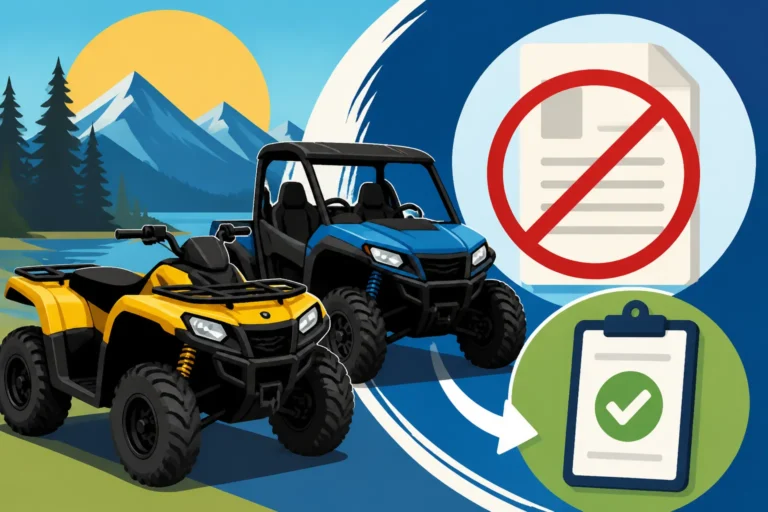
The challenge of [BC Machines With No Paperwork] is real. Many older quads were bought for cash, passed down through families, or simply have missing receipts from sales decades ago. This doesn't mean you can't register your machine, but it does mean you'll need an alternative solution. This is where a [BC Statutory Declaration for an ORV] comes into play. If you're missing bills of sale, a statutory declaration allows you to swear under oath that you are the rightful owner, detailing how you acquired the machine. Online services like LawDepot can be incredibly helpful here, offering customizable templates for statutory declarations that meet legal requirements. This can save you time and ensure you have all the necessary legal language.
Visiting an Authorized Autoplan Broker
Once you've diligently gathered all your documents, the next step is to head to your chosen Autoplan broker. You can find one easily – they are often located in strip malls, shopping centres, or standalone offices in most towns and cities across BC. There are [Nine Hundred Brokers Province-Wide] who can assist you.
Here's what to expect:
- Arrival and Initial Discussion: Let the broker know you're there to register an off-road vehicle. They'll typically ask you about the machine (make, model, year, VIN) and how you acquired it.
- Document Submission: You'll hand over all your compiled paperwork. The broker will meticulously review it, looking for that continuous chain of ownership. If there are gaps, they'll advise you on the statutory declaration process.
- VIN Verification: They might ask you to confirm the VIN from the machine itself, or they might accept photos. In some cases, for very old or modified machines, they might require a physical inspection to ensure the VIN matches the documents and is legitimate.
- Fee Payment: There is a one-time registration fee. As of now, [BC ORV Registration You Pay Once] and that's it for the registration itself – there's no annual renewal fee for the registration. You'll also pay any outstanding PST and, if you choose, the premiums for your FSR liability insurance through ICBC.
- Issuance of Documents and Plate: Once everything is processed and paid, the broker will issue you a few critical items:
- Certificate of Registration: This is your official proof of registration and ownership.
- ORV Number Plate: A physical licence plate specifically for your off-road vehicle.
- Decals: Small stickers (often year-specific for insurance purposes) to go on your machine.
The [BC Registration Processing Time] is usually quite quick. In most cases, if you have all your documents in order, you can walk out of the broker's office with your Certificate of Registration and plate the same day. However, complex cases, especially those requiring statutory declarations or VIN research, might take a bit longer. Don't be afraid to ask [BC Registration Questions Brokers Hear] to clarify anything during the process.
What You Receive After Registering Your ATV
After you’ve navigated the paperwork and the Autoplan broker has done their magic, you won’t just walk out empty-handed. You'll receive a couple of very important pieces of documentation and hardware that signify your ATV is legally registered and ready for the trails. These are your official proof that you’ve met the provincial requirements under the Off-Road Vehicle Act.
The Certificate of Registration: Your Proof of Ownership
This is perhaps the most important document you'll receive, and it’s critical to understand exactly what it is – and what it isn't. In BC, your off-road vehicle gets a [BC's Certificate of Registration Explained], not a traditional "title" like a car might have in other jurisdictions. This can be confusing for people coming from places like the United States, where titles are standard. In BC, [Why Your Quad Gets a Certificate and Not a Title] is a fundamental difference in how ORVs are legally recognized compared to highway vehicles. So, don't go looking for a "title" document, because it doesn't exist for ORVs here.
The Certificate of Registration will contain key information about your machine and its registered owner:
- Your Name and Address: As the registered owner.
- Machine Details: Make, model, year, and most importantly, the Vehicle Identification Number (VIN) or serial number.
- Registration Number: This is a unique identifier assigned to your ORV within the provincial system.
- Date of Registration: The date your machine was formally entered into the system.
This document serves as your official proof that the machine is registered in your name. It’s absolutely vital to protect it, just as you would your driver’s licence or vehicle registration. Beyond that, the Off-Road Vehicle Act specifically requires that [BC Riders Must Carry the Certificate] whenever they are operating their ORV on Crown land or resource roads. This means keeping a physical copy with you, or a legible digital copy on your phone, to present to law enforcement or conservation officers if requested. Failure to produce it can lead to fines, even if your machine is technically registered.
Your ORV Plate and Decals
In addition to the Certificate of Registration, you’ll be handed a physical ORV number plate and a decal (or decals). These are what visibly indicate that your machine is legally registered for use on Crown land.
- The ORV Number Plate: This is a smaller, often square-shaped plate, distinct from a standard vehicle licence plate. It will display a unique combination of letters and numbers assigned to your ORV. This plate is your machine's visible identifier, much like a licence plate for a car. The Act is quite specific about [BC Plate Placement on Front, Back or Left]. You must mount it securely and visibly on the front, back, or left side of your ORV. It must be horizontally mounted and kept clean and legible at all times. If you have a side-by-side, placing it on the front bumper or grill is common; for a quad, it might go on the front rack or the rear fender. The key is visibility from a reasonable distance.
- Decals: You may also receive a decal or sticker, often displaying the year. These usually relate more to your insurance coverage than the registration itself. While the registration is a one-time process, your insurance is renewed annually, and the decal can indicate current coverage. The broker will advise you on [BC ORV Number Plates and Decals] and where any decals should be placed on your machine for proper display. Ensuring your plate is always clean and visible, not obscured by mud, gear, or brush, is also important for avoiding potential tickets.
Common Challenges and Solutions in the Registration Process
Even with the clearest instructions, registering an ORV can sometimes throw a curveball. The unique history of off-road vehicle ownership in BC, coupled with the specificity of the Off-Road Vehicle Act, means that riders often encounter hurdles that require creative solutions.
Navigating Missing Paperwork and Ownership Gaps
As we've touched on, the requirement for a complete [BC Ownership Chains Going Back Decades] is frequently the biggest headache. Imagine you bought a classic quad from a farmer who acquired it from a relative, who in turn bought it from a friend years ago – and none of these transactions involved a formal bill of sale. Suddenly, you have a gap, or multiple gaps, in the ownership chain. This is not uncommon, especially for machines bought before the 2015 Act made registration mandatory.
The good news is that these gaps aren't insurmountable. The primary solution is the [BC Statutory Declaration for an ORV]. This is a formal legal document where you, as the claimant, declare under oath that you are the rightful owner of the ORV, detailing how and when you acquired it, and explaining the absence of a formal bill of sale. You'll need to sign this declaration in front of a commissioner for taking affidavits or a notary public.
When preparing a statutory declaration, it's essential to include as much detail as possible:
- Machine Description: Make, model, year, VIN/serial number.
- Acquisition Details: How you came into possession (e.g., purchased privately, inherited, gifted).
- Date and Location of Acquisition: As accurately as you can recall.
- Reason for Missing Documentation: Explain why a bill of sale isn't available (e.g., "seller has moved, unable to contact," "informal private sale from decades ago").
- Your Assertion of Ownership: Clearly state that you are the sole and rightful owner and that the machine is not stolen or encumbered.
Services like LawDepot are incredibly useful for this, as they provide structured templates for statutory declarations that guide you through the necessary legal language. Using a template ensures you don't miss any critical information that an Autoplan broker or the province might require. Filling out a well-prepared declaration can significantly smooth over those historical gaps in paperwork, allowing the broker to proceed with registration.
Registering an Older or Imported Machine
Beyond missing paperwork, older and imported machines present their own unique sets of challenges.
For [BC Registration for an Older Machine], sometimes the problem isn't just missing bills of sale, but the machine itself lacking standard modern identifiers. Very old ATVs might not have a typical 17-digit VIN, or their serial numbers might be difficult to locate due to age, wear, or custom modifications. In these cases, the Autoplan broker might need to do some extra legwork, sometimes involving physical inspection of the machine, to verify its identity. It's helpful if you can provide any historical photos, manuals, or even manufacturer's data that might help confirm the machine's authenticity and details. Be patient, as these unique cases might take a little longer to process.
If you're bringing an ORV into BC from another province or country, you're dealing with [BC Registration for an Imported Machine].
- From another Canadian province: If the machine was registered in Alberta, Saskatchewan, or another Canadian province, you'll need its previous registration documents. The broker will use these to establish the ownership chain. Note that not all provinces registered ORVs in the same way, or at all, prior to BC's 2015 Act.
- From outside Canada (e.g., USA): This is where customs paperwork becomes paramount. You'll need documents proving the ORV legally entered Canada, such as the Canada Customs Form 1 (Form E-439 if it's over 15 years old), or a Vehicle Import Form. Without these, the machine cannot be registered in BC, as it can't be legally established that it cleared Canadian borders and all applicable duties and taxes were paid. Ensure all your customs documents are in order before heading to the broker. You'll also pay PST on the declared value of the machine if you haven't already.
The key to overcoming these challenges is thoroughness and patience. Don't assume a problem is a dead end; always discuss it with an Autoplan broker, who has experience with a wide range of unique ORV situations.
Ongoing Responsibilities After Registration
Congratulations! Your ATV is registered, you have your plate, and you're ready to hit the trails. But the process doesn't end there. There are still a few ongoing responsibilities you need to be aware of to ensure your machine remains legally compliant and you avoid any surprises down the road.
Annual Costs and Renewals: What to Expect
One of the great pieces of news for ORV owners in BC is that the core registration itself is a one-time deal. Unlike your car, which requires an annual registration renewal and sticker, [BC Has No Annual Renewal Sticker] for your ORV's registration. Once you've paid the initial fee and received your Certificate of Registration and plate, that registration covers the machine for as long as you own it. You don't pay anything further to maintain the registration itself. This is a significant difference from highway vehicle registration and is often a pleasant surprise for new ORV owners.
However, while the registration is permanent, your insurance is not. As mentioned earlier, [BC ORV Registration You Pay Once], but your liability insurance (especially the mandatory $200,000 for Forest Service Roads, through ICBC) needs to be renewed annually. This is where your yearly costs will come in. The Autoplan broker who handled your registration will also be able to assist you with renewing your ICBC ORV insurance each year. They will issue updated insurance papers and any new decals that might be required to indicate current coverage. It's vital to keep this insurance current, especially if you plan on riding on FSRs, as operating without it can lead to serious legal and financial consequences in the event of an accident.
Transferring Ownership When You Sell Your Machine
Life happens, and eventually, you might decide to sell your registered ATV. This is another point where proper procedure is essential to ensure a smooth transition for both you and the new owner. [Selling a Registered Machine in BC] requires you to provide the buyer with all the necessary documentation to allow them to register the machine in their name.
Here's the typical process:
- Bill of Sale: You will need to provide the buyer with a detailed bill of sale. This document should include:
- Your name and contact information.
- The buyer's name and contact information.
- The ORV's make, model, year, and VIN/serial number.
- The purchase price.
- The date of sale.
- Both your signature and the buyer's signature.
A professional bill of sale template, which you can easily find on platforms like LawDepot, can help ensure all the necessary legal information is included, protecting both you and the buyer.
- Certificate of Registration: You will sign the back of your Certificate of Registration to formally transfer ownership to the buyer. This is similar to signing over a vehicle registration.
- ORV Plate: The ORV plate stays with the machine when it's sold. You do not keep it, unlike a personal licence plate for a car.
- Notify Your Broker (Optional but Recommended): While not strictly mandatory for the province, it's a good idea to notify your Autoplan broker that you've sold the machine. This ensures your insurance coverage is cancelled for that specific ORV and that you are no longer associated with it in their records.
The new owner is then responsible for taking these documents to an Autoplan broker to complete the [BC Transfer of Ownership Explained]. They will pay the transfer fee, any applicable PST on the purchase price, and secure their own insurance. It’s important for them to do this promptly, not only to be legally registered in their name but also to avoid any issues with the ownership chain down the road if they decide to sell it. As the seller, ensuring you provide a clear, dated bill of sale and signed Certificate of Registration protects you from any future liability or questions of ownership.
What Happens if You Don't Register Your ATV?
It's tempting to think you can skirt the rules, especially if you mostly ride on quiet, remote trails. But ignoring the ORV registration requirements in BC is a risky gamble that can lead to significant headaches, financial penalties, and even loss of your machine. The Off-Road Vehicle Act is enforced by various authorities, including RCMP, local police, and conservation officers. They are empowered to check for registration and take action against non-compliant riders.
Legal Penalties for Unregistered Operation
Operating an off-road vehicle on Crown land or a forest service road without proper registration is a violation of the Off-Road Vehicle Act. This means you are liable for tickets and fines. [BC Tickets for an Unregistered Machine] can quickly add up, turning a fun day on the trails into a costly mistake.
The specific [BC Penalties for Riding Unregistered] can include:
- Violation Tickets: Expect a fine for operating an unregistered ORV. These fines are often substantial and are issued on the spot.
- Machine Seizure: In more serious or repeated instances, or if there's suspicion of other illegal activity, law enforcement has the power to seize your off-road vehicle. Getting a seized machine back can be a lengthy, expensive, and frustrating process, involving storage fees and potentially further legal costs.
- Court Fines: If the matter goes to court, you could face even higher fines, and possibly other penalties depending on the circumstances.
- No Grace Period: There's no "I didn't know" excuse. The law has been in effect since 2015, and riders are expected to be aware of their responsibilities.
Remember, the registration rule applies to Crown land, which includes the vast majority of trails, wilderness areas, and, critically, forest service roads. Even briefly crossing a section of Crown land without registration can put you at risk. The consequences are simply not worth the perceived hassle of avoiding the registration process.
Implications for Insurance and Accidents
Beyond the direct legal penalties, operating an unregistered ORV can have severe financial implications, particularly in the event of an accident.
- Invalidating Insurance: While you can purchase insurance for your ORV, many policies (especially those from private insurers) will have clauses that require the machine to be legally registered and operated. If you have an accident while operating an unregistered machine on Crown land, your insurance provider might deny your claim, leaving you personally responsible for all damages, injuries, and legal costs. This could include medical bills for yourself or others, repair costs for your machine or other property, and legal fees if you are sued.
- Personal Liability: Without insurance backing you up, any accident that causes injury to another person or damage to their property (or public property) could result in you facing massive personal liability. Imagine accidentally hitting a hiker on a trail, or colliding with a logging truck on an FSR. The financial fallout from such incidents can be life-altering.
- Complications with ICBC Claims: If you have the mandatory ICBC FSR liability coverage, but your machine isn't registered, it creates a grey area that ICBC might dispute. While the insurance is designed to protect you, operating outside the legal framework for the machine's registration could complicate or jeopardize that protection.
The peace of mind that comes with knowing your ATV is legally registered and properly insured is invaluable. It protects you from fines, seizures, and potentially devastating financial repercussions in the event of an accident. The one-time registration fee and annual insurance premium are a small price to pay for the freedom and security of legally exploring BC's incredible backcountry.
| Feature | Highway Vehicle (e.g., Car) | Off-Road Vehicle (e.g., ATV) |
|---|---|---|
| Governing Act | Motor Vehicle Act | Off-Road Vehicle Act (since 2015) |
| Registry Body | ICBC (Driver Licensing) | Provincial Government (via Autoplan Brokers) |
| Registration Type | Annual Renewal with Sticker | One-Time (lasts as long as you own it) |
| Primary Insurer | ICBC (Basic Autoplan) | ICBC (for FSR liability) & Private Insurers |
| Proof of Ownership | Vehicle Registration/Title (varies) | Certificate of Registration (no "title") |
| Plate Placement | Front & Rear (usually) | Front, Back, or Left Side |
| Main Requirement Trigger | Highway Use | Crown Land & Resource Road Use |
| Annual Fee | Yes (for registration & insurance) | Yes (for insurance only) |
Disclaimer
This article is for general informational purposes only and does not constitute professional advice. Laws, prices and regulations vary by location and change over time. Consult a qualified professional for guidance on your specific situation.