E-Bikes Caught by a Closure
An e-bike can feel very different from an ATV, but that does not automatically make it legal inside a BC area closed to motorized travel. The tricky part is that “e-bike” and “motor vehicle” can mean different things under different rules. This guide explains how to check a closure, why the exact wording matters, and what to do before riding.
Why a closure can apply to an e-bike
The label “e-bike” does not answer every legal question
Riders often assume that because an e-bike is treated differently from a motorcycle or ATV for ordinary road-use purposes, it must also be exempt from a motor-vehicle closure. That assumption can lead to an unpleasant surprise at a trailhead. A closure may use a definition of “motor vehicle” that applies to the specific restriction, rather than relying on the everyday meaning of the term.
BC e-bikes are commonly discussed as motor-assisted cycles, but the rules that apply depend on the law, regulation, order, or land-management restriction in question. A rule written for a particular area may define covered vehicles or modes of travel in its own way. That is why riders should not treat “it is an e-bike” as a complete answer.
The practical question is not only, “What category is my bike?” It is also, “What does this closure prohibit, where does it apply, and which definition does the relevant rule use?” For a useful overview of the broader issue, see BC E-Bikes Treated as Motor Vehicles and BC Motor Vehicle Closures and How to Find Them.
Closures are about the location and the rule, not just the machine
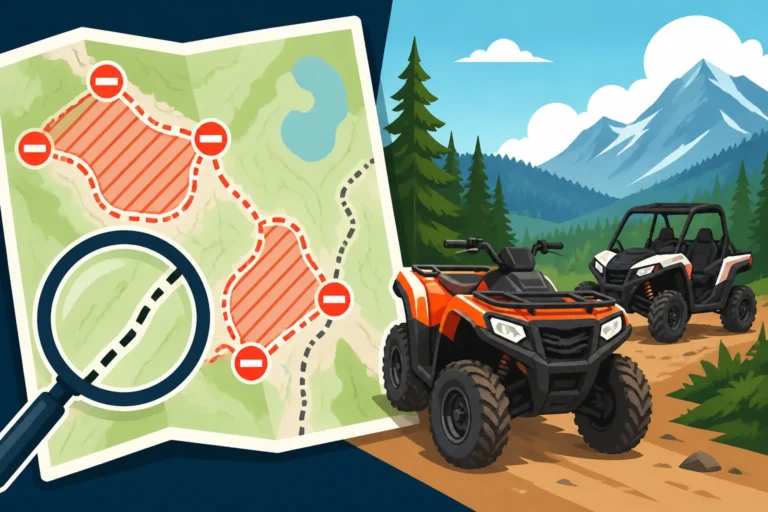
BC closures can be established for different reasons and can cover different places, dates, and activities. Some restrictions are aimed at protecting wildlife or habitat, while others may be connected to fire danger, road conditions, public safety, or active industrial work. A map label saying “closed” is a warning to investigate, not enough by itself to tell you precisely which routes, vehicles, or time periods are covered.
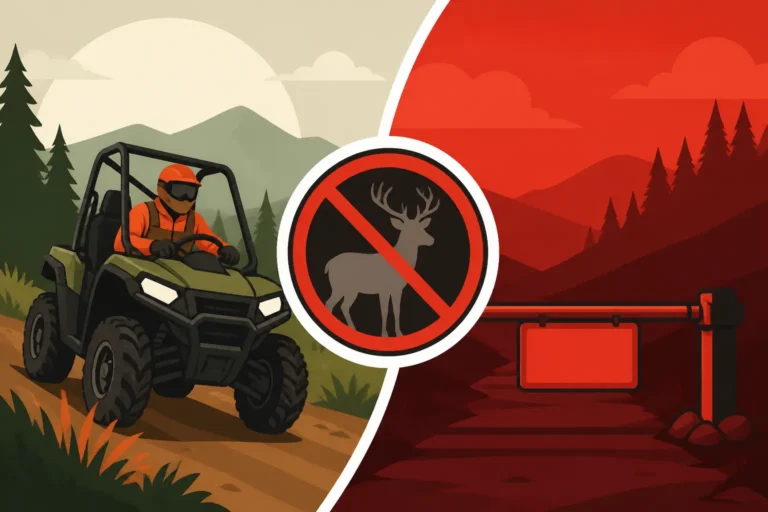
A closure may apply to a defined area rather than a single trail. It may also apply only during a specified season or while a particular condition is in effect. For example, a restriction associated with hunting activity may have boundaries and dates that differ from a road closure for industrial operations. The details matter, especially where a route crosses between public land, a managed recreation area, and private property.
If you ride an e-bike and an ATV on different days, avoid assuming that the rules for one automatically settle the rules for the other. Check the restriction that applies to the exact route and activity. Closures Published for Hunters explains why hunting-related notices deserve a careful read, while Closures That Apply Only While You Are Hunting points to an important distinction riders can easily overlook.
How to check whether your route is closed
Start with the official notice and read the whole thing
Before loading your bike or heading out from a familiar staging area, find the notice or official map for the area. Read beyond the headline. Look for the boundaries, effective dates, exceptions, vehicle language, and any route-specific conditions. If the notice refers to a regulation or order, check that document too rather than relying only on a summary.
Pay close attention to how the notice describes the prohibited activity. It may identify motor vehicles, motorized use, specified vehicle classes, or particular routes. It may also state that access is permitted only for certain purposes or users. Do not assume that an exception for one group—such as a land manager, permit holder, or person carrying out a specific task—extends to recreational riders.
A basic cross-check can help keep the details straight:
| What to check | Why it matters | A useful question |
|---|---|---|
| The closure boundary | Nearby trails may fall on different sides of the line | Does my planned route enter the restricted area? |
| Dates and conditions | A restriction may be seasonal or conditional | Is it active on the day I plan to ride? |
| Vehicle wording | Different rules may define covered vehicles differently | Does the notice specifically include my type of e-bike? |
| Exceptions | Exceptions may be narrow and purpose-specific | Does the exception clearly apply to recreational riding? |
| Route access | A road or trail may have its own restrictions | Is the route open even if the surrounding area is accessible? |
If the wording is unclear, do not resolve the ambiguity in favour of riding. Contact the relevant land manager or authority and ask about the exact location, the exact closure, and the e-bike you intend to use. Keep a note of the answer and the date you received it. A general answer about e-bikes in BC may not settle a question about one particular closure.
Use digital maps as planning tools, not legal permission
A mapping app can make it easier to spot access points, compare route options, and keep your planned ride organized. Some riders use onX Offroad to explore routes and plan around mapped restrictions. That can be useful as part of your preparation, but an app should not be treated as the final authority on whether a route is legally open.
Map data can be incomplete, delayed, or displayed at a scale that hides a boundary detail. A line on a screen may not match the exact wording of an official order. The map may also show a trail without making clear whether access is restricted for a particular vehicle type or during a particular season. In other words, a route appearing on a map is not proof that you can legally ride it.
Use onX Offroad, if it is part of your planning routine, alongside official closure notices and area information. Compare the route with the published boundary, check the dates, and look for signs at the access point. If those sources appear to conflict, pause and get clarification rather than relying on whichever one is more convenient. More detail about locating and interpreting closure information is available in Reading a Closure Map and Regions One Through Eight.
Common situations that cause confusion
A familiar trail has a new seasonal restriction
Imagine you have ridden a gravel access road several times on an e-bike. On your next visit, you see a seasonal closure notice near the staging area. Because the road is familiar and you are not on an ATV, it can be tempting to think the notice is meant for other users. That is exactly when it pays to stop, read the sign, and check the official notice.
The sign may be a short version of the rule, with more detail available on a posted map or through the managing authority. Check whether the closure is in force on that date, whether it covers the route you planned, and what vehicle language it uses. If you cannot establish that e-bike access is allowed, choose an open route instead.
This is especially important for closures associated with wildlife protection or hunting seasons. Boundaries can be easy to misread when you are approaching from a side road or following a route that crosses a mapped line. Which Seasonal Closure Riders Most Often Miss is a useful reminder that checking only your usual trail entrance may not reveal every restriction affecting a ride.
An app shows a route, but a sign says it is closed
This is a frustrating situation: your route planner shows a line through the area, but a sign at the entrance says access is restricted. Treat the sign as a reason to stop and verify, not as a minor inconvenience to ride past. The map may not reflect the latest change, or the sign may apply to a larger area than the route line suggests.
Take a photo of the sign if it is safe and appropriate, note the road or trail name, and look for the authority responsible for the closure. Then compare that information with the current official notice. onX Offroad can still be helpful for understanding your route options, but it cannot override a posted legal restriction. If you cannot confirm that the route is open to your e-bike, turn around and use an alternative.
That choice can feel like wasted effort, particularly after a long drive to a trailhead. Still, a detour is better than an avoidable ticket, conflict with a land manager, or harm to an area that has been closed for a reason. It also helps to have a backup route planned before leaving home. Checking a Fire Ban Before You Ride in BC offers a similar planning habit for restrictions that can change access conditions.
A practical pre-ride routine for e-bike riders
Check the route, the dates, and the vehicle wording
Make closure checks part of planning rather than something you do only after arriving at the trailhead. Start by writing down the trail, road, or staging area you intend to use. Then check whether the route crosses a restricted area, whether any dates or conditions apply, and whether the notice specifically addresses e-bikes or uses broader vehicle language.
If your ride includes several connected roads or trails, check each segment. A route that is open at the start may pass into an area with different rules. Do not assume that access remains permitted because you can physically ride from one segment to the next. This matters particularly where a route crosses a boundary, joins an industrial road, or approaches a managed recreation site.
A simple pre-ride checklist can prevent last-minute guesswork:
- Identify the exact trail, road, or staging area.
- Find the official closure notice or map for that location.
- Read the boundary, dates, vehicle wording, and exceptions.
- Compare the planned route with posted signs and official area information.
- Ask the responsible authority if e-bike access remains unclear.
- Save an alternative route that is outside the restricted area.
You can use onX Offroad during this process to organize possible routes, but verify access against the official information. Keep the relevant notice or contact details available offline where possible, especially if cell service is limited.
When the safest answer is to choose another route
Sometimes you will not be able to get a clear answer before the ride. The notice might use unfamiliar language, the boundary may be difficult to match to the trail, or the responsible office may not be available. In that situation, the sensible choice is to avoid the questionable section and ride somewhere you can confirm is open.
This does not mean every e-bike is automatically prohibited anywhere a motor-vehicle closure exists. It means you should not assume an exemption without a sound basis in the wording of the rule. The distinction can depend on the particular restriction, so a confident answer for one area may not apply to another.
Build some flexibility into your plans. If a closure affects your first choice, use a verified alternative, check whether an adjacent route is open, or reschedule. It is also worth revisiting your route information shortly before departure because closures and access conditions may change. A few careful checks can save a long drive, reduce uncertainty on the trail, and help protect the places riders want to return to.
Disclaimer
This article is for general informational purposes only and does not constitute professional advice. Laws, prices and regulations vary by location and change over time. Consult a qualified professional for guidance on your specific situation.